Compare commits
11
Commits
| Author | SHA1 | Date | |
|---|---|---|---|
 Lysandre |
46d2d18c5c | ||
|
Lysandre Debut
|
8194df8e0c | ||
|
Patrick von Platen
|
38f5fe9e02 | ||
|
Sam Shleifer
|
129f0604ac | ||
|
Lysandre Debut
|
0e84559d64 | ||
|
Sam Shleifer
|
92487a1dc0 | ||
|
Joe Davison
|
c36416e53c | ||
|
saippuakauppias
|
cafc4dfc7c | ||
|
Malte Pietsch
|
34b4b5a9ed | ||
|
Manuel Romero
|
7df12d7bf8 | ||
|
Joe Davison
|
197d74f988 |
No files matched your search
@@ -142,3 +142,6 @@ debug.env
|
||||
|
||||
# vim
|
||||
.*.swp
|
||||
|
||||
#ctags
|
||||
tags
|
||||
+3
-3
@@ -442,14 +442,14 @@ This example code fine-tunes XLNet on both SQuAD1.0 and SQuAD2.0 dataset. See ab
|
||||
```bash
|
||||
export SQUAD_DIR=/path/to/SQUAD
|
||||
|
||||
python /data/home/hlu/transformers/examples/run_squad.py \
|
||||
python run_squad.py \
|
||||
--model_type xlnet \
|
||||
--model_name_or_path xlnet-large-cased \
|
||||
--do_train \
|
||||
--do_eval \
|
||||
--do_lower_case \
|
||||
--train_file /data/home/hlu/notebooks/NLP/examples/question_answering/train-v1.1.json \
|
||||
--predict_file /data/home/hlu/notebooks/NLP/examples/question_answering/dev-v1.1.json \
|
||||
--train_file $SQUAD_DIR/train-v1.1.json \
|
||||
--predict_file $SQUAD_DIR/dev-v1.1.json \
|
||||
--learning_rate 3e-5 \
|
||||
--num_train_epochs 2 \
|
||||
--max_seq_length 384 \
|
||||
|
||||
@@ -1,10 +1,10 @@
|
||||
---
|
||||
language: german
|
||||
thumbnail: https://thumb.tildacdn.com/tild3162-6462-4566-b663-376630376138/-/format/webp/Screenshot_from_2020.png
|
||||
thumbnail: https://static.tildacdn.com/tild6438-3730-4164-b266-613634323466/german_bert.png
|
||||
---
|
||||
|
||||
# German BERT
|
||||
|
||||

|
||||
## Overview
|
||||
**Language model:** bert-base-cased
|
||||
**Language:** German
|
||||
@@ -68,4 +68,4 @@ Some of our work:
|
||||
- [Haystack](https://github.com/deepset-ai/haystack/)
|
||||
|
||||
Get in touch:
|
||||
[Twitter](https://twitter.com/deepset_ai) | [LinkedIn](https://www.linkedin.com/company/deepset-ai/) | [Website](https://deepset.ai)
|
||||
[Twitter](https://twitter.com/deepset_ai) | [LinkedIn](https://www.linkedin.com/company/deepset-ai/) | [Website](https://deepset.ai)
|
||||
+35
-6
@@ -89,7 +89,37 @@ The model was trained on a Tesla P100 GPU and 25GB of RAM with the following com
|
||||
|
||||
So, yes, this version is even more accurate.
|
||||
|
||||
### Model in action (in a Colab Notebook)
|
||||
### Model in action
|
||||
|
||||
Fast usage with **pipelines**:
|
||||
|
||||
```python
|
||||
from transformers import *
|
||||
|
||||
# Important!: By now the QA pipeline is not compatible with fast tokenizer, but they are working on it. So that pass the object to the tokenizer {"use_fast": False} as in the following example:
|
||||
|
||||
nlp = pipeline(
|
||||
'question-answering',
|
||||
model='mrm8488/distill-bert-base-spanish-wwm-cased-finetuned-spa-squad2-es',
|
||||
tokenizer=(
|
||||
'mrm8488/distill-bert-base-spanish-wwm-cased-finetuned-spa-squad2-es',
|
||||
{"use_fast": False}
|
||||
)
|
||||
)
|
||||
|
||||
nlp(
|
||||
{
|
||||
'question': '¿Para qué lenguaje está trabajando?',
|
||||
'context': 'Manuel Romero está colaborando activamente con huggingface/transformers ' +
|
||||
'para traer el poder de las últimas técnicas de procesamiento de lenguaje natural al idioma español'
|
||||
}
|
||||
)
|
||||
# Output: {'answer': 'español', 'end': 169, 'score': 0.67530957344621, 'start': 163}
|
||||
```
|
||||
|
||||
Play with this model and ```pipelines``` in a Colab:
|
||||
|
||||
<a href="https://colab.research.google.com/github/mrm8488/shared_colab_notebooks/blob/master/Using_Spanish_BERT_fine_tuned_for_Q%26A_pipelines.ipynb" target="_parent"><img src="https://camo.githubusercontent.com/52feade06f2fecbf006889a904d221e6a730c194/68747470733a2f2f636f6c61622e72657365617263682e676f6f676c652e636f6d2f6173736574732f636f6c61622d62616467652e737667" alt="Open In Colab" data-canonical-src="https://colab.research.google.com/assets/colab-badge.svg"></a>
|
||||
|
||||
<details>
|
||||
|
||||
@@ -100,13 +130,12 @@ So, yes, this version is even more accurate.
|
||||
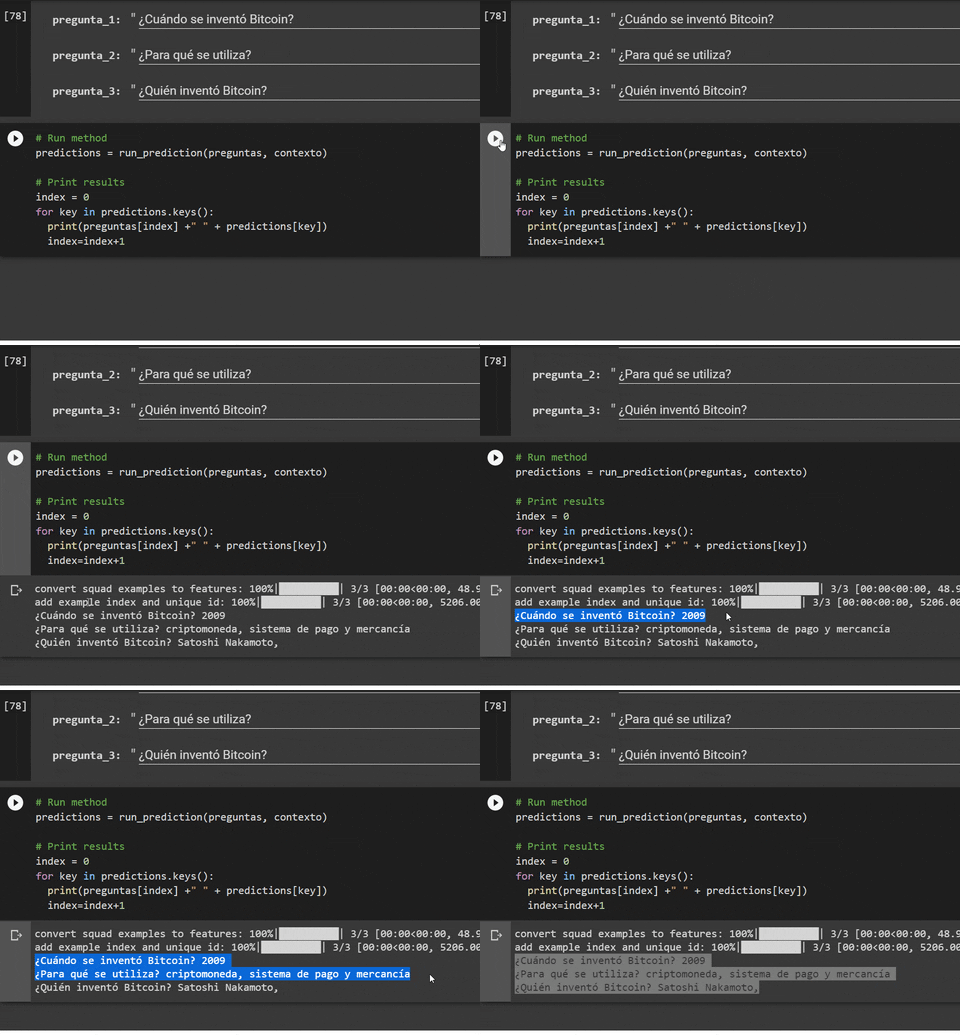
2. Run predictions:
|
||||
|
||||
|
||||
|
||||
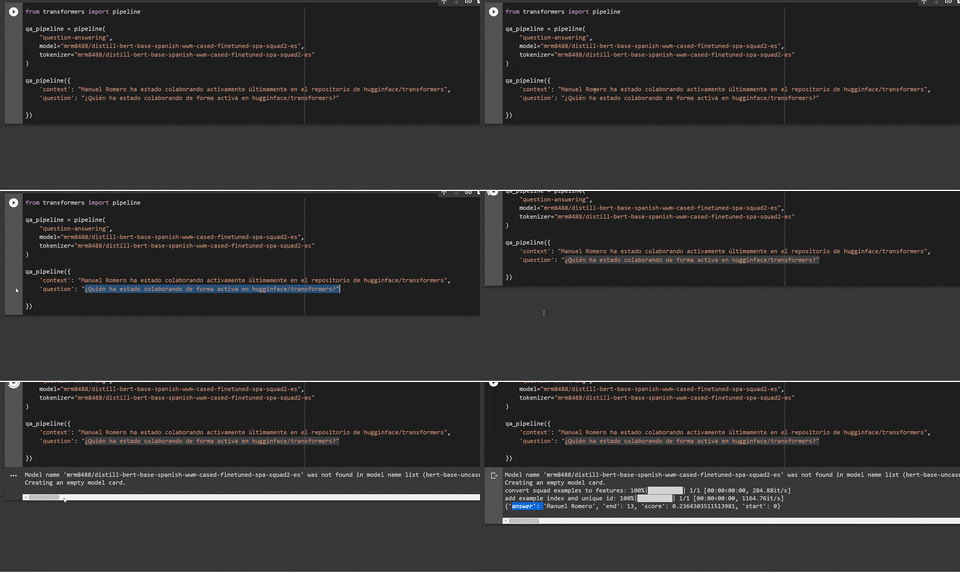
3. Using **Pipelines**
|
||||
|
||||
|
||||
|
||||
</details>
|
||||
|
||||
More about ``` Huggingface pipelines```? check this Colab out:
|
||||
|
||||
<a href="https://colab.research.google.com/github/mrm8488/shared_colab_notebooks/blob/master/Huggingface_pipelines_demo.ipynb" target="_parent"><img src="https://camo.githubusercontent.com/52feade06f2fecbf006889a904d221e6a730c194/68747470733a2f2f636f6c61622e72657365617263682e676f6f676c652e636f6d2f6173736574732f636f6c61622d62616467652e737667" alt="Open In Colab" data-canonical-src="https://colab.research.google.com/assets/colab-badge.svg"></a>
|
||||
|
||||
> Created by [Manuel Romero/@mrm8488](https://twitter.com/mrm8488)
|
||||
|
||||
> Made with <span style="color: #e25555;">♥</span> in Spain
|
||||
@@ -359,16 +359,12 @@ class AutoModel(object):
|
||||
Set to ``True`` to also return a dictionnary containing missing keys, unexpected keys and error messages.
|
||||
|
||||
kwargs: (`optional`) Remaining dictionary of keyword arguments:
|
||||
Can be used to update the configuration object (after it being loaded) and initiate the model. (e.g. ``output_attention=True``). Behave differently depending on whether a `config` is provided or automatically loaded:
|
||||
|
||||
- If a configuration is provided with ``config``, ``**kwargs`` will be directly passed to the underlying model's ``__init__`` method (we assume all relevant updates to the configuration have already been done)
|
||||
- If a configuration is not provided, ``kwargs`` will be first passed to the configuration class initialization function (:func:`~transformers.PretrainedConfig.from_pretrained`). Each key of ``kwargs`` that corresponds to a configuration attribute will be used to override said attribute with the supplied ``kwargs`` value. Remaining keys that do not correspond to any configuration attribute will be passed to the underlying model's ``__init__`` function.
|
||||
These arguments will be passed to the configuration and the model.
|
||||
|
||||
Examples::
|
||||
|
||||
model = AutoModel.from_pretrained('bert-base-uncased') # Download model and configuration from S3 and cache.
|
||||
model = AutoModel.from_pretrained('./test/bert_model/') # E.g. model was saved using `save_pretrained('./test/saved_model/')`
|
||||
model = AutoModel.from_pretrained('bert-base-uncased', output_attention=True) # Update configuration during loading
|
||||
assert model.config.output_attention == True
|
||||
# Loading from a TF checkpoint file instead of a PyTorch model (slower)
|
||||
config = AutoConfig.from_json_file('./tf_model/bert_tf_model_config.json')
|
||||
@@ -503,24 +499,12 @@ class AutoModelForPreTraining(object):
|
||||
output_loading_info: (`optional`) boolean:
|
||||
Set to ``True`` to also return a dictionnary containing missing keys, unexpected keys and error messages.
|
||||
kwargs: (`optional`) Remaining dictionary of keyword arguments:
|
||||
Can be used to update the configuration object (after it being loaded) and initiate the model.
|
||||
(e.g. ``output_attention=True``). Behave differently depending on whether a `config` is provided or
|
||||
automatically loaded:
|
||||
|
||||
- If a configuration is provided with ``config``, ``**kwargs`` will be directly passed to the
|
||||
underlying model's ``__init__`` method (we assume all relevant updates to the configuration have
|
||||
already been done)
|
||||
- If a configuration is not provided, ``kwargs`` will be first passed to the configuration class
|
||||
initialization function (:func:`~transformers.PretrainedConfig.from_pretrained`). Each key of
|
||||
``kwargs`` that corresponds to a configuration attribute will be used to override said attribute
|
||||
with the supplied ``kwargs`` value. Remaining keys that do not correspond to any configuration
|
||||
attribute will be passed to the underlying model's ``__init__`` function.
|
||||
These arguments will be passed to the configuration and the model.
|
||||
|
||||
Examples::
|
||||
|
||||
model = AutoModelForPreTraining.from_pretrained('bert-base-uncased') # Download model and configuration from S3 and cache.
|
||||
model = AutoModelForPreTraining.from_pretrained('./test/bert_model/') # E.g. model was saved using `save_pretrained('./test/saved_model/')`
|
||||
model = AutoModelForPreTraining.from_pretrained('bert-base-uncased', output_attention=True) # Update configuration during loading
|
||||
assert model.config.output_attention == True
|
||||
# Loading from a TF checkpoint file instead of a PyTorch model (slower)
|
||||
config = AutoConfig.from_json_file('./tf_model/bert_tf_model_config.json')
|
||||
@@ -657,24 +641,12 @@ class AutoModelWithLMHead(object):
|
||||
output_loading_info: (`optional`) boolean:
|
||||
Set to ``True`` to also return a dictionnary containing missing keys, unexpected keys and error messages.
|
||||
kwargs: (`optional`) Remaining dictionary of keyword arguments:
|
||||
Can be used to update the configuration object (after it being loaded) and initiate the model.
|
||||
(e.g. ``output_attention=True``). Behave differently depending on whether a `config` is provided or
|
||||
automatically loaded:
|
||||
|
||||
- If a configuration is provided with ``config``, ``**kwargs`` will be directly passed to the
|
||||
underlying model's ``__init__`` method (we assume all relevant updates to the configuration have
|
||||
already been done)
|
||||
- If a configuration is not provided, ``kwargs`` will be first passed to the configuration class
|
||||
initialization function (:func:`~transformers.PretrainedConfig.from_pretrained`). Each key of
|
||||
``kwargs`` that corresponds to a configuration attribute will be used to override said attribute
|
||||
with the supplied ``kwargs`` value. Remaining keys that do not correspond to any configuration
|
||||
attribute will be passed to the underlying model's ``__init__`` function.
|
||||
These arguments will be passed to the configuration and the model.
|
||||
|
||||
Examples::
|
||||
|
||||
model = AutoModelWithLMHead.from_pretrained('bert-base-uncased') # Download model and configuration from S3 and cache.
|
||||
model = AutoModelWithLMHead.from_pretrained('./test/bert_model/') # E.g. model was saved using `save_pretrained('./test/saved_model/')`
|
||||
model = AutoModelWithLMHead.from_pretrained('bert-base-uncased', output_attention=True) # Update configuration during loading
|
||||
assert model.config.output_attention == True
|
||||
# Loading from a TF checkpoint file instead of a PyTorch model (slower)
|
||||
config = AutoConfig.from_json_file('./tf_model/bert_tf_model_config.json')
|
||||
@@ -814,16 +786,12 @@ class AutoModelForSequenceClassification(object):
|
||||
Set to ``True`` to also return a dictionnary containing missing keys, unexpected keys and error messages.
|
||||
|
||||
kwargs: (`optional`) Remaining dictionary of keyword arguments:
|
||||
Can be used to update the configuration object (after it being loaded) and initiate the model. (e.g. ``output_attention=True``). Behave differently depending on whether a `config` is provided or automatically loaded:
|
||||
|
||||
- If a configuration is provided with ``config``, ``**kwargs`` will be directly passed to the underlying model's ``__init__`` method (we assume all relevant updates to the configuration have already been done)
|
||||
- If a configuration is not provided, ``kwargs`` will be first passed to the configuration class initialization function (:func:`~transformers.PretrainedConfig.from_pretrained`). Each key of ``kwargs`` that corresponds to a configuration attribute will be used to override said attribute with the supplied ``kwargs`` value. Remaining keys that do not correspond to any configuration attribute will be passed to the underlying model's ``__init__`` function.
|
||||
These arguments will be passed to the configuration and the model.
|
||||
|
||||
Examples::
|
||||
|
||||
model = AutoModelForSequenceClassification.from_pretrained('bert-base-uncased') # Download model and configuration from S3 and cache.
|
||||
model = AutoModelForSequenceClassification.from_pretrained('./test/bert_model/') # E.g. model was saved using `save_pretrained('./test/saved_model/')`
|
||||
model = AutoModelForSequenceClassification.from_pretrained('bert-base-uncased', output_attention=True) # Update configuration during loading
|
||||
assert model.config.output_attention == True
|
||||
# Loading from a TF checkpoint file instead of a PyTorch model (slower)
|
||||
config = AutoConfig.from_json_file('./tf_model/bert_tf_model_config.json')
|
||||
@@ -957,16 +925,12 @@ class AutoModelForQuestionAnswering(object):
|
||||
Set to ``True`` to also return a dictionnary containing missing keys, unexpected keys and error messages.
|
||||
|
||||
kwargs: (`optional`) Remaining dictionary of keyword arguments:
|
||||
Can be used to update the configuration object (after it being loaded) and initiate the model. (e.g. ``output_attention=True``). Behave differently depending on whether a `config` is provided or automatically loaded:
|
||||
|
||||
- If a configuration is provided with ``config``, ``**kwargs`` will be directly passed to the underlying model's ``__init__`` method (we assume all relevant updates to the configuration have already been done)
|
||||
- If a configuration is not provided, ``kwargs`` will be first passed to the configuration class initialization function (:func:`~transformers.PretrainedConfig.from_pretrained`). Each key of ``kwargs`` that corresponds to a configuration attribute will be used to override said attribute with the supplied ``kwargs`` value. Remaining keys that do not correspond to any configuration attribute will be passed to the underlying model's ``__init__`` function.
|
||||
These arguments will be passed to the configuration and the model.
|
||||
|
||||
Examples::
|
||||
|
||||
model = AutoModelForQuestionAnswering.from_pretrained('bert-base-uncased') # Download model and configuration from S3 and cache.
|
||||
model = AutoModelForQuestionAnswering.from_pretrained('./test/bert_model/') # E.g. model was saved using `save_pretrained('./test/saved_model/')`
|
||||
model = AutoModelForQuestionAnswering.from_pretrained('bert-base-uncased', output_attention=True) # Update configuration during loading
|
||||
assert model.config.output_attention == True
|
||||
# Loading from a TF checkpoint file instead of a PyTorch model (slower)
|
||||
config = AutoConfig.from_json_file('./tf_model/bert_tf_model_config.json')
|
||||
@@ -1101,16 +1065,12 @@ class AutoModelForTokenClassification:
|
||||
Set to ``True`` to also return a dictionnary containing missing keys, unexpected keys and error messages.
|
||||
|
||||
kwargs: (`optional`) Remaining dictionary of keyword arguments:
|
||||
Can be used to update the configuration object (after it being loaded) and initiate the model. (e.g. ``output_attention=True``). Behave differently depending on whether a `config` is provided or automatically loaded:
|
||||
|
||||
- If a configuration is provided with ``config``, ``**kwargs`` will be directly passed to the underlying model's ``__init__`` method (we assume all relevant updates to the configuration have already been done)
|
||||
- If a configuration is not provided, ``kwargs`` will be first passed to the configuration class initialization function (:func:`~transformers.PretrainedConfig.from_pretrained`). Each key of ``kwargs`` that corresponds to a configuration attribute will be used to override said attribute with the supplied ``kwargs`` value. Remaining keys that do not correspond to any configuration attribute will be passed to the underlying model's ``__init__`` function.
|
||||
These arguments will be passed to the configuration and the model.
|
||||
|
||||
Examples::
|
||||
|
||||
model = AutoModelForTokenClassification.from_pretrained('bert-base-uncased') # Download model and configuration from S3 and cache.
|
||||
model = AutoModelForTokenClassification.from_pretrained('./test/bert_model/') # E.g. model was saved using `save_pretrained('./test/saved_model/')`
|
||||
model = AutoModelForTokenClassification.from_pretrained('bert-base-uncased', output_attention=True) # Update configuration during loading
|
||||
assert model.config.output_attention == True
|
||||
# Loading from a TF checkpoint file instead of a PyTorch model (slower)
|
||||
config = AutoConfig.from_json_file('./tf_model/bert_tf_model_config.json')
|
||||
|
||||
@@ -470,10 +470,6 @@ class BartDecoder(nn.Module):
|
||||
"""
|
||||
# embed positions
|
||||
positions = self.embed_positions(input_ids)
|
||||
|
||||
if decoder_cached_states is not None:
|
||||
input_ids = input_ids[:, -1:]
|
||||
positions = positions[:, -1:]
|
||||
x = self.embed_tokens(input_ids)
|
||||
|
||||
if positions is not None:
|
||||
@@ -491,7 +487,7 @@ class BartDecoder(nn.Module):
|
||||
decoder_layer # type: DecoderLayer
|
||||
# add LayerDrop (see https://arxiv.org/abs/1909.11556 for description)
|
||||
dropout_probability = random.uniform(0, 1)
|
||||
if self.training and (dropout_probability > self.layerdrop):
|
||||
if self.training and (dropout_probability < self.layerdrop):
|
||||
continue
|
||||
layer_state = decoder_cached_states[i] if decoder_cached_states is not None else None
|
||||
x, layer_self_attn, layer_past = decoder_layer.forward(
|
||||
@@ -940,7 +936,7 @@ class BartForMaskedLM(PretrainedBartModel):
|
||||
|
||||
@staticmethod
|
||||
def prepare_inputs_for_generation(input_ids, past, **kwargs):
|
||||
return {"input_ids": input_ids, "decoder_cached_states": past, "decoder_input_ids": input_ids}
|
||||
return {"input_ids": input_ids, "decoder_cached_states": past, "decoder_input_ids": input_ids[:, -1:]}
|
||||
|
||||
def get_output_embeddings(self):
|
||||
return self.lm_head
|
||||
|
||||
@@ -18,7 +18,6 @@
|
||||
import logging
|
||||
import os
|
||||
|
||||
import torch
|
||||
from torch import nn
|
||||
|
||||
from .modeling_auto import AutoModel, AutoModelWithLMHead
|
||||
@@ -294,21 +293,3 @@ class Model2Model(PreTrainedEncoderDecoder):
|
||||
)
|
||||
|
||||
return model
|
||||
|
||||
|
||||
class Model2LSTM(PreTrainedEncoderDecoder):
|
||||
@classmethod
|
||||
def from_pretrained(cls, *args, **kwargs):
|
||||
if kwargs.get("decoder_model", None) is None:
|
||||
# We will create a randomly initilized LSTM model as decoder
|
||||
if "decoder_config" not in kwargs:
|
||||
raise ValueError(
|
||||
"To load an LSTM in Encoder-Decoder model, please supply either: "
|
||||
" - a torch.nn.LSTM model as `decoder_model` parameter (`decoder_model=lstm_model`), or"
|
||||
" - a dictionary of configuration parameters that will be used to initialize a"
|
||||
" torch.nn.LSTM model as `decoder_config` keyword argument. "
|
||||
" E.g. `decoder_config={'input_size': 768, 'hidden_size': 768, 'num_layers': 2}`"
|
||||
)
|
||||
kwargs["decoder_model"] = torch.nn.LSTM(kwargs.pop("decoder_config"))
|
||||
model = super().from_pretrained(*args, **kwargs)
|
||||
return model
|
||||
@@ -114,6 +114,11 @@ class AlbertTokenizer(PreTrainedTokenizer):
|
||||
def vocab_size(self):
|
||||
return len(self.sp_model)
|
||||
|
||||
def get_vocab(self):
|
||||
vocab = {self.convert_ids_to_tokens(i): i for i in range(self.vocab_size)}
|
||||
vocab.update(self.added_tokens_encoder)
|
||||
return vocab
|
||||
|
||||
def __getstate__(self):
|
||||
state = self.__dict__.copy()
|
||||
state["sp_model"] = None
|
||||
|
||||
@@ -195,6 +195,9 @@ class BertTokenizer(PreTrainedTokenizer):
|
||||
def vocab_size(self):
|
||||
return len(self.vocab)
|
||||
|
||||
def get_vocab(self):
|
||||
return dict(self.vocab, **self.added_tokens_encoder)
|
||||
|
||||
def _tokenize(self, text):
|
||||
split_tokens = []
|
||||
if self.do_basic_tokenize:
|
||||
|
||||
@@ -147,6 +147,9 @@ class CTRLTokenizer(PreTrainedTokenizer):
|
||||
def vocab_size(self):
|
||||
return len(self.encoder)
|
||||
|
||||
def get_vocab(self):
|
||||
return dict(self.encoder, **self.added_tokens_encoder)
|
||||
|
||||
def bpe(self, token):
|
||||
if token in self.cache:
|
||||
return self.cache[token]
|
||||
|
||||
@@ -149,6 +149,9 @@ class GPT2Tokenizer(PreTrainedTokenizer):
|
||||
def vocab_size(self):
|
||||
return len(self.encoder)
|
||||
|
||||
def get_vocab(self):
|
||||
return dict(self.encoder, **self.added_tokens_encoder)
|
||||
|
||||
def bpe(self, token):
|
||||
if token in self.cache:
|
||||
return self.cache[token]
|
||||
|
||||
@@ -125,6 +125,9 @@ class OpenAIGPTTokenizer(PreTrainedTokenizer):
|
||||
def vocab_size(self):
|
||||
return len(self.encoder)
|
||||
|
||||
def get_vocab(self):
|
||||
return dict(self.encoder, **self.added_tokens_encoder)
|
||||
|
||||
def bpe(self, token):
|
||||
word = tuple(token[:-1]) + (token[-1] + "</w>",)
|
||||
if token in self.cache:
|
||||
|
||||
@@ -119,6 +119,11 @@ class T5Tokenizer(PreTrainedTokenizer):
|
||||
def vocab_size(self):
|
||||
return self.sp_model.get_piece_size() + self._extra_ids
|
||||
|
||||
def get_vocab(self):
|
||||
vocab = {self.convert_ids_to_tokens(i): i for i in range(self.vocab_size)}
|
||||
vocab.update(self.added_tokens_encoder)
|
||||
return vocab
|
||||
|
||||
def __getstate__(self):
|
||||
state = self.__dict__.copy()
|
||||
state["sp_model"] = None
|
||||
|
||||
@@ -273,6 +273,9 @@ class TransfoXLTokenizer(PreTrainedTokenizer):
|
||||
def vocab_size(self):
|
||||
return len(self.idx2sym)
|
||||
|
||||
def get_vocab(self):
|
||||
return dict(self.sym2idx, **self.added_tokens_encoder)
|
||||
|
||||
def _tokenize(self, line, add_eos=False, add_double_eos=False):
|
||||
line = line.strip()
|
||||
# convert to lower case
|
||||
|
||||
@@ -286,6 +286,10 @@ class PreTrainedTokenizer(object):
|
||||
""" Ids of all the additional special tokens in the vocabulary (list of integers). Log an error if used while not having been set. """
|
||||
return self.convert_tokens_to_ids(self.additional_special_tokens)
|
||||
|
||||
def get_vocab(self):
|
||||
""" Returns the vocabulary as a dict of {token: index} pairs. `tokenizer.get_vocab()[token]` is equivalent to `tokenizer.convert_tokens_to_ids(token)` when `token` is in the vocab. """
|
||||
raise NotImplementedError()
|
||||
|
||||
def __init__(self, max_len=None, **kwargs):
|
||||
self._bos_token = None
|
||||
self._eos_token = None
|
||||
@@ -1229,7 +1233,10 @@ class PreTrainedTokenizer(object):
|
||||
token_type_ids = [0] * len(ids) + ([1] * len(pair_ids) if pair else [])
|
||||
|
||||
if return_special_tokens_mask:
|
||||
encoded_inputs["special_tokens_mask"] = self.get_special_tokens_mask(ids, pair_ids)
|
||||
if add_special_tokens:
|
||||
encoded_inputs["special_tokens_mask"] = self.get_special_tokens_mask(ids, pair_ids)
|
||||
else:
|
||||
encoded_inputs["special_tokens_mask"] = [0] * len(sequence)
|
||||
|
||||
encoded_inputs["input_ids"] = sequence
|
||||
if return_token_type_ids:
|
||||
|
||||
@@ -662,6 +662,9 @@ class XLMTokenizer(PreTrainedTokenizer):
|
||||
def vocab_size(self):
|
||||
return len(self.encoder)
|
||||
|
||||
def get_vocab(self):
|
||||
return dict(self.encoder, **self.added_tokens_encoder)
|
||||
|
||||
def bpe(self, token):
|
||||
word = tuple(token[:-1]) + (token[-1] + "</w>",)
|
||||
if token in self.cache:
|
||||
|
||||
@@ -190,6 +190,11 @@ class XLMRobertaTokenizer(PreTrainedTokenizer):
|
||||
def vocab_size(self):
|
||||
return len(self.sp_model) + len(self.fairseq_tokens_to_ids)
|
||||
|
||||
def get_vocab(self):
|
||||
vocab = {self.convert_ids_to_tokens(i): i for i in range(self.vocab_size)}
|
||||
vocab.update(self.added_tokens_encoder)
|
||||
return vocab
|
||||
|
||||
def _tokenize(self, text):
|
||||
return self.sp_model.EncodeAsPieces(text)
|
||||
|
||||
|
||||
@@ -114,6 +114,11 @@ class XLNetTokenizer(PreTrainedTokenizer):
|
||||
def vocab_size(self):
|
||||
return len(self.sp_model)
|
||||
|
||||
def get_vocab(self):
|
||||
vocab = {self.convert_ids_to_tokens(i): i for i in range(self.vocab_size)}
|
||||
vocab.update(self.added_tokens_encoder)
|
||||
return vocab
|
||||
|
||||
def __getstate__(self):
|
||||
state = self.__dict__.copy()
|
||||
state["sp_model"] = None
|
||||
|
||||
@@ -251,6 +251,7 @@ class BartHeadTests(unittest.TestCase):
|
||||
output_past=True,
|
||||
)
|
||||
lm_model = BartForMaskedLM(config)
|
||||
lm_model.eval()
|
||||
new_input_ids = lm_model.generate(input_ids)
|
||||
self.assertEqual(new_input_ids.shape, (input_ids.shape[0], 20))
|
||||
|
||||
|
||||
@@ -542,3 +542,23 @@ class TokenizerTesterMixin:
|
||||
print(new_tokenizer.init_kwargs)
|
||||
assert tokenizer.init_kwargs["random_argument"] is True
|
||||
assert new_tokenizer.init_kwargs["random_argument"] is False
|
||||
|
||||
def test_get_vocab(self):
|
||||
tokenizer = self.get_tokenizer()
|
||||
vocab = tokenizer.get_vocab()
|
||||
|
||||
self.assertIsInstance(vocab, dict)
|
||||
self.assertEqual(len(vocab), len(tokenizer))
|
||||
|
||||
for word, ind in vocab.items():
|
||||
self.assertEqual(tokenizer.convert_tokens_to_ids(word), ind)
|
||||
self.assertEqual(tokenizer.convert_ids_to_tokens(ind), word)
|
||||
|
||||
tokenizer.add_tokens(["asdfasdfasdfasdf"])
|
||||
vocab = tokenizer.get_vocab()
|
||||
self.assertIsInstance(vocab, dict)
|
||||
self.assertEqual(len(vocab), len(tokenizer))
|
||||
|
||||
for word, ind in vocab.items():
|
||||
self.assertEqual(tokenizer.convert_tokens_to_ids(word), ind)
|
||||
self.assertEqual(tokenizer.convert_ids_to_tokens(ind), word)
|
||||
Reference in new issue
Block a user