Compare commits
2
Commits
| Author | SHA1 | Date | |
|---|---|---|---|
 Lysandre Lysandre
|
b3931505ca | ||
|
Lysandre
|
751ac4d58f |
+31
-5
@@ -3,7 +3,7 @@ jobs:
|
||||
run_tests_torch_and_tf:
|
||||
working_directory: ~/transformers
|
||||
docker:
|
||||
- image: circleci/python:3.6
|
||||
- image: circleci/python:3.5
|
||||
environment:
|
||||
OMP_NUM_THREADS: 1
|
||||
resource_class: xlarge
|
||||
@@ -14,6 +14,22 @@ jobs:
|
||||
- run: sudo pip install codecov pytest-cov
|
||||
- run: python -m pytest -n 8 --dist=loadfile -s -v ./tests/ --cov
|
||||
- run: codecov
|
||||
run_all_tests_torch_and_tf:
|
||||
working_directory: ~/transformers
|
||||
docker:
|
||||
- image: circleci/python:3.5
|
||||
environment:
|
||||
OMP_NUM_THREADS: 1
|
||||
RUN_SLOW: yes
|
||||
RUN_CUSTOM_TOKENIZERS: yes
|
||||
resource_class: xlarge
|
||||
parallelism: 1
|
||||
steps:
|
||||
- checkout
|
||||
- run: sudo pip install .[mecab,sklearn,tf-cpu,torch,testing]
|
||||
- run:
|
||||
command: python -m pytest -n 8 --dist=loadfile -s -v ./tests/
|
||||
no_output_timeout: 4h
|
||||
|
||||
run_tests_torch:
|
||||
working_directory: ~/transformers
|
||||
@@ -46,7 +62,7 @@ jobs:
|
||||
run_tests_custom_tokenizers:
|
||||
working_directory: ~/transformers
|
||||
docker:
|
||||
- image: circleci/python:3.6
|
||||
- image: circleci/python:3.5
|
||||
environment:
|
||||
RUN_CUSTOM_TOKENIZERS: yes
|
||||
steps:
|
||||
@@ -56,7 +72,7 @@ jobs:
|
||||
run_examples_torch:
|
||||
working_directory: ~/transformers
|
||||
docker:
|
||||
- image: circleci/python:3.6
|
||||
- image: circleci/python:3.5
|
||||
environment:
|
||||
OMP_NUM_THREADS: 1
|
||||
resource_class: xlarge
|
||||
@@ -69,7 +85,7 @@ jobs:
|
||||
deploy_doc:
|
||||
working_directory: ~/transformers
|
||||
docker:
|
||||
- image: circleci/python:3.6
|
||||
- image: circleci/python:3.5
|
||||
steps:
|
||||
- add_ssh_keys:
|
||||
fingerprints:
|
||||
@@ -94,7 +110,7 @@ jobs:
|
||||
check_repository_consistency:
|
||||
working_directory: ~/transformers
|
||||
docker:
|
||||
- image: circleci/python:3.6
|
||||
- image: circleci/python:3.5
|
||||
resource_class: small
|
||||
parallelism: 1
|
||||
steps:
|
||||
@@ -118,3 +134,13 @@ workflows:
|
||||
- run_tests_torch
|
||||
- run_tests_tf
|
||||
- deploy_doc: *workflow_filters
|
||||
run_slow_tests:
|
||||
triggers:
|
||||
- schedule:
|
||||
cron: "0 4 * * *"
|
||||
filters:
|
||||
branches:
|
||||
only:
|
||||
- master
|
||||
jobs:
|
||||
- run_all_tests_torch_and_tf
|
||||
|
||||
@@ -1,19 +0,0 @@
|
||||
name: GitHub-hosted runner
|
||||
|
||||
on: push
|
||||
|
||||
jobs:
|
||||
check_code_quality:
|
||||
runs-on: ubuntu-18.04
|
||||
steps:
|
||||
- uses: actions/checkout@v2
|
||||
- name: Set up Python
|
||||
uses: actions/setup-python@v1
|
||||
with:
|
||||
python-version: 3.7
|
||||
- name: Install dependencies
|
||||
run: |
|
||||
pip install .[tf,torch,quality]
|
||||
|
||||
|
||||
|
||||
@@ -1,50 +0,0 @@
|
||||
name: Self-hosted runner (push)
|
||||
|
||||
on:
|
||||
# push:
|
||||
# branches:
|
||||
# - master
|
||||
# pull_request:
|
||||
repository_dispatch:
|
||||
|
||||
|
||||
jobs:
|
||||
run_tests_torch_and_tf_gpu:
|
||||
runs-on: self-hosted
|
||||
steps:
|
||||
- uses: actions/checkout@v2
|
||||
- name: Python version
|
||||
run: |
|
||||
which python
|
||||
python --version
|
||||
pip --version
|
||||
- name: Current dir
|
||||
run: pwd
|
||||
- run: nvidia-smi
|
||||
- name: Create new python env (on self-hosted runners we have to handle isolation ourselves)
|
||||
run: |
|
||||
python -m venv .env
|
||||
source .env/bin/activate
|
||||
which python
|
||||
python --version
|
||||
pip --version
|
||||
- name: Install dependencies
|
||||
run: |
|
||||
source .env/bin/activate
|
||||
pip install .[sklearn,tf,torch,testing]
|
||||
pip uninstall -y tensorflow
|
||||
|
||||
- name: Are GPUs recognized by our DL frameworks
|
||||
run: |
|
||||
source .env/bin/activate
|
||||
python -c "import torch; print(torch.cuda.is_available())"
|
||||
|
||||
- name: Run all non-slow tests on GPU
|
||||
env:
|
||||
TF_FORCE_GPU_ALLOW_GROWTH: "true"
|
||||
# TF_GPU_MEMORY_LIMIT: 4096
|
||||
OMP_NUM_THREADS: 1
|
||||
USE_CUDA: yes
|
||||
run: |
|
||||
source .env/bin/activate
|
||||
python -m pytest -n 2 --dist=loadfile -s -v ./tests/
|
||||
@@ -1,51 +0,0 @@
|
||||
name: Self-hosted runner (scheduled)
|
||||
|
||||
on:
|
||||
push:
|
||||
branches:
|
||||
- ci_*
|
||||
repository_dispatch:
|
||||
schedule:
|
||||
- cron: "0 0 * * *"
|
||||
|
||||
jobs:
|
||||
run_all_tests_torch_and_tf_gpu:
|
||||
runs-on: self-hosted
|
||||
steps:
|
||||
- uses: actions/checkout@v2
|
||||
- name: Python version
|
||||
run: |
|
||||
which python
|
||||
python --version
|
||||
pip --version
|
||||
- name: Current dir
|
||||
run: pwd
|
||||
- run: nvidia-smi
|
||||
- name: Create new python env (on self-hosted runners we have to handle isolation ourselves)
|
||||
run: |
|
||||
python -m venv .env
|
||||
source .env/bin/activate
|
||||
which python
|
||||
python --version
|
||||
pip --version
|
||||
- name: Install dependencies
|
||||
run: |
|
||||
source .env/bin/activate
|
||||
pip install .[sklearn,tf,torch,testing]
|
||||
|
||||
- name: Are GPUs recognized by our DL frameworks
|
||||
run: |
|
||||
source .env/bin/activate
|
||||
python -c "import torch; print(torch.cuda.is_available())"
|
||||
python -c "import tensorflow as tf; print(tf.test.is_built_with_cuda(), tf.config.list_physical_devices('GPU'))"
|
||||
|
||||
- name: Run all tests on GPU
|
||||
env:
|
||||
TF_FORCE_GPU_ALLOW_GROWTH: "true"
|
||||
OMP_NUM_THREADS: 1
|
||||
RUN_SLOW: yes
|
||||
USE_CUDA: yes
|
||||
run: |
|
||||
source .env/bin/activate
|
||||
python -m pytest -n 1 --dist=loadfile -s -v ./tests/
|
||||
|
||||
@@ -66,7 +66,7 @@ Choose the right framework for every part of a model's lifetime
|
||||
|
||||
## Installation
|
||||
|
||||
This repo is tested on Python 3.6+, PyTorch 1.0.0+ and TensorFlow 2.0.0-rc1
|
||||
This repo is tested on Python 3.5+, PyTorch 1.0.0+ and TensorFlow 2.0.0-rc1
|
||||
|
||||
You should install 🤗 Transformers in a [virtual environment](https://docs.python.org/3/library/venv.html). If you're unfamiliar with Python virtual environments, check out the [user guide](https://packaging.python.org/guides/installing-using-pip-and-virtual-environments/).
|
||||
|
||||
@@ -163,9 +163,8 @@ At some point in the future, you'll be able to seamlessly move from pre-training
|
||||
13. **[XLM-RoBERTa](https://github.com/pytorch/fairseq/tree/master/examples/xlmr)** (from Facebook AI), released together with the paper [Unsupervised Cross-lingual Representation Learning at Scale](https://arxiv.org/abs/1911.02116) by Alexis Conneau*, Kartikay Khandelwal*, Naman Goyal, Vishrav Chaudhary, Guillaume Wenzek, Francisco Guzmán, Edouard Grave, Myle Ott, Luke Zettlemoyer and Veselin Stoyanov.
|
||||
14. **[MMBT](https://github.com/facebookresearch/mmbt/)** (from Facebook), released together with the paper a [Supervised Multimodal Bitransformers for Classifying Images and Text](https://arxiv.org/pdf/1909.02950.pdf) by Douwe Kiela, Suvrat Bhooshan, Hamed Firooz, Davide Testuggine.
|
||||
15. **[FlauBERT](https://github.com/getalp/Flaubert)** (from CNRS) released with the paper [FlauBERT: Unsupervised Language Model Pre-training for French](https://arxiv.org/abs/1912.05372) by Hang Le, Loïc Vial, Jibril Frej, Vincent Segonne, Maximin Coavoux, Benjamin Lecouteux, Alexandre Allauzen, Benoît Crabbé, Laurent Besacier, Didier Schwab.
|
||||
16. **[BART](https://github.com/pytorch/fairseq/tree/master/examples/bart)** (from Facebook) released with the paper [BART: Denoising Sequence-to-Sequence Pre-training for Natural Language Generation, Translation, and Comprehension](https://arxiv.org/pdf/1910.13461.pdf) by Mike Lewis, Yinhan Liu, Naman Goyal, Marjan Ghazvininejad, Abdelrahman Mohamed, Omer Levy, Ves Stoyanov and Luke Zettlemoyer.
|
||||
17. **[Other community models](https://huggingface.co/models)**, contributed by the [community](https://huggingface.co/users).
|
||||
18. Want to contribute a new model? We have added a **detailed guide and templates** to guide you in the process of adding a new model. You can find them in the [`templates`](./templates) folder of the repository. Be sure to check the [contributing guidelines](./CONTRIBUTING.md) and contact the maintainers or open an issue to collect feedbacks before starting your PR.
|
||||
16. **[Other community models](https://huggingface.co/models)**, contributed by the [community](https://huggingface.co/users).
|
||||
17. Want to contribute a new model? We have added a **detailed guide and templates** to guide you in the process of adding a new model. You can find them in the [`templates`](./templates) folder of the repository. Be sure to check the [contributing guidelines](./CONTRIBUTING.md) and contact the maintainers or open an issue to collect feedbacks before starting your PR.
|
||||
|
||||
These implementations have been tested on several datasets (see the example scripts) and should match the performances of the original implementations (e.g. ~93 F1 on SQuAD for BERT Whole-Word-Masking, ~88 F1 on RocStories for OpenAI GPT, ~18.3 perplexity on WikiText 103 for Transformer-XL, ~0.916 Peason R coefficient on STS-B for XLNet). You can find more details on the performances in the Examples section of the [documentation](https://huggingface.co/transformers/examples.html).
|
||||
|
||||
@@ -472,7 +471,7 @@ python ./examples/run_generation.py \
|
||||
|
||||
Starting with `v2.2.2`, you can now upload and share your fine-tuned models with the community, using the <abbr title="Command-line interface">CLI</abbr> that's built-in to the library.
|
||||
|
||||
**First, create an account on [https://huggingface.co/join](https://huggingface.co/join)**. Optionally, join an existing organization or create a new one. Then:
|
||||
**First, create an account on [https://huggingface.co/join](https://huggingface.co/join)**. Then:
|
||||
|
||||
```shell
|
||||
transformers-cli login
|
||||
@@ -491,26 +490,19 @@ transformers-cli upload ./config.json [--filename folder/foobar.json]
|
||||
# (you can optionally override its filename, which can be nested inside a folder)
|
||||
```
|
||||
|
||||
If you want your model to be namespaced by your organization name rather than your username, add the following flag to any command:
|
||||
```shell
|
||||
--organization organization_name
|
||||
```
|
||||
|
||||
Your model will then be accessible through its identifier, a concatenation of your username (or organization name) and the folder name above:
|
||||
Your model will then be accessible through its identifier, a concatenation of your username and the folder name above:
|
||||
```python
|
||||
"username/pretrained_model"
|
||||
# or if an org:
|
||||
"organization_name/pretrained_model"
|
||||
```
|
||||
|
||||
**Please add a README.md model card** to the repo under `model_cards/` with: model description, training params (dataset, preprocessing, hardware used, hyperparameters), evaluation results, intended uses & limitations, etc.
|
||||
**Please add a README.md model card** to the repo under `model_cards/` with: model description, training params (dataset, preprocessing, hyperparameters), evaluation results, intended uses & limitations, etc.
|
||||
|
||||
Your model now has a page on huggingface.co/models 🔥
|
||||
|
||||
Anyone can load it from code:
|
||||
```python
|
||||
tokenizer = AutoTokenizer.from_pretrained("namespace/pretrained_model")
|
||||
model = AutoModel.from_pretrained("namespace/pretrained_model")
|
||||
tokenizer = AutoTokenizer.from_pretrained("username/pretrained_model")
|
||||
model = AutoModel.from_pretrained("username/pretrained_model")
|
||||
```
|
||||
|
||||
List all your files on S3:
|
||||
|
||||
@@ -0,0 +1,7 @@
|
||||
FROM pytorch/pytorch:latest
|
||||
|
||||
RUN git clone https://github.com/NVIDIA/apex.git && cd apex && python setup.py install --cuda_ext --cpp_ext
|
||||
|
||||
RUN pip install transformers
|
||||
|
||||
WORKDIR /workspace
|
||||
@@ -1,26 +0,0 @@
|
||||
FROM ubuntu:18.04
|
||||
LABEL maintainer="Hugging Face"
|
||||
LABEL repository="transformers"
|
||||
|
||||
RUN apt update && \
|
||||
apt install -y bash \
|
||||
build-essential \
|
||||
git \
|
||||
curl \
|
||||
ca-certificates \
|
||||
python3 \
|
||||
python3-pip && \
|
||||
rm -rf /var/lib/apt/lists
|
||||
|
||||
RUN python3 -m pip install --no-cache-dir --upgrade pip && \
|
||||
python3 -m pip install --no-cache-dir \
|
||||
jupyter \
|
||||
tensorflow-cpu \
|
||||
torch
|
||||
|
||||
WORKDIR /workspace
|
||||
COPY . transformers/
|
||||
RUN cd transformers/ && \
|
||||
python3 -m pip install --no-cache-dir .
|
||||
|
||||
CMD ["/bin/bash"]
|
||||
@@ -1,26 +0,0 @@
|
||||
FROM nvidia/cuda:10.1-cudnn7-runtime-ubuntu18.04
|
||||
LABEL maintainer="Hugging Face"
|
||||
LABEL repository="transformers"
|
||||
|
||||
RUN apt update && \
|
||||
apt install -y bash \
|
||||
build-essential \
|
||||
git \
|
||||
curl \
|
||||
ca-certificates \
|
||||
python3 \
|
||||
python3-pip && \
|
||||
rm -rf /var/lib/apt/lists
|
||||
|
||||
RUN python3 -m pip install --no-cache-dir --upgrade pip && \
|
||||
python3 -m pip install --no-cache-dir \
|
||||
jupyter \
|
||||
tensorflow \
|
||||
torch
|
||||
|
||||
WORKDIR /workspace
|
||||
COPY . transformers/
|
||||
RUN cd transformers/ && \
|
||||
python3 -m pip install --no-cache-dir .
|
||||
|
||||
CMD ["/bin/bash"]
|
||||
@@ -1,25 +0,0 @@
|
||||
FROM ubuntu:18.04
|
||||
LABEL maintainer="Hugging Face"
|
||||
LABEL repository="transformers"
|
||||
|
||||
RUN apt update && \
|
||||
apt install -y bash \
|
||||
build-essential \
|
||||
git \
|
||||
curl \
|
||||
ca-certificates \
|
||||
python3 \
|
||||
python3-pip && \
|
||||
rm -rf /var/lib/apt/lists
|
||||
|
||||
RUN python3 -m pip install --no-cache-dir --upgrade pip && \
|
||||
python3 -m pip install --no-cache-dir \
|
||||
jupyter \
|
||||
torch
|
||||
|
||||
WORKDIR /workspace
|
||||
COPY . transformers/
|
||||
RUN cd transformers/ && \
|
||||
python3 -m pip install --no-cache-dir .
|
||||
|
||||
CMD ["/bin/bash"]
|
||||
@@ -1,25 +0,0 @@
|
||||
FROM nvidia/cuda:10.1-cudnn7-runtime-ubuntu18.04
|
||||
LABEL maintainer="Hugging Face"
|
||||
LABEL repository="transformers"
|
||||
|
||||
RUN apt update && \
|
||||
apt install -y bash \
|
||||
build-essential \
|
||||
git \
|
||||
curl \
|
||||
ca-certificates \
|
||||
python3 \
|
||||
python3-pip && \
|
||||
rm -rf /var/lib/apt/lists
|
||||
|
||||
RUN python3 -m pip install --no-cache-dir --upgrade pip && \
|
||||
python3 -m pip install --no-cache-dir \
|
||||
mkl \
|
||||
torch
|
||||
|
||||
WORKDIR /workspace
|
||||
COPY . transformers/
|
||||
RUN cd transformers/ && \
|
||||
python3 -m pip install --no-cache-dir .
|
||||
|
||||
CMD ["/bin/bash"]
|
||||
@@ -1,25 +0,0 @@
|
||||
FROM ubuntu:18.04
|
||||
LABEL maintainer="Hugging Face"
|
||||
LABEL repository="transformers"
|
||||
|
||||
RUN apt update && \
|
||||
apt install -y bash \
|
||||
build-essential \
|
||||
git \
|
||||
curl \
|
||||
ca-certificates \
|
||||
python3 \
|
||||
python3-pip && \
|
||||
rm -rf /var/lib/apt/lists
|
||||
|
||||
RUN python3 -m pip install --no-cache-dir --upgrade pip && \
|
||||
python3 -m pip install --no-cache-dir \
|
||||
mkl \
|
||||
tensorflow-cpu
|
||||
|
||||
WORKDIR /workspace
|
||||
COPY . transformers/
|
||||
RUN cd transformers/ && \
|
||||
python3 -m pip install --no-cache-dir .
|
||||
|
||||
CMD ["/bin/bash"]
|
||||
@@ -1,25 +0,0 @@
|
||||
FROM nvidia/cuda:10.1-cudnn7-runtime-ubuntu18.04
|
||||
LABEL maintainer="Hugging Face"
|
||||
LABEL repository="transformers"
|
||||
|
||||
RUN apt update && \
|
||||
apt install -y bash \
|
||||
build-essential \
|
||||
git \
|
||||
curl \
|
||||
ca-certificates \
|
||||
python3 \
|
||||
python3-pip && \
|
||||
rm -rf /var/lib/apt/lists
|
||||
|
||||
RUN python3 -m pip install --no-cache-dir --upgrade pip && \
|
||||
python3 -m pip install --no-cache-dir \
|
||||
mkl \
|
||||
tensorflow
|
||||
|
||||
WORKDIR /workspace
|
||||
COPY . transformers/
|
||||
RUN cd transformers/ && \
|
||||
python3 -m pip install --no-cache-dir .
|
||||
|
||||
CMD ["/bin/bash"]
|
||||
+1
-1
@@ -26,7 +26,7 @@ author = u'huggingface'
|
||||
# The short X.Y version
|
||||
version = u''
|
||||
# The full version, including alpha/beta/rc tags
|
||||
release = u'2.7.0'
|
||||
release = u'2.5.1'
|
||||
|
||||
|
||||
# -- General configuration ---------------------------------------------------
|
||||
|
||||
@@ -80,7 +80,6 @@ The library currently contains PyTorch and Tensorflow implementations, pre-train
|
||||
main_classes/configuration
|
||||
main_classes/model
|
||||
main_classes/tokenizer
|
||||
main_classes/pipelines
|
||||
main_classes/optimizer_schedules
|
||||
main_classes/processors
|
||||
|
||||
@@ -103,4 +102,3 @@ The library currently contains PyTorch and Tensorflow implementations, pre-train
|
||||
model_doc/xlmroberta
|
||||
model_doc/flaubert
|
||||
model_doc/bart
|
||||
model_doc/t5
|
||||
|
||||
@@ -1,6 +1,6 @@
|
||||
# Installation
|
||||
|
||||
Transformers is tested on Python 3.6+ and PyTorch 1.1.0
|
||||
Transformers is tested on Python 3.5+ and PyTorch 1.1.0
|
||||
|
||||
## With pip
|
||||
|
||||
|
||||
@@ -1,68 +0,0 @@
|
||||
Pipelines
|
||||
----------------------------------------------------
|
||||
|
||||
The pipelines are a great and easy way to use models for inference. These pipelines are objects that abstract most
|
||||
of the complex code from the library, offering a simple API dedicated to several tasks, including Named Entity
|
||||
Recognition, Masked Language Modeling, Sentiment Analysis, Feature Extraction and Question Answering.
|
||||
|
||||
There are two categories of pipeline abstractions to be aware about:
|
||||
|
||||
- The :class:`~transformers.pipeline` which is the most powerful object encapsulating all other pipelines
|
||||
- The other task-specific pipelines, such as :class:`~transformers.NerPipeline`
|
||||
or :class:`~transformers.QuestionAnsweringPipeline`
|
||||
|
||||
The pipeline abstraction
|
||||
~~~~~~~~~~~~~~~~~~~~~~~~~~~~~~~~~~~~~~~~~~
|
||||
|
||||
The `pipeline` abstraction is a wrapper around all the other available pipelines. It is instantiated as any
|
||||
other pipeline but requires an additional argument which is the `task`.
|
||||
|
||||
.. autoclass:: transformers.pipeline
|
||||
:members:
|
||||
|
||||
|
||||
The task specific pipelines
|
||||
~~~~~~~~~~~~~~~~~~~~~~~~~~~~~~~~~~~~~~~~~~
|
||||
|
||||
Parent class: Pipeline
|
||||
=========================================
|
||||
|
||||
.. autoclass:: transformers.Pipeline
|
||||
:members: predict, transform, save_pretrained
|
||||
|
||||
NerPipeline
|
||||
==========================================
|
||||
|
||||
.. autoclass:: transformers.NerPipeline
|
||||
|
||||
TokenClassificationPipeline
|
||||
==========================================
|
||||
|
||||
This class is an alias of the :class:`~transformers.NerPipeline` defined above. Please refer to that pipeline for
|
||||
documentation and usage examples.
|
||||
|
||||
FillMaskPipeline
|
||||
==========================================
|
||||
|
||||
.. autoclass:: transformers.FillMaskPipeline
|
||||
|
||||
FeatureExtractionPipeline
|
||||
==========================================
|
||||
|
||||
.. autoclass:: transformers.FeatureExtractionPipeline
|
||||
|
||||
TextClassificationPipeline
|
||||
==========================================
|
||||
|
||||
.. autoclass:: transformers.TextClassificationPipeline
|
||||
|
||||
QuestionAnsweringPipeline
|
||||
==========================================
|
||||
|
||||
.. autoclass:: transformers.QuestionAnsweringPipeline
|
||||
|
||||
|
||||
SummarizationPipeline
|
||||
==========================================
|
||||
|
||||
.. autoclass:: transformers.SummarizationPipeline
|
||||
@@ -4,42 +4,33 @@ Bart
|
||||
file a `Github Issue <https://github.com/huggingface/transformers/issues/new?assignees=&labels=&template=bug-report.md&title>`__ and assign
|
||||
@sshleifer
|
||||
|
||||
Paper
|
||||
~~~~~
|
||||
The Bart model was `proposed <https://arxiv.org/abs/1910.13461>`_ by Mike Lewis, Yinhan Liu, Naman Goyal, Marjan Ghazvininejad, Abdelrahman Mohamed, Omer Levy, Ves Stoyanov and Luke Zettlemoyer on 29 Oct, 2019.
|
||||
According to the abstract,
|
||||
The Bart model was `proposed <https://arxiv.org/abs/1910.13461>`_ by Mike Lewis, Yinhan Liu, Naman Goyal, Marjan Ghazvininejad, Abdelrahman Mohamed, Omer Levy, Ves Stoyanov, Luke Zettlemoyer on 29 Oct, 2019.
|
||||
It is a sequence to sequence model where both encoder and decoder are transformers. The paper also introduces a novel pretraining objective, and demonstrates excellent summarization results.
|
||||
The authors released their code `here <https://github.com/pytorch/fairseq/tree/master/examples/bart>`_
|
||||
|
||||
- Bart uses a standard seq2seq/machine translation architecture with a bidirectional encoder (like BERT) and a left-to-right decoder (like GPT).
|
||||
- The pretraining task involves randomly shuffling the order of the original sentences and a novel in-filling scheme, where spans of text are replaced with a single mask token.
|
||||
- BART is particularly effective when fine tuned for text generation but also works well for comprehension tasks. It matches the performance of RoBERTa with comparable training resources on GLUE and SQuAD, achieves new state-of-the-art results on a range of abstractive dialogue, question answering, and summarization tasks, with gains of up to 6 ROUGE.
|
||||
**Abstract:**
|
||||
|
||||
The Authors' code can be found `here <https://github.com/pytorch/fairseq/tree/master/examples/bart>`_
|
||||
|
||||
|
||||
Implementation Notes
|
||||
~~~~~~~~~~~~~~~~~~~~
|
||||
- Bart doesn't use :obj:`token_type_ids` for sequence classification. Use BartTokenizer.encode to get the proper splitting.
|
||||
- The forward pass of ``BartModel`` will create decoder inputs (using the helper function ``transformers.modeling_bart._prepare_bart_decoder_inputs``) if they are not passed. This is different than some other modeling APIs.
|
||||
- Model predictions are intended to be identical to the original implementation. This only works, however, if the string you pass to ``fairseq.encode`` starts with a space.
|
||||
- ``BartForConditionalGeneration.generate`` should be used for conditional generation tasks like summarization, see the example in that docstrings
|
||||
- Models that load the ``"bart-large-cnn"`` weights will not have a ``mask_token_id``, or be able to perform mask filling tasks.
|
||||
*We present BART, a denoising autoencoder for pretraining sequence-to-sequence models. BART is trained by (1) corrupting text with an arbitrary noising function, and (2) learning a model to reconstruct the original text. It uses a standard Tranformer-based neural machine translation architecture which, despite its simplicity, can be seen as generalizing BERT (due to the bidirectional encoder), GPT (with the left-to-right decoder), and many other more recent pretraining schemes. We evaluate a number of noising approaches, finding the best performance by both randomly shuffling the order of the original sentences and using a novel in-filling scheme, where spans of text are replaced with a single mask token. BART is particularly effective when fine tuned for text generation but also works well for comprehension tasks. It matches the performance of RoBERTa with comparable training resources on GLUE and SQuAD, achieves new state-of-the-art results on a range of abstractive dialogue, question answering, and summarization tasks, with gains of up to 6 ROUGE. BART also provides a 1.1 BLEU increase over a back-translation system for machine translation, with only target language pretraining. We also report ablation experiments that replicate other pretraining schemes within the BART framework, to better measure which factors most influence end-task performance.*
|
||||
`BART: Denoising Sequence-to-Sequence Pre-training for Natural Language Generation, Translation, and Comprehension`
|
||||
|
||||
|
||||
Notes:
|
||||
- Bart doesn't use :obj:`token_type_ids`, for sequence classification just use BartTokenizer.encode to get the proper splitting.
|
||||
- Inputs to the decoder are created by BartModel.forward if they are not passed. This is different than some other model APIs.
|
||||
- Model predictions are intended to be identical to the original implementation. This only works, however, if the string you pass to fairseq.encode starts with a space.
|
||||
|
||||
BartModel
|
||||
~~~~~~~~~~~~~
|
||||
~~~~~~~~~~~~~~~~~~~~
|
||||
|
||||
.. autoclass:: transformers.BartModel
|
||||
:members: forward
|
||||
|
||||
.. autofunction:: transformers.modeling_bart._prepare_bart_decoder_inputs
|
||||
|
||||
BartForMaskedLM
|
||||
~~~~~~~~~~~~~~~~~~~~~~~~~~
|
||||
|
||||
BartForConditionalGeneration
|
||||
~~~~~~~~~~~~~~~~~~~~~~~~~~~~~~~~~
|
||||
|
||||
.. autoclass:: transformers.BartForConditionalGeneration
|
||||
:members: generate, forward
|
||||
.. autoclass:: transformers.BartForMaskedLM
|
||||
:members: forward
|
||||
|
||||
|
||||
BartForSequenceClassification
|
||||
@@ -54,3 +45,8 @@ BartConfig
|
||||
.. autoclass:: transformers.BartConfig
|
||||
:members:
|
||||
|
||||
Automatic Creation of Decoder Inputs
|
||||
~~~~~~~~~~~~~~~~~~~~~~~~~~~~~~~~~~~~
|
||||
This is enabled by default
|
||||
|
||||
.. autofunction:: transformers.modeling_bart._prepare_bart_decoder_inputs
|
||||
|
||||
@@ -1,101 +0,0 @@
|
||||
T5
|
||||
----------------------------------------------------
|
||||
**DISCLAIMER:** This model is still a work in progress, if you see something strange,
|
||||
file a `Github Issue <https://github.com/huggingface/transformers/issues/new?assignees=&labels=&template=bug-report.md&title>`_
|
||||
|
||||
Overview
|
||||
~~~~~
|
||||
The T5 model was presented in `Exploring the Limits of Transfer Learning with a Unified Text-to-Text Transformer <https://arxiv.org/pdf/1910.10683.pdf>`_ by Colin Raffel, Noam Shazeer, Adam Roberts, Katherine Lee, Sharan Narang, Michael Matena, Yanqi Zhou, Wei Li, Peter J. Liu in
|
||||
Here the abstract:
|
||||
|
||||
*Transfer learning, where a model is first pre-trained on a data-rich task before being fine-tuned on a downstream task, has emerged as a powerful technique in natural language processing (NLP). The effectiveness of transfer learning has given rise to a diversity of approaches, methodology, and practice.
|
||||
In this paper, we explore the landscape of transfer learning techniques for NLP by introducing a unified framework that converts every language problem into a text-to-text format.
|
||||
Our systematic study compares pre-training objectives, architectures, unlabeled datasets, transfer approaches, and other factors on dozens of language understanding tasks.
|
||||
By combining the insights from our exploration with scale and our new "Colossal Clean Crawled Corpus", we achieve state-of-the-art results on many benchmarks covering summarization, question answering, text classification, and more.
|
||||
To facilitate future work on transfer learning for NLP, we release our dataset, pre-trained models, and code.*
|
||||
|
||||
The Authors' code can be found `here <https://github.com/google-research/text-to-text-transfer-transformer>`_ .
|
||||
|
||||
Training
|
||||
~~~~~~~~~~~~~~~~~~~~
|
||||
T5 is an encoder-decoder model and converts all NLP problems into a text-to-text format. It is trained using teacher forcing.
|
||||
This means that for training we always need an input sequence and a target sequence.
|
||||
The input sequence is fed to the model using ``input_ids``. The target sequence is shifted to the right, *i.e.* perprended by a start-sequence token and fed to the decoder using the `decoder_input_ids`. In teacher-forcing style, the target sequence is then appended by the EOS token and corresponds to the ``lm_labels``. The PAD token is hereby used as the start-sequence token.
|
||||
T5 can be trained / fine-tuned both in a supervised and unsupervised fashion.
|
||||
|
||||
- Unsupervised denoising training
|
||||
In this setup spans of the input sequence are masked by so-called sentinel tokens (*a.k.a* unique mask tokens)
|
||||
and the output sequence is formed as a concatenation of the same sentinel tokens and the *real* masked tokens.
|
||||
Each sentinel tokens represents a unique mask token for this sentence and should start with ``<extra_id_1>``, ``<extrac_id_2>``, ... up to ``<extra_id_100>``. As a default 100 sentinel tokens are available in ``T5Tokenizer``.
|
||||
*E.g.* the sentence "The cute dog walks in the park" with the masks put on "cute dog" and "the" should be processed as follows:
|
||||
|
||||
::
|
||||
|
||||
input_ids = tokenizer.encode('The <extra_id_1> walks in <extra_id_2> park', return_tensors='pt')
|
||||
lm_labels = tokenizer.encode('<extra_id_1> cute dog <extra_id_2> the <extra_id_3> </s>', return_tensors='pt')
|
||||
# the forward function automatically creates the correct decoder_input_ids
|
||||
model(input_ids=input_ids, lm_labels=lm_labels)
|
||||
|
||||
- Supervised training
|
||||
In this setup the input sequence and output sequence are standard sequence to sequence input output mapping.
|
||||
In translation, *e.g.* the input sequence "The house is wonderful." and output sequence "Das Haus ist wunderbar." should
|
||||
be processed as follows:
|
||||
|
||||
::
|
||||
|
||||
input_ids = tokenizer.encode('translate English to German: The house is wonderful. </s>', return_tensors='pt')
|
||||
lm_labels = tokenizer.encode('Das Haus ist wunderbar. </s>', return_tensors='pt')
|
||||
# the forward function automatically creates the correct decoder_input_ids
|
||||
model(input_ids=input_ids, lm_labels=lm_labels)
|
||||
|
||||
Tips
|
||||
~~~~~~~~~~~~~~~~~~~~
|
||||
- T5 is an encoder-decoder model pre-trained on a multi-task mixture of unsupervised
|
||||
and supervised tasks and for which each task is converted into a text-to-text format.
|
||||
T5 works well on a variety of tasks out-of-the-box by prepending a different prefix to the input corresponding to each task, e.g.: for translation: *translate English to German: ..., summarize: ...*.
|
||||
For more information about which prefix to use, it is easiest to look into Appendix D of the `paper <https://arxiv.org/pdf/1910.10683.pdf>`_ .
|
||||
- For sequence to sequence generation, it is recommended to use ``T5ForConditionalGeneration.generate()``. The method takes care of feeding the encoded input via cross-attention layers to the decoder and auto-regressively generates the decoder output.
|
||||
- T5 uses relative scalar embeddings. Encoder input padding can be done on the left and on the right.
|
||||
|
||||
|
||||
T5Config
|
||||
~~~~~~~~~~~~~~~~~~~~~
|
||||
|
||||
.. autoclass:: transformers.T5Config
|
||||
:members:
|
||||
|
||||
|
||||
T5Tokenizer
|
||||
~~~~~~~~~~~~~~~~~~~~~
|
||||
|
||||
.. autoclass:: transformers.T5Tokenizer
|
||||
:members: build_inputs_with_special_tokens, get_special_tokens_mask,
|
||||
create_token_type_ids_from_sequences, save_vocabulary
|
||||
|
||||
|
||||
T5Model
|
||||
~~~~~~~~~~~~~~~~~~~~
|
||||
|
||||
.. autoclass:: transformers.T5Model
|
||||
:members:
|
||||
|
||||
|
||||
T5ForConditionalGeneration
|
||||
~~~~~~~~~~~~~~~~~~~~~~~~~~~~~~~~~~~~~~~~
|
||||
|
||||
.. autoclass:: transformers.T5ForConditionalGeneration
|
||||
:members:
|
||||
|
||||
|
||||
TFT5Model
|
||||
~~~~~~~~~~~~~~~~~~~~
|
||||
|
||||
.. autoclass:: transformers.TFT5Model
|
||||
:members:
|
||||
|
||||
|
||||
TFT5ForConditionalGeneration
|
||||
~~~~~~~~~~~~~~~~~~~~~~~~~~
|
||||
|
||||
.. autoclass:: transformers.TFT5ForConditionalGeneration
|
||||
:members:
|
||||
@@ -2,7 +2,7 @@
|
||||
|
||||
Starting with `v2.2.2`, you can now upload and share your fine-tuned models with the community, using the <abbr title="Command-line interface">CLI</abbr> that's built-in to the library.
|
||||
|
||||
**First, create an account on [https://huggingface.co/join](https://huggingface.co/join)**. Optionally, join an existing organization or create a new one. Then:
|
||||
**First, create an account on [https://huggingface.co/join](https://huggingface.co/join)**. Then:
|
||||
|
||||
```shell
|
||||
transformers-cli login
|
||||
@@ -21,26 +21,19 @@ transformers-cli upload ./config.json [--filename folder/foobar.json]
|
||||
# (you can optionally override its filename, which can be nested inside a folder)
|
||||
```
|
||||
|
||||
If you want your model to be namespaced by your organization name rather than your username, add the following flag to any command:
|
||||
```shell
|
||||
--organization organization_name
|
||||
```
|
||||
|
||||
Your model will then be accessible through its identifier, a concatenation of your username (or organization name) and the folder name above:
|
||||
Your model will then be accessible through its identifier, a concatenation of your username and the folder name above:
|
||||
```python
|
||||
"username/pretrained_model"
|
||||
# or if an org:
|
||||
"organization_name/pretrained_model"
|
||||
```
|
||||
|
||||
**Please add a README.md model card** to the repo under `model_cards/` with: model description, training params (dataset, preprocessing, hardware used, hyperparameters), evaluation results, intended uses & limitations, etc.
|
||||
**Please add a README.md model card** to the repo under `model_cards/` with: model description, training params (dataset, preprocessing, hyperparameters), evaluation results, intended uses & limitations, etc.
|
||||
|
||||
Your model now has a page on huggingface.co/models 🔥
|
||||
|
||||
Anyone can load it from code:
|
||||
```python
|
||||
tokenizer = AutoTokenizer.from_pretrained("namespace/pretrained_model")
|
||||
model = AutoModel.from_pretrained("namespace/pretrained_model")
|
||||
tokenizer = AutoTokenizer.from_pretrained("username/pretrained_model")
|
||||
model = AutoModel.from_pretrained("username/pretrained_model")
|
||||
```
|
||||
|
||||
List all your files on S3:
|
||||
@@ -52,4 +45,4 @@ You can also delete unneeded files:
|
||||
|
||||
```shell
|
||||
transformers-cli s3 rm …
|
||||
```
|
||||
```
|
||||
@@ -47,7 +47,6 @@ The different languages this model/tokenizer handles, as well as the ids of thes
|
||||
|
||||
.. code-block::
|
||||
|
||||
# Continuation of the previous script
|
||||
print(tokenizer.lang2id) # {'en': 0, 'fr': 1}
|
||||
|
||||
|
||||
@@ -55,7 +54,6 @@ These ids should be used when passing a language parameter during a model pass.
|
||||
|
||||
.. code-block::
|
||||
|
||||
# Continuation of the previous script
|
||||
input_ids = torch.tensor([tokenizer.encode("Wikipedia was used to")]) # batch size of 1
|
||||
|
||||
|
||||
@@ -64,7 +62,6 @@ filled with the appropriate language ids, of the same size as input_ids. For eng
|
||||
|
||||
.. code-block::
|
||||
|
||||
# Continuation of the previous script
|
||||
language_id = tokenizer.lang2id['en'] # 0
|
||||
langs = torch.tensor([language_id] * input_ids.shape[1]) # torch.tensor([0, 0, 0, ..., 0])
|
||||
|
||||
@@ -76,7 +73,6 @@ You can then feed it all as input to your model:
|
||||
|
||||
.. code-block::
|
||||
|
||||
# Continuation of the previous script
|
||||
outputs = model(input_ids, langs=langs)
|
||||
|
||||
|
||||
|
||||
@@ -275,12 +275,13 @@ For a list that includes community-uploaded models, refer to `https://huggingfac
|
||||
| | | | FlauBERT large architecture |
|
||||
| | | (see `details <https://github.com/getalp/Flaubert>`__) |
|
||||
+-------------------+------------------------------------------------------------+---------------------------------------------------------------------------------------------------------------------------------------+
|
||||
+-------------------+------------------------------------------------------------+---------------------------------------------------------------------------------------------------------------------------------------+
|
||||
| Bart | ``bart-large`` | | 12-layer, 1024-hidden, 16-heads, 406M parameters |
|
||||
| | | (see `details <https://github.com/pytorch/fairseq/tree/master/examples/bart>`_) |
|
||||
| +------------------------------------------------------------+---------------------------------------------------------------------------------------------------------------------------------------+
|
||||
| | ``bart-large-mnli`` | | Adds a 2 layer classification head with 1 million parameters |
|
||||
| | | | bart-large base architecture with a classification head, finetuned on MNLI |
|
||||
| +------------------------------------------------------------+---------------------------------------------------------------------------------------------------------------------------------------+
|
||||
| | ``bart-large-cnn`` | | 12-layer, 1024-hidden, 16-heads, 406M parameters (same as base) |
|
||||
| | | | bart-large base architecture finetuned on cnn summarization task |
|
||||
| | | | bart-large base architecture with a classification head |
|
||||
+-------------------+------------------------------------------------------------+---------------------------------------------------------------------------------------------------------------------------------------+
|
||||
|
||||
|
||||
.. <https://huggingface.co/transformers/examples.html>`__
|
||||
|
||||
@@ -220,3 +220,96 @@ print(sequence)
|
||||
```
|
||||
|
||||
The model only requires a single token as input as all the previous tokens' key/value pairs are contained in the `past`.
|
||||
|
||||
### Model2Model example
|
||||
|
||||
Encoder-decoder architectures require two tokenized inputs: one for the encoder and the other one for the decoder. Let's assume that we want to use `Model2Model` for generative question answering, and start by tokenizing the question and answer that will be fed to the model.
|
||||
|
||||
```python
|
||||
import torch
|
||||
from transformers import BertTokenizer, Model2Model
|
||||
|
||||
# OPTIONAL: if you want to have more information on what's happening under the hood, activate the logger as follows
|
||||
import logging
|
||||
logging.basicConfig(level=logging.INFO)
|
||||
|
||||
# Load pre-trained model tokenizer (vocabulary)
|
||||
tokenizer = BertTokenizer.from_pretrained('bert-base-uncased')
|
||||
|
||||
# Encode the input to the encoder (the question)
|
||||
question = "Who was Jim Henson?"
|
||||
encoded_question = tokenizer.encode(question)
|
||||
|
||||
# Encode the input to the decoder (the answer)
|
||||
answer = "Jim Henson was a puppeteer"
|
||||
encoded_answer = tokenizer.encode(answer)
|
||||
|
||||
# Convert inputs to PyTorch tensors
|
||||
question_tensor = torch.tensor([encoded_question])
|
||||
answer_tensor = torch.tensor([encoded_answer])
|
||||
```
|
||||
|
||||
Let's see how we can use `Model2Model` to get the value of the loss associated with this (question, answer) pair:
|
||||
|
||||
```python
|
||||
# In order to compute the loss we need to provide language model
|
||||
# labels (the token ids that the model should have produced) to
|
||||
# the decoder.
|
||||
lm_labels = encoded_answer
|
||||
labels_tensor = torch.tensor([lm_labels])
|
||||
|
||||
# Load pre-trained model (weights)
|
||||
model = Model2Model.from_pretrained('bert-base-uncased')
|
||||
|
||||
# Set the model in evaluation mode to deactivate the DropOut modules
|
||||
# This is IMPORTANT to have reproducible results during evaluation!
|
||||
model.eval()
|
||||
|
||||
# If you have a GPU, put everything on cuda
|
||||
question_tensor = question_tensor.to('cuda')
|
||||
answer_tensor = answer_tensor.to('cuda')
|
||||
labels_tensor = labels_tensor.to('cuda')
|
||||
model.to('cuda')
|
||||
|
||||
# Predict hidden states features for each layer
|
||||
with torch.no_grad():
|
||||
# See the models docstrings for the detail of the inputs
|
||||
outputs = model(question_tensor, answer_tensor, decoder_lm_labels=labels_tensor)
|
||||
# Transformers models always output tuples.
|
||||
# See the models docstrings for the detail of all the outputs
|
||||
# In our case, the first element is the value of the LM loss
|
||||
lm_loss = outputs[0]
|
||||
```
|
||||
|
||||
This loss can be used to fine-tune `Model2Model` on the question answering task. Assuming that we fine-tuned the model, let us now see how to generate an answer:
|
||||
|
||||
```python
|
||||
# Let's re-use the previous question
|
||||
question = "Who was Jim Henson?"
|
||||
encoded_question = tokenizer.encode(question)
|
||||
question_tensor = torch.tensor([encoded_question])
|
||||
|
||||
# This time we try to generate the answer, so we start with an empty sequence
|
||||
answer = "[CLS]"
|
||||
encoded_answer = tokenizer.encode(answer, add_special_tokens=False)
|
||||
answer_tensor = torch.tensor([encoded_answer])
|
||||
|
||||
# Load pre-trained model (weights)
|
||||
model = Model2Model.from_pretrained('fine-tuned-weights')
|
||||
model.eval()
|
||||
|
||||
# If you have a GPU, put everything on cuda
|
||||
question_tensor = question_tensor.to('cuda')
|
||||
answer_tensor = answer_tensor.to('cuda')
|
||||
model.to('cuda')
|
||||
|
||||
# Predict all tokens
|
||||
with torch.no_grad():
|
||||
outputs = model(question_tensor, answer_tensor)
|
||||
predictions = outputs[0]
|
||||
|
||||
# confirm we were able to predict 'jim'
|
||||
predicted_index = torch.argmax(predictions[0, -1]).item()
|
||||
predicted_token = tokenizer.convert_ids_to_tokens([predicted_index])[0]
|
||||
assert predicted_token == 'jim'
|
||||
```
|
||||
|
||||
+1
-1
@@ -379,7 +379,7 @@ export SQUAD_DIR=/path/to/SQUAD
|
||||
|
||||
python run_squad.py \
|
||||
--model_type bert \
|
||||
--model_name_or_path bert-base-uncased \
|
||||
--model_name_or_path bert-base-cased \
|
||||
--do_train \
|
||||
--do_eval \
|
||||
--do_lower_case \
|
||||
|
||||
+22
-155
@@ -24,15 +24,7 @@ import timeit
|
||||
from time import time
|
||||
from typing import List
|
||||
|
||||
from transformers import (
|
||||
AutoConfig,
|
||||
AutoTokenizer,
|
||||
MemorySummary,
|
||||
is_tf_available,
|
||||
is_torch_available,
|
||||
start_memory_tracing,
|
||||
stop_memory_tracing,
|
||||
)
|
||||
from transformers import AutoConfig, AutoTokenizer, is_tf_available, is_torch_available
|
||||
|
||||
|
||||
if is_tf_available():
|
||||
@@ -258,21 +250,15 @@ as they entered."""
|
||||
|
||||
def create_setup_and_compute(
|
||||
model_names: List[str],
|
||||
batch_sizes: List[int],
|
||||
slice_sizes: List[int],
|
||||
gpu: bool = True,
|
||||
tensorflow: bool = False,
|
||||
average_over: int = 3,
|
||||
no_speed: bool = False,
|
||||
no_memory: bool = False,
|
||||
verbose: bool = False,
|
||||
torchscript: bool = False,
|
||||
xla: bool = False,
|
||||
amp: bool = False,
|
||||
fp16: bool = False,
|
||||
save_to_csv: bool = False,
|
||||
csv_filename: str = f"results_{round(time())}.csv",
|
||||
csv_memory_filename: str = f"memory_{round(time())}.csv",
|
||||
):
|
||||
if xla:
|
||||
tf.config.optimizer.set_jit(True)
|
||||
@@ -281,25 +267,11 @@ def create_setup_and_compute(
|
||||
|
||||
if tensorflow:
|
||||
dictionary = {model_name: {} for model_name in model_names}
|
||||
results = _compute_tensorflow(
|
||||
model_names, batch_sizes, slice_sizes, dictionary, average_over, amp, no_speed, no_memory, verbose
|
||||
)
|
||||
results = _compute_tensorflow(model_names, dictionary, average_over, amp)
|
||||
else:
|
||||
device = "cuda" if (gpu and torch.cuda.is_available()) else "cpu"
|
||||
dictionary = {model_name: {} for model_name in model_names}
|
||||
results = _compute_pytorch(
|
||||
model_names,
|
||||
batch_sizes,
|
||||
slice_sizes,
|
||||
dictionary,
|
||||
average_over,
|
||||
device,
|
||||
torchscript,
|
||||
fp16,
|
||||
no_speed,
|
||||
no_memory,
|
||||
verbose,
|
||||
)
|
||||
results = _compute_pytorch(model_names, dictionary, average_over, device, torchscript, fp16)
|
||||
|
||||
print("=========== RESULTS ===========")
|
||||
for model_name in model_names:
|
||||
@@ -308,19 +280,13 @@ def create_setup_and_compute(
|
||||
print("\t\t" + f"===== BATCH SIZE: {batch_size} =====")
|
||||
for slice_size in results[model_name]["ss"]:
|
||||
result = results[model_name]["results"][batch_size][slice_size]
|
||||
memory = results[model_name]["memory"][batch_size][slice_size]
|
||||
if isinstance(result, str):
|
||||
print(f"\t\t{model_name}/{batch_size}/{slice_size}: " f"{result} " f"{memory}")
|
||||
print(f"\t\t{model_name}/{batch_size}/{slice_size}: " f"{result}")
|
||||
else:
|
||||
print(
|
||||
f"\t\t{model_name}/{batch_size}/{slice_size}: "
|
||||
f"{(round(1000 * result) / 1000)}"
|
||||
f"s "
|
||||
f"{memory}"
|
||||
)
|
||||
print(f"\t\t{model_name}/{batch_size}/{slice_size}: " f"{(round(1000 * result) / 1000)}" f"s")
|
||||
|
||||
if save_to_csv:
|
||||
with open(csv_filename, mode="w") as csv_file, open(csv_memory_filename, mode="w") as csv_memory_file:
|
||||
with open(csv_filename, mode="w") as csv_file:
|
||||
fieldnames = [
|
||||
"model",
|
||||
"1x8",
|
||||
@@ -351,8 +317,6 @@ def create_setup_and_compute(
|
||||
|
||||
writer = csv.DictWriter(csv_file, fieldnames=fieldnames)
|
||||
writer.writeheader()
|
||||
memory_writer = csv.DictWriter(csv_memory_file, fieldnames=fieldnames)
|
||||
memory_writer.writeheader()
|
||||
|
||||
for model_name in model_names:
|
||||
model_results = {
|
||||
@@ -362,52 +326,8 @@ def create_setup_and_compute(
|
||||
}
|
||||
writer.writerow({"model": model_name, **model_results})
|
||||
|
||||
model_memory_results = {
|
||||
f"{bs}x{ss}": results[model_name]["memory"][bs][ss]
|
||||
for bs in results[model_name]["memory"]
|
||||
for ss in results[model_name]["memory"][bs]
|
||||
}
|
||||
memory_writer.writerow({"model": model_name, **model_memory_results})
|
||||
|
||||
|
||||
def print_summary_statistics(summary: MemorySummary):
|
||||
print(
|
||||
"\nLines by line memory consumption:\n"
|
||||
+ "\n".join(
|
||||
f"{state.frame.filename}:{state.frame.line_number}: mem {state.cpu_gpu}: {state.frame.line_text}"
|
||||
for state in summary.sequential
|
||||
)
|
||||
)
|
||||
print(
|
||||
"\nLines with top memory consumption:\n"
|
||||
+ "\n".join(
|
||||
f"=> {state.frame.filename}:{state.frame.line_number}: mem {state.cpu_gpu}: {state.frame.line_text}"
|
||||
for state in summary.cumulative[:6]
|
||||
)
|
||||
)
|
||||
print(
|
||||
"\nLines with lowest memory consumption:\n"
|
||||
+ "\n".join(
|
||||
f"=> {state.frame.filename}:{state.frame.line_number}: mem {state.cpu_gpu}: {state.frame.line_text}"
|
||||
for state in summary.cumulative[-6:]
|
||||
)
|
||||
)
|
||||
print(f"\nTotal memory increase: {summary.total}")
|
||||
|
||||
|
||||
def _compute_pytorch(
|
||||
model_names,
|
||||
batch_sizes,
|
||||
slice_sizes,
|
||||
dictionary,
|
||||
average_over,
|
||||
device,
|
||||
torchscript,
|
||||
fp16,
|
||||
no_speed,
|
||||
no_memory,
|
||||
verbose,
|
||||
):
|
||||
def _compute_pytorch(model_names, dictionary, average_over, device, torchscript, fp16):
|
||||
for c, model_name in enumerate(model_names):
|
||||
print(f"{c + 1} / {len(model_names)}")
|
||||
config = AutoConfig.from_pretrained(model_name, torchscript=torchscript)
|
||||
@@ -417,17 +337,17 @@ def _compute_pytorch(
|
||||
tokenized_sequence = tokenizer.encode(input_text, add_special_tokens=False)
|
||||
|
||||
max_input_size = tokenizer.max_model_input_sizes[model_name]
|
||||
batch_sizes = [1, 2, 4, 8]
|
||||
slice_sizes = [8, 64, 128, 256, 512, 1024]
|
||||
|
||||
dictionary[model_name] = {"bs": batch_sizes, "ss": slice_sizes, "results": {}, "memory": {}}
|
||||
dictionary[model_name] = {"bs": batch_sizes, "ss": slice_sizes, "results": {}}
|
||||
dictionary[model_name]["results"] = {i: {} for i in batch_sizes}
|
||||
dictionary[model_name]["memory"] = {i: {} for i in batch_sizes}
|
||||
|
||||
for batch_size in batch_sizes:
|
||||
if fp16:
|
||||
model.half()
|
||||
model.to(device)
|
||||
model.eval()
|
||||
|
||||
for slice_size in slice_sizes:
|
||||
if max_input_size is not None and slice_size > max_input_size:
|
||||
dictionary[model_name]["results"][batch_size][slice_size] = "N/A"
|
||||
@@ -442,40 +362,18 @@ def _compute_pytorch(
|
||||
inference = model
|
||||
inference(sequence)
|
||||
|
||||
if not no_memory:
|
||||
# model.add_memory_hooks() # Forward method tracing (only for PyTorch models)
|
||||
|
||||
# Line by line memory tracing (all code in the module `transformers`) works for all models/arbitrary code
|
||||
trace = start_memory_tracing("transformers")
|
||||
inference(sequence)
|
||||
summary = stop_memory_tracing(trace)
|
||||
|
||||
if verbose:
|
||||
print_summary_statistics(summary)
|
||||
|
||||
dictionary[model_name]["memory"][batch_size][slice_size] = str(summary.total)
|
||||
else:
|
||||
dictionary[model_name]["memory"][batch_size][slice_size] = "N/A"
|
||||
|
||||
if not no_speed:
|
||||
print("Going through model with sequence of shape", sequence.shape)
|
||||
runtimes = timeit.repeat(lambda: inference(sequence), repeat=average_over, number=3)
|
||||
average_time = sum(runtimes) / float(len(runtimes)) / 3.0
|
||||
dictionary[model_name]["results"][batch_size][slice_size] = average_time
|
||||
else:
|
||||
dictionary[model_name]["results"][batch_size][slice_size] = "N/A"
|
||||
|
||||
print("Going through model with sequence of shape", sequence.shape)
|
||||
runtimes = timeit.repeat(lambda: inference(sequence), repeat=average_over, number=3)
|
||||
average_time = sum(runtimes) / float(len(runtimes)) / 3.0
|
||||
dictionary[model_name]["results"][batch_size][slice_size] = average_time
|
||||
except RuntimeError as e:
|
||||
print("Doesn't fit on GPU.", e)
|
||||
torch.cuda.empty_cache()
|
||||
dictionary[model_name]["results"][batch_size][slice_size] = "N/A"
|
||||
dictionary[model_name]["memory"][batch_size][slice_size] = "N/A"
|
||||
return dictionary
|
||||
|
||||
|
||||
def _compute_tensorflow(
|
||||
model_names, batch_sizes, slice_sizes, dictionary, average_over, amp, no_speed, no_memory, verbose
|
||||
):
|
||||
def _compute_tensorflow(model_names, dictionary, average_over, amp):
|
||||
for c, model_name in enumerate(model_names):
|
||||
print(f"{c + 1} / {len(model_names)}")
|
||||
config = AutoConfig.from_pretrained(model_name)
|
||||
@@ -485,10 +383,11 @@ def _compute_tensorflow(
|
||||
tokenized_sequence = tokenizer.encode(input_text, add_special_tokens=False)
|
||||
|
||||
max_input_size = tokenizer.max_model_input_sizes[model_name]
|
||||
batch_sizes = [1, 2, 4, 8]
|
||||
slice_sizes = [8, 64, 128, 256, 512, 1024]
|
||||
|
||||
dictionary[model_name] = {"bs": batch_sizes, "ss": slice_sizes, "results": {}, "memory": {}}
|
||||
dictionary[model_name] = {"bs": batch_sizes, "ss": slice_sizes, "results": {}}
|
||||
dictionary[model_name]["results"] = {i: {} for i in batch_sizes}
|
||||
dictionary[model_name]["memory"] = {i: {} for i in batch_sizes}
|
||||
|
||||
print("Using model", model)
|
||||
|
||||
@@ -510,30 +409,13 @@ def _compute_tensorflow(
|
||||
# To make sure that the model is traced + that the tensors are on the appropriate device
|
||||
inference(sequence)
|
||||
|
||||
if not no_memory:
|
||||
# Line by line memory tracing (all code in the module `transformers`) works for all models/arbitrary code
|
||||
trace = start_memory_tracing("transformers")
|
||||
inference(sequence)
|
||||
summary = stop_memory_tracing(trace)
|
||||
|
||||
if verbose:
|
||||
print_summary_statistics(summary)
|
||||
|
||||
dictionary[model_name]["memory"][batch_size][slice_size] = str(summary.total)
|
||||
else:
|
||||
dictionary[model_name]["memory"][batch_size][slice_size] = "N/A"
|
||||
|
||||
if not no_speed:
|
||||
runtimes = timeit.repeat(lambda: inference(sequence), repeat=average_over, number=3)
|
||||
average_time = sum(runtimes) / float(len(runtimes)) / 3.0
|
||||
dictionary[model_name]["results"][batch_size][slice_size] = average_time
|
||||
else:
|
||||
dictionary[model_name]["results"][batch_size][slice_size] = "N/A"
|
||||
|
||||
runtimes = timeit.repeat(lambda: inference(sequence), repeat=average_over, number=3)
|
||||
average_time = sum(runtimes) / float(len(runtimes)) / 3.0
|
||||
dictionary[model_name]["results"][batch_size][slice_size] = average_time
|
||||
except tf.errors.ResourceExhaustedError as e:
|
||||
print("Doesn't fit on GPU.", e)
|
||||
torch.cuda.empty_cache()
|
||||
dictionary[model_name]["results"][batch_size][slice_size] = "N/A"
|
||||
dictionary[model_name]["memory"][batch_size][slice_size] = "N/A"
|
||||
return dictionary
|
||||
|
||||
|
||||
@@ -551,9 +433,6 @@ def main():
|
||||
"of all available model "
|
||||
"architectures.",
|
||||
)
|
||||
parser.add_argument("--verbose", required=False, action="store_true", help="Verbose memory tracing")
|
||||
parser.add_argument("--no_speed", required=False, action="store_true", help="Don't perform speed measurments")
|
||||
parser.add_argument("--no_memory", required=False, action="store_true", help="Don't perform memory measurments")
|
||||
parser.add_argument(
|
||||
"--torch", required=False, action="store_true", help="Benchmark the Pytorch version of the " "models"
|
||||
)
|
||||
@@ -598,8 +477,6 @@ def main():
|
||||
parser.add_argument(
|
||||
"--average_over", required=False, default=30, type=int, help="Times an experiment will be run."
|
||||
)
|
||||
parser.add_argument("--batch_sizes", nargs="+", type=int, default=[1, 2, 4, 8])
|
||||
parser.add_argument("--slice_sizes", nargs="+", type=int, default=[8, 64, 128, 256, 512, 1024])
|
||||
|
||||
args = parser.parse_args()
|
||||
if args.models == "all":
|
||||
@@ -624,8 +501,6 @@ def main():
|
||||
if is_torch_available():
|
||||
create_setup_and_compute(
|
||||
model_names=args.models,
|
||||
batch_sizes=args.batch_sizes,
|
||||
slice_sizes=args.slice_sizes,
|
||||
tensorflow=False,
|
||||
gpu=args.torch_cuda,
|
||||
torchscript=args.torchscript,
|
||||
@@ -633,9 +508,6 @@ def main():
|
||||
save_to_csv=args.save_to_csv,
|
||||
csv_filename=args.csv_filename,
|
||||
average_over=args.average_over,
|
||||
no_speed=args.no_speed,
|
||||
no_memory=args.no_memory,
|
||||
verbose=args.verbose,
|
||||
)
|
||||
else:
|
||||
raise ImportError("Trying to run a PyTorch benchmark but PyTorch was not found in the environment.")
|
||||
@@ -644,17 +516,12 @@ def main():
|
||||
if is_tf_available():
|
||||
create_setup_and_compute(
|
||||
model_names=args.models,
|
||||
batch_sizes=args.batch_sizes,
|
||||
slice_sizes=args.slice_sizes,
|
||||
tensorflow=True,
|
||||
xla=args.xla,
|
||||
amp=args.amp,
|
||||
save_to_csv=args.save_to_csv,
|
||||
csv_filename=args.csv_filename,
|
||||
average_over=args.average_over,
|
||||
no_speed=args.no_speed,
|
||||
no_memory=args.no_memory,
|
||||
verbose=args.verbose,
|
||||
)
|
||||
else:
|
||||
raise ImportError("Trying to run a TensorFlow benchmark but TensorFlow was not found in the environment.")
|
||||
|
||||
@@ -249,8 +249,8 @@ def main():
|
||||
losses = model(input_ids, mc_token_ids=mc_token_ids, lm_labels=lm_labels, mc_labels=mc_labels)
|
||||
loss = args.lm_coef * losses[0] + losses[1]
|
||||
loss.backward()
|
||||
optimizer.step()
|
||||
scheduler.step()
|
||||
optimizer.step()
|
||||
optimizer.zero_grad()
|
||||
tr_loss += loss.item()
|
||||
exp_average_loss = (
|
||||
|
||||
@@ -622,7 +622,7 @@ def main():
|
||||
# Setup CUDA, GPU & distributed training
|
||||
if args.local_rank == -1 or args.no_cuda:
|
||||
device = torch.device("cuda" if torch.cuda.is_available() and not args.no_cuda else "cpu")
|
||||
args.n_gpu = 0 if args.no_cuda else torch.cuda.device_count()
|
||||
args.n_gpu = torch.cuda.device_count()
|
||||
else: # Initializes the distributed backend which will take care of sychronizing nodes/GPUs
|
||||
torch.cuda.set_device(args.local_rank)
|
||||
device = torch.device("cuda", args.local_rank)
|
||||
|
||||
@@ -10,14 +10,14 @@ This folder contains the original code used to train Distil* as well as examples
|
||||
|
||||
**October 23, 2019 - Update** We release **DistilRoBERTa**: 95% of `RoBERTa-base`'s performance on GLUE, twice as fast as RoBERTa while being 35% smaller.
|
||||
|
||||
**October 3, 2019 - Update** We release our [NeurIPS workshop paper](https://arxiv.org/abs/1910.01108) explaining our approach on **DistilBERT**. It includes updated results and further experiments. We applied the same method to GPT2 and release the weights of **DistilGPT2**. DistilGPT2 is two times faster and 33% smaller than GPT2. **The paper supersedes our [previous blogpost](https://medium.com/huggingface/distilbert-8cf3380435b5) with a different distillation loss and better performances. Please use the paper as a reference when comparing/reporting results on DistilBERT.**
|
||||
**October 3, 2019 - Update** We release our [NeurIPS workshop paper](https://arxiv.org/abs/1910.01108) explaining our approach on **DistilBERT**. It includes updated results and further experiments. We applied the same method to GPT2 and release the weights of **DistilGPT2**. DistilGPT2 is two times faster and 33% smaller than GPT2. **The paper superseeds our [previous blogpost](https://medium.com/huggingface/distilbert-8cf3380435b5) with a different distillation loss and better performances. Please use the paper as a reference when comparing/reporting results on DistilBERT.**
|
||||
|
||||
**September 19, 2019 - Update:** We fixed bugs in the code and released an upadted version of the weights trained with a modification of the distillation loss. DistilBERT now reaches 99% of `BERT-base`'s performance on GLUE, and 86.9 F1 score on SQuAD v1.1 dev set (compared to 88.5 for `BERT-base`). We will publish a formal write-up of our approach in the near future!
|
||||
|
||||
|
||||
## What is Distil*
|
||||
|
||||
Distil* is a class of compressed models that started with DistilBERT. DistilBERT stands for Distillated-BERT. DistilBERT is a small, fast, cheap and light Transformer model based on Bert architecture. It has 40% less parameters than `bert-base-uncased`, runs 60% faster while preserving 97% of BERT's performances as measured on the GLUE language understanding benchmark. DistilBERT is trained using knowledge distillation, a technique to compress a large model called the teacher into a smaller model called the student. By distillating Bert, we obtain a smaller Transformer model that bears a lot of similarities with the original BERT model while being lighter, smaller and faster to run. DistilBERT is thus an interesting option to put large-scaled trained Transformer model into production.
|
||||
Distil* is a class of compressed models that started with DistilBERT. DistilBERT stands for Distillated-BERT. DistilBERT is a small, fast, cheap and light Transformer model based on Bert architecture. It has 40% less parameters than `bert-base-uncased`, runs 60% faster while preserving 99% of BERT's performances as measured on the GLUE language understanding benchmark. DistilBERT is trained using knowledge distillation, a technique to compress a large model called the teacher into a smaller model called the student. By distillating Bert, we obtain a smaller Transformer model that bears a lot of similarities with the original BERT model while being lighter, smaller and faster to run. DistilBERT is thus an interesting option to put large-scaled trained Transformer model into production.
|
||||
|
||||
We have applied the same method to other Transformer architectures and released the weights:
|
||||
- GPT2: on the [WikiText-103](https://blog.einstein.ai/the-wikitext-long-term-dependency-language-modeling-dataset/) benchmark, GPT2 reaches a perplexity on the test set of 16.3 compared to 21.1 for **DistilGPT2** (after fine-tuning on the train set).
|
||||
@@ -31,15 +31,15 @@ Here are the results on the dev sets of GLUE:
|
||||
|
||||
| Model | Macro-score | CoLA | MNLI | MRPC | QNLI | QQP | RTE | SST-2| STS-B| WNLI |
|
||||
| :---: | :---: | :---:| :---:| :---:| :---:| :---:| :---:| :---:| :---:| :---: |
|
||||
| BERT-base-uncased | **79.5** | 56.3 | 84.7 | 88.6 | 91.8 | 89.6 | 69.3 | 92.7 | 89.0 | 53.5 |
|
||||
| DistilBERT-base-uncased | **77.0** | 51.3 | 82.1 | 87.5 | 89.2 | 88.5 | 59.9 | 91.3 | 86.9 | 56.3 |
|
||||
| BERT-base-uncased | **74.9** | 49.2 | 80.8 | 87.4 | 87.5 | 86.4 | 61.7 | 92.0 | 83.8 | 45.1 |
|
||||
| DistilBERT-base-uncased | **74.3** | 43.6 | 79.0 | 87.5 | 85.3 | 84.9 | 59.9 | 90.7 | 81.2 | 56.3 |
|
||||
| BERT-base-cased | **78.2** | 58.2 | 83.9 | 87.8 | 91.0 | 89.2 | 66.1 | 91.7 | 89.2 | 46.5 |
|
||||
| DistilBERT-base-cased | **75.9** | 47.2 | 81.5 | 85.6 | 88.2 | 87.8 | 60.6 | 90.4 | 85.5 | 56.3 |
|
||||
| --- | --- | --- | --- | --- | --- | --- | --- | --- | --- | --- |
|
||||
| RoBERTa-base (reported) | **83.2**/**86.4**<sup>2</sup> | 63.6 | 87.6 | 90.2 | 92.8 | 91.9 | 78.7 | 94.8 | 91.2 | 57.7<sup>3</sup> |
|
||||
| DistilRoBERTa<sup>1</sup> | **79.0**/**82.3**<sup>2</sup> | 59.3 | 84.0 | 86.6 | 90.8 | 89.4 | 67.9 | 92.5 | 88.3 | 52.1 |
|
||||
|
||||
<sup>1</sup> We did not use the MNLI checkpoint for fine-tuning but directly perform transfer learning on the pre-trained DistilRoBERTa.
|
||||
<sup>1</sup> We did not use the MNLI checkpoint for fine-tuning but directy perform transfer learning on the pre-trained DistilRoBERTa.
|
||||
|
||||
<sup>2</sup> Macro-score computed without WNLI.
|
||||
|
||||
@@ -65,9 +65,9 @@ This part of the library has only be tested with Python3.6+. There are few speci
|
||||
Transformers includes five pre-trained Distil* models, currently only provided for English and German (we are investigating the possibility to train and release a multilingual version of DistilBERT):
|
||||
|
||||
- `distilbert-base-uncased`: DistilBERT English language model pretrained on the same data used to pretrain Bert (concatenation of the Toronto Book Corpus and full English Wikipedia) using distillation with the supervision of the `bert-base-uncased` version of Bert. The model has 6 layers, 768 dimension and 12 heads, totalizing 66M parameters.
|
||||
- `distilbert-base-uncased-distilled-squad`: A finetuned version of `distilbert-base-uncased` finetuned using (a second step of) knowledge distillation on SQuAD 1.0. This model reaches a F1 score of 86.9 on the dev set (for comparison, Bert `bert-base-uncased` version reaches a 88.5 F1 score).
|
||||
- `distilbert-base-uncased-distilled-squad`: A finetuned version of `distilbert-base-uncased` finetuned using (a second step of) knwoledge distillation on SQuAD 1.0. This model reaches a F1 score of 79.8 on the dev set (for comparison, Bert `bert-base-uncased` version reaches a 82.3 F1 score).
|
||||
- `distilbert-base-cased`: DistilBERT English language model pretrained on the same data used to pretrain Bert (concatenation of the Toronto Book Corpus and full English Wikipedia) using distillation with the supervision of the `bert-base-cased` version of Bert. The model has 6 layers, 768 dimension and 12 heads, totalizing 65M parameters.
|
||||
- `distilbert-base-cased-distilled-squad`: A finetuned version of `distilbert-base-cased` finetuned using (a second step of) knowledge distillation on SQuAD 1.0. This model reaches a F1 score of 87.1 on the dev set (for comparison, Bert `bert-base-cased` version reaches a 88.7 F1 score).
|
||||
- `distilbert-base-cased-distilled-squad`: A finetuned version of `distilbert-base-cased` finetuned using (a second step of) knwoledge distillation on SQuAD 1.0. This model reaches a F1 score of 87.1 on the dev set (for comparison, Bert `bert-base-cased` version reaches a 88.7 F1 score).
|
||||
- `distilbert-base-german-cased`: DistilBERT German language model pretrained on 1/2 of the data used to pretrain Bert using distillation with the supervision of the `bert-base-german-dbmdz-cased` version of German DBMDZ Bert. For NER tasks the model reaches a F1 score of 83.49 on the CoNLL-2003 test set (for comparison, `bert-base-german-dbmdz-cased` reaches a 84.52 F1 score), and a F1 score of 85.23 on the GermEval 2014 test set (`bert-base-german-dbmdz-cased` reaches a 86.89 F1 score).
|
||||
- `distilgpt2`: DistilGPT2 English language model pretrained with the supervision of `gpt2` (the smallest version of GPT2) on [OpenWebTextCorpus](https://skylion007.github.io/OpenWebTextCorpus/), a reproduction of OpenAI's WebText dataset. The model has 6 layers, 768 dimension and 12 heads, totalizing 82M parameters (compared to 124M parameters for GPT2). On average, DistilGPT2 is two times faster than GPT2.
|
||||
- `distilroberta-base`: DistilRoBERTa English language model pretrained with the supervision of `roberta-base` solely on [OpenWebTextCorpus](https://skylion007.github.io/OpenWebTextCorpus/), a reproduction of OpenAI's WebText dataset (it is ~4 times less training data than the teacher RoBERTa). The model has 6 layers, 768 dimension and 12 heads, totalizing 82M parameters (compared to 125M parameters for RoBERTa-base). On average DistilRoBERTa is twice as fast as Roberta-base.
|
||||
@@ -111,7 +111,7 @@ python scripts/binarized_data.py \
|
||||
--dump_file data/binarized_text
|
||||
```
|
||||
|
||||
Our implementation of masked language modeling loss follows [XLM](https://github.com/facebookresearch/XLM)'s one and smoothes the probability of masking with a factor that put more emphasis on rare words. Thus we count the occurrences of each tokens in the data:
|
||||
Our implementation of masked language modeling loss follows [XLM](https://github.com/facebookresearch/XLM)'s one and smoothes the probability of masking with a factor that put more emphasis on rare words. Thus we count the occurences of each tokens in the data:
|
||||
|
||||
```bash
|
||||
python scripts/token_counts.py \
|
||||
|
||||
@@ -3,5 +3,5 @@ transformers
|
||||
gitpython==3.0.2
|
||||
tensorboard>=1.14.0
|
||||
tensorboardX==1.8
|
||||
psutil==5.6.6
|
||||
psutil==5.6.3
|
||||
scipy==1.3.1
|
||||
|
||||
@@ -39,9 +39,6 @@ from transformers import (
|
||||
DistilBertConfig,
|
||||
DistilBertForQuestionAnswering,
|
||||
DistilBertTokenizer,
|
||||
RobertaConfig,
|
||||
RobertaForQuestionAnswering,
|
||||
RobertaTokenizer,
|
||||
XLMConfig,
|
||||
XLMForQuestionAnswering,
|
||||
XLMTokenizer,
|
||||
@@ -76,7 +73,6 @@ MODEL_CLASSES = {
|
||||
"xlnet": (XLNetConfig, XLNetForQuestionAnswering, XLNetTokenizer),
|
||||
"xlm": (XLMConfig, XLMForQuestionAnswering, XLMTokenizer),
|
||||
"distilbert": (DistilBertConfig, DistilBertForQuestionAnswering, DistilBertTokenizer),
|
||||
"roberta": (RobertaConfig, RobertaForQuestionAnswering, RobertaTokenizer),
|
||||
}
|
||||
|
||||
|
||||
@@ -720,7 +716,7 @@ def main():
|
||||
# Setup CUDA, GPU & distributed training
|
||||
if args.local_rank == -1 or args.no_cuda:
|
||||
device = torch.device("cuda" if torch.cuda.is_available() and not args.no_cuda else "cpu")
|
||||
args.n_gpu = 0 if args.no_cuda else torch.cuda.device_count()
|
||||
args.n_gpu = torch.cuda.device_count()
|
||||
else: # Initializes the distributed backend which will take care of sychronizing nodes/GPUs
|
||||
torch.cuda.set_device(args.local_rank)
|
||||
device = torch.device("cuda", args.local_rank)
|
||||
|
||||
@@ -1,9 +0,0 @@
|
||||
# GLUE Benchmark
|
||||
|
||||
Based on the script [`run_glue.py`](https://github.com/huggingface/transformers/blob/master/examples/run_glue.py).
|
||||
|
||||
#### Run PyTorch version using PyTorch-Lightning
|
||||
|
||||
Run `bash run_pl.sh` from the `glue` directory. This will also install `pytorch-lightning` and the requirements in `examples/requirements.txt`. It is a shell pipeline that will automatically download, pre-process the data and run the specified models. Logs are saved in `lightning_logs` directory.
|
||||
|
||||
Pass `--n_gpu` flag to change the number of GPUs. Default uses 1. At the end, the expected results are: `TEST RESULTS {'val_loss': tensor(0.0707), 'precision': 0.852427800698191, 'recall': 0.869537067011978, 'f1': 0.8608974358974358}`
|
||||
@@ -1,38 +0,0 @@
|
||||
# Install newest ptl.
|
||||
pip install -U git+http://github.com/PyTorchLightning/pytorch-lightning/
|
||||
# Install example requirements
|
||||
pip install -r ../requirements.txt
|
||||
|
||||
# Download glue data
|
||||
python3 ../../utils/download_glue_data.py
|
||||
|
||||
export TASK=mrpc
|
||||
export DATA_DIR=./glue_data/MRPC/
|
||||
export MAX_LENGTH=128
|
||||
export LEARNING_RATE=2e-5
|
||||
export BERT_MODEL=bert-base-cased
|
||||
export MODEL_TYPE=bert
|
||||
export BATCH_SIZE=32
|
||||
export NUM_EPOCHS=3
|
||||
export SEED=2
|
||||
export OUTPUT_DIR_NAME=mrpc-pl-bert
|
||||
export CURRENT_DIR=${PWD}
|
||||
export OUTPUT_DIR=${CURRENT_DIR}/${OUTPUT_DIR_NAME}
|
||||
|
||||
# Make output directory if it doesn't exist
|
||||
mkdir -p $OUTPUT_DIR
|
||||
# Add parent directory to python path to access transformer_base.py
|
||||
export PYTHONPATH="../":"${PYTHONPATH}"
|
||||
|
||||
python3 run_pl_glue.py --data_dir $DATA_DIR \
|
||||
--model_type $MODEL_TYPE \
|
||||
--task $TASK \
|
||||
--model_name_or_path $BERT_MODEL \
|
||||
--output_dir $OUTPUT_DIR \
|
||||
--max_seq_length $MAX_LENGTH \
|
||||
--learning_rate $LEARNING_RATE \
|
||||
--num_train_epochs $NUM_EPOCHS \
|
||||
--train_batch_size $BATCH_SIZE \
|
||||
--seed $SEED \
|
||||
--do_train \
|
||||
--do_predict
|
||||
@@ -1,196 +0,0 @@
|
||||
import argparse
|
||||
import glob
|
||||
import logging
|
||||
import os
|
||||
import time
|
||||
|
||||
import numpy as np
|
||||
import torch
|
||||
from torch.utils.data import DataLoader, TensorDataset
|
||||
|
||||
from transformer_base import BaseTransformer, add_generic_args, generic_train
|
||||
from transformers import glue_compute_metrics as compute_metrics
|
||||
from transformers import glue_convert_examples_to_features as convert_examples_to_features
|
||||
from transformers import glue_output_modes
|
||||
from transformers import glue_processors as processors
|
||||
from transformers import glue_tasks_num_labels
|
||||
|
||||
|
||||
logger = logging.getLogger(__name__)
|
||||
|
||||
|
||||
class GLUETransformer(BaseTransformer):
|
||||
|
||||
mode = "sequence-classification"
|
||||
|
||||
def __init__(self, hparams):
|
||||
hparams.glue_output_mode = glue_output_modes[hparams.task]
|
||||
num_labels = glue_tasks_num_labels[hparams.task]
|
||||
|
||||
super().__init__(hparams, num_labels, self.mode)
|
||||
|
||||
def forward(self, **inputs):
|
||||
return self.model(**inputs)
|
||||
|
||||
def training_step(self, batch, batch_idx):
|
||||
inputs = {"input_ids": batch[0], "attention_mask": batch[1], "labels": batch[3]}
|
||||
|
||||
if self.hparams.model_type != "distilbert":
|
||||
inputs["token_type_ids"] = batch[2] if self.hparams.model_type in ["bert", "xlnet", "albert"] else None
|
||||
|
||||
outputs = self(**inputs)
|
||||
loss = outputs[0]
|
||||
|
||||
tensorboard_logs = {"loss": loss, "rate": self.lr_scheduler.get_last_lr()[-1]}
|
||||
return {"loss": loss, "log": tensorboard_logs}
|
||||
|
||||
def prepare_data(self):
|
||||
"Called to initialize data. Use the call to construct features"
|
||||
args = self.hparams
|
||||
processor = processors[args.task]()
|
||||
self.labels = processor.get_labels()
|
||||
|
||||
for mode in ["train", "dev"]:
|
||||
cached_features_file = self._feature_file(mode)
|
||||
if not os.path.exists(cached_features_file) and not args.overwrite_cache:
|
||||
logger.info("Creating features from dataset file at %s", args.data_dir)
|
||||
examples = (
|
||||
processor.get_dev_examples(args.data_dir)
|
||||
if mode == "dev"
|
||||
else processor.get_train_examples(args.data_dir)
|
||||
)
|
||||
features = convert_examples_to_features(
|
||||
examples,
|
||||
self.tokenizer,
|
||||
max_length=args.max_seq_length,
|
||||
task=args.task,
|
||||
label_list=self.labels,
|
||||
output_mode=args.glue_output_mode,
|
||||
pad_on_left=bool(args.model_type in ["xlnet"]), # pad on the left for xlnet
|
||||
pad_token=self.tokenizer.convert_tokens_to_ids([self.tokenizer.pad_token])[0],
|
||||
pad_token_segment_id=4 if args.model_type in ["xlnet"] else 0,
|
||||
)
|
||||
logger.info("Saving features into cached file %s", cached_features_file)
|
||||
torch.save(features, cached_features_file)
|
||||
|
||||
def load_dataset(self, mode, batch_size):
|
||||
"Load datasets. Called after prepare data."
|
||||
|
||||
# We test on dev set to compare to benchmarks without having to submit to GLUE server
|
||||
mode = "dev" if mode == "test" else mode
|
||||
|
||||
cached_features_file = self._feature_file(mode)
|
||||
logger.info("Loading features from cached file %s", cached_features_file)
|
||||
features = torch.load(cached_features_file)
|
||||
all_input_ids = torch.tensor([f.input_ids for f in features], dtype=torch.long)
|
||||
all_attention_mask = torch.tensor([f.attention_mask for f in features], dtype=torch.long)
|
||||
all_token_type_ids = torch.tensor([f.token_type_ids for f in features], dtype=torch.long)
|
||||
if self.hparams.glue_output_mode == "classification":
|
||||
all_labels = torch.tensor([f.label for f in features], dtype=torch.long)
|
||||
elif self.hparams.glue_output_mode == "regression":
|
||||
all_labels = torch.tensor([f.label for f in features], dtype=torch.float)
|
||||
|
||||
return DataLoader(
|
||||
TensorDataset(all_input_ids, all_attention_mask, all_token_type_ids, all_labels),
|
||||
batch_size=batch_size,
|
||||
shuffle=True,
|
||||
)
|
||||
|
||||
def validation_step(self, batch, batch_idx):
|
||||
inputs = {"input_ids": batch[0], "attention_mask": batch[1], "labels": batch[3]}
|
||||
|
||||
if self.hparams.model_type != "distilbert":
|
||||
inputs["token_type_ids"] = batch[2] if self.hparams.model_type in ["bert", "xlnet", "albert"] else None
|
||||
|
||||
outputs = self(**inputs)
|
||||
tmp_eval_loss, logits = outputs[:2]
|
||||
preds = logits.detach().cpu().numpy()
|
||||
out_label_ids = inputs["labels"].detach().cpu().numpy()
|
||||
|
||||
return {"val_loss": tmp_eval_loss.detach().cpu(), "pred": preds, "target": out_label_ids}
|
||||
|
||||
def _eval_end(self, outputs):
|
||||
val_loss_mean = torch.stack([x["val_loss"] for x in outputs]).mean().detach().cpu().item()
|
||||
preds = np.concatenate([x["pred"] for x in outputs], axis=0)
|
||||
|
||||
if self.hparams.glue_output_mode == "classification":
|
||||
preds = np.argmax(preds, axis=1)
|
||||
elif self.hparams.glue_output_mode == "regression":
|
||||
preds = np.squeeze(preds)
|
||||
|
||||
out_label_ids = np.concatenate([x["target"] for x in outputs], axis=0)
|
||||
out_label_list = [[] for _ in range(out_label_ids.shape[0])]
|
||||
preds_list = [[] for _ in range(out_label_ids.shape[0])]
|
||||
|
||||
results = {**{"val_loss": val_loss_mean}, **compute_metrics(self.hparams.task, preds, out_label_ids)}
|
||||
|
||||
ret = {k: v for k, v in results.items()}
|
||||
ret["log"] = results
|
||||
return ret, preds_list, out_label_list
|
||||
|
||||
def validation_end(self, outputs: list) -> dict:
|
||||
ret, preds, targets = self._eval_end(outputs)
|
||||
logs = ret["log"]
|
||||
return {"val_loss": logs["val_loss"], "log": logs, "progress_bar": logs}
|
||||
|
||||
def test_epoch_end(self, outputs):
|
||||
# updating to test_epoch_end instead of deprecated test_end
|
||||
ret, predictions, targets = self._eval_end(outputs)
|
||||
|
||||
# Converting to the dic required by pl
|
||||
# https://github.com/PyTorchLightning/pytorch-lightning/blob/master/\
|
||||
# pytorch_lightning/trainer/logging.py#L139
|
||||
logs = ret["log"]
|
||||
# `val_loss` is the key returned by `self._eval_end()` but actually refers to `test_loss`
|
||||
return {"avg_test_loss": logs["val_loss"], "log": logs, "progress_bar": logs}
|
||||
|
||||
@staticmethod
|
||||
def add_model_specific_args(parser, root_dir):
|
||||
# Add NER specific options
|
||||
BaseTransformer.add_model_specific_args(parser, root_dir)
|
||||
parser.add_argument(
|
||||
"--max_seq_length",
|
||||
default=128,
|
||||
type=int,
|
||||
help="The maximum total input sequence length after tokenization. Sequences longer "
|
||||
"than this will be truncated, sequences shorter will be padded.",
|
||||
)
|
||||
|
||||
parser.add_argument(
|
||||
"--task", default="", type=str, required=True, help="The GLUE task to run",
|
||||
)
|
||||
|
||||
parser.add_argument(
|
||||
"--data_dir",
|
||||
default=None,
|
||||
type=str,
|
||||
required=True,
|
||||
help="The input data dir. Should contain the training files for the CoNLL-2003 NER task.",
|
||||
)
|
||||
|
||||
parser.add_argument(
|
||||
"--overwrite_cache", action="store_true", help="Overwrite the cached training and evaluation sets"
|
||||
)
|
||||
|
||||
return parser
|
||||
|
||||
|
||||
if __name__ == "__main__":
|
||||
parser = argparse.ArgumentParser()
|
||||
add_generic_args(parser, os.getcwd())
|
||||
parser = GLUETransformer.add_model_specific_args(parser, os.getcwd())
|
||||
args = parser.parse_args()
|
||||
|
||||
# If output_dir not provided, a folder will be generated in pwd
|
||||
if args.output_dir is None:
|
||||
args.output_dir = os.path.join("./results", f"{args.task}_{args.model_type}_{time.strftime('%Y%m%d_%H%M%S')}",)
|
||||
os.makedirs(args.output_dir)
|
||||
|
||||
model = GLUETransformer(args)
|
||||
trainer = generic_train(model, args)
|
||||
|
||||
# Optionally, predict on dev set and write to output_dir
|
||||
if args.do_predict:
|
||||
checkpoints = list(sorted(glob.glob(os.path.join(args.output_dir, "checkpointepoch=*.ckpt"), recursive=True)))
|
||||
GLUETransformer.load_from_checkpoint(checkpoints[-1])
|
||||
trainer.test(model)
|
||||
@@ -520,7 +520,7 @@ def main():
|
||||
# Setup CUDA, GPU & distributed training
|
||||
if args.local_rank == -1 or args.no_cuda:
|
||||
device = torch.device("cuda" if torch.cuda.is_available() and not args.no_cuda else "cpu")
|
||||
args.n_gpu = 0 if args.no_cuda else torch.cuda.device_count()
|
||||
args.n_gpu = torch.cuda.device_count()
|
||||
else: # Initializes the distributed backend which will take care of sychronizing nodes/GPUs
|
||||
torch.cuda.set_device(args.local_rank)
|
||||
device = torch.device("cuda", args.local_rank)
|
||||
|
||||
@@ -492,7 +492,7 @@ def main():
|
||||
# Setup CUDA, GPU & distributed training
|
||||
if args.local_rank == -1 or args.no_cuda:
|
||||
device = torch.device("cuda" if torch.cuda.is_available() and not args.no_cuda else "cpu")
|
||||
args.n_gpu = 0 if args.no_cuda else torch.cuda.device_count()
|
||||
args.n_gpu = torch.cuda.device_count()
|
||||
else: # Initializes the distributed backend which will take care of sychronizing nodes/GPUs
|
||||
torch.cuda.set_device(args.local_rank)
|
||||
device = torch.device("cuda", args.local_rank)
|
||||
|
||||
@@ -112,13 +112,6 @@ Here is a small comparison between BERT (large, cased), RoBERTa (large, cased) a
|
||||
| `roberta-large` | 95.96 | 91.87
|
||||
| `distilbert-base-uncased` | 94.34 | 90.32
|
||||
|
||||
#### Run PyTorch version using PyTorch-Lightning
|
||||
|
||||
Run `bash run_pl.sh` from the `ner` directory. This would also install `pytorch-lightning` and the `examples/requirements.txt`. It is a shell pipeline which would automatically download, pre-process the data and run the models in `germeval-model` directory. Logs are saved in `lightning_logs` directory.
|
||||
|
||||
Pass `--n_gpu` flag to change the number of GPUs. Default uses 1. At the end, the expected results are: `TEST RESULTS {'val_loss': tensor(0.0707), 'precision': 0.852427800698191, 'recall': 0.869537067011978, 'f1': 0.8608974358974358}`
|
||||
|
||||
|
||||
### Run the Tensorflow 2 version
|
||||
|
||||
To start training, just run:
|
||||
|
||||
+42
-29
@@ -31,12 +31,23 @@ from torch.utils.data.distributed import DistributedSampler
|
||||
from tqdm import tqdm, trange
|
||||
|
||||
from transformers import (
|
||||
MODEL_FOR_TOKEN_CLASSIFICATION_MAPPING,
|
||||
WEIGHTS_NAME,
|
||||
AdamW,
|
||||
AutoConfig,
|
||||
AutoModelForTokenClassification,
|
||||
AutoTokenizer,
|
||||
BertConfig,
|
||||
BertForTokenClassification,
|
||||
BertTokenizer,
|
||||
CamembertConfig,
|
||||
CamembertForTokenClassification,
|
||||
CamembertTokenizer,
|
||||
DistilBertConfig,
|
||||
DistilBertForTokenClassification,
|
||||
DistilBertTokenizer,
|
||||
RobertaConfig,
|
||||
RobertaForTokenClassification,
|
||||
RobertaTokenizer,
|
||||
XLMRobertaConfig,
|
||||
XLMRobertaForTokenClassification,
|
||||
XLMRobertaTokenizer,
|
||||
get_linear_schedule_with_warmup,
|
||||
)
|
||||
from utils_ner import convert_examples_to_features, get_labels, read_examples_from_file
|
||||
@@ -50,12 +61,21 @@ except ImportError:
|
||||
|
||||
logger = logging.getLogger(__name__)
|
||||
|
||||
MODEL_CONFIG_CLASSES = list(MODEL_FOR_TOKEN_CLASSIFICATION_MAPPING.keys())
|
||||
MODEL_TYPES = tuple(conf.model_type for conf in MODEL_CONFIG_CLASSES)
|
||||
ALL_MODELS = sum(
|
||||
(
|
||||
tuple(conf.pretrained_config_archive_map.keys())
|
||||
for conf in (BertConfig, RobertaConfig, DistilBertConfig, CamembertConfig, XLMRobertaConfig)
|
||||
),
|
||||
(),
|
||||
)
|
||||
|
||||
ALL_MODELS = sum((tuple(conf.pretrained_config_archive_map.keys()) for conf in MODEL_CONFIG_CLASSES), ())
|
||||
|
||||
TOKENIZER_ARGS = ["do_lower_case", "strip_accents", "keep_accents", "use_fast"]
|
||||
MODEL_CLASSES = {
|
||||
"bert": (BertConfig, BertForTokenClassification, BertTokenizer),
|
||||
"roberta": (RobertaConfig, RobertaForTokenClassification, RobertaTokenizer),
|
||||
"distilbert": (DistilBertConfig, DistilBertForTokenClassification, DistilBertTokenizer),
|
||||
"camembert": (CamembertConfig, CamembertForTokenClassification, CamembertTokenizer),
|
||||
"xlmroberta": (XLMRobertaConfig, XLMRobertaForTokenClassification, XLMRobertaTokenizer),
|
||||
}
|
||||
|
||||
|
||||
def set_seed(args):
|
||||
@@ -196,8 +216,8 @@ def train(args, train_dataset, model, tokenizer, labels, pad_token_label_id):
|
||||
else:
|
||||
torch.nn.utils.clip_grad_norm_(model.parameters(), args.max_grad_norm)
|
||||
|
||||
optimizer.step()
|
||||
scheduler.step() # Update learning rate schedule
|
||||
optimizer.step()
|
||||
model.zero_grad()
|
||||
global_step += 1
|
||||
|
||||
@@ -385,7 +405,7 @@ def main():
|
||||
default=None,
|
||||
type=str,
|
||||
required=True,
|
||||
help="Model type selected in the list: " + ", ".join(MODEL_TYPES),
|
||||
help="Model type selected in the list: " + ", ".join(MODEL_CLASSES.keys()),
|
||||
)
|
||||
parser.add_argument(
|
||||
"--model_name_or_path",
|
||||
@@ -442,13 +462,7 @@ def main():
|
||||
parser.add_argument(
|
||||
"--do_lower_case", action="store_true", help="Set this flag if you are using an uncased model."
|
||||
)
|
||||
parser.add_argument(
|
||||
"--keep_accents", action="store_const", const=True, help="Set this flag if model is trained with accents."
|
||||
)
|
||||
parser.add_argument(
|
||||
"--strip_accents", action="store_const", const=True, help="Set this flag if model is trained without accents."
|
||||
)
|
||||
parser.add_argument("--use_fast", action="store_const", const=True, help="Set this flag to use fast tokenization.")
|
||||
|
||||
parser.add_argument("--per_gpu_train_batch_size", default=8, type=int, help="Batch size per GPU/CPU for training.")
|
||||
parser.add_argument(
|
||||
"--per_gpu_eval_batch_size", default=8, type=int, help="Batch size per GPU/CPU for evaluation."
|
||||
@@ -531,7 +545,7 @@ def main():
|
||||
# Setup CUDA, GPU & distributed training
|
||||
if args.local_rank == -1 or args.no_cuda:
|
||||
device = torch.device("cuda" if torch.cuda.is_available() and not args.no_cuda else "cpu")
|
||||
args.n_gpu = 0 if args.no_cuda else torch.cuda.device_count()
|
||||
args.n_gpu = torch.cuda.device_count()
|
||||
else: # Initializes the distributed backend which will take care of sychronizing nodes/GPUs
|
||||
torch.cuda.set_device(args.local_rank)
|
||||
device = torch.device("cuda", args.local_rank)
|
||||
@@ -568,21 +582,20 @@ def main():
|
||||
torch.distributed.barrier() # Make sure only the first process in distributed training will download model & vocab
|
||||
|
||||
args.model_type = args.model_type.lower()
|
||||
config = AutoConfig.from_pretrained(
|
||||
config_class, model_class, tokenizer_class = MODEL_CLASSES[args.model_type]
|
||||
config = config_class.from_pretrained(
|
||||
args.config_name if args.config_name else args.model_name_or_path,
|
||||
num_labels=num_labels,
|
||||
id2label={str(i): label for i, label in enumerate(labels)},
|
||||
label2id={label: i for i, label in enumerate(labels)},
|
||||
cache_dir=args.cache_dir if args.cache_dir else None,
|
||||
)
|
||||
tokenizer_args = {k: v for k, v in vars(args).items() if v is not None and k in TOKENIZER_ARGS}
|
||||
logger.info("Tokenizer arguments: %s", tokenizer_args)
|
||||
tokenizer = AutoTokenizer.from_pretrained(
|
||||
tokenizer = tokenizer_class.from_pretrained(
|
||||
args.tokenizer_name if args.tokenizer_name else args.model_name_or_path,
|
||||
do_lower_case=args.do_lower_case,
|
||||
cache_dir=args.cache_dir if args.cache_dir else None,
|
||||
**tokenizer_args,
|
||||
)
|
||||
model = AutoModelForTokenClassification.from_pretrained(
|
||||
model = model_class.from_pretrained(
|
||||
args.model_name_or_path,
|
||||
from_tf=bool(".ckpt" in args.model_name_or_path),
|
||||
config=config,
|
||||
@@ -623,7 +636,7 @@ def main():
|
||||
# Evaluation
|
||||
results = {}
|
||||
if args.do_eval and args.local_rank in [-1, 0]:
|
||||
tokenizer = AutoTokenizer.from_pretrained(args.output_dir, **tokenizer_args)
|
||||
tokenizer = tokenizer_class.from_pretrained(args.output_dir, do_lower_case=args.do_lower_case)
|
||||
checkpoints = [args.output_dir]
|
||||
if args.eval_all_checkpoints:
|
||||
checkpoints = list(
|
||||
@@ -633,7 +646,7 @@ def main():
|
||||
logger.info("Evaluate the following checkpoints: %s", checkpoints)
|
||||
for checkpoint in checkpoints:
|
||||
global_step = checkpoint.split("-")[-1] if len(checkpoints) > 1 else ""
|
||||
model = AutoModelForTokenClassification.from_pretrained(checkpoint)
|
||||
model = model_class.from_pretrained(checkpoint)
|
||||
model.to(args.device)
|
||||
result, _ = evaluate(args, model, tokenizer, labels, pad_token_label_id, mode="dev", prefix=global_step)
|
||||
if global_step:
|
||||
@@ -645,8 +658,8 @@ def main():
|
||||
writer.write("{} = {}\n".format(key, str(results[key])))
|
||||
|
||||
if args.do_predict and args.local_rank in [-1, 0]:
|
||||
tokenizer = AutoTokenizer.from_pretrained(args.output_dir, **tokenizer_args)
|
||||
model = AutoModelForTokenClassification.from_pretrained(args.output_dir)
|
||||
tokenizer = tokenizer_class.from_pretrained(args.output_dir, do_lower_case=args.do_lower_case)
|
||||
model = model_class.from_pretrained(args.output_dir)
|
||||
model.to(args.device)
|
||||
result, predictions = evaluate(args, model, tokenizer, labels, pad_token_label_id, mode="test")
|
||||
# Save results
|
||||
|
||||
Executable → Regular
+6
-28
@@ -1,35 +1,12 @@
|
||||
#!/usr/bin/env bash
|
||||
|
||||
# Install newest ptl.
|
||||
pip install -U git+http://github.com/PyTorchLightning/pytorch-lightning/
|
||||
# for seqeval metrics import
|
||||
pip install -r ../requirements.txt
|
||||
|
||||
curl -L 'https://sites.google.com/site/germeval2014ner/data/NER-de-train.tsv?attredirects=0&d=1' \
|
||||
| grep -v "^#" | cut -f 2,3 | tr '\t' ' ' > train.txt.tmp
|
||||
curl -L 'https://sites.google.com/site/germeval2014ner/data/NER-de-dev.tsv?attredirects=0&d=1' \
|
||||
| grep -v "^#" | cut -f 2,3 | tr '\t' ' ' > dev.txt.tmp
|
||||
curl -L 'https://sites.google.com/site/germeval2014ner/data/NER-de-test.tsv?attredirects=0&d=1' \
|
||||
| grep -v "^#" | cut -f 2,3 | tr '\t' ' ' > test.txt.tmp
|
||||
wget "https://raw.githubusercontent.com/stefan-it/fine-tuned-berts-seq/master/scripts/preprocess.py"
|
||||
# Require pytorch-lightning=0.6
|
||||
export MAX_LENGTH=128
|
||||
export BERT_MODEL=bert-base-multilingual-cased
|
||||
python3 preprocess.py train.txt.tmp $BERT_MODEL $MAX_LENGTH > train.txt
|
||||
python3 preprocess.py dev.txt.tmp $BERT_MODEL $MAX_LENGTH > dev.txt
|
||||
python3 preprocess.py test.txt.tmp $BERT_MODEL $MAX_LENGTH > test.txt
|
||||
cat train.txt dev.txt test.txt | cut -d " " -f 2 | grep -v "^$"| sort | uniq > labels.txt
|
||||
export OUTPUT_DIR=germeval-model
|
||||
export BATCH_SIZE=32
|
||||
export NUM_EPOCHS=3
|
||||
export SAVE_STEPS=750
|
||||
export SEED=1
|
||||
|
||||
export OUTPUT_DIR_NAME=germeval-model
|
||||
export CURRENT_DIR=${PWD}
|
||||
export OUTPUT_DIR=${CURRENT_DIR}/${OUTPUT_DIR_NAME}
|
||||
mkdir -p $OUTPUT_DIR
|
||||
|
||||
# Add parent directory to python path to access transformer_base.py
|
||||
export PYTHONPATH="../":"${PYTHONPATH}"
|
||||
|
||||
python3 run_pl_ner.py --data_dir ./ \
|
||||
--model_type bert \
|
||||
--labels ./labels.txt \
|
||||
@@ -37,7 +14,8 @@ python3 run_pl_ner.py --data_dir ./ \
|
||||
--output_dir $OUTPUT_DIR \
|
||||
--max_seq_length $MAX_LENGTH \
|
||||
--num_train_epochs $NUM_EPOCHS \
|
||||
--train_batch_size $BATCH_SIZE \
|
||||
--train_batch_size 32 \
|
||||
--save_steps $SAVE_STEPS \
|
||||
--seed $SEED \
|
||||
--do_train \
|
||||
--do_predict
|
||||
--do_predict
|
||||
|
||||
+109
-67
@@ -7,7 +7,8 @@ import numpy as np
|
||||
import torch
|
||||
from seqeval.metrics import f1_score, precision_score, recall_score
|
||||
from torch.nn import CrossEntropyLoss
|
||||
from torch.utils.data import DataLoader, TensorDataset
|
||||
from torch.utils.data import DataLoader, RandomSampler, SequentialSampler, TensorDataset
|
||||
from torch.utils.data.distributed import DistributedSampler
|
||||
|
||||
from transformer_base import BaseTransformer, add_generic_args, generic_train
|
||||
from utils_ner import convert_examples_to_features, get_labels, read_examples_from_file
|
||||
@@ -21,85 +22,57 @@ class NERTransformer(BaseTransformer):
|
||||
A training module for NER. See BaseTransformer for the core options.
|
||||
"""
|
||||
|
||||
mode = "token-classification"
|
||||
|
||||
def __init__(self, hparams):
|
||||
self.labels = get_labels(hparams.labels)
|
||||
num_labels = len(self.labels)
|
||||
self.pad_token_label_id = CrossEntropyLoss().ignore_index
|
||||
super(NERTransformer, self).__init__(hparams, num_labels, self.mode)
|
||||
super(NERTransformer, self).__init__(hparams, num_labels)
|
||||
|
||||
def forward(self, **inputs):
|
||||
return self.model(**inputs)
|
||||
|
||||
def training_step(self, batch, batch_num):
|
||||
"Compute loss and log."
|
||||
"Compute loss"
|
||||
inputs = {"input_ids": batch[0], "attention_mask": batch[1], "labels": batch[3]}
|
||||
if self.hparams.model_type != "distilbert":
|
||||
inputs["token_type_ids"] = (
|
||||
batch[2] if self.hparams.model_type in ["bert", "xlnet"] else None
|
||||
) # XLM and RoBERTa don"t use segment_ids
|
||||
|
||||
outputs = self(**inputs)
|
||||
outputs = self.forward(**inputs)
|
||||
loss = outputs[0]
|
||||
|
||||
tensorboard_logs = {"loss": loss, "rate": self.lr_scheduler.get_last_lr()[-1]}
|
||||
return {"loss": loss, "log": tensorboard_logs}
|
||||
|
||||
def prepare_data(self):
|
||||
"Called to initialize data. Use the call to construct features"
|
||||
args = self.hparams
|
||||
for mode in ["train", "dev", "test"]:
|
||||
cached_features_file = self._feature_file(mode)
|
||||
if not os.path.exists(cached_features_file):
|
||||
logger.info("Creating features from dataset file at %s", args.data_dir)
|
||||
examples = read_examples_from_file(args.data_dir, mode)
|
||||
features = convert_examples_to_features(
|
||||
examples,
|
||||
self.labels,
|
||||
args.max_seq_length,
|
||||
self.tokenizer,
|
||||
cls_token_at_end=bool(args.model_type in ["xlnet"]),
|
||||
cls_token=self.tokenizer.cls_token,
|
||||
cls_token_segment_id=2 if args.model_type in ["xlnet"] else 0,
|
||||
sep_token=self.tokenizer.sep_token,
|
||||
sep_token_extra=bool(args.model_type in ["roberta"]),
|
||||
pad_on_left=bool(args.model_type in ["xlnet"]),
|
||||
pad_token=self.tokenizer.convert_tokens_to_ids([self.tokenizer.pad_token])[0],
|
||||
pad_token_segment_id=4 if args.model_type in ["xlnet"] else 0,
|
||||
pad_token_label_id=self.pad_token_label_id,
|
||||
)
|
||||
logger.info("Saving features into cached file %s", cached_features_file)
|
||||
torch.save(features, cached_features_file)
|
||||
|
||||
def load_dataset(self, mode, batch_size):
|
||||
"Load datasets. Called after prepare data."
|
||||
cached_features_file = self._feature_file(mode)
|
||||
logger.info("Loading features from cached file %s", cached_features_file)
|
||||
features = torch.load(cached_features_file)
|
||||
all_input_ids = torch.tensor([f.input_ids for f in features], dtype=torch.long)
|
||||
all_input_mask = torch.tensor([f.input_mask for f in features], dtype=torch.long)
|
||||
all_segment_ids = torch.tensor([f.segment_ids for f in features], dtype=torch.long)
|
||||
all_label_ids = torch.tensor([f.label_ids for f in features], dtype=torch.long)
|
||||
return DataLoader(
|
||||
TensorDataset(all_input_ids, all_input_mask, all_segment_ids, all_label_ids), batch_size=batch_size
|
||||
)
|
||||
labels = get_labels(self.hparams.labels)
|
||||
self.pad_token_label_id = CrossEntropyLoss().ignore_index
|
||||
dataset = self.load_and_cache_examples(labels, self.pad_token_label_id, mode)
|
||||
if mode == "train":
|
||||
if self.hparams.n_gpu > 1:
|
||||
sampler = DistributedSampler(dataset)
|
||||
else:
|
||||
sampler = RandomSampler(dataset)
|
||||
else:
|
||||
sampler = SequentialSampler(dataset)
|
||||
dataloader = DataLoader(dataset, sampler=sampler, batch_size=batch_size)
|
||||
return dataloader
|
||||
|
||||
def validation_step(self, batch, batch_nb):
|
||||
"Compute validation"
|
||||
|
||||
inputs = {"input_ids": batch[0], "attention_mask": batch[1], "labels": batch[3]}
|
||||
if self.hparams.model_type != "distilbert":
|
||||
inputs["token_type_ids"] = (
|
||||
batch[2] if self.hparams.model_type in ["bert", "xlnet"] else None
|
||||
) # XLM and RoBERTa don"t use segment_ids
|
||||
outputs = self(**inputs)
|
||||
outputs = self.forward(**inputs)
|
||||
tmp_eval_loss, logits = outputs[:2]
|
||||
preds = logits.detach().cpu().numpy()
|
||||
out_label_ids = inputs["labels"].detach().cpu().numpy()
|
||||
return {"val_loss": tmp_eval_loss.detach().cpu(), "pred": preds, "target": out_label_ids}
|
||||
|
||||
return {"val_loss": tmp_eval_loss, "pred": preds, "target": out_label_ids}
|
||||
|
||||
def _eval_end(self, outputs):
|
||||
"Evaluation called for both Val and Test"
|
||||
"Task specific validation"
|
||||
val_loss_mean = torch.stack([x["val_loss"] for x in outputs]).mean()
|
||||
preds = np.concatenate([x["pred"] for x in outputs], axis=0)
|
||||
preds = np.argmax(preds, axis=2)
|
||||
@@ -122,27 +95,100 @@ class NERTransformer(BaseTransformer):
|
||||
"f1": f1_score(out_label_list, preds_list),
|
||||
}
|
||||
|
||||
if self.is_logger():
|
||||
logger.info(self.proc_rank)
|
||||
logger.info("***** Eval results *****")
|
||||
for key in sorted(results.keys()):
|
||||
logger.info(" %s = %s", key, str(results[key]))
|
||||
|
||||
tensorboard_logs = results
|
||||
ret = {k: v for k, v in results.items()}
|
||||
ret["log"] = results
|
||||
ret["log"] = tensorboard_logs
|
||||
return ret, preds_list, out_label_list
|
||||
|
||||
def validation_end(self, outputs):
|
||||
# todo: update to validation_epoch_end instead of deprecated validation_end
|
||||
# when stable
|
||||
ret, preds, targets = self._eval_end(outputs)
|
||||
logs = ret["log"]
|
||||
return {"val_loss": logs["val_loss"], "log": logs, "progress_bar": logs}
|
||||
return ret
|
||||
|
||||
def test_epoch_end(self, outputs):
|
||||
# updating to test_epoch_end instead of deprecated test_end
|
||||
def test_end(self, outputs):
|
||||
ret, predictions, targets = self._eval_end(outputs)
|
||||
|
||||
# Converting to the dict required by pl
|
||||
# https://github.com/PyTorchLightning/pytorch-lightning/blob/master/\
|
||||
# pytorch_lightning/trainer/logging.py#L139
|
||||
logs = ret["log"]
|
||||
# `val_loss` is the key returned by `self._eval_end()` but actually refers to `test_loss`
|
||||
return {"avg_test_loss": logs["val_loss"], "log": logs, "progress_bar": logs}
|
||||
if self.is_logger():
|
||||
# Write output to a file:
|
||||
# Save results
|
||||
output_test_results_file = os.path.join(self.hparams.output_dir, "test_results.txt")
|
||||
with open(output_test_results_file, "w") as writer:
|
||||
for key in sorted(ret.keys()):
|
||||
if key != "log":
|
||||
writer.write("{} = {}\n".format(key, str(ret[key])))
|
||||
# Save predictions
|
||||
output_test_predictions_file = os.path.join(self.hparams.output_dir, "test_predictions.txt")
|
||||
with open(output_test_predictions_file, "w") as writer:
|
||||
with open(os.path.join(self.hparams.data_dir, "test.txt"), "r") as f:
|
||||
example_id = 0
|
||||
for line in f:
|
||||
if line.startswith("-DOCSTART-") or line == "" or line == "\n":
|
||||
writer.write(line)
|
||||
if not predictions[example_id]:
|
||||
example_id += 1
|
||||
elif predictions[example_id]:
|
||||
output_line = line.split()[0] + " " + predictions[example_id].pop(0) + "\n"
|
||||
writer.write(output_line)
|
||||
else:
|
||||
logger.warning(
|
||||
"Maximum sequence length exceeded: No prediction for '%s'.", line.split()[0]
|
||||
)
|
||||
return ret
|
||||
|
||||
def load_and_cache_examples(self, labels, pad_token_label_id, mode):
|
||||
args = self.hparams
|
||||
tokenizer = self.tokenizer
|
||||
if self.proc_rank not in [-1, 0] and mode == "train":
|
||||
torch.distributed.barrier() # Make sure only the first process in distributed training process the dataset, and the others will use the cache
|
||||
|
||||
# Load data features from cache or dataset file
|
||||
cached_features_file = os.path.join(
|
||||
args.data_dir,
|
||||
"cached_{}_{}_{}".format(
|
||||
mode, list(filter(None, args.model_name_or_path.split("/"))).pop(), str(args.max_seq_length)
|
||||
),
|
||||
)
|
||||
if os.path.exists(cached_features_file) and not args.overwrite_cache:
|
||||
logger.info("Loading features from cached file %s", cached_features_file)
|
||||
features = torch.load(cached_features_file)
|
||||
else:
|
||||
logger.info("Creating features from dataset file at %s", args.data_dir)
|
||||
examples = read_examples_from_file(args.data_dir, mode)
|
||||
features = convert_examples_to_features(
|
||||
examples,
|
||||
labels,
|
||||
args.max_seq_length,
|
||||
tokenizer,
|
||||
cls_token_at_end=bool(args.model_type in ["xlnet"]),
|
||||
cls_token=tokenizer.cls_token,
|
||||
cls_token_segment_id=2 if args.model_type in ["xlnet"] else 0,
|
||||
sep_token=tokenizer.sep_token,
|
||||
sep_token_extra=bool(args.model_type in ["roberta"]),
|
||||
pad_on_left=bool(args.model_type in ["xlnet"]),
|
||||
pad_token=tokenizer.convert_tokens_to_ids([tokenizer.pad_token])[0],
|
||||
pad_token_segment_id=4 if args.model_type in ["xlnet"] else 0,
|
||||
pad_token_label_id=pad_token_label_id,
|
||||
)
|
||||
if self.proc_rank in [-1, 0]:
|
||||
logger.info("Saving features into cached file %s", cached_features_file)
|
||||
torch.save(features, cached_features_file)
|
||||
|
||||
if self.proc_rank == 0 and mode == "train":
|
||||
torch.distributed.barrier() # Make sure only the first process in distributed training process the dataset, and the others will use the cache
|
||||
|
||||
# Convert to Tensors and build dataset
|
||||
all_input_ids = torch.tensor([f.input_ids for f in features], dtype=torch.long)
|
||||
all_input_mask = torch.tensor([f.input_mask for f in features], dtype=torch.long)
|
||||
all_segment_ids = torch.tensor([f.segment_ids for f in features], dtype=torch.long)
|
||||
all_label_ids = torch.tensor([f.label_ids for f in features], dtype=torch.long)
|
||||
|
||||
dataset = TensorDataset(all_input_ids, all_input_mask, all_segment_ids, all_label_ids)
|
||||
return dataset
|
||||
|
||||
@staticmethod
|
||||
def add_model_specific_args(parser, root_dir):
|
||||
@@ -187,10 +233,6 @@ if __name__ == "__main__":
|
||||
trainer = generic_train(model, args)
|
||||
|
||||
if args.do_predict:
|
||||
# See https://github.com/huggingface/transformers/issues/3159
|
||||
# pl use this format to create a checkpoint:
|
||||
# https://github.com/PyTorchLightning/pytorch-lightning/blob/master\
|
||||
# /pytorch_lightning/callbacks/model_checkpoint.py#L169
|
||||
checkpoints = list(sorted(glob.glob(os.path.join(args.output_dir, "checkpointepoch=*.ckpt"), recursive=True)))
|
||||
checkpoints = list(sorted(glob.glob(args.output_dir + "/checkpoint_*.ckpt", recursive=True)))
|
||||
NERTransformer.load_from_checkpoint(checkpoints[-1])
|
||||
trainer.test(model)
|
||||
|
||||
+26
-15
@@ -13,11 +13,16 @@ from seqeval import metrics
|
||||
|
||||
from transformers import (
|
||||
TF2_WEIGHTS_NAME,
|
||||
TF_MODEL_FOR_TOKEN_CLASSIFICATION_MAPPING,
|
||||
AutoConfig,
|
||||
AutoTokenizer,
|
||||
BertConfig,
|
||||
BertTokenizer,
|
||||
DistilBertConfig,
|
||||
DistilBertTokenizer,
|
||||
GradientAccumulator,
|
||||
TFAutoModelForTokenClassification,
|
||||
RobertaConfig,
|
||||
RobertaTokenizer,
|
||||
TFBertForTokenClassification,
|
||||
TFDistilBertForTokenClassification,
|
||||
TFRobertaForTokenClassification,
|
||||
create_optimizer,
|
||||
)
|
||||
from utils_ner import convert_examples_to_features, get_labels, read_examples_from_file
|
||||
@@ -29,17 +34,22 @@ except ImportError:
|
||||
from fastprogress.fastprogress import master_bar, progress_bar
|
||||
|
||||
|
||||
MODEL_CONFIG_CLASSES = list(TF_MODEL_FOR_TOKEN_CLASSIFICATION_MAPPING.keys())
|
||||
MODEL_TYPES = tuple(conf.model_type for conf in MODEL_CONFIG_CLASSES)
|
||||
ALL_MODELS = sum(
|
||||
(tuple(conf.pretrained_config_archive_map.keys()) for conf in (BertConfig, RobertaConfig, DistilBertConfig)), ()
|
||||
)
|
||||
|
||||
ALL_MODELS = sum((tuple(conf.pretrained_config_archive_map.keys()) for conf in MODEL_CONFIG_CLASSES), (),)
|
||||
MODEL_CLASSES = {
|
||||
"bert": (BertConfig, TFBertForTokenClassification, BertTokenizer),
|
||||
"roberta": (RobertaConfig, TFRobertaForTokenClassification, RobertaTokenizer),
|
||||
"distilbert": (DistilBertConfig, TFDistilBertForTokenClassification, DistilBertTokenizer),
|
||||
}
|
||||
|
||||
|
||||
flags.DEFINE_string(
|
||||
"data_dir", None, "The input data dir. Should contain the .conll files (or other data files) " "for the task."
|
||||
)
|
||||
|
||||
flags.DEFINE_string("model_type", None, "Model type selected in the list: " + ", ".join(MODEL_TYPES))
|
||||
flags.DEFINE_string("model_type", None, "Model type selected in the list: " + ", ".join(MODEL_CLASSES.keys()))
|
||||
|
||||
flags.DEFINE_string(
|
||||
"model_name_or_path",
|
||||
@@ -499,7 +509,8 @@ def main(_):
|
||||
labels = get_labels(args["labels"])
|
||||
num_labels = len(labels) + 1
|
||||
pad_token_label_id = 0
|
||||
config = AutoConfig.from_pretrained(
|
||||
config_class, model_class, tokenizer_class = MODEL_CLASSES[args["model_type"]]
|
||||
config = config_class.from_pretrained(
|
||||
args["config_name"] if args["config_name"] else args["model_name_or_path"],
|
||||
num_labels=num_labels,
|
||||
cache_dir=args["cache_dir"] if args["cache_dir"] else None,
|
||||
@@ -509,14 +520,14 @@ def main(_):
|
||||
|
||||
# Training
|
||||
if args["do_train"]:
|
||||
tokenizer = AutoTokenizer.from_pretrained(
|
||||
tokenizer = tokenizer_class.from_pretrained(
|
||||
args["tokenizer_name"] if args["tokenizer_name"] else args["model_name_or_path"],
|
||||
do_lower_case=args["do_lower_case"],
|
||||
cache_dir=args["cache_dir"] if args["cache_dir"] else None,
|
||||
)
|
||||
|
||||
with strategy.scope():
|
||||
model = TFAutoModelForTokenClassification.from_pretrained(
|
||||
model = model_class.from_pretrained(
|
||||
args["model_name_or_path"],
|
||||
from_pt=bool(".bin" in args["model_name_or_path"]),
|
||||
config=config,
|
||||
@@ -551,7 +562,7 @@ def main(_):
|
||||
|
||||
# Evaluation
|
||||
if args["do_eval"]:
|
||||
tokenizer = AutoTokenizer.from_pretrained(args["output_dir"], do_lower_case=args["do_lower_case"])
|
||||
tokenizer = tokenizer_class.from_pretrained(args["output_dir"], do_lower_case=args["do_lower_case"])
|
||||
checkpoints = []
|
||||
results = []
|
||||
|
||||
@@ -573,7 +584,7 @@ def main(_):
|
||||
global_step = checkpoint.split("-")[-1] if re.match(".*checkpoint-[0-9]", checkpoint) else "final"
|
||||
|
||||
with strategy.scope():
|
||||
model = TFAutoModelForTokenClassification.from_pretrained(checkpoint)
|
||||
model = model_class.from_pretrained(checkpoint)
|
||||
|
||||
y_true, y_pred, eval_loss = evaluate(
|
||||
args, strategy, model, tokenizer, labels, pad_token_label_id, mode="dev"
|
||||
@@ -600,8 +611,8 @@ def main(_):
|
||||
writer.write("\n")
|
||||
|
||||
if args["do_predict"]:
|
||||
tokenizer = AutoTokenizer.from_pretrained(args["output_dir"], do_lower_case=args["do_lower_case"])
|
||||
model = TFAutoModelForTokenClassification.from_pretrained(args["output_dir"])
|
||||
tokenizer = tokenizer_class.from_pretrained(args["output_dir"], do_lower_case=args["do_lower_case"])
|
||||
model = model_class.from_pretrained(args["output_dir"])
|
||||
eval_batch_size = args["per_device_eval_batch_size"] * args["n_device"]
|
||||
predict_dataset, _ = load_and_cache_examples(
|
||||
args, tokenizer, labels, pad_token_label_id, eval_batch_size, mode="test"
|
||||
|
||||
@@ -1,4 +1,3 @@
|
||||
import logging
|
||||
import os
|
||||
import random
|
||||
|
||||
@@ -7,34 +6,40 @@ import pytorch_lightning as pl
|
||||
import torch
|
||||
|
||||
from transformers import (
|
||||
ALL_PRETRAINED_MODEL_ARCHIVE_MAP,
|
||||
AdamW,
|
||||
AutoConfig,
|
||||
AutoModel,
|
||||
AutoModelForPreTraining,
|
||||
AutoModelForQuestionAnswering,
|
||||
AutoModelForSequenceClassification,
|
||||
AutoModelForTokenClassification,
|
||||
AutoModelWithLMHead,
|
||||
AutoTokenizer,
|
||||
BertConfig,
|
||||
BertForTokenClassification,
|
||||
BertTokenizer,
|
||||
CamembertConfig,
|
||||
CamembertForTokenClassification,
|
||||
CamembertTokenizer,
|
||||
DistilBertConfig,
|
||||
DistilBertForTokenClassification,
|
||||
DistilBertTokenizer,
|
||||
RobertaConfig,
|
||||
RobertaForTokenClassification,
|
||||
RobertaTokenizer,
|
||||
XLMRobertaConfig,
|
||||
XLMRobertaForTokenClassification,
|
||||
XLMRobertaTokenizer,
|
||||
get_linear_schedule_with_warmup,
|
||||
)
|
||||
from transformers.modeling_auto import MODEL_MAPPING
|
||||
|
||||
|
||||
logger = logging.getLogger(__name__)
|
||||
ALL_MODELS = sum(
|
||||
(
|
||||
tuple(conf.pretrained_config_archive_map.keys())
|
||||
for conf in (BertConfig, RobertaConfig, DistilBertConfig, CamembertConfig, XLMRobertaConfig)
|
||||
),
|
||||
(),
|
||||
)
|
||||
|
||||
|
||||
ALL_MODELS = tuple(ALL_PRETRAINED_MODEL_ARCHIVE_MAP)
|
||||
MODEL_CLASSES = tuple(m.model_type for m in MODEL_MAPPING)
|
||||
|
||||
MODEL_MODES = {
|
||||
"base": AutoModel,
|
||||
"sequence-classification": AutoModelForSequenceClassification,
|
||||
"question-answering": AutoModelForQuestionAnswering,
|
||||
"pretraining": AutoModelForPreTraining,
|
||||
"token-classification": AutoModelForTokenClassification,
|
||||
"language-modeling": AutoModelWithLMHead,
|
||||
MODEL_CLASSES = {
|
||||
"bert": (BertConfig, BertForTokenClassification, BertTokenizer),
|
||||
"roberta": (RobertaConfig, RobertaForTokenClassification, RobertaTokenizer),
|
||||
"distilbert": (DistilBertConfig, DistilBertForTokenClassification, DistilBertTokenizer),
|
||||
"camembert": (CamembertConfig, CamembertForTokenClassification, CamembertTokenizer),
|
||||
"xlmroberta": (XLMRobertaConfig, XLMRobertaForTokenClassification, XLMRobertaTokenizer),
|
||||
}
|
||||
|
||||
|
||||
@@ -47,37 +52,45 @@ def set_seed(args):
|
||||
|
||||
|
||||
class BaseTransformer(pl.LightningModule):
|
||||
def __init__(self, hparams, num_labels=None, mode="base"):
|
||||
def __init__(self, hparams, num_labels=None):
|
||||
"Initialize a model."
|
||||
|
||||
super(BaseTransformer, self).__init__()
|
||||
self.hparams = hparams
|
||||
self.hparams.model_type = self.hparams.model_type.lower()
|
||||
config = AutoConfig.from_pretrained(
|
||||
|
||||
config_class, model_class, tokenizer_class = MODEL_CLASSES[self.hparams.model_type]
|
||||
config = config_class.from_pretrained(
|
||||
self.hparams.config_name if self.hparams.config_name else self.hparams.model_name_or_path,
|
||||
**({"num_labels": num_labels} if num_labels is not None else {}),
|
||||
num_labels=num_labels,
|
||||
cache_dir=self.hparams.cache_dir if self.hparams.cache_dir else None,
|
||||
)
|
||||
tokenizer = AutoTokenizer.from_pretrained(
|
||||
tokenizer = tokenizer_class.from_pretrained(
|
||||
self.hparams.tokenizer_name if self.hparams.tokenizer_name else self.hparams.model_name_or_path,
|
||||
do_lower_case=self.hparams.do_lower_case,
|
||||
cache_dir=self.hparams.cache_dir if self.hparams.cache_dir else None,
|
||||
)
|
||||
model = MODEL_MODES[mode].from_pretrained(
|
||||
model = model_class.from_pretrained(
|
||||
self.hparams.model_name_or_path,
|
||||
from_tf=bool(".ckpt" in self.hparams.model_name_or_path),
|
||||
config=config,
|
||||
cache_dir=self.hparams.cache_dir if self.hparams.cache_dir else None,
|
||||
)
|
||||
self.config, self.tokenizer, self.model = config, tokenizer, model
|
||||
self.proc_rank = -1
|
||||
|
||||
def is_logger(self):
|
||||
return self.trainer.proc_rank <= 0
|
||||
return self.proc_rank <= 0
|
||||
|
||||
def configure_optimizers(self):
|
||||
"Prepare optimizer and schedule (linear warmup and decay)"
|
||||
|
||||
model = self.model
|
||||
|
||||
t_total = (
|
||||
len(self.train_dataloader())
|
||||
// self.hparams.gradient_accumulation_steps
|
||||
* float(self.hparams.num_train_epochs)
|
||||
)
|
||||
no_decay = ["bias", "LayerNorm.weight"]
|
||||
optimizer_grouped_parameters = [
|
||||
{
|
||||
@@ -90,16 +103,18 @@ class BaseTransformer(pl.LightningModule):
|
||||
},
|
||||
]
|
||||
optimizer = AdamW(optimizer_grouped_parameters, lr=self.hparams.learning_rate, eps=self.hparams.adam_epsilon)
|
||||
self.opt = optimizer
|
||||
scheduler = get_linear_schedule_with_warmup(
|
||||
optimizer, num_warmup_steps=self.hparams.warmup_steps, num_training_steps=t_total
|
||||
)
|
||||
self.lr_scheduler = scheduler
|
||||
return [optimizer]
|
||||
|
||||
def optimizer_step(self, epoch, batch_idx, optimizer, optimizer_idx, second_order_closure=None):
|
||||
if self.trainer.use_tpu:
|
||||
xm.optimizer_step(optimizer)
|
||||
else:
|
||||
optimizer.step()
|
||||
optimizer.zero_grad()
|
||||
|
||||
# Step each time.
|
||||
optimizer.step()
|
||||
self.lr_scheduler.step()
|
||||
optimizer.zero_grad()
|
||||
|
||||
def get_tqdm_dict(self):
|
||||
tqdm_dict = {"loss": "{:.3f}".format(self.trainer.avg_loss), "lr": self.lr_scheduler.get_last_lr()[-1]}
|
||||
@@ -112,36 +127,21 @@ class BaseTransformer(pl.LightningModule):
|
||||
def test_end(self, outputs):
|
||||
return self.validation_end(outputs)
|
||||
|
||||
@pl.data_loader
|
||||
def train_dataloader(self):
|
||||
train_batch_size = self.hparams.train_batch_size
|
||||
dataloader = self.load_dataset("train", train_batch_size)
|
||||
|
||||
t_total = (
|
||||
(len(dataloader.dataset) // (train_batch_size * max(1, self.hparams.n_gpu)))
|
||||
// self.hparams.gradient_accumulation_steps
|
||||
* float(self.hparams.num_train_epochs)
|
||||
)
|
||||
scheduler = get_linear_schedule_with_warmup(
|
||||
self.opt, num_warmup_steps=self.hparams.warmup_steps, num_training_steps=t_total
|
||||
)
|
||||
self.lr_scheduler = scheduler
|
||||
return dataloader
|
||||
return self.load_dataset("train", self.hparams.train_batch_size)
|
||||
|
||||
@pl.data_loader
|
||||
def val_dataloader(self):
|
||||
return self.load_dataset("dev", self.hparams.eval_batch_size)
|
||||
|
||||
@pl.data_loader
|
||||
def test_dataloader(self):
|
||||
return self.load_dataset("test", self.hparams.eval_batch_size)
|
||||
|
||||
def _feature_file(self, mode):
|
||||
return os.path.join(
|
||||
self.hparams.data_dir,
|
||||
"cached_{}_{}_{}".format(
|
||||
mode,
|
||||
list(filter(None, self.hparams.model_name_or_path.split("/"))).pop(),
|
||||
str(self.hparams.max_seq_length),
|
||||
),
|
||||
)
|
||||
def init_ddp_connection(self, proc_rank, world_size):
|
||||
self.proc_rank = proc_rank
|
||||
super(BaseTransformer, self).init_ddp_connection(proc_rank, world_size)
|
||||
|
||||
@staticmethod
|
||||
def add_model_specific_args(parser, root_dir):
|
||||
@@ -150,7 +150,7 @@ class BaseTransformer(pl.LightningModule):
|
||||
default=None,
|
||||
type=str,
|
||||
required=True,
|
||||
help="Model type selected in the list: " + ", ".join(MODEL_CLASSES),
|
||||
help="Model type selected in the list: " + ", ".join(MODEL_CLASSES.keys()),
|
||||
)
|
||||
parser.add_argument(
|
||||
"--model_name_or_path",
|
||||
@@ -189,31 +189,6 @@ class BaseTransformer(pl.LightningModule):
|
||||
parser.add_argument("--eval_batch_size", default=32, type=int)
|
||||
|
||||
|
||||
class LoggingCallback(pl.Callback):
|
||||
def on_validation_end(self, trainer, pl_module):
|
||||
logger.info("***** Validation results *****")
|
||||
if pl_module.is_logger():
|
||||
metrics = trainer.callback_metrics
|
||||
# Log results
|
||||
for key in sorted(metrics):
|
||||
if key not in ["log", "progress_bar"]:
|
||||
logger.info("{} = {}\n".format(key, str(metrics[key])))
|
||||
|
||||
def on_test_end(self, trainer, pl_module):
|
||||
logger.info("***** Test results *****")
|
||||
|
||||
if pl_module.is_logger():
|
||||
metrics = trainer.callback_metrics
|
||||
|
||||
# Log and save results to file
|
||||
output_test_results_file = os.path.join(pl_module.hparams.output_dir, "test_results.txt")
|
||||
with open(output_test_results_file, "w") as writer:
|
||||
for key in sorted(metrics):
|
||||
if key not in ["log", "progress_bar"]:
|
||||
logger.info("{} = {}\n".format(key, str(metrics[key])))
|
||||
writer.write("{} = {}\n".format(key, str(metrics[key])))
|
||||
|
||||
|
||||
def add_generic_args(parser, root_dir):
|
||||
parser.add_argument(
|
||||
"--output_dir",
|
||||
@@ -238,7 +213,6 @@ def add_generic_args(parser, root_dir):
|
||||
)
|
||||
|
||||
parser.add_argument("--n_gpu", type=int, default=1)
|
||||
parser.add_argument("--n_tpu_cores", type=int, default=0)
|
||||
parser.add_argument("--max_grad_norm", default=1.0, type=float, help="Max gradient norm.")
|
||||
parser.add_argument("--do_train", action="store_true", help="Whether to run training.")
|
||||
parser.add_argument("--do_predict", action="store_true", help="Whether to run predictions on the test set.")
|
||||
@@ -278,23 +252,13 @@ def generic_train(model, args):
|
||||
accumulate_grad_batches=args.gradient_accumulation_steps,
|
||||
gpus=args.n_gpu,
|
||||
max_epochs=args.num_train_epochs,
|
||||
early_stop_callback=False,
|
||||
gradient_clip_val=args.max_grad_norm,
|
||||
checkpoint_callback=checkpoint_callback,
|
||||
callbacks=[LoggingCallback()],
|
||||
)
|
||||
|
||||
if args.fp16:
|
||||
train_params["use_amp"] = args.fp16
|
||||
train_params["amp_level"] = args.fp16_opt_level
|
||||
|
||||
if args.n_tpu_cores > 0:
|
||||
global xm
|
||||
import torch_xla.core.xla_model as xm
|
||||
|
||||
train_params["num_tpu_cores"] = args.n_tpu_cores
|
||||
train_params["gpus"] = 0
|
||||
|
||||
if args.n_gpu > 1:
|
||||
train_params["distributed_backend"] = "ddp"
|
||||
|
||||
@@ -112,15 +112,12 @@ def convert_examples_to_features(
|
||||
label_ids = []
|
||||
for word, label in zip(example.words, example.labels):
|
||||
word_tokens = tokenizer.tokenize(word)
|
||||
|
||||
# bert-base-multilingual-cased sometimes output "nothing ([]) when calling tokenize with just a space.
|
||||
if len(word_tokens) > 0:
|
||||
tokens.extend(word_tokens)
|
||||
# Use the real label id for the first token of the word, and padding ids for the remaining tokens
|
||||
label_ids.extend([label_map[label]] + [pad_token_label_id] * (len(word_tokens) - 1))
|
||||
tokens.extend(word_tokens)
|
||||
# Use the real label id for the first token of the word, and padding ids for the remaining tokens
|
||||
label_ids.extend([label_map[label]] + [pad_token_label_id] * (len(word_tokens) - 1))
|
||||
|
||||
# Account for [CLS] and [SEP] with "- 2" and with "- 3" for RoBERTa.
|
||||
special_tokens_count = tokenizer.num_added_tokens()
|
||||
special_tokens_count = 3 if sep_token_extra else 2
|
||||
if len(tokens) > max_seq_length - special_tokens_count:
|
||||
tokens = tokens[: (max_seq_length - special_tokens_count)]
|
||||
label_ids = label_ids[: (max_seq_length - special_tokens_count)]
|
||||
|
||||
@@ -2,7 +2,3 @@ tensorboardX
|
||||
tensorboard
|
||||
scikit-learn
|
||||
seqeval
|
||||
psutil
|
||||
sacrebleu
|
||||
rouge-score
|
||||
tensorflow_datasets
|
||||
@@ -338,7 +338,7 @@ def main():
|
||||
# Setup devices and distributed training
|
||||
if args.local_rank == -1 or args.no_cuda:
|
||||
args.device = torch.device("cuda" if torch.cuda.is_available() and not args.no_cuda else "cpu")
|
||||
args.n_gpu = 0 if args.no_cuda else torch.cuda.device_count()
|
||||
args.n_gpu = torch.cuda.device_count()
|
||||
else:
|
||||
torch.cuda.set_device(args.local_rank)
|
||||
args.device = torch.device("cuda", args.local_rank)
|
||||
|
||||
@@ -189,7 +189,7 @@ def main():
|
||||
args = parser.parse_args()
|
||||
|
||||
args.device = torch.device("cuda" if torch.cuda.is_available() and not args.no_cuda else "cpu")
|
||||
args.n_gpu = 0 if args.no_cuda else torch.cuda.device_count()
|
||||
args.n_gpu = torch.cuda.device_count()
|
||||
|
||||
set_seed(args)
|
||||
|
||||
|
||||
+63
-26
@@ -30,12 +30,32 @@ from torch.utils.data.distributed import DistributedSampler
|
||||
from tqdm import tqdm, trange
|
||||
|
||||
from transformers import (
|
||||
MODEL_FOR_SEQUENCE_CLASSIFICATION_MAPPING,
|
||||
WEIGHTS_NAME,
|
||||
AdamW,
|
||||
AutoConfig,
|
||||
AutoModelForSequenceClassification,
|
||||
AutoTokenizer,
|
||||
AlbertConfig,
|
||||
AlbertForSequenceClassification,
|
||||
AlbertTokenizer,
|
||||
BertConfig,
|
||||
BertForSequenceClassification,
|
||||
BertTokenizer,
|
||||
DistilBertConfig,
|
||||
DistilBertForSequenceClassification,
|
||||
DistilBertTokenizer,
|
||||
FlaubertConfig,
|
||||
FlaubertForSequenceClassification,
|
||||
FlaubertTokenizer,
|
||||
RobertaConfig,
|
||||
RobertaForSequenceClassification,
|
||||
RobertaTokenizer,
|
||||
XLMConfig,
|
||||
XLMForSequenceClassification,
|
||||
XLMRobertaConfig,
|
||||
XLMRobertaForSequenceClassification,
|
||||
XLMRobertaTokenizer,
|
||||
XLMTokenizer,
|
||||
XLNetConfig,
|
||||
XLNetForSequenceClassification,
|
||||
XLNetTokenizer,
|
||||
get_linear_schedule_with_warmup,
|
||||
)
|
||||
from transformers import glue_compute_metrics as compute_metrics
|
||||
@@ -52,10 +72,33 @@ except ImportError:
|
||||
|
||||
logger = logging.getLogger(__name__)
|
||||
|
||||
MODEL_CONFIG_CLASSES = list(MODEL_FOR_SEQUENCE_CLASSIFICATION_MAPPING.keys())
|
||||
MODEL_TYPES = tuple(conf.model_type for conf in MODEL_CONFIG_CLASSES)
|
||||
ALL_MODELS = sum(
|
||||
(
|
||||
tuple(conf.pretrained_config_archive_map.keys())
|
||||
for conf in (
|
||||
BertConfig,
|
||||
XLNetConfig,
|
||||
XLMConfig,
|
||||
RobertaConfig,
|
||||
DistilBertConfig,
|
||||
AlbertConfig,
|
||||
XLMRobertaConfig,
|
||||
FlaubertConfig,
|
||||
)
|
||||
),
|
||||
(),
|
||||
)
|
||||
|
||||
ALL_MODELS = sum((tuple(conf.pretrained_config_archive_map.keys()) for conf in MODEL_CONFIG_CLASSES), (),)
|
||||
MODEL_CLASSES = {
|
||||
"bert": (BertConfig, BertForSequenceClassification, BertTokenizer),
|
||||
"xlnet": (XLNetConfig, XLNetForSequenceClassification, XLNetTokenizer),
|
||||
"xlm": (XLMConfig, XLMForSequenceClassification, XLMTokenizer),
|
||||
"roberta": (RobertaConfig, RobertaForSequenceClassification, RobertaTokenizer),
|
||||
"distilbert": (DistilBertConfig, DistilBertForSequenceClassification, DistilBertTokenizer),
|
||||
"albert": (AlbertConfig, AlbertForSequenceClassification, AlbertTokenizer),
|
||||
"xlmroberta": (XLMRobertaConfig, XLMRobertaForSequenceClassification, XLMRobertaTokenizer),
|
||||
"flaubert": (FlaubertConfig, FlaubertForSequenceClassification, FlaubertTokenizer),
|
||||
}
|
||||
|
||||
|
||||
def set_seed(args):
|
||||
@@ -140,11 +183,8 @@ def train(args, train_dataset, model, tokenizer):
|
||||
steps_trained_in_current_epoch = 0
|
||||
# Check if continuing training from a checkpoint
|
||||
if os.path.exists(args.model_name_or_path):
|
||||
# set global_step to global_step of last saved checkpoint from model path
|
||||
try:
|
||||
global_step = int(args.model_name_or_path.split("-")[-1].split("/")[0])
|
||||
except ValueError:
|
||||
global_step = 0
|
||||
# set global_step to gobal_step of last saved checkpoint from model path
|
||||
global_step = int(args.model_name_or_path.split("-")[-1].split("/")[0])
|
||||
epochs_trained = global_step // (len(train_dataloader) // args.gradient_accumulation_steps)
|
||||
steps_trained_in_current_epoch = global_step % (len(train_dataloader) // args.gradient_accumulation_steps)
|
||||
|
||||
@@ -190,11 +230,7 @@ def train(args, train_dataset, model, tokenizer):
|
||||
loss.backward()
|
||||
|
||||
tr_loss += loss.item()
|
||||
if (step + 1) % args.gradient_accumulation_steps == 0 or (
|
||||
# last step in epoch but step is always smaller than gradient_accumulation_steps
|
||||
len(epoch_iterator) <= args.gradient_accumulation_steps
|
||||
and (step + 1) == len(epoch_iterator)
|
||||
):
|
||||
if (step + 1) % args.gradient_accumulation_steps == 0:
|
||||
if args.fp16:
|
||||
torch.nn.utils.clip_grad_norm_(amp.master_params(optimizer), args.max_grad_norm)
|
||||
else:
|
||||
@@ -399,7 +435,7 @@ def main():
|
||||
default=None,
|
||||
type=str,
|
||||
required=True,
|
||||
help="Model type selected in the list: " + ", ".join(MODEL_TYPES),
|
||||
help="Model type selected in the list: " + ", ".join(MODEL_CLASSES.keys()),
|
||||
)
|
||||
parser.add_argument(
|
||||
"--model_name_or_path",
|
||||
@@ -539,7 +575,7 @@ def main():
|
||||
# Setup CUDA, GPU & distributed training
|
||||
if args.local_rank == -1 or args.no_cuda:
|
||||
device = torch.device("cuda" if torch.cuda.is_available() and not args.no_cuda else "cpu")
|
||||
args.n_gpu = 0 if args.no_cuda else torch.cuda.device_count()
|
||||
args.n_gpu = torch.cuda.device_count()
|
||||
else: # Initializes the distributed backend which will take care of sychronizing nodes/GPUs
|
||||
torch.cuda.set_device(args.local_rank)
|
||||
device = torch.device("cuda", args.local_rank)
|
||||
@@ -579,18 +615,19 @@ def main():
|
||||
torch.distributed.barrier() # Make sure only the first process in distributed training will download model & vocab
|
||||
|
||||
args.model_type = args.model_type.lower()
|
||||
config = AutoConfig.from_pretrained(
|
||||
config_class, model_class, tokenizer_class = MODEL_CLASSES[args.model_type]
|
||||
config = config_class.from_pretrained(
|
||||
args.config_name if args.config_name else args.model_name_or_path,
|
||||
num_labels=num_labels,
|
||||
finetuning_task=args.task_name,
|
||||
cache_dir=args.cache_dir if args.cache_dir else None,
|
||||
)
|
||||
tokenizer = AutoTokenizer.from_pretrained(
|
||||
tokenizer = tokenizer_class.from_pretrained(
|
||||
args.tokenizer_name if args.tokenizer_name else args.model_name_or_path,
|
||||
do_lower_case=args.do_lower_case,
|
||||
cache_dir=args.cache_dir if args.cache_dir else None,
|
||||
)
|
||||
model = AutoModelForSequenceClassification.from_pretrained(
|
||||
model = model_class.from_pretrained(
|
||||
args.model_name_or_path,
|
||||
from_tf=bool(".ckpt" in args.model_name_or_path),
|
||||
config=config,
|
||||
@@ -629,14 +666,14 @@ def main():
|
||||
torch.save(args, os.path.join(args.output_dir, "training_args.bin"))
|
||||
|
||||
# Load a trained model and vocabulary that you have fine-tuned
|
||||
model = AutoModelForSequenceClassification.from_pretrained(args.output_dir)
|
||||
tokenizer = AutoTokenizer.from_pretrained(args.output_dir)
|
||||
model = model_class.from_pretrained(args.output_dir)
|
||||
tokenizer = tokenizer_class.from_pretrained(args.output_dir)
|
||||
model.to(args.device)
|
||||
|
||||
# Evaluation
|
||||
results = {}
|
||||
if args.do_eval and args.local_rank in [-1, 0]:
|
||||
tokenizer = AutoTokenizer.from_pretrained(args.output_dir, do_lower_case=args.do_lower_case)
|
||||
tokenizer = tokenizer_class.from_pretrained(args.output_dir, do_lower_case=args.do_lower_case)
|
||||
checkpoints = [args.output_dir]
|
||||
if args.eval_all_checkpoints:
|
||||
checkpoints = list(
|
||||
@@ -648,7 +685,7 @@ def main():
|
||||
global_step = checkpoint.split("-")[-1] if len(checkpoints) > 1 else ""
|
||||
prefix = checkpoint.split("/")[-1] if checkpoint.find("checkpoint") != -1 else ""
|
||||
|
||||
model = AutoModelForSequenceClassification.from_pretrained(checkpoint)
|
||||
model = model_class.from_pretrained(checkpoint)
|
||||
model.to(args.device)
|
||||
result = evaluate(args, model, tokenizer, prefix=prefix)
|
||||
result = dict((k + "_{}".format(global_step), v) for k, v in result.items())
|
||||
|
||||
@@ -38,14 +38,28 @@ from torch.utils.data.distributed import DistributedSampler
|
||||
from tqdm import tqdm, trange
|
||||
|
||||
from transformers import (
|
||||
MODEL_WITH_LM_HEAD_MAPPING,
|
||||
WEIGHTS_NAME,
|
||||
AdamW,
|
||||
AutoConfig,
|
||||
AutoModelWithLMHead,
|
||||
AutoTokenizer,
|
||||
BertConfig,
|
||||
BertForMaskedLM,
|
||||
BertTokenizer,
|
||||
CamembertConfig,
|
||||
CamembertForMaskedLM,
|
||||
CamembertTokenizer,
|
||||
DistilBertConfig,
|
||||
DistilBertForMaskedLM,
|
||||
DistilBertTokenizer,
|
||||
GPT2Config,
|
||||
GPT2LMHeadModel,
|
||||
GPT2Tokenizer,
|
||||
OpenAIGPTConfig,
|
||||
OpenAIGPTLMHeadModel,
|
||||
OpenAIGPTTokenizer,
|
||||
PreTrainedModel,
|
||||
PreTrainedTokenizer,
|
||||
RobertaConfig,
|
||||
RobertaForMaskedLM,
|
||||
RobertaTokenizer,
|
||||
get_linear_schedule_with_warmup,
|
||||
)
|
||||
|
||||
@@ -59,8 +73,14 @@ except ImportError:
|
||||
logger = logging.getLogger(__name__)
|
||||
|
||||
|
||||
MODEL_CONFIG_CLASSES = list(MODEL_WITH_LM_HEAD_MAPPING.keys())
|
||||
MODEL_TYPES = tuple(conf.model_type for conf in MODEL_CONFIG_CLASSES)
|
||||
MODEL_CLASSES = {
|
||||
"gpt2": (GPT2Config, GPT2LMHeadModel, GPT2Tokenizer),
|
||||
"openai-gpt": (OpenAIGPTConfig, OpenAIGPTLMHeadModel, OpenAIGPTTokenizer),
|
||||
"bert": (BertConfig, BertForMaskedLM, BertTokenizer),
|
||||
"roberta": (RobertaConfig, RobertaForMaskedLM, RobertaTokenizer),
|
||||
"distilbert": (DistilBertConfig, DistilBertForMaskedLM, DistilBertTokenizer),
|
||||
"camembert": (CamembertConfig, CamembertForMaskedLM, CamembertTokenizer),
|
||||
}
|
||||
|
||||
|
||||
class TextDataset(Dataset):
|
||||
@@ -643,7 +663,7 @@ def main():
|
||||
# Setup CUDA, GPU & distributed training
|
||||
if args.local_rank == -1 or args.no_cuda:
|
||||
device = torch.device("cuda" if torch.cuda.is_available() and not args.no_cuda else "cpu")
|
||||
args.n_gpu = 0 if args.no_cuda else torch.cuda.device_count()
|
||||
args.n_gpu = torch.cuda.device_count()
|
||||
else: # Initializes the distributed backend which will take care of sychronizing nodes/GPUs
|
||||
torch.cuda.set_device(args.local_rank)
|
||||
device = torch.device("cuda", args.local_rank)
|
||||
@@ -673,26 +693,23 @@ def main():
|
||||
if args.local_rank not in [-1, 0]:
|
||||
torch.distributed.barrier() # Barrier to make sure only the first process in distributed training download model & vocab
|
||||
|
||||
config_class, model_class, tokenizer_class = MODEL_CLASSES[args.model_type]
|
||||
|
||||
if args.config_name:
|
||||
config = AutoConfig.from_pretrained(args.config_name, cache_dir=args.cache_dir)
|
||||
config = config_class.from_pretrained(args.config_name, cache_dir=args.cache_dir)
|
||||
elif args.model_name_or_path:
|
||||
config = AutoConfig.from_pretrained(args.model_name_or_path, cache_dir=args.cache_dir)
|
||||
config = config_class.from_pretrained(args.model_name_or_path, cache_dir=args.cache_dir)
|
||||
else:
|
||||
# When we release a pip version exposing CONFIG_MAPPING,
|
||||
# we can do `config = CONFIG_MAPPING[args.model_type]()`.
|
||||
raise ValueError(
|
||||
"You are instantiating a new config instance from scratch. This is not supported, but you can do it from another script, save it,"
|
||||
"and load it from here, using --config_name"
|
||||
)
|
||||
config = config_class()
|
||||
|
||||
if args.tokenizer_name:
|
||||
tokenizer = AutoTokenizer.from_pretrained(args.tokenizer_name, cache_dir=args.cache_dir)
|
||||
tokenizer = tokenizer_class.from_pretrained(args.tokenizer_name, cache_dir=args.cache_dir)
|
||||
elif args.model_name_or_path:
|
||||
tokenizer = AutoTokenizer.from_pretrained(args.model_name_or_path, cache_dir=args.cache_dir)
|
||||
tokenizer = tokenizer_class.from_pretrained(args.model_name_or_path, cache_dir=args.cache_dir)
|
||||
else:
|
||||
raise ValueError(
|
||||
"You are instantiating a new tokenizer from scratch. This is not supported, but you can do it from another script, save it,"
|
||||
"and load it from here, using --tokenizer_name"
|
||||
"You are instantiating a new {} tokenizer. This is not supported, but you can do it from another script, save it,"
|
||||
"and load it from here, using --tokenizer_name".format(tokenizer_class.__name__)
|
||||
)
|
||||
|
||||
if args.block_size <= 0:
|
||||
@@ -702,7 +719,7 @@ def main():
|
||||
args.block_size = min(args.block_size, tokenizer.max_len)
|
||||
|
||||
if args.model_name_or_path:
|
||||
model = AutoModelWithLMHead.from_pretrained(
|
||||
model = model_class.from_pretrained(
|
||||
args.model_name_or_path,
|
||||
from_tf=bool(".ckpt" in args.model_name_or_path),
|
||||
config=config,
|
||||
@@ -710,7 +727,7 @@ def main():
|
||||
)
|
||||
else:
|
||||
logger.info("Training new model from scratch")
|
||||
model = AutoModelWithLMHead.from_config(config)
|
||||
model = model_class(config=config)
|
||||
|
||||
model.to(args.device)
|
||||
|
||||
@@ -751,8 +768,8 @@ def main():
|
||||
torch.save(args, os.path.join(args.output_dir, "training_args.bin"))
|
||||
|
||||
# Load a trained model and vocabulary that you have fine-tuned
|
||||
model = AutoModelWithLMHead.from_pretrained(args.output_dir)
|
||||
tokenizer = AutoTokenizer.from_pretrained(args.output_dir)
|
||||
model = model_class.from_pretrained(args.output_dir)
|
||||
tokenizer = tokenizer_class.from_pretrained(args.output_dir)
|
||||
model.to(args.device)
|
||||
|
||||
# Evaluation
|
||||
@@ -769,7 +786,7 @@ def main():
|
||||
global_step = checkpoint.split("-")[-1] if len(checkpoints) > 1 else ""
|
||||
prefix = checkpoint.split("/")[-1] if checkpoint.find("checkpoint") != -1 else ""
|
||||
|
||||
model = AutoModelWithLMHead.from_pretrained(checkpoint)
|
||||
model = model_class.from_pretrained(checkpoint)
|
||||
model.to(args.device)
|
||||
result = evaluate(args, model, tokenizer, prefix=prefix)
|
||||
result = dict((k + "_{}".format(global_step), v) for k, v in result.items())
|
||||
|
||||
@@ -535,7 +535,7 @@ def main():
|
||||
# Setup CUDA, GPU & distributed training
|
||||
if args.local_rank == -1 or args.no_cuda:
|
||||
device = torch.device("cuda" if torch.cuda.is_available() and not args.no_cuda else "cpu")
|
||||
args.n_gpu = 0 if args.no_cuda else torch.cuda.device_count()
|
||||
args.n_gpu = torch.cuda.device_count()
|
||||
else: # Initializes the distributed backend which will take care of sychronizing nodes/GPUs
|
||||
torch.cuda.set_device(args.local_rank)
|
||||
device = torch.device("cuda", args.local_rank)
|
||||
|
||||
+46
-15
@@ -30,12 +30,29 @@ from torch.utils.data.distributed import DistributedSampler
|
||||
from tqdm import tqdm, trange
|
||||
|
||||
from transformers import (
|
||||
MODEL_FOR_QUESTION_ANSWERING_MAPPING,
|
||||
WEIGHTS_NAME,
|
||||
AdamW,
|
||||
AutoConfig,
|
||||
AutoModelForQuestionAnswering,
|
||||
AutoTokenizer,
|
||||
AlbertConfig,
|
||||
AlbertForQuestionAnswering,
|
||||
AlbertTokenizer,
|
||||
BertConfig,
|
||||
BertForQuestionAnswering,
|
||||
BertTokenizer,
|
||||
CamembertConfig,
|
||||
CamembertForQuestionAnswering,
|
||||
CamembertTokenizer,
|
||||
DistilBertConfig,
|
||||
DistilBertForQuestionAnswering,
|
||||
DistilBertTokenizer,
|
||||
RobertaConfig,
|
||||
RobertaForQuestionAnswering,
|
||||
RobertaTokenizer,
|
||||
XLMConfig,
|
||||
XLMForQuestionAnswering,
|
||||
XLMTokenizer,
|
||||
XLNetConfig,
|
||||
XLNetForQuestionAnswering,
|
||||
XLNetTokenizer,
|
||||
get_linear_schedule_with_warmup,
|
||||
squad_convert_examples_to_features,
|
||||
)
|
||||
@@ -55,10 +72,23 @@ except ImportError:
|
||||
|
||||
logger = logging.getLogger(__name__)
|
||||
|
||||
MODEL_CONFIG_CLASSES = list(MODEL_FOR_QUESTION_ANSWERING_MAPPING.keys())
|
||||
MODEL_TYPES = tuple(conf.model_type for conf in MODEL_CONFIG_CLASSES)
|
||||
ALL_MODELS = sum(
|
||||
(
|
||||
tuple(conf.pretrained_config_archive_map.keys())
|
||||
for conf in (BertConfig, CamembertConfig, RobertaConfig, XLNetConfig, XLMConfig)
|
||||
),
|
||||
(),
|
||||
)
|
||||
|
||||
ALL_MODELS = sum((tuple(conf.pretrained_config_archive_map.keys()) for conf in MODEL_CONFIG_CLASSES), (),)
|
||||
MODEL_CLASSES = {
|
||||
"bert": (BertConfig, BertForQuestionAnswering, BertTokenizer),
|
||||
"camembert": (CamembertConfig, CamembertForQuestionAnswering, CamembertTokenizer),
|
||||
"roberta": (RobertaConfig, RobertaForQuestionAnswering, RobertaTokenizer),
|
||||
"xlnet": (XLNetConfig, XLNetForQuestionAnswering, XLNetTokenizer),
|
||||
"xlm": (XLMConfig, XLMForQuestionAnswering, XLMTokenizer),
|
||||
"distilbert": (DistilBertConfig, DistilBertForQuestionAnswering, DistilBertTokenizer),
|
||||
"albert": (AlbertConfig, AlbertForQuestionAnswering, AlbertTokenizer),
|
||||
}
|
||||
|
||||
|
||||
def set_seed(args):
|
||||
@@ -483,7 +513,7 @@ def main():
|
||||
default=None,
|
||||
type=str,
|
||||
required=True,
|
||||
help="Model type selected in the list: " + ", ".join(MODEL_TYPES),
|
||||
help="Model type selected in the list: " + ", ".join(MODEL_CLASSES.keys()),
|
||||
)
|
||||
parser.add_argument(
|
||||
"--model_name_or_path",
|
||||
@@ -695,7 +725,7 @@ def main():
|
||||
# Setup CUDA, GPU & distributed training
|
||||
if args.local_rank == -1 or args.no_cuda:
|
||||
device = torch.device("cuda" if torch.cuda.is_available() and not args.no_cuda else "cpu")
|
||||
args.n_gpu = 0 if args.no_cuda else torch.cuda.device_count()
|
||||
args.n_gpu = torch.cuda.device_count()
|
||||
else: # Initializes the distributed backend which will take care of sychronizing nodes/GPUs
|
||||
torch.cuda.set_device(args.local_rank)
|
||||
device = torch.device("cuda", args.local_rank)
|
||||
@@ -727,16 +757,17 @@ def main():
|
||||
torch.distributed.barrier()
|
||||
|
||||
args.model_type = args.model_type.lower()
|
||||
config = AutoConfig.from_pretrained(
|
||||
config_class, model_class, tokenizer_class = MODEL_CLASSES[args.model_type]
|
||||
config = config_class.from_pretrained(
|
||||
args.config_name if args.config_name else args.model_name_or_path,
|
||||
cache_dir=args.cache_dir if args.cache_dir else None,
|
||||
)
|
||||
tokenizer = AutoTokenizer.from_pretrained(
|
||||
tokenizer = tokenizer_class.from_pretrained(
|
||||
args.tokenizer_name if args.tokenizer_name else args.model_name_or_path,
|
||||
do_lower_case=args.do_lower_case,
|
||||
cache_dir=args.cache_dir if args.cache_dir else None,
|
||||
)
|
||||
model = AutoModelForQuestionAnswering.from_pretrained(
|
||||
model = model_class.from_pretrained(
|
||||
args.model_name_or_path,
|
||||
from_tf=bool(".ckpt" in args.model_name_or_path),
|
||||
config=config,
|
||||
@@ -786,8 +817,8 @@ def main():
|
||||
torch.save(args, os.path.join(args.output_dir, "training_args.bin"))
|
||||
|
||||
# Load a trained model and vocabulary that you have fine-tuned
|
||||
model = AutoModelForQuestionAnswering.from_pretrained(args.output_dir) # , force_download=True)
|
||||
tokenizer = AutoTokenizer.from_pretrained(args.output_dir, do_lower_case=args.do_lower_case)
|
||||
model = model_class.from_pretrained(args.output_dir) # , force_download=True)
|
||||
tokenizer = tokenizer_class.from_pretrained(args.output_dir, do_lower_case=args.do_lower_case)
|
||||
model.to(args.device)
|
||||
|
||||
# Evaluation - we can ask to evaluate all the checkpoints (sub-directories) in a directory
|
||||
@@ -811,7 +842,7 @@ def main():
|
||||
for checkpoint in checkpoints:
|
||||
# Reload the model
|
||||
global_step = checkpoint.split("-")[-1] if len(checkpoints) > 1 else ""
|
||||
model = AutoModelForQuestionAnswering.from_pretrained(checkpoint) # , force_download=True)
|
||||
model = model_class.from_pretrained(checkpoint) # , force_download=True)
|
||||
model.to(args.device)
|
||||
|
||||
# Evaluate
|
||||
|
||||
@@ -530,7 +530,7 @@ def main():
|
||||
# Setup CUDA, GPU & distributed training
|
||||
if args.local_rank == -1 or args.no_cuda:
|
||||
device = torch.device("cuda" if torch.cuda.is_available() and not args.no_cuda else "cpu")
|
||||
args.n_gpu = 0 if args.no_cuda else torch.cuda.device_count()
|
||||
args.n_gpu = torch.cuda.device_count()
|
||||
else: # Initializes the distributed backend which will take care of sychronizing nodes/GPUs
|
||||
torch.cuda.set_device(args.local_rank)
|
||||
device = torch.device("cuda", args.local_rank)
|
||||
|
||||
@@ -15,7 +15,7 @@ pip install nltk py-rouge
|
||||
cd examples/summarization
|
||||
```
|
||||
|
||||
## Reproduce the authors' ROUGE score
|
||||
## Reproduce the authors' results on ROUGE
|
||||
|
||||
To be able to reproduce the authors' results on the CNN/Daily Mail dataset you first need to download both CNN and Daily Mail datasets [from Kyunghyun Cho's website](https://cs.nyu.edu/~kcho/DMQA/) (the links next to "Stories") in the same folder. Then uncompress the archives by running:
|
||||
|
||||
@@ -1,52 +0,0 @@
|
||||
### Get Preprocessed CNN Data
|
||||
To be able to reproduce the authors' results on the CNN/Daily Mail dataset you first need to download both CNN and Daily Mail datasets [from Kyunghyun Cho's website](https://cs.nyu.edu/~kcho/DMQA/) (the links next to "Stories") in the same folder. Then uncompress the archives by running:
|
||||
|
||||
```bash
|
||||
wget https://s3.amazonaws.com/datasets.huggingface.co/summarization/cnn_dm.tgz
|
||||
tar -xzvf cnn_dm.tgz
|
||||
```
|
||||
|
||||
this should make a directory called cnn_dm/ with files like `test.source`.
|
||||
To use your own data, copy that files format. Each article to be summarized is on its own line.
|
||||
|
||||
### Evaluation
|
||||
To create summaries for each article in dataset, run:
|
||||
```bash
|
||||
python evaluate_cnn.py <path_to_test.source> cnn_test_summaries.txt
|
||||
```
|
||||
the default batch size, 8, fits in 16GB GPU memory, but may need to be adjusted to fit your system.
|
||||
|
||||
|
||||
### Training
|
||||
Run/modify `run_train.sh`
|
||||
|
||||
### Where is the code?
|
||||
The core model is in `src/transformers/modeling_bart.py`. This directory only contains examples.
|
||||
|
||||
## (WIP) Rouge Scores
|
||||
|
||||
### Stanford CoreNLP Setup
|
||||
```
|
||||
ptb_tokenize () {
|
||||
cat $1 | java edu.stanford.nlp.process.PTBTokenizer -ioFileList -preserveLines > $2
|
||||
}
|
||||
|
||||
sudo apt install openjdk-8-jre-headless
|
||||
sudo apt-get install ant
|
||||
wget http://nlp.stanford.edu/software/stanford-corenlp-full-2018-10-05.zip
|
||||
unzip stanford-corenlp-full-2018-10-05.zip
|
||||
cd stanford-corenlp-full-2018-10-05
|
||||
export CLASSPATH=stanford-corenlp-3.9.2.jar:stanford-corenlp-3.9.2-models.jar
|
||||
```
|
||||
Then run `ptb_tokenize` on `test.target` and your generated hypotheses.
|
||||
### Rouge Setup
|
||||
Install `files2rouge` following the instructions at [here](https://github.com/pltrdy/files2rouge).
|
||||
I also needed to run `sudo apt-get install libxml-parser-perl`
|
||||
|
||||
```python
|
||||
from files2rouge import files2rouge
|
||||
from files2rouge import settings
|
||||
files2rouge.run(<path_to_tokenized_hypo>,
|
||||
<path_to_tokenized_target>,
|
||||
saveto='rouge_output.txt')
|
||||
```
|
||||
@@ -1,66 +0,0 @@
|
||||
import argparse
|
||||
from pathlib import Path
|
||||
|
||||
import torch
|
||||
from tqdm import tqdm
|
||||
|
||||
from transformers import BartForConditionalGeneration, BartTokenizer
|
||||
|
||||
|
||||
DEFAULT_DEVICE = "cuda" if torch.cuda.is_available() else "cpu"
|
||||
|
||||
|
||||
def chunks(lst, n):
|
||||
"""Yield successive n-sized chunks from lst."""
|
||||
for i in range(0, len(lst), n):
|
||||
yield lst[i : i + n]
|
||||
|
||||
|
||||
def generate_summaries(lns, out_file, batch_size=8, device=DEFAULT_DEVICE):
|
||||
fout = Path(out_file).open("w")
|
||||
model = BartForConditionalGeneration.from_pretrained("bart-large-cnn", output_past=True,).to(device)
|
||||
tokenizer = BartTokenizer.from_pretrained("bart-large")
|
||||
|
||||
max_length = 140
|
||||
min_length = 55
|
||||
|
||||
for batch in tqdm(list(chunks(lns, batch_size))):
|
||||
dct = tokenizer.batch_encode_plus(batch, max_length=1024, return_tensors="pt", pad_to_max_length=True)
|
||||
summaries = model.generate(
|
||||
input_ids=dct["input_ids"].to(device),
|
||||
attention_mask=dct["attention_mask"].to(device),
|
||||
num_beams=4,
|
||||
length_penalty=2.0,
|
||||
max_length=max_length + 2, # +2 from original because we start at step=1 and stop before max_length
|
||||
min_length=min_length + 1, # +1 from original because we start at step=1
|
||||
no_repeat_ngram_size=3,
|
||||
early_stopping=True,
|
||||
decoder_start_token_id=model.config.eos_token_id,
|
||||
)
|
||||
dec = [tokenizer.decode(g, skip_special_tokens=True, clean_up_tokenization_spaces=False) for g in summaries]
|
||||
for hypothesis in dec:
|
||||
fout.write(hypothesis + "\n")
|
||||
fout.flush()
|
||||
|
||||
|
||||
def _run_generate():
|
||||
parser = argparse.ArgumentParser()
|
||||
parser.add_argument(
|
||||
"source_path", type=str, help="like cnn_dm/test.source",
|
||||
)
|
||||
parser.add_argument(
|
||||
"output_path", type=str, help="where to save summaries",
|
||||
)
|
||||
parser.add_argument(
|
||||
"--device", type=str, required=False, default=DEFAULT_DEVICE, help="cuda, cuda:1, cpu etc.",
|
||||
)
|
||||
parser.add_argument(
|
||||
"--bs", type=int, default=8, required=False, help="batch size: how many to summarize at a time",
|
||||
)
|
||||
args = parser.parse_args()
|
||||
lns = [" " + x.rstrip() for x in open(args.source_path).readlines()]
|
||||
generate_summaries(lns, args.output_path, batch_size=args.bs, device=args.device)
|
||||
|
||||
|
||||
if __name__ == "__main__":
|
||||
_run_generate()
|
||||
@@ -1,172 +0,0 @@
|
||||
import argparse
|
||||
import glob
|
||||
import logging
|
||||
import os
|
||||
import time
|
||||
|
||||
import torch
|
||||
from torch.utils.data import DataLoader
|
||||
|
||||
from transformer_base import BaseTransformer, add_generic_args, generic_train, get_linear_schedule_with_warmup
|
||||
from utils import SummarizationDataset
|
||||
|
||||
|
||||
logger = logging.getLogger(__name__)
|
||||
|
||||
|
||||
class BartSystem(BaseTransformer):
|
||||
|
||||
mode = "language-modeling"
|
||||
|
||||
def __init__(self, hparams):
|
||||
super(BartSystem, self).__init__(hparams, num_labels=None, mode=self.mode)
|
||||
|
||||
def forward(
|
||||
self, input_ids, attention_mask=None, decoder_input_ids=None, decoder_attention_mask=None, lm_labels=None
|
||||
):
|
||||
return self.model(
|
||||
input_ids,
|
||||
attention_mask=attention_mask,
|
||||
decoder_input_ids=decoder_input_ids,
|
||||
decoder_attention_mask=decoder_attention_mask,
|
||||
lm_labels=lm_labels,
|
||||
)
|
||||
|
||||
def _step(self, batch):
|
||||
y = batch["target_ids"]
|
||||
y_ids = y[:, :-1].contiguous()
|
||||
lm_labels = y[:, 1:].clone()
|
||||
lm_labels[y[:, 1:] == self.tokenizer.pad_token_id] = -100
|
||||
outputs = self(
|
||||
input_ids=batch["source_ids"],
|
||||
attention_mask=batch["source_mask"],
|
||||
decoder_input_ids=y_ids,
|
||||
lm_labels=lm_labels,
|
||||
)
|
||||
|
||||
loss = outputs[0]
|
||||
|
||||
return loss
|
||||
|
||||
def training_step(self, batch, batch_idx):
|
||||
loss = self._step(batch)
|
||||
|
||||
tensorboard_logs = {"train_loss": loss}
|
||||
return {"loss": loss, "log": tensorboard_logs}
|
||||
|
||||
def validation_step(self, batch, batch_idx):
|
||||
loss = self._step(batch)
|
||||
return {"val_loss": loss}
|
||||
|
||||
def validation_end(self, outputs):
|
||||
avg_loss = torch.stack([x["val_loss"] for x in outputs]).mean()
|
||||
tensorboard_logs = {"val_loss": avg_loss}
|
||||
return {"avg_val_loss": avg_loss, "log": tensorboard_logs}
|
||||
|
||||
def test_step(self, batch, batch_idx):
|
||||
generated_ids = self.model.generate(
|
||||
batch["source_ids"],
|
||||
attention_mask=batch["source_mask"],
|
||||
num_beams=1,
|
||||
max_length=80,
|
||||
repetition_penalty=2.5,
|
||||
length_penalty=1.0,
|
||||
early_stopping=True,
|
||||
)
|
||||
preds = [
|
||||
self.tokenizer.decode(g, skip_special_tokens=True, clean_up_tokenization_spaces=True)
|
||||
for g in generated_ids
|
||||
]
|
||||
target = [
|
||||
self.tokenizer.decode(t, skip_special_tokens=True, clean_up_tokenization_spaces=True)
|
||||
for t in batch["target_ids"]
|
||||
]
|
||||
loss = self._step(batch)
|
||||
|
||||
return {"val_loss": loss, "preds": preds, "target": target}
|
||||
|
||||
def test_end(self, outputs):
|
||||
return self.validation_end(outputs)
|
||||
|
||||
def test_epoch_end(self, outputs):
|
||||
output_test_predictions_file = os.path.join(self.hparams.output_dir, "test_predictions.txt")
|
||||
output_test_targets_file = os.path.join(self.hparams.output_dir, "test_targets.txt")
|
||||
# write predictions and targets for later rouge evaluation.
|
||||
with open(output_test_predictions_file, "w+") as p_writer, open(output_test_targets_file, "w+") as t_writer:
|
||||
for output_batch in outputs:
|
||||
p_writer.writelines(s + "\n" for s in output_batch["preds"])
|
||||
t_writer.writelines(s + "\n" for s in output_batch["target"])
|
||||
p_writer.close()
|
||||
t_writer.close()
|
||||
|
||||
return self.test_end(outputs)
|
||||
|
||||
def train_dataloader(self):
|
||||
train_dataset = SummarizationDataset(
|
||||
self.tokenizer, data_dir=self.hparams.data_dir, type_path="train", block_size=self.hparams.max_seq_length
|
||||
)
|
||||
dataloader = DataLoader(train_dataset, batch_size=self.hparams.train_batch_size)
|
||||
t_total = (
|
||||
(len(dataloader.dataset) // (self.hparams.train_batch_size * max(1, self.hparams.n_gpu)))
|
||||
// self.hparams.gradient_accumulation_steps
|
||||
* float(self.hparams.num_train_epochs)
|
||||
)
|
||||
scheduler = get_linear_schedule_with_warmup(
|
||||
self.opt, num_warmup_steps=self.hparams.warmup_steps, num_training_steps=t_total
|
||||
)
|
||||
self.lr_scheduler = scheduler
|
||||
return dataloader
|
||||
|
||||
def val_dataloader(self):
|
||||
val_dataset = SummarizationDataset(
|
||||
self.tokenizer, data_dir=self.hparams.data_dir, type_path="val", block_size=self.hparams.max_seq_length
|
||||
)
|
||||
return DataLoader(val_dataset, batch_size=self.hparams.eval_batch_size)
|
||||
|
||||
def test_dataloader(self):
|
||||
test_dataset = SummarizationDataset(
|
||||
self.tokenizer, data_dir=self.hparams.data_dir, type_path="test", block_size=self.hparams.max_seq_length
|
||||
)
|
||||
return DataLoader(test_dataset, batch_size=self.hparams.eval_batch_size)
|
||||
|
||||
@staticmethod
|
||||
def add_model_specific_args(parser, root_dir):
|
||||
BaseTransformer.add_model_specific_args(parser, root_dir)
|
||||
# Add BART specific options
|
||||
parser.add_argument(
|
||||
"--max_seq_length",
|
||||
default=1024,
|
||||
type=int,
|
||||
help="The maximum total input sequence length after tokenization. Sequences longer "
|
||||
"than this will be truncated, sequences shorter will be padded.",
|
||||
)
|
||||
|
||||
parser.add_argument(
|
||||
"--data_dir",
|
||||
default=None,
|
||||
type=str,
|
||||
required=True,
|
||||
help="The input data dir. Should contain the dataset files for the CNN/DM summarization task.",
|
||||
)
|
||||
return parser
|
||||
|
||||
|
||||
if __name__ == "__main__":
|
||||
parser = argparse.ArgumentParser()
|
||||
add_generic_args(parser, os.getcwd())
|
||||
parser = BartSystem.add_model_specific_args(parser, os.getcwd())
|
||||
args = parser.parse_args()
|
||||
|
||||
# If output_dir not provided, a folder will be generated in pwd
|
||||
if args.output_dir is None:
|
||||
args.output_dir = os.path.join("./results", f"{args.task}_{args.model_type}_{time.strftime('%Y%m%d_%H%M%S')}",)
|
||||
os.makedirs(args.output_dir)
|
||||
|
||||
model = BartSystem(args)
|
||||
trainer = generic_train(model, args)
|
||||
|
||||
# Optionally, predict on dev set and write to output_dir
|
||||
if args.do_predict:
|
||||
checkpoints = list(sorted(glob.glob(os.path.join(args.output_dir, "checkpointepoch=*.ckpt"), recursive=True)))
|
||||
BartSystem.load_from_checkpoint(checkpoints[-1])
|
||||
trainer.test(model)
|
||||
@@ -1,23 +0,0 @@
|
||||
# Install newest ptl.
|
||||
pip install -U git+http://github.com/PyTorchLightning/pytorch-lightning/
|
||||
|
||||
|
||||
export OUTPUT_DIR_NAME=bart_sum
|
||||
export CURRENT_DIR=${PWD}
|
||||
export OUTPUT_DIR=${CURRENT_DIR}/${OUTPUT_DIR_NAME}
|
||||
|
||||
# Make output directory if it doesn't exist
|
||||
mkdir -p $OUTPUT_DIR
|
||||
|
||||
# Add parent directory to python path to access transformer_base.py
|
||||
export PYTHONPATH="../../":"${PYTHONPATH}"
|
||||
|
||||
python run_bart_sum.py \
|
||||
--data_dir=./cnn-dailymail/cnn_dm \
|
||||
--model_type=bart \
|
||||
--model_name_or_path=bart-large \
|
||||
--learning_rate=3e-5 \
|
||||
--train_batch_size=4 \
|
||||
--eval_batch_size=4 \
|
||||
--output_dir=$OUTPUT_DIR \
|
||||
--do_train
|
||||
@@ -1,32 +0,0 @@
|
||||
import logging
|
||||
import os
|
||||
import sys
|
||||
import tempfile
|
||||
import unittest
|
||||
from pathlib import Path
|
||||
from unittest.mock import patch
|
||||
|
||||
from .evaluate_cnn import _run_generate
|
||||
|
||||
|
||||
output_file_name = "output_bart_sum.txt"
|
||||
|
||||
articles = [" New York (CNN)When Liana Barrientos was 23 years old, she got married in Westchester County."]
|
||||
|
||||
logging.basicConfig(level=logging.DEBUG)
|
||||
|
||||
logger = logging.getLogger()
|
||||
|
||||
|
||||
class TestBartExamples(unittest.TestCase):
|
||||
def test_bart_cnn_cli(self):
|
||||
stream_handler = logging.StreamHandler(sys.stdout)
|
||||
logger.addHandler(stream_handler)
|
||||
tmp = Path(tempfile.gettempdir()) / "utest_generations_bart_sum.hypo"
|
||||
with tmp.open("w") as f:
|
||||
f.write("\n".join(articles))
|
||||
testargs = ["evaluate_cnn.py", str(tmp), output_file_name]
|
||||
with patch.object(sys, "argv", testargs):
|
||||
_run_generate()
|
||||
self.assertTrue(Path(output_file_name).exists())
|
||||
os.remove(Path(output_file_name))
|
||||
@@ -1,43 +0,0 @@
|
||||
import os
|
||||
|
||||
from torch.utils.data import Dataset
|
||||
|
||||
|
||||
class SummarizationDataset(Dataset):
|
||||
def __init__(self, tokenizer, data_dir="./cnn-dailymail/cnn_dm/", type_path="train", block_size=1024):
|
||||
super(SummarizationDataset,).__init__()
|
||||
self.tokenizer = tokenizer
|
||||
|
||||
self.source = []
|
||||
self.target = []
|
||||
|
||||
print("loading " + type_path + " source.")
|
||||
|
||||
with open(os.path.join(data_dir, type_path + ".source"), "r") as f:
|
||||
for text in f.readlines(): # each text is a line and a full story
|
||||
tokenized = tokenizer.batch_encode_plus(
|
||||
[text], max_length=block_size, pad_to_max_length=True, return_tensors="pt"
|
||||
)
|
||||
self.source.append(tokenized)
|
||||
f.close()
|
||||
|
||||
print("loading " + type_path + " target.")
|
||||
|
||||
with open(os.path.join(data_dir, type_path + ".target"), "r") as f:
|
||||
for text in f.readlines(): # each text is a line and a summary
|
||||
tokenized = tokenizer.batch_encode_plus(
|
||||
[text], max_length=56, pad_to_max_length=True, return_tensors="pt"
|
||||
)
|
||||
self.target.append(tokenized)
|
||||
f.close()
|
||||
|
||||
def __len__(self):
|
||||
return len(self.source)
|
||||
|
||||
def __getitem__(self, index):
|
||||
source_ids = self.source[index]["input_ids"].squeeze()
|
||||
target_ids = self.target[index]["input_ids"].squeeze()
|
||||
|
||||
src_mask = self.source[index]["attention_mask"].squeeze() # might need to squeeze
|
||||
|
||||
return {"source_ids": source_ids, "source_mask": src_mask, "target_ids": target_ids}
|
||||
+1
-1
@@ -23,7 +23,7 @@ logger = logging.getLogger(__name__)
|
||||
|
||||
|
||||
BERTABS_FINETUNED_CONFIG_MAP = {
|
||||
"bertabs-finetuned-cnndm": "https://s3.amazonaws.com/models.huggingface.co/bert/remi/bertabs-finetuned-cnndm-extractive-abstractive-summarization/config.json",
|
||||
"bertabs-finetuned-cnndm": "https://s3.amazonaws.com/models.huggingface.co/bert/remi/bertabs-finetuned-cnndm-extractive-abstractive-summarization-config.json",
|
||||
}
|
||||
|
||||
|
||||
+1
-1
@@ -157,7 +157,7 @@ def convert_bertabs_checkpoints(path_to_checkpoints, dump_path):
|
||||
# directory structure. We save the state_dict instead.
|
||||
logging.info("saving the model's state dictionary")
|
||||
torch.save(
|
||||
new_model.state_dict(), "./bertabs-finetuned-cnndm-extractive-abstractive-summarization/pytorch_model.bin"
|
||||
new_model.state_dict(), "bertabs-finetuned-cnndm-extractive-abstractive-summarization-pytorch_model.bin"
|
||||
)
|
||||
|
||||
|
||||
+2
-2
@@ -34,7 +34,7 @@ from transformers import BertConfig, BertModel, PreTrainedModel
|
||||
MAX_SIZE = 5000
|
||||
|
||||
BERTABS_FINETUNED_MODEL_MAP = {
|
||||
"bertabs-finetuned-cnndm": "https://s3.amazonaws.com/models.huggingface.co/bert/remi/bertabs-finetuned-cnndm-extractive-abstractive-summarization/pytorch_model.bin",
|
||||
"bertabs-finetuned-cnndm": "https://s3.amazonaws.com/models.huggingface.co/bert/remi/bertabs-finetuned-cnndm-extractive-abstractive-summarization-pytorch_model.bin",
|
||||
}
|
||||
|
||||
|
||||
@@ -844,7 +844,7 @@ class Translator(object):
|
||||
dec_out, dec_states = self.model.decoder(decoder_input, src_features, dec_states, step=step)
|
||||
|
||||
# Generator forward.
|
||||
log_probs = self.generator(dec_out.transpose(0, 1).squeeze(0))
|
||||
log_probs = self.generator.forward(dec_out.transpose(0, 1).squeeze(0))
|
||||
vocab_size = log_probs.size(-1)
|
||||
|
||||
if step < min_length:
|
||||
+5
-6
@@ -11,13 +11,12 @@ from tqdm import tqdm
|
||||
|
||||
from modeling_bertabs import BertAbs, build_predictor
|
||||
from transformers import BertTokenizer
|
||||
|
||||
from .utils_summarization import (
|
||||
CNNDMDataset,
|
||||
from utils_summarization import (
|
||||
SummarizationDataset,
|
||||
build_mask,
|
||||
compute_token_type_ids,
|
||||
encode_for_summarization,
|
||||
truncate_or_pad,
|
||||
fit_to_block_size,
|
||||
)
|
||||
|
||||
|
||||
@@ -195,7 +194,7 @@ def build_data_iterator(args, tokenizer):
|
||||
|
||||
|
||||
def load_and_cache_examples(args, tokenizer):
|
||||
dataset = CNNDMDataset(args.documents_dir)
|
||||
dataset = SummarizationDataset(args.documents_dir)
|
||||
return dataset
|
||||
|
||||
|
||||
@@ -212,7 +211,7 @@ def collate(data, tokenizer, block_size, device):
|
||||
|
||||
encoded_text = [encode_for_summarization(story, summary, tokenizer) for _, story, summary in data]
|
||||
encoded_stories = torch.tensor(
|
||||
[truncate_or_pad(story, block_size, tokenizer.pad_token_id) for story, _ in encoded_text]
|
||||
[fit_to_block_size(story, block_size, tokenizer.pad_token_id) for story, _ in encoded_text]
|
||||
)
|
||||
encoder_token_type_ids = compute_token_type_ids(encoded_stories, tokenizer.cls_token_id)
|
||||
encoder_mask = build_mask(encoded_stories, tokenizer.pad_token_id)
|
||||
@@ -1,25 +0,0 @@
|
||||
***This script evaluates the the multitask pre-trained checkpoint for ``t5-base`` (see paper [here](https://arxiv.org/pdf/1910.10683.pdf)) on the CNN/Daily Mail test dataset. Please note that the results in the paper were attained using a model fine-tuned on summarization, so that results will be worse here by approx. 0.5 ROUGE points***
|
||||
|
||||
### Get the CNN Data
|
||||
First, you need to download the CNN data. It's about ~400 MB and can be downloaded by
|
||||
running
|
||||
|
||||
```bash
|
||||
python download_cnn_daily_mail.py cnn_articles_input_data.txt cnn_articles_reference_summaries.txt
|
||||
```
|
||||
|
||||
You should confirm that each file has 11490 lines:
|
||||
|
||||
```bash
|
||||
wc -l cnn_articles_input_data.txt # should print 11490
|
||||
wc -l cnn_articles_reference_summaries.txt # should print 11490
|
||||
```
|
||||
|
||||
### Usage
|
||||
|
||||
To create summaries for each article in dataset, run:
|
||||
```bash
|
||||
python evaluate_cnn.py cnn_articles_input_data.txt cnn_generated_articles_summaries.txt cnn_articles_reference_summaries.txt rouge_score.txt
|
||||
```
|
||||
The default batch size, 8, fits in 16GB GPU memory, but may need to be adjusted to fit your system.
|
||||
The rouge scores "rouge1, rouge2, rougeL" are automatically created and saved in ``rouge_score.txt``.
|
||||
@@ -1,31 +0,0 @@
|
||||
import argparse
|
||||
from pathlib import Path
|
||||
|
||||
import tensorflow_datasets as tfds
|
||||
|
||||
|
||||
def main(input_path, reference_path, data_dir):
|
||||
cnn_ds = tfds.load("cnn_dailymail", split="test", shuffle_files=False, data_dir=data_dir)
|
||||
cnn_ds_iter = tfds.as_numpy(cnn_ds)
|
||||
|
||||
test_articles_file = Path(input_path).open("w")
|
||||
test_summaries_file = Path(reference_path).open("w")
|
||||
|
||||
for example in cnn_ds_iter:
|
||||
test_articles_file.write(example["article"].decode("utf-8") + "\n")
|
||||
test_articles_file.flush()
|
||||
test_summaries_file.write(example["highlights"].decode("utf-8").replace("\n", " ") + "\n")
|
||||
test_summaries_file.flush()
|
||||
|
||||
|
||||
if __name__ == "__main__":
|
||||
parser = argparse.ArgumentParser()
|
||||
parser.add_argument("input_path", type=str, help="where to save the articles input data")
|
||||
parser.add_argument(
|
||||
"reference_path", type=str, help="where to save the reference summaries",
|
||||
)
|
||||
parser.add_argument(
|
||||
"--data_dir", type=str, default="~/tensorflow_datasets", help="where to save the tensorflow datasets.",
|
||||
)
|
||||
args = parser.parse_args()
|
||||
main(args.input_path, args.reference_path, args.data_dir)
|
||||
@@ -1,101 +0,0 @@
|
||||
import argparse
|
||||
from pathlib import Path
|
||||
|
||||
import torch
|
||||
from tqdm import tqdm
|
||||
|
||||
from rouge_score import rouge_scorer, scoring
|
||||
from transformers import T5ForConditionalGeneration, T5Tokenizer
|
||||
|
||||
|
||||
def chunks(lst, n):
|
||||
"""Yield successive n-sized chunks from lst."""
|
||||
for i in range(0, len(lst), n):
|
||||
yield lst[i : i + n]
|
||||
|
||||
|
||||
def generate_summaries(lns, output_file_path, model_size, batch_size, device):
|
||||
output_file = Path(output_file_path).open("w")
|
||||
|
||||
model = T5ForConditionalGeneration.from_pretrained(model_size)
|
||||
model.to(device)
|
||||
|
||||
tokenizer = T5Tokenizer.from_pretrained(model_size)
|
||||
|
||||
# update config with summarization specific params
|
||||
task_specific_params = model.config.task_specific_params
|
||||
if task_specific_params is not None:
|
||||
model.config.update(task_specific_params.get("summarization", {}))
|
||||
|
||||
for batch in tqdm(list(chunks(lns, batch_size))):
|
||||
batch = [model.config.prefix + text for text in batch]
|
||||
|
||||
dct = tokenizer.batch_encode_plus(batch, max_length=512, return_tensors="pt", pad_to_max_length=True)
|
||||
input_ids = dct["input_ids"].to(device)
|
||||
attention_mask = dct["attention_mask"].to(device)
|
||||
|
||||
summaries = model.generate(input_ids=input_ids, attention_mask=attention_mask)
|
||||
dec = [tokenizer.decode(g, skip_special_tokens=True, clean_up_tokenization_spaces=False) for g in summaries]
|
||||
|
||||
for hypothesis in dec:
|
||||
output_file.write(hypothesis + "\n")
|
||||
output_file.flush()
|
||||
|
||||
|
||||
def calculate_rouge(output_lns, reference_lns, score_path):
|
||||
score_file = Path(score_path).open("w")
|
||||
scorer = rouge_scorer.RougeScorer(["rouge1", "rouge2", "rougeL"], use_stemmer=True)
|
||||
aggregator = scoring.BootstrapAggregator()
|
||||
|
||||
for reference_ln, output_ln in zip(reference_lns, output_lns):
|
||||
scores = scorer.score(reference_ln, output_ln)
|
||||
aggregator.add_scores(scores)
|
||||
|
||||
result = aggregator.aggregate()
|
||||
score_file.write(
|
||||
"ROUGE_1: \n{} \n\n ROUGE_2: \n{} \n\n ROUGE_L: \n{} \n\n".format(
|
||||
result["rouge1"], result["rouge2"], result["rougeL"]
|
||||
)
|
||||
)
|
||||
|
||||
|
||||
def run_generate():
|
||||
parser = argparse.ArgumentParser()
|
||||
parser.add_argument(
|
||||
"model_size",
|
||||
type=str,
|
||||
help="T5 model size, either 't5-small', 't5-base' or 't5-large'. Defaults to base.",
|
||||
default="t5-base",
|
||||
)
|
||||
parser.add_argument(
|
||||
"input_path", type=str, help="like cnn_dm/test_articles_input.txt",
|
||||
)
|
||||
parser.add_argument(
|
||||
"output_path", type=str, help="where to save summaries",
|
||||
)
|
||||
parser.add_argument("reference_path", type=str, help="like cnn_dm/test_reference_summaries.txt")
|
||||
parser.add_argument(
|
||||
"score_path", type=str, help="where to save the rouge score",
|
||||
)
|
||||
parser.add_argument(
|
||||
"--batch_size", type=int, default=8, required=False, help="batch size: how many to summarize at a time",
|
||||
)
|
||||
parser.add_argument(
|
||||
"--no_cuda", default=False, type=bool, help="Whether to force the execution on CPU.",
|
||||
)
|
||||
|
||||
args = parser.parse_args()
|
||||
args.device = torch.device("cuda" if torch.cuda.is_available() and not args.no_cuda else "cpu")
|
||||
|
||||
source_lns = [x.rstrip() for x in open(args.input_path).readlines()]
|
||||
|
||||
generate_summaries(source_lns, args.output_path, args.model_size, args.batch_size, args.device)
|
||||
|
||||
output_lns = [x.rstrip() for x in open(args.output_path).readlines()]
|
||||
reference_lns = [x.rstrip() for x in open(args.reference_path).readlines()]
|
||||
|
||||
calculate_rouge(output_lns, reference_lns, args.score_path)
|
||||
|
||||
|
||||
if __name__ == "__main__":
|
||||
run_generate()
|
||||
@@ -1,35 +0,0 @@
|
||||
import logging
|
||||
import os
|
||||
import sys
|
||||
import tempfile
|
||||
import unittest
|
||||
from pathlib import Path
|
||||
from unittest.mock import patch
|
||||
|
||||
from .evaluate_cnn import run_generate
|
||||
|
||||
|
||||
output_file_name = "output_t5_sum.txt"
|
||||
score_file_name = "score_t5_sum.txt"
|
||||
|
||||
articles = ["New York (CNN)When Liana Barrientos was 23 years old, she got married in Westchester County."]
|
||||
|
||||
logging.basicConfig(level=logging.DEBUG)
|
||||
|
||||
logger = logging.getLogger()
|
||||
|
||||
|
||||
class TestT5Examples(unittest.TestCase):
|
||||
def test_t5_cli(self):
|
||||
stream_handler = logging.StreamHandler(sys.stdout)
|
||||
logger.addHandler(stream_handler)
|
||||
tmp = Path(tempfile.gettempdir()) / "utest_generations_t5_sum.hypo"
|
||||
with tmp.open("w") as f:
|
||||
f.write("\n".join(articles))
|
||||
testargs = ["evaluate_cnn.py", "t5-small", str(tmp), output_file_name, str(tmp), score_file_name]
|
||||
with patch.object(sys, "argv", testargs):
|
||||
run_generate()
|
||||
self.assertTrue(Path(output_file_name).exists())
|
||||
self.assertTrue(Path(score_file_name).exists())
|
||||
os.remove(Path(output_file_name))
|
||||
os.remove(Path(score_file_name))
|
||||
+4
-4
@@ -17,7 +17,7 @@ import unittest
|
||||
import numpy as np
|
||||
import torch
|
||||
|
||||
from .utils_summarization import build_mask, compute_token_type_ids, process_story, truncate_or_pad
|
||||
from utils_summarization import build_mask, compute_token_type_ids, fit_to_block_size, process_story
|
||||
|
||||
|
||||
class SummarizationDataProcessingTest(unittest.TestCase):
|
||||
@@ -28,19 +28,19 @@ class SummarizationDataProcessingTest(unittest.TestCase):
|
||||
""" Pad the sequence with 0 if the sequence is smaller than the block size."""
|
||||
sequence = [1, 2, 3, 4]
|
||||
expected_output = [1, 2, 3, 4, 0, 0, 0, 0, 0, 0]
|
||||
self.assertEqual(truncate_or_pad(sequence, self.block_size, 0), expected_output)
|
||||
self.assertEqual(fit_to_block_size(sequence, self.block_size, 0), expected_output)
|
||||
|
||||
def test_fit_to_block_sequence_fit_exactly(self):
|
||||
""" Do nothing if the sequence is the right size. """
|
||||
sequence = [1, 2, 3, 4, 5, 6, 7, 8, 9, 10]
|
||||
expected_output = [1, 2, 3, 4, 5, 6, 7, 8, 9, 10]
|
||||
self.assertEqual(truncate_or_pad(sequence, self.block_size, 0), expected_output)
|
||||
self.assertEqual(fit_to_block_size(sequence, self.block_size, 0), expected_output)
|
||||
|
||||
def test_fit_to_block_sequence_too_big(self):
|
||||
""" Truncate the sequence if it is too long. """
|
||||
sequence = [1, 2, 3, 4, 5, 6, 7, 8, 9, 10, 11, 12, 13]
|
||||
expected_output = [1, 2, 3, 4, 5, 6, 7, 8, 9, 10]
|
||||
self.assertEqual(truncate_or_pad(sequence, self.block_size, 0), expected_output)
|
||||
self.assertEqual(fit_to_block_size(sequence, self.block_size, 0), expected_output)
|
||||
|
||||
def test_process_story_no_highlights(self):
|
||||
""" Processing a story with no highlights returns an empty list for the summary.
|
||||
+4
-4
@@ -10,7 +10,7 @@ from torch.utils.data import Dataset
|
||||
# ------------
|
||||
|
||||
|
||||
class CNNDMDataset(Dataset):
|
||||
class SummarizationDataset(Dataset):
|
||||
""" Abstracts the dataset used to train seq2seq models.
|
||||
|
||||
The class will process the documents that are located in the specified
|
||||
@@ -62,11 +62,11 @@ class CNNDMDataset(Dataset):
|
||||
def process_story(raw_story):
|
||||
""" Extract the story and summary from a story file.
|
||||
|
||||
Arguments:
|
||||
Attributes:
|
||||
raw_story (str): content of the story file as an utf-8 encoded string.
|
||||
|
||||
Raises:
|
||||
IndexError: If the story is empty or contains no highlights.
|
||||
IndexError: If the stoy is empty or contains no highlights.
|
||||
"""
|
||||
nonempty_lines = list(filter(lambda x: len(x) != 0, [line.strip() for line in raw_story.split("\n")]))
|
||||
|
||||
@@ -107,7 +107,7 @@ def _add_missing_period(line):
|
||||
# --------------------------
|
||||
|
||||
|
||||
def truncate_or_pad(sequence, block_size, pad_token_id):
|
||||
def fit_to_block_size(sequence, block_size, pad_token_id):
|
||||
""" Adapt the source and target sequences' lengths to the block size.
|
||||
If the sequence is shorter we append padding token to the right of the sequence.
|
||||
"""
|
||||
@@ -1,51 +0,0 @@
|
||||
***This script evaluates the multitask pre-trained checkpoint for ``t5-base`` (see paper [here](https://arxiv.org/pdf/1910.10683.pdf)) on the English to German WMT dataset. Please note that the results in the paper were attained using a model fine-tuned on translation, so that results will be worse here by approx. 1.5 BLEU points***
|
||||
|
||||
### Intro
|
||||
|
||||
This example shows how T5 (here the official [paper](https://arxiv.org/abs/1910.10683)) can be
|
||||
evaluated on the WMT English-German dataset.
|
||||
|
||||
### Get the WMT Data
|
||||
|
||||
To be able to reproduce the authors' results on WMT English to German, you first need to download
|
||||
the WMT14 en-de news datasets.
|
||||
Go on Stanford's official NLP [website](https://nlp.stanford.edu/projects/nmt/) and find "newstest2013.en" and "newstest2013.de" under WMT'14 English-German data or download the dataset directly via:
|
||||
|
||||
```bash
|
||||
curl https://nlp.stanford.edu/projects/nmt/data/wmt14.en-de/newstest2013.en > newstest2013.en
|
||||
curl https://nlp.stanford.edu/projects/nmt/data/wmt14.en-de/newstest2013.de > newstest2013.de
|
||||
```
|
||||
|
||||
You should have 3000 sentence in each file. You can verify this by running:
|
||||
|
||||
```bash
|
||||
wc -l newstest2013.en # should give 3000
|
||||
```
|
||||
|
||||
### Usage
|
||||
|
||||
Let's check the longest and shortest sentence in our file to find reasonable decoding hyperparameters:
|
||||
|
||||
Get the longest and shortest sentence:
|
||||
|
||||
```bash
|
||||
awk '{print NF}' newstest2013.en | sort -n | head -1 # shortest sentence has 1 word
|
||||
awk '{print NF}' newstest2013.en | sort -n | tail -1 # longest sentence has 106 words
|
||||
```
|
||||
|
||||
We will set our `max_length` to ~3 times the longest sentence and leave `min_length` to its default value of 0.
|
||||
We decode with beam search `num_beams=4` as proposed in the paper. Also as is common in beam search we set `early_stopping=True` and `length_penalty=2.0`.
|
||||
|
||||
To create translation for each in dataset and get a final BLEU score, run:
|
||||
```bash
|
||||
python evaluate_wmt.py <path_to_newstest2013.en> newstest2013_de_translations.txt <path_to_newstest2013.de> newsstest2013_en_de_bleu.txt
|
||||
```
|
||||
the default batch size, 16, fits in 16GB GPU memory, but may need to be adjusted to fit your system.
|
||||
|
||||
### Where is the code?
|
||||
The core model is in `src/transformers/modeling_t5.py`. This directory only contains examples.
|
||||
|
||||
### BLEU Scores
|
||||
|
||||
The BLEU score is calculated using [sacrebleu](https://github.com/mjpost/sacreBLEU) by mjpost.
|
||||
To get the BLEU score we used
|
||||
@@ -1,90 +0,0 @@
|
||||
import argparse
|
||||
from pathlib import Path
|
||||
|
||||
import torch
|
||||
from tqdm import tqdm
|
||||
|
||||
from sacrebleu import corpus_bleu
|
||||
from transformers import T5ForConditionalGeneration, T5Tokenizer
|
||||
|
||||
|
||||
def chunks(lst, n):
|
||||
"""Yield successive n-sized chunks from lst."""
|
||||
for i in range(0, len(lst), n):
|
||||
yield lst[i : i + n]
|
||||
|
||||
|
||||
def generate_translations(lns, output_file_path, batch_size, device):
|
||||
output_file = Path(output_file_path).open("w")
|
||||
|
||||
model = T5ForConditionalGeneration.from_pretrained("t5-base")
|
||||
model.to(device)
|
||||
|
||||
tokenizer = T5Tokenizer.from_pretrained("t5-base")
|
||||
|
||||
# update config with summarization specific params
|
||||
task_specific_params = model.config.task_specific_params
|
||||
if task_specific_params is not None:
|
||||
model.config.update(task_specific_params.get("translation_en_to_de", {}))
|
||||
|
||||
for batch in tqdm(list(chunks(lns, batch_size))):
|
||||
batch = [model.config.prefix + text for text in batch]
|
||||
|
||||
dct = tokenizer.batch_encode_plus(batch, max_length=512, return_tensors="pt", pad_to_max_length=True)
|
||||
|
||||
input_ids = dct["input_ids"].to(device)
|
||||
attention_mask = dct["attention_mask"].to(device)
|
||||
|
||||
translations = model.generate(input_ids=input_ids, attention_mask=attention_mask)
|
||||
dec = [tokenizer.decode(g, skip_special_tokens=True, clean_up_tokenization_spaces=False) for g in translations]
|
||||
|
||||
for hypothesis in dec:
|
||||
output_file.write(hypothesis + "\n")
|
||||
output_file.flush()
|
||||
|
||||
|
||||
def calculate_bleu_score(output_lns, refs_lns, score_path):
|
||||
bleu = corpus_bleu(output_lns, [refs_lns])
|
||||
result = "BLEU score: {}".format(bleu.score)
|
||||
score_file = Path(score_path).open("w")
|
||||
score_file.write(result)
|
||||
|
||||
|
||||
def run_generate():
|
||||
parser = argparse.ArgumentParser()
|
||||
parser.add_argument(
|
||||
"input_path", type=str, help="like wmt/newstest2013.en",
|
||||
)
|
||||
parser.add_argument(
|
||||
"output_path", type=str, help="where to save translation",
|
||||
)
|
||||
parser.add_argument(
|
||||
"reference_path", type=str, help="like wmt/newstest2013.de",
|
||||
)
|
||||
parser.add_argument(
|
||||
"score_path", type=str, help="where to save the bleu score",
|
||||
)
|
||||
parser.add_argument(
|
||||
"--batch_size", type=int, default=16, required=False, help="batch size: how many to summarize at a time",
|
||||
)
|
||||
parser.add_argument(
|
||||
"--no_cuda", default=False, type=bool, help="Whether to force the execution on CPU.",
|
||||
)
|
||||
|
||||
args = parser.parse_args()
|
||||
args.device = torch.device("cuda" if torch.cuda.is_available() and not args.no_cuda else "cpu")
|
||||
|
||||
dash_pattern = (" ##AT##-##AT## ", "-")
|
||||
|
||||
input_lns = [x.strip().replace(dash_pattern[0], dash_pattern[1]) for x in open(args.input_path).readlines()]
|
||||
|
||||
generate_translations(input_lns, args.output_path, args.batch_size, args.device)
|
||||
|
||||
output_lns = [x.strip() for x in open(args.output_path).readlines()]
|
||||
refs_lns = [x.strip().replace(dash_pattern[0], dash_pattern[1]) for x in open(args.reference_path).readlines()]
|
||||
|
||||
calculate_bleu_score(output_lns, refs_lns, args.score_path)
|
||||
|
||||
|
||||
if __name__ == "__main__":
|
||||
run_generate()
|
||||
@@ -1,43 +0,0 @@
|
||||
import logging
|
||||
import os
|
||||
import sys
|
||||
import tempfile
|
||||
import unittest
|
||||
from pathlib import Path
|
||||
from unittest.mock import patch
|
||||
|
||||
from .evaluate_wmt import run_generate
|
||||
|
||||
|
||||
text = ["When Liana Barrientos was 23 years old, she got married in Westchester County."]
|
||||
translation = ["Als Liana Barrientos 23 Jahre alt war, heiratete sie in Westchester County."]
|
||||
|
||||
output_file_name = "output_t5_trans.txt"
|
||||
score_file_name = "score_t5_trans.txt"
|
||||
|
||||
logging.basicConfig(level=logging.DEBUG)
|
||||
|
||||
logger = logging.getLogger()
|
||||
|
||||
|
||||
class TestT5Examples(unittest.TestCase):
|
||||
def test_t5_cli(self):
|
||||
stream_handler = logging.StreamHandler(sys.stdout)
|
||||
logger.addHandler(stream_handler)
|
||||
|
||||
tmp_source = Path(tempfile.gettempdir()) / "utest_generations_t5_trans.hypo"
|
||||
with tmp_source.open("w") as f:
|
||||
f.write("\n".join(text))
|
||||
|
||||
tmp_target = Path(tempfile.gettempdir()) / "utest_generations_t5_trans.target"
|
||||
with tmp_target.open("w") as f:
|
||||
f.write("\n".join(translation))
|
||||
|
||||
testargs = ["evaluate_wmt.py", str(tmp_source), output_file_name, str(tmp_target), score_file_name]
|
||||
|
||||
with patch.object(sys, "argv", testargs):
|
||||
run_generate()
|
||||
self.assertTrue(Path(output_file_name).exists())
|
||||
self.assertTrue(Path(score_file_name).exists())
|
||||
os.remove(Path(output_file_name))
|
||||
os.remove(Path(score_file_name))
|
||||
@@ -320,9 +320,7 @@ def convert_examples_to_features(
|
||||
else:
|
||||
text_b = example.question + " " + ending
|
||||
|
||||
inputs = tokenizer.encode_plus(
|
||||
text_a, text_b, add_special_tokens=True, max_length=max_length, return_token_type_ids=True
|
||||
)
|
||||
inputs = tokenizer.encode_plus(text_a, text_b, add_special_tokens=True, max_length=max_length,)
|
||||
if "num_truncated_tokens" in inputs and inputs["num_truncated_tokens"] > 0:
|
||||
logger.info(
|
||||
"Attention! you are cropping tokens (swag task is ok). "
|
||||
|
||||
@@ -1,14 +0,0 @@
|
||||
---
|
||||
language:
|
||||
- bulgarian
|
||||
- czech
|
||||
- polish
|
||||
- russian
|
||||
---
|
||||
|
||||
# bert-base-bg-cs-pl-ru-cased
|
||||
|
||||
SlavicBERT\[1\] \(Slavic \(bg, cs, pl, ru\), cased, 12‑layer, 768‑hidden, 12‑heads, 180M parameters\) was trained on Russian News and four Wikipedias: Bulgarian, Czech, Polish, and Russian. Subtoken vocabulary was built using this data. Multilingual BERT was used as an initialization for SlavicBERT.
|
||||
|
||||
|
||||
\[1\]: Arkhipov M., Trofimova M., Kuratov Y., Sorokin A. \(2019\). [Tuning Multilingual Transformers for Language-Specific Named Entity Recognition](https://www.aclweb.org/anthology/W19-3712/). ACL anthology W19-3712.
|
||||
@@ -1,17 +0,0 @@
|
||||
---
|
||||
language:
|
||||
- english
|
||||
---
|
||||
|
||||
# bert-base-cased-conversational
|
||||
|
||||
Conversational BERT \(English, cased, 12‑layer, 768‑hidden, 12‑heads, 110M parameters\) was trained on the English part of Twitter, Reddit, DailyDialogues\[1\], OpenSubtitles\[2\], Debates\[3\], Blogs\[4\], Facebook News Comments. We used this training data to build the vocabulary of English subtokens and took English cased version of BERT‑base as an initialization for English Conversational BERT.
|
||||
|
||||
|
||||
\[1\]: Yanran Li, Hui Su, Xiaoyu Shen, Wenjie Li, Ziqiang Cao, and Shuzi Niu. DailyDialog: A Manually Labelled Multi-turn Dialogue Dataset. IJCNLP 2017.
|
||||
|
||||
\[2\]: P. Lison and J. Tiedemann, 2016, OpenSubtitles2016: Extracting Large Parallel Corpora from Movie and TV Subtitles. In Proceedings of the 10th International Conference on Language Resources and Evaluation \(LREC 2016\)
|
||||
|
||||
\[3\]: Justine Zhang, Ravi Kumar, Sujith Ravi, Cristian Danescu-Niculescu-Mizil. Proceedings of NAACL, 2016.
|
||||
|
||||
\[4\]: J. Schler, M. Koppel, S. Argamon and J. Pennebaker \(2006\). Effects of Age and Gender on Blogging in Proceedings of 2006 AAAI Spring Symposium on Computational Approaches for Analyzing Weblogs.
|
||||
@@ -1,15 +0,0 @@
|
||||
---
|
||||
language:
|
||||
- multilingual
|
||||
---
|
||||
|
||||
# bert-base-multilingual-cased-sentence
|
||||
|
||||
Sentence Multilingual BERT \(101 languages, cased, 12‑layer, 768‑hidden, 12‑heads, 180M parameters\) is a representation‑based sentence encoder for 101 languages of Multilingual BERT. It is initialized with Multilingual BERT and then fine‑tuned on english MultiNLI\[1\] and on dev set of multilingual XNLI\[2\]. Sentence representations are mean pooled token embeddings in the same manner as in Sentence‑BERT\[3\].
|
||||
|
||||
|
||||
\[1\]: Williams A., Nangia N. & Bowman S. \(2017\) A Broad-Coverage Challenge Corpus for Sentence Understanding through Inference. arXiv preprint [arXiv:1704.05426](https://arxiv.org/abs/1704.05426)
|
||||
|
||||
\[2\]: Williams A., Bowman S. \(2018\) XNLI: Evaluating Cross-lingual Sentence Representations. arXiv preprint [arXiv:1809.05053](https://arxiv.org/abs/1809.05053)
|
||||
|
||||
\[3\]: N. Reimers, I. Gurevych \(2019\) Sentence-BERT: Sentence Embeddings using Siamese BERT-Networks. arXiv preprint [arXiv:1908.10084](https://arxiv.org/abs/1908.10084)
|
||||
@@ -1,13 +0,0 @@
|
||||
---
|
||||
language:
|
||||
- russian
|
||||
---
|
||||
|
||||
# rubert-base-cased-conversational
|
||||
|
||||
Conversational RuBERT \(Russian, cased, 12‑layer, 768‑hidden, 12‑heads, 180M parameters\) was trained on OpenSubtitles\[1\], [Dirty](https://d3.ru/), [Pikabu](https://pikabu.ru/), and a Social Media segment of Taiga corpus\[2\]. We assembled a new vocabulary for Conversational RuBERT model on this data and initialized the model with [RuBERT](../rubert-base-cased).
|
||||
|
||||
|
||||
\[1\]: P. Lison and J. Tiedemann, 2016, OpenSubtitles2016: Extracting Large Parallel Corpora from Movie and TV Subtitles. In Proceedings of the 10th International Conference on Language Resources and Evaluation \(LREC 2016\)
|
||||
|
||||
\[2\]: Shavrina T., Shapovalova O. \(2017\) TO THE METHODOLOGY OF CORPUS CONSTRUCTION FOR MACHINE LEARNING: «TAIGA» SYNTAX TREE CORPUS AND PARSER. in proc. of “CORPORA2017”, international conference , Saint-Petersbourg, 2017.
|
||||
@@ -1,15 +0,0 @@
|
||||
---
|
||||
language:
|
||||
- russian
|
||||
---
|
||||
|
||||
# rubert-base-cased-sentence
|
||||
|
||||
Sentence RuBERT \(Russian, cased, 12-layer, 768-hidden, 12-heads, 180M parameters\) is a representation‑based sentence encoder for Russian. It is initialized with RuBERT and fine‑tuned on SNLI\[1\] google-translated to russian and on russian part of XNLI dev set\[2\]. Sentence representations are mean pooled token embeddings in the same manner as in Sentence‑BERT\[3\].
|
||||
|
||||
|
||||
\[1\]: S. R. Bowman, G. Angeli, C. Potts, and C. D. Manning. \(2015\) A large annotated corpus for learning natural language inference. arXiv preprint [arXiv:1508.05326](https://arxiv.org/abs/1508.05326)
|
||||
|
||||
\[2\]: Williams A., Bowman S. \(2018\) XNLI: Evaluating Cross-lingual Sentence Representations. arXiv preprint [arXiv:1809.05053](https://arxiv.org/abs/1809.05053)
|
||||
|
||||
\[3\]: N. Reimers, I. Gurevych \(2019\) Sentence-BERT: Sentence Embeddings using Siamese BERT-Networks. arXiv preprint [arXiv:1908.10084](https://arxiv.org/abs/1908.10084)
|
||||
@@ -1,11 +0,0 @@
|
||||
---
|
||||
language:
|
||||
- russian
|
||||
---
|
||||
|
||||
# rubert-base-cased
|
||||
|
||||
RuBERT \(Russian, cased, 12‑layer, 768‑hidden, 12‑heads, 180M parameters\) was trained on the Russian part of Wikipedia and news data. We used this training data to build a vocabulary of Russian subtokens and took a multilingual version of BERT‑base as an initialization for RuBERT\[1\].
|
||||
|
||||
|
||||
\[1\]: Kuratov, Y., Arkhipov, M. \(2019\). Adaptation of Deep Bidirectional Multilingual Transformers for Russian Language. arXiv preprint [arXiv:1905.07213](https://arxiv.org/abs/1905.07213).
|
||||
@@ -1,84 +0,0 @@
|
||||
---
|
||||
language: finnish
|
||||
---
|
||||
|
||||
## Quickstart
|
||||
|
||||
**Release 1.0** (November 25, 2019)
|
||||
|
||||
Download the models here:
|
||||
|
||||
* Cased Finnish BERT Base: [bert-base-finnish-cased-v1.zip](http://dl.turkunlp.org/finbert/bert-base-finnish-cased-v1.zip)
|
||||
* Uncased Finnish BERT Base: [bert-base-finnish-uncased-v1.zip](http://dl.turkunlp.org/finbert/bert-base-finnish-uncased-v1.zip)
|
||||
|
||||
We generally recommend the use of the cased model.
|
||||
|
||||
Paper presenting Finnish BERT: [arXiv:1912.07076](https://arxiv.org/abs/1912.07076)
|
||||
|
||||
## What's this?
|
||||
|
||||
A version of Google's [BERT](https://github.com/google-research/bert) deep transfer learning model for Finnish. The model can be fine-tuned to achieve state-of-the-art results for various Finnish natural language processing tasks.
|
||||
|
||||
FinBERT features a custom 50,000 wordpiece vocabulary that has much better coverage of Finnish words than e.g. the previously released [multilingual BERT](https://github.com/google-research/bert/blob/master/multilingual.md) models from Google:
|
||||
|
||||
| Vocabulary | Example |
|
||||
|------------|---------|
|
||||
| FinBERT | Suomessa vaihtuu kesän aikana sekä pääministeri että valtiovarain ##ministeri . |
|
||||
| Multilingual BERT | Suomessa vai ##htuu kes ##än aikana sekä p ##ää ##minister ##i että valt ##io ##vara ##in ##minister ##i . |
|
||||
|
||||
FinBERT has been pre-trained for 1 million steps on over 3 billion tokens (24B characters) of Finnish text drawn from news, online discussion, and internet crawls. By contrast, Multilingual BERT was trained on Wikipedia texts, where the Finnish Wikipedia text is approximately 3% of the amount used to train FinBERT.
|
||||
|
||||
These features allow FinBERT to outperform not only Multilingual BERT but also all previously proposed models when fine-tuned for Finnish natural language processing tasks.
|
||||
|
||||
## Results
|
||||
|
||||
### Document classification
|
||||
|
||||
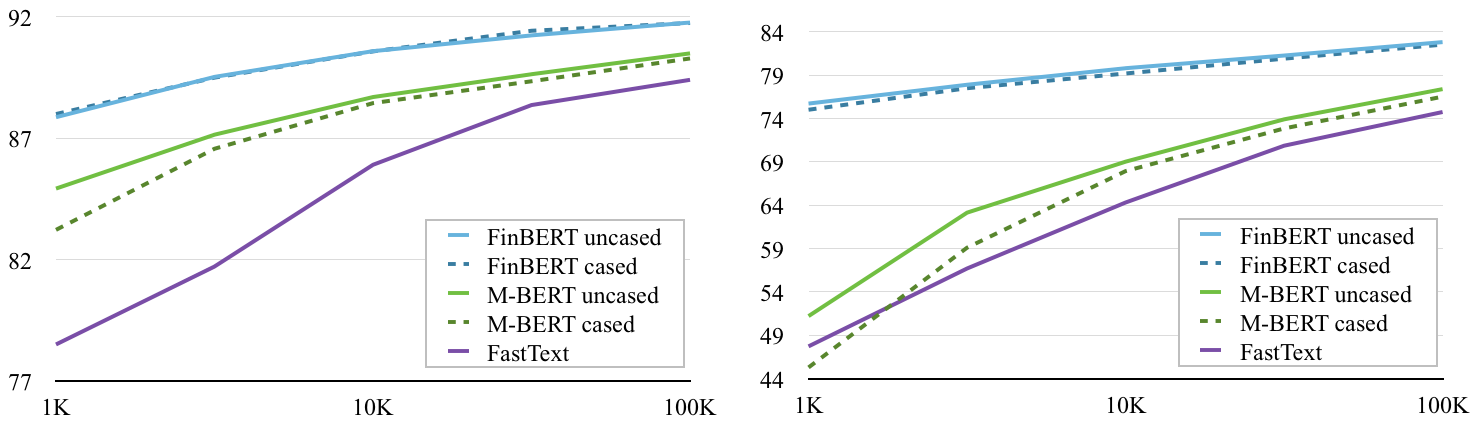
|
||||
|
||||
FinBERT outperforms multilingual BERT (M-BERT) on document classification over a range of training set sizes on the Yle news (left) and Ylilauta online discussion (right) corpora. (Baseline classification performance with [FastText](https://fasttext.cc/) included for reference.)
|
||||
|
||||
[[code](https://github.com/spyysalo/finbert-text-classification)][[Yle data](https://github.com/spyysalo/yle-corpus)] [[Ylilauta data](https://github.com/spyysalo/ylilauta-corpus)]
|
||||
|
||||
### Named Entity Recognition
|
||||
|
||||
Evaluation on FiNER corpus ([Ruokolainen et al 2019](https://arxiv.org/abs/1908.04212))
|
||||
|
||||
| Model | Accuracy |
|
||||
|--------------------|----------|
|
||||
| **FinBERT** | **92.40%** |
|
||||
| Multilingual BERT | 90.29% |
|
||||
| [FiNER-tagger](https://github.com/Traubert/FiNer-rules) (rule-based) | 86.82% |
|
||||
|
||||
(FiNER tagger results from [Ruokolainen et al. 2019](https://arxiv.org/pdf/1908.04212.pdf))
|
||||
|
||||
[[code](https://github.com/jouniluoma/keras-bert-ner)][[data](https://github.com/mpsilfve/finer-data)]
|
||||
|
||||
### Part of speech tagging
|
||||
|
||||
Evaluation on three Finnish corpora annotated with [Universal Dependencies](https://universaldependencies.org/) part-of-speech tags: the Turku Dependency Treebank (TDT), FinnTreeBank (FTB), and Parallel UD treebank (PUD)
|
||||
|
||||
| Model | TDT | FTB | PUD |
|
||||
|-------------------|-------------|-------------|-------------|
|
||||
| **FinBERT** | **98.23%** | **98.39%** | **98.08%** |
|
||||
| Multilingual BERT | 96.97% | 95.87% | 97.58% |
|
||||
|
||||
[[code](https://github.com/spyysalo/bert-pos)][[data](http://hdl.handle.net/11234/1-2837)]
|
||||
|
||||
## Use with PyTorch
|
||||
|
||||
If you want to use the model with the huggingface/transformers library, follow the steps in [huggingface_transformers.md](https://github.com/TurkuNLP/FinBERT/blob/master/huggingface_transformers.md)
|
||||
|
||||
## Previous releases
|
||||
|
||||
### Release 0.2
|
||||
|
||||
**October 24, 2019** Beta version of the BERT base uncased model trained from scratch on a corpus of Finnish news, online discussions, and crawled data.
|
||||
|
||||
Download the model here: [bert-base-finnish-uncased.zip](http://dl.turkunlp.org/finbert/bert-base-finnish-uncased.zip)
|
||||
|
||||
### Release 0.1
|
||||
|
||||
**September 30, 2019** We release a beta version of the BERT base cased model trained from scratch on a corpus of Finnish news, online discussions, and crawled data.
|
||||
|
||||
Download the model here: [bert-base-finnish-cased.zip](http://dl.turkunlp.org/finbert/bert-base-finnish-cased.zip)
|
||||
@@ -1,84 +0,0 @@
|
||||
---
|
||||
language: finnish
|
||||
---
|
||||
|
||||
## Quickstart
|
||||
|
||||
**Release 1.0** (November 25, 2019)
|
||||
|
||||
Download the models here:
|
||||
|
||||
* Cased Finnish BERT Base: [bert-base-finnish-cased-v1.zip](http://dl.turkunlp.org/finbert/bert-base-finnish-cased-v1.zip)
|
||||
* Uncased Finnish BERT Base: [bert-base-finnish-uncased-v1.zip](http://dl.turkunlp.org/finbert/bert-base-finnish-uncased-v1.zip)
|
||||
|
||||
We generally recommend the use of the cased model.
|
||||
|
||||
Paper presenting Finnish BERT: [arXiv:1912.07076](https://arxiv.org/abs/1912.07076)
|
||||
|
||||
## What's this?
|
||||
|
||||
A version of Google's [BERT](https://github.com/google-research/bert) deep transfer learning model for Finnish. The model can be fine-tuned to achieve state-of-the-art results for various Finnish natural language processing tasks.
|
||||
|
||||
FinBERT features a custom 50,000 wordpiece vocabulary that has much better coverage of Finnish words than e.g. the previously released [multilingual BERT](https://github.com/google-research/bert/blob/master/multilingual.md) models from Google:
|
||||
|
||||
| Vocabulary | Example |
|
||||
|------------|---------|
|
||||
| FinBERT | Suomessa vaihtuu kesän aikana sekä pääministeri että valtiovarain ##ministeri . |
|
||||
| Multilingual BERT | Suomessa vai ##htuu kes ##än aikana sekä p ##ää ##minister ##i että valt ##io ##vara ##in ##minister ##i . |
|
||||
|
||||
FinBERT has been pre-trained for 1 million steps on over 3 billion tokens (24B characters) of Finnish text drawn from news, online discussion, and internet crawls. By contrast, Multilingual BERT was trained on Wikipedia texts, where the Finnish Wikipedia text is approximately 3% of the amount used to train FinBERT.
|
||||
|
||||
These features allow FinBERT to outperform not only Multilingual BERT but also all previously proposed models when fine-tuned for Finnish natural language processing tasks.
|
||||
|
||||
## Results
|
||||
|
||||
### Document classification
|
||||
|
||||

|
||||
|
||||
FinBERT outperforms multilingual BERT (M-BERT) on document classification over a range of training set sizes on the Yle news (left) and Ylilauta online discussion (right) corpora. (Baseline classification performance with [FastText](https://fasttext.cc/) included for reference.)
|
||||
|
||||
[[code](https://github.com/spyysalo/finbert-text-classification)][[Yle data](https://github.com/spyysalo/yle-corpus)] [[Ylilauta data](https://github.com/spyysalo/ylilauta-corpus)]
|
||||
|
||||
### Named Entity Recognition
|
||||
|
||||
Evaluation on FiNER corpus ([Ruokolainen et al 2019](https://arxiv.org/abs/1908.04212))
|
||||
|
||||
| Model | Accuracy |
|
||||
|--------------------|----------|
|
||||
| **FinBERT** | **92.40%** |
|
||||
| Multilingual BERT | 90.29% |
|
||||
| [FiNER-tagger](https://github.com/Traubert/FiNer-rules) (rule-based) | 86.82% |
|
||||
|
||||
(FiNER tagger results from [Ruokolainen et al. 2019](https://arxiv.org/pdf/1908.04212.pdf))
|
||||
|
||||
[[code](https://github.com/jouniluoma/keras-bert-ner)][[data](https://github.com/mpsilfve/finer-data)]
|
||||
|
||||
### Part of speech tagging
|
||||
|
||||
Evaluation on three Finnish corpora annotated with [Universal Dependencies](https://universaldependencies.org/) part-of-speech tags: the Turku Dependency Treebank (TDT), FinnTreeBank (FTB), and Parallel UD treebank (PUD)
|
||||
|
||||
| Model | TDT | FTB | PUD |
|
||||
|-------------------|-------------|-------------|-------------|
|
||||
| **FinBERT** | **98.23%** | **98.39%** | **98.08%** |
|
||||
| Multilingual BERT | 96.97% | 95.87% | 97.58% |
|
||||
|
||||
[[code](https://github.com/spyysalo/bert-pos)][[data](http://hdl.handle.net/11234/1-2837)]
|
||||
|
||||
## Use with PyTorch
|
||||
|
||||
If you want to use the model with the huggingface/transformers library, follow the steps in [huggingface_transformers.md](https://github.com/TurkuNLP/FinBERT/blob/master/huggingface_transformers.md)
|
||||
|
||||
## Previous releases
|
||||
|
||||
### Release 0.2
|
||||
|
||||
**October 24, 2019** Beta version of the BERT base uncased model trained from scratch on a corpus of Finnish news, online discussions, and crawled data.
|
||||
|
||||
Download the model here: [bert-base-finnish-uncased.zip](http://dl.turkunlp.org/finbert/bert-base-finnish-uncased.zip)
|
||||
|
||||
### Release 0.1
|
||||
|
||||
**September 30, 2019** We release a beta version of the BERT base cased model trained from scratch on a corpus of Finnish news, online discussions, and crawled data.
|
||||
|
||||
Download the model here: [bert-base-finnish-cased.zip](http://dl.turkunlp.org/finbert/bert-base-finnish-cased.zip)
|
||||
@@ -1,26 +0,0 @@
|
||||
# SciBERT
|
||||
|
||||
This is the pretrained model presented in [SciBERT: A Pretrained Language Model for Scientific Text](https://www.aclweb.org/anthology/D19-1371/), which is a BERT model trained on scientific text.
|
||||
|
||||
The training corpus was papers taken from [Semantic Scholar](https://www.semanticscholar.org). Corpus size is 1.14M papers, 3.1B tokens. We use the full text of the papers in training, not just abstracts.
|
||||
|
||||
SciBERT has its own wordpiece vocabulary (scivocab) that's built to best match the training corpus. We trained cased and uncased versions.
|
||||
|
||||
Available models include:
|
||||
* `scibert_scivocab_cased`
|
||||
* `scibert_scivocab_uncased`
|
||||
|
||||
|
||||
The original repo can be found [here](https://github.com/allenai/scibert).
|
||||
|
||||
If using these models, please cite the following paper:
|
||||
```
|
||||
@inproceedings{beltagy-etal-2019-scibert,
|
||||
title = "SciBERT: A Pretrained Language Model for Scientific Text",
|
||||
author = "Beltagy, Iz and Lo, Kyle and Cohan, Arman",
|
||||
booktitle = "EMNLP",
|
||||
year = "2019",
|
||||
publisher = "Association for Computational Linguistics",
|
||||
url = "https://www.aclweb.org/anthology/D19-1371"
|
||||
}
|
||||
```
|
||||
@@ -1,26 +0,0 @@
|
||||
# SciBERT
|
||||
|
||||
This is the pretrained model presented in [SciBERT: A Pretrained Language Model for Scientific Text](https://www.aclweb.org/anthology/D19-1371/), which is a BERT model trained on scientific text.
|
||||
|
||||
The training corpus was papers taken from [Semantic Scholar](https://www.semanticscholar.org). Corpus size is 1.14M papers, 3.1B tokens. We use the full text of the papers in training, not just abstracts.
|
||||
|
||||
SciBERT has its own wordpiece vocabulary (scivocab) that's built to best match the training corpus. We trained cased and uncased versions.
|
||||
|
||||
Available models include:
|
||||
* `scibert_scivocab_cased`
|
||||
* `scibert_scivocab_uncased`
|
||||
|
||||
|
||||
The original repo can be found [here](https://github.com/allenai/scibert).
|
||||
|
||||
If using these models, please cite the following paper:
|
||||
```
|
||||
@inproceedings{beltagy-etal-2019-scibert,
|
||||
title = "SciBERT: A Pretrained Language Model for Scientific Text",
|
||||
author = "Beltagy, Iz and Lo, Kyle and Cohan, Arman",
|
||||
booktitle = "EMNLP",
|
||||
year = "2019",
|
||||
publisher = "Association for Computational Linguistics",
|
||||
url = "https://www.aclweb.org/anthology/D19-1371"
|
||||
}
|
||||
```
|
||||
@@ -1,48 +0,0 @@
|
||||
---
|
||||
language: arabic
|
||||
---
|
||||
|
||||
# Arabic BERT Model
|
||||
|
||||
Pretrained BERT base language model for Arabic
|
||||
|
||||
## Pretraining Corpus
|
||||
|
||||
`arabic-bert-base` model was pretrained on ~8.2 Billion words:
|
||||
|
||||
- Arabic version of [OSCAR](https://traces1.inria.fr/oscar/) - filtered from [Common Crawl](http://commoncrawl.org/)
|
||||
- Recent dump of Arabic [Wikipedia](https://dumps.wikimedia.org/backup-index.html)
|
||||
|
||||
and other Arabic resources which sum up to ~95GB of text.
|
||||
|
||||
__Notes on training data:__
|
||||
|
||||
- Our final version of corpus contains some non-Arabic words inlines, which we did not remove from sentences since that would affect some tasks like NER.
|
||||
- Although non-Arabic characters were lowered as a preprocessing step, since Arabic characters does not have upper or lower case, there is no cased and uncased version of the model.
|
||||
- The corpus and vocabulary set are not restricted to Modern Standard Arabic, they contain some dialectical Arabic too.
|
||||
|
||||
## Pretraining details
|
||||
|
||||
- This model was trained using Google BERT's github [repository](https://github.com/google-research/bert) on a single TPU v3-8 provided for free from [TFRC](https://www.tensorflow.org/tfrc).
|
||||
- Our pretraining procedure follows training settings of bert with some changes: trained for 3M training steps with batchsize of 128, instead of 1M with batchsize of 256.
|
||||
|
||||
## Load Pretrained Model
|
||||
|
||||
You can use this model by installing `torch` or `tensorflow` and Huggingface library `transformers`. And you can use it directly by initializing it like this:
|
||||
|
||||
```python
|
||||
from transformers import AutoTokenizer, AutoModel
|
||||
|
||||
tokenizer = AutoTokenizer.from_pretrained("asafaya/bert-base-arabic")
|
||||
model = AutoModel.from_pretrained("asafaya/bert-base-arabic")
|
||||
```
|
||||
|
||||
## Results
|
||||
|
||||
For further details on the models performance or any other queries, please refer to [Arabic-BERT](https://github.com/alisafaya/Arabic-BERT)
|
||||
|
||||
## Acknowledgement
|
||||
|
||||
Thanks to Google for providing free TPU for the training process and for Huggingface for hosting this model on their servers 😊
|
||||
|
||||
|
||||
@@ -1,93 +0,0 @@
|
||||
---
|
||||
language: arabic
|
||||
---
|
||||
|
||||
# AraBERT : Pre-training BERT for Arabic Language Understanding
|
||||
|
||||
**AraBERT** is an Arabic pretrained lanaguage model based on [Google's BERT architechture](https://github.com/google-research/bert). AraBERT uses the same BERT-Base config.
|
||||
|
||||
There are two version off the model AraBERTv0.1 and AraBERTv1, with the difference being that AraBERTv1 uses pre-segmented text where prefixes and suffixes were splitted using the [Farasa Segmenter](http://alt.qcri.org/farasa/segmenter.html).
|
||||
|
||||
The model was trained on ~70M sentences or ~23GB of Arabic text with ~3B words. The training corpora are a collection of publically available large scale raw arabic text ([Arabic Wikidumps](https://archive.org/details/arwiki-20190201), [The 1.5B words Arabic Corpus](https://www.semanticscholar.org/paper/1.5-billion-words-Arabic-Corpus-El-Khair/f3eeef4afb81223df96575adadf808fe7fe440b4), [The OSIAN Corpus](https://www.aclweb.org/anthology/W19-4619), Assafir news articles, and 4 other manually crawled news websites (Al-Akhbar, Annahar, AL-Ahram, AL-Wafd) from [the Wayback Machine](http://web.archive.org/))
|
||||
|
||||
We evalaute both AraBERT models on different downstream tasks and compare it to [mBERT]((https://github.com/google-research/bert/blob/master/multilingual.md)), and other state of the art models (*To the extent of our knowledge*). The Tasks were Sentiment Analysis on 6 different datasets ([HARD](https://github.com/elnagara/HARD-Arabic-Dataset), [ASTD-Balanced](https://www.aclweb.org/anthology/D15-1299), [ArsenTD-Lev](https://staff.aub.edu.lb/~we07/Publications/ArSentD-LEV_Sentiment_Corpus.pdf), [LABR](https://github.com/mohamedadaly/LABR), [ArSaS](http://lrec-conf.org/workshops/lrec2018/W30/pdf/22_W30.pdf)), Named Entity Recognition with the [ANERcorp](http://curtis.ml.cmu.edu/w/courses/index.php/ANERcorp), and Arabic Question Answering on [Arabic-SQuAD and ARCD](https://github.com/husseinmozannar/SOQAL)
|
||||
|
||||
## Results (Acc.)
|
||||
Task | prev. SOTA | mBERT | AraBERTv0.1 | AraBERTv1
|
||||
---|:---:|:---:|:---:|:---:
|
||||
HARD |95.7 [ElJundi et.al.](https://www.aclweb.org/anthology/W19-4608/)|95.7|96.2|96.1
|
||||
ASTD |86.5 [ElJundi et.al.](https://www.aclweb.org/anthology/W19-4608/)| 80.1|92.2|92.6
|
||||
ArsenTD-Lev|52.4 [ElJundi et.al.](https://www.aclweb.org/anthology/W19-4608/)|51|58.9|59.4
|
||||
AJGT|93 [Dahou et.al.](https://dl.acm.org/doi/fullHtml/10.1145/3314941)| 83.6|94.1|93.8
|
||||
LABR|87.5 [Dahou et.al.](https://dl.acm.org/doi/fullHtml/10.1145/3314941)|83|85.9|86.7
|
||||
ANERcorp|81.7 (BiLSTM-CRF)|78.4|84.2|81.9
|
||||
ARCD|mBERT|EM:34.2 F1: 61.3|EM:30.1 F1:61.2|EM:30.6 F1: 62.7
|
||||
|
||||
*We would be extremly thankful if everyone can contibute to the Results table by adding more scores on different datasets*
|
||||
|
||||
## How to use
|
||||
|
||||
You can easily use AraBERT since it is almost fully compatible with existing codebases (You can use this repo instead of the official BERT one, the only difference is in the ```tokenization.py``` file where we modify the _is_punctuation function to make it compatible with the "+" symbol and the "[" and "]" characters)
|
||||
|
||||
To use HuggingFace's Transformer repository you only need to provide a lost of token that forces the model to not split them, also make sure that the text is pre-segmented:
|
||||
|
||||
```python
|
||||
from transformers import AutoTokenizer
|
||||
from preprocess_arabert import never_split_tokens
|
||||
|
||||
arabert_tokenizer = AutoTokenizer.from_pretrained(
|
||||
"aubmindlab/bert-base-arabert",
|
||||
do_lower_case=False,
|
||||
do_basic_tokenize=True,
|
||||
never_split=never_split_tokens)
|
||||
arabert_model = AutoModel.from_pretrained("aubmindlab/bert-base-arabert")
|
||||
|
||||
arabert_tokenizer.tokenize("و+ لن نبالغ إذا قل +نا إن هاتف أو كمبيوتر ال+ مكتب في زمن +نا هذا ضروري")
|
||||
|
||||
>>> ['و+', 'لن', 'نبال', '##غ', 'إذا', 'قل', '+نا', 'إن', 'هاتف', 'أو', 'كمبيوتر', 'ال+', 'مكتب', 'في', 'زمن', '+نا', 'هذا', 'ضروري']
|
||||
```
|
||||
|
||||
**AraBERTv0.1 is compatible with all existing libraries, since it needs no pre-segmentation.**
|
||||
```python
|
||||
from transformers import AutoTokenizer
|
||||
from preprocess_arabert import never_split_tokens
|
||||
|
||||
arabert_tokenizer = AutoTokenizer.from_pretrained("aubmindlab/bert-base-arabertv01",do_lower_case=False)
|
||||
arabert_model = AutoModel.from_pretrained("aubmindlab/bert-base-arabertv01")
|
||||
|
||||
arabert_tokenizer.tokenize("ولن نبالغ إذا قلنا إن هاتف أو كمبيوتر المكتب في زمننا هذا ضروري")
|
||||
|
||||
>>> ['ولن', 'ن', '##بالغ', 'إذا', 'قلنا', 'إن', 'هاتف', 'أو', 'كمبيوتر', 'المكتب', 'في', 'زمن', '##ن', '##ا', 'هذا', 'ضروري']
|
||||
```
|
||||
|
||||
|
||||
The ```araBERT_(initial_Demo_TF)_.ipynb``` Notebook is a small demo using the AJGT dataset using TensorFlow (GPU and TPU compatible).
|
||||
|
||||
## Model Weights and Vocab Download
|
||||
Models | AraBERTv0.1 | AraBERTv1
|
||||
---|:---:|:---:
|
||||
TensorFlow|[Drive Link](https://drive.google.com/open?id=1-kVmTUZZ4DP2rzeHNjTPkY8OjnQCpomO) | [Drive Link](https://drive.google.com/open?id=1-d7-9ljKgDJP5mx73uBtio-TuUZCqZnt)
|
||||
PyTorch| [Drive_Link](https://drive.google.com/open?id=1-_3te42mQCPD8SxwZ3l-VBL7yaJH-IOv)| [Drive_Link](https://drive.google.com/open?id=1-69s6Pxqbi63HOQ1M9wTcr-Ovc6PWLLo)
|
||||
|
||||
**You can find the PyTorch models in HuggingFace's Transformer Library under the ```aubmindlab``` username**
|
||||
|
||||
## If you used this model please cite us as:
|
||||
```
|
||||
@misc{antoun2020arabert,
|
||||
title={AraBERT: Transformer-based Model for Arabic Language Understanding},
|
||||
author={Wissam Antoun and Fady Baly and Hazem Hajj},
|
||||
year={2020},
|
||||
eprint={2003.00104},
|
||||
archivePrefix={arXiv},
|
||||
primaryClass={cs.CL}
|
||||
}
|
||||
```
|
||||
## Acknowledgments
|
||||
Thanks to TensorFlow Research Cloud (TFRC) for the free access to Cloud TPUs, couldn't have done it without this program, and to the [AUB MIND Lab](https://sites.aub.edu.lb/mindlab/) Members for the continous support. Also thanks to [Yakshof](https://www.yakshof.com/#/) and Assafir for data and storage access.
|
||||
|
||||
## Contacts
|
||||
**Wissam Antoun**: [Linkedin](https://www.linkedin.com/in/giulio-ravasio-3a81a9110/) | [Twitter](https://twitter.com/wissam_antoun) | [Github](https://github.com/WissamAntoun) | <wfa07@mail.aub.edu> | <wissam.antoun@gmail.com>
|
||||
|
||||
**Fady Baly**: [Linkedin](https://www.linkedin.com/in/fadybaly/) | [Twitter](https://twitter.com/BalyFady) | [Github](https://github.com/fadybaly) | <fgb06@mail.aub.edu> | <baly.fady@gmail.com>
|
||||
|
||||
***We are looking for sponsors to train BERT-Large and other Transformer models, the sponsor only needs to cover to data storage and compute cost of the generating the pretraining data***
|
||||
@@ -1,93 +0,0 @@
|
||||
---
|
||||
language: arabic
|
||||
---
|
||||
|
||||
# AraBERT : Pre-training BERT for Arabic Language Understanding
|
||||
|
||||
**AraBERT** is an Arabic pretrained lanaguage model based on [Google's BERT architechture](https://github.com/google-research/bert). AraBERT uses the same BERT-Base config.
|
||||
|
||||
There are two version off the model AraBERTv0.1 and AraBERTv1, with the difference being that AraBERTv1 uses pre-segmented text where prefixes and suffixes were splitted using the [Farasa Segmenter](http://alt.qcri.org/farasa/segmenter.html).
|
||||
|
||||
The model was trained on ~70M sentences or ~23GB of Arabic text with ~3B words. The training corpora are a collection of publically available large scale raw arabic text ([Arabic Wikidumps](https://archive.org/details/arwiki-20190201), [The 1.5B words Arabic Corpus](https://www.semanticscholar.org/paper/1.5-billion-words-Arabic-Corpus-El-Khair/f3eeef4afb81223df96575adadf808fe7fe440b4), [The OSIAN Corpus](https://www.aclweb.org/anthology/W19-4619), Assafir news articles, and 4 other manually crawled news websites (Al-Akhbar, Annahar, AL-Ahram, AL-Wafd) from [the Wayback Machine](http://web.archive.org/))
|
||||
|
||||
We evalaute both AraBERT models on different downstream tasks and compare it to [mBERT]((https://github.com/google-research/bert/blob/master/multilingual.md)), and other state of the art models (*To the extent of our knowledge*). The Tasks were Sentiment Analysis on 6 different datasets ([HARD](https://github.com/elnagara/HARD-Arabic-Dataset), [ASTD-Balanced](https://www.aclweb.org/anthology/D15-1299), [ArsenTD-Lev](https://staff.aub.edu.lb/~we07/Publications/ArSentD-LEV_Sentiment_Corpus.pdf), [LABR](https://github.com/mohamedadaly/LABR), [ArSaS](http://lrec-conf.org/workshops/lrec2018/W30/pdf/22_W30.pdf)), Named Entity Recognition with the [ANERcorp](http://curtis.ml.cmu.edu/w/courses/index.php/ANERcorp), and Arabic Question Answering on [Arabic-SQuAD and ARCD](https://github.com/husseinmozannar/SOQAL)
|
||||
|
||||
## Results (Acc.)
|
||||
Task | prev. SOTA | mBERT | AraBERTv0.1 | AraBERTv1
|
||||
---|:---:|:---:|:---:|:---:
|
||||
HARD |95.7 [ElJundi et.al.](https://www.aclweb.org/anthology/W19-4608/)|95.7|96.2|96.1
|
||||
ASTD |86.5 [ElJundi et.al.](https://www.aclweb.org/anthology/W19-4608/)| 80.1|92.2|92.6
|
||||
ArsenTD-Lev|52.4 [ElJundi et.al.](https://www.aclweb.org/anthology/W19-4608/)|51|58.9|59.4
|
||||
AJGT|93 [Dahou et.al.](https://dl.acm.org/doi/fullHtml/10.1145/3314941)| 83.6|94.1|93.8
|
||||
LABR|87.5 [Dahou et.al.](https://dl.acm.org/doi/fullHtml/10.1145/3314941)|83|85.9|86.7
|
||||
ANERcorp|81.7 (BiLSTM-CRF)|78.4|84.2|81.9
|
||||
ARCD|mBERT|EM:34.2 F1: 61.3|EM:30.1 F1:61.2|EM:30.6 F1: 62.7
|
||||
|
||||
*We would be extremly thankful if everyone can contibute to the Results table by adding more scores on different datasets*
|
||||
|
||||
## How to use
|
||||
|
||||
You can easily use AraBERT since it is almost fully compatible with existing codebases (You can use this repo instead of the official BERT one, the only difference is in the ```tokenization.py``` file where we modify the _is_punctuation function to make it compatible with the "+" symbol and the "[" and "]" characters)
|
||||
|
||||
To use HuggingFace's Transformer repository you only need to provide a lost of token that forces the model to not split them, also make sure that the text is pre-segmented:
|
||||
|
||||
```python
|
||||
from transformers import AutoTokenizer
|
||||
from preprocess_arabert import never_split_tokens
|
||||
|
||||
arabert_tokenizer = AutoTokenizer.from_pretrained(
|
||||
"aubmindlab/bert-base-arabert",
|
||||
do_lower_case=False,
|
||||
do_basic_tokenize=True,
|
||||
never_split=never_split_tokens)
|
||||
arabert_model = AutoModel.from_pretrained("aubmindlab/bert-base-arabert")
|
||||
|
||||
arabert_tokenizer.tokenize("و+ لن نبالغ إذا قل +نا إن هاتف أو كمبيوتر ال+ مكتب في زمن +نا هذا ضروري")
|
||||
|
||||
>>> ['و+', 'لن', 'نبال', '##غ', 'إذا', 'قل', '+نا', 'إن', 'هاتف', 'أو', 'كمبيوتر', 'ال+', 'مكتب', 'في', 'زمن', '+نا', 'هذا', 'ضروري']
|
||||
```
|
||||
|
||||
**AraBERTv0.1 is compatible with all existing libraries, since it needs no pre-segmentation.**
|
||||
```python
|
||||
from transformers import AutoTokenizer
|
||||
from preprocess_arabert import never_split_tokens
|
||||
|
||||
arabert_tokenizer = AutoTokenizer.from_pretrained("aubmindlab/bert-base-arabertv01",do_lower_case=False)
|
||||
arabert_model = AutoModel.from_pretrained("aubmindlab/bert-base-arabertv01")
|
||||
|
||||
arabert_tokenizer.tokenize("ولن نبالغ إذا قلنا إن هاتف أو كمبيوتر المكتب في زمننا هذا ضروري")
|
||||
|
||||
>>> ['ولن', 'ن', '##بالغ', 'إذا', 'قلنا', 'إن', 'هاتف', 'أو', 'كمبيوتر', 'المكتب', 'في', 'زمن', '##ن', '##ا', 'هذا', 'ضروري']
|
||||
```
|
||||
|
||||
|
||||
The ```araBERT_(initial_Demo_TF)_.ipynb``` Notebook is a small demo using the AJGT dataset using TensorFlow (GPU and TPU compatible).
|
||||
|
||||
## Model Weights and Vocab Download
|
||||
Models | AraBERTv0.1 | AraBERTv1
|
||||
---|:---:|:---:
|
||||
TensorFlow|[Drive Link](https://drive.google.com/open?id=1-kVmTUZZ4DP2rzeHNjTPkY8OjnQCpomO) | [Drive Link](https://drive.google.com/open?id=1-d7-9ljKgDJP5mx73uBtio-TuUZCqZnt)
|
||||
PyTorch| [Drive_Link](https://drive.google.com/open?id=1-_3te42mQCPD8SxwZ3l-VBL7yaJH-IOv)| [Drive_Link](https://drive.google.com/open?id=1-69s6Pxqbi63HOQ1M9wTcr-Ovc6PWLLo)
|
||||
|
||||
**You can find the PyTorch models in HuggingFace's Transformer Library under the ```aubmindlab``` username**
|
||||
|
||||
## If you used this model please cite us as:
|
||||
```
|
||||
@misc{antoun2020arabert,
|
||||
title={AraBERT: Transformer-based Model for Arabic Language Understanding},
|
||||
author={Wissam Antoun and Fady Baly and Hazem Hajj},
|
||||
year={2020},
|
||||
eprint={2003.00104},
|
||||
archivePrefix={arXiv},
|
||||
primaryClass={cs.CL}
|
||||
}
|
||||
```
|
||||
## Acknowledgments
|
||||
Thanks to TensorFlow Research Cloud (TFRC) for the free access to Cloud TPUs, couldn't have done it without this program, and to the [AUB MIND Lab](https://sites.aub.edu.lb/mindlab/) Members for the continous support. Also thanks to [Yakshof](https://www.yakshof.com/#/) and Assafir for data and storage access.
|
||||
|
||||
## Contacts
|
||||
**Wissam Antoun**: [Linkedin](https://www.linkedin.com/in/giulio-ravasio-3a81a9110/) | [Twitter](https://twitter.com/wissam_antoun) | [Github](https://github.com/WissamAntoun) | <wfa07@mail.aub.edu> | <wissam.antoun@gmail.com>
|
||||
|
||||
**Fady Baly**: [Linkedin](https://www.linkedin.com/in/fadybaly/) | [Twitter](https://twitter.com/BalyFady) | [Github](https://github.com/fadybaly) | <fgb06@mail.aub.edu> | <baly.fady@gmail.com>
|
||||
|
||||
***We are looking for sponsors to train BERT-Large and other Transformer models, the sponsor only needs to cover to data storage and compute cost of the generating the pretraining data***
|
||||
@@ -1,9 +0,0 @@
|
||||
# CamemBERT
|
||||
|
||||
CamemBERT is a state-of-the-art language model for French based on the RoBERTa architecture pretrained on the French subcorpus of the newly available multilingual corpus OSCAR.
|
||||
|
||||
CamemBERT was originally evaluated on four different downstream tasks for French: part-of-speech (POS) tagging, dependency parsing, named entity recognition (NER) and natural language inference (NLI); improving the state of the art for most tasks over previous monolingual and multilingual approaches, which confirms the effectiveness of large pretrained language models for French.
|
||||
|
||||
CamemBERT was trained and evaluated by Louis Martin, Benjamin Muller, Pedro Javier Ortiz Suárez, Yoann Dupont, Laurent Romary, Éric Villemonte de la Clergerie, Djamé Seddah and Benoît Sagot.
|
||||
|
||||
Preprint can be found [CamemBERT: a Tasty French Language Model](https://arxiv.org/abs/1911.03894)
|
||||
@@ -1,31 +0,0 @@
|
||||
## albert_chinese_small
|
||||
|
||||
### Overview
|
||||
|
||||
**Language model:** albert-small
|
||||
**Model size:** 18.5M
|
||||
**Language:** Chinese
|
||||
**Training data:** [CLUECorpusSmall](https://github.com/CLUEbenchmark/CLUECorpus2020)
|
||||
**Eval data:** [CLUE dataset](https://github.com/CLUEbenchmark/CLUE)
|
||||
|
||||
### Results
|
||||
|
||||
For results on downstream tasks like text classification, please refer to [this repository](https://github.com/CLUEbenchmark/CLUE).
|
||||
|
||||
### Usage
|
||||
|
||||
**NOTE:**Since sentencepiece is not used in `albert_chinese_small` model, you have to call **BertTokenizer** instead of AlbertTokenizer !!!
|
||||
|
||||
```
|
||||
import torch
|
||||
from transformers import BertTokenizer, AlbertModel
|
||||
tokenizer = BertTokenizer.from_pretrained("clue/albert_chinese_small")
|
||||
albert = AlbertModel.from_pretrained("clue/albert_chinese_small")
|
||||
```
|
||||
|
||||
### About CLUE benchmark
|
||||
|
||||
Organization of Language Understanding Evaluation benchmark for Chinese: tasks & datasets, baselines, pre-trained Chinese models, corpus and leaderboard.
|
||||
|
||||
Github: https://github.com/CLUEbenchmark
|
||||
Website: https://www.cluebenchmarks.com/
|
||||
@@ -1,31 +0,0 @@
|
||||
## albert_chinese_tiny
|
||||
|
||||
### Overview
|
||||
|
||||
**Language model:** albert-tiny
|
||||
**Model size:** 16M
|
||||
**Language:** Chinese
|
||||
**Training data:** [CLUECorpusSmall](https://github.com/CLUEbenchmark/CLUECorpus2020)
|
||||
**Eval data:** [CLUE dataset](https://github.com/CLUEbenchmark/CLUE)
|
||||
|
||||
### Results
|
||||
|
||||
For results on downstream tasks like text classification, please refer to [this repository](https://github.com/CLUEbenchmark/CLUE).
|
||||
|
||||
### Usage
|
||||
|
||||
**NOTE:**Since sentencepiece is not used in `albert_chinese_tiny` model, you have to call **BertTokenizer** instead of AlbertTokenizer !!!
|
||||
|
||||
```
|
||||
import torch
|
||||
from transformers import BertTokenizer, AlbertModel
|
||||
tokenizer = BertTokenizer.from_pretrained("clue/albert_chinese_tiny")
|
||||
albert = AlbertModel.from_pretrained("clue/albert_chinese_tiny")
|
||||
```
|
||||
|
||||
### About CLUE benchmark
|
||||
|
||||
Organization of Language Understanding Evaluation benchmark for Chinese: tasks & datasets, baselines, pre-trained Chinese models, corpus and leaderboard.
|
||||
|
||||
Github: https://github.com/CLUEbenchmark
|
||||
Website: https://www.cluebenchmarks.com/
|
||||
@@ -1,39 +0,0 @@
|
||||
# Introduction
|
||||
This model was trained on TPU and the details are as follows:
|
||||
|
||||
## Model
|
||||
##
|
||||
|
||||
| Model_name | params | size | Training_corpus | Vocab |
|
||||
| :------------------------------------------ | :----- | :------- | :----------------- | :-----------: |
|
||||
| **`RoBERTa-tiny-clue`** <br/>Super_small_model | 7.5M | 28.3M | **CLUECorpus2020** | **CLUEVocab** |
|
||||
| **`RoBERTa-tiny-pair`** <br/>Super_small_sentence_pair_model | 7.5M | 28.3M | **CLUECorpus2020** | **CLUEVocab** |
|
||||
| **`RoBERTa-tiny3L768-clue`** <br/>small_model | 38M | 110M | **CLUECorpus2020** | **CLUEVocab** |
|
||||
| **`RoBERTa-tiny3L312-clue`** <br/>small_model | <7.5M | 24M | **CLUECorpus2020** | **CLUEVocab** |
|
||||
| **`RoBERTa-large-clue`** <br/> Large_model | 290M | 1.20G | **CLUECorpus2020** | **CLUEVocab** |
|
||||
| **`RoBERTa-large-pair`** <br/>Large_sentence_pair_model | 290M | 1.20G | **CLUECorpus2020** | **CLUEVocab** |
|
||||
|
||||
### Usage
|
||||
|
||||
With the help of[Huggingface-Transformers 2.5.1](https://github.com/huggingface/transformers), you could use these model as follows
|
||||
|
||||
```
|
||||
tokenizer = BertTokenizer.from_pretrained("MODEL_NAME")
|
||||
model = BertModel.from_pretrained("MODEL_NAME")
|
||||
```
|
||||
|
||||
`MODEL_NAME`:
|
||||
|
||||
| Model_NAME | MODEL_LINK |
|
||||
| -------------------------- | ------------------------------------------------------------ |
|
||||
| **RoBERTa-tiny-clue** | [`clue/roberta_chinese_clue_tiny`](https://huggingface.co/clue/roberta_chinese_clue_tiny) |
|
||||
| **RoBERTa-tiny-pair** | [`clue/roberta_chinese_pair_tiny`](https://huggingface.co/clue/roberta_chinese_pair_tiny) |
|
||||
| **RoBERTa-tiny3L768-clue** | [`clue/roberta_chinese_3L768_clue_tiny`](https://huggingface.co/clue/roberta_chinese_3L768_clue_tiny) |
|
||||
| **RoBERTa-tiny3L312-clue** | [`clue/roberta_chinese_3L312_clue_tiny`](https://huggingface.co/clue/roberta_chinese_3L312_clue_tiny) |
|
||||
| **RoBERTa-large-clue** | [`clue/roberta_chinese_clue_large`](https://huggingface.co/clue/roberta_chinese_clue_large) |
|
||||
| **RoBERTa-large-pair** | [`clue/roberta_chinese_pair_large`](https://huggingface.co/clue/roberta_chinese_pair_large) |
|
||||
|
||||
## Details
|
||||
Please read <a href='https://arxiv.org/pdf/2003.01355'>https://arxiv.org/pdf/2003.01355.
|
||||
|
||||
Please visit our repository: https://github.com/CLUEbenchmark/CLUEPretrainedModels.git
|
||||
@@ -1,31 +0,0 @@
|
||||
## roberta_chinese_base
|
||||
|
||||
### Overview
|
||||
|
||||
**Language model:** roberta-base
|
||||
**Model size:** 392M
|
||||
**Language:** Chinese
|
||||
**Training data:** [CLUECorpusSmall](https://github.com/CLUEbenchmark/CLUECorpus2020)
|
||||
**Eval data:** [CLUE dataset](https://github.com/CLUEbenchmark/CLUE)
|
||||
|
||||
### Results
|
||||
|
||||
For results on downstream tasks like text classification, please refer to [this repository](https://github.com/CLUEbenchmark/CLUE).
|
||||
|
||||
### Usage
|
||||
|
||||
**NOTE:** You have to call **BertTokenizer** instead of RobertaTokenizer !!!
|
||||
|
||||
```
|
||||
import torch
|
||||
from transformers import BertTokenizer, BertModel
|
||||
tokenizer = BertTokenizer.from_pretrained("clue/roberta_chinese_base")
|
||||
roberta = BertModel.from_pretrained("clue/roberta_chinese_base")
|
||||
```
|
||||
|
||||
### About CLUE benchmark
|
||||
|
||||
Organization of Language Understanding Evaluation benchmark for Chinese: tasks & datasets, baselines, pre-trained Chinese models, corpus and leaderboard.
|
||||
|
||||
Github: https://github.com/CLUEbenchmark
|
||||
Website: https://www.cluebenchmarks.com/
|
||||
@@ -1,6 +1,5 @@
|
||||
---
|
||||
language: german
|
||||
license: mit
|
||||
---
|
||||
|
||||
# 🤗 + 📚 dbmdz German BERT models
|
||||
|
||||
@@ -1,6 +1,5 @@
|
||||
---
|
||||
language: german
|
||||
license: mit
|
||||
tags:
|
||||
- "historic german"
|
||||
---
|
||||
|
||||
@@ -1,6 +1,5 @@
|
||||
---
|
||||
language: german
|
||||
license: mit
|
||||
tags:
|
||||
- "historic german"
|
||||
---
|
||||
|
||||
@@ -1,6 +1,5 @@
|
||||
---
|
||||
language: german
|
||||
license: mit
|
||||
---
|
||||
|
||||
# 🤗 + 📚 dbmdz German BERT models
|
||||
|
||||
@@ -1,6 +1,5 @@
|
||||
---
|
||||
language: italian
|
||||
license: mit
|
||||
---
|
||||
|
||||
# 🤗 + 📚 dbmdz BERT models
|
||||
|
||||
@@ -1,6 +1,5 @@
|
||||
---
|
||||
language: italian
|
||||
license: mit
|
||||
---
|
||||
|
||||
# 🤗 + 📚 dbmdz BERT models
|
||||
|
||||
Some files were not shown because too many files have changed in this diff Show More
Reference in New Issue
Block a user