Compare commits
132
Commits
| Author | SHA1 | Date | |
|---|---|---|---|
 Morgan Funtowicz Morgan Funtowicz
|
7cfdbb24b7 | ||
|
Morgan Funtowicz
|
a53e7b2e87 | ||
|
Morgan Funtowicz
|
d8043889c1 | ||
|
Sylvain Gugger
|
f5518e5631 | ||
|
Chady Kamar
|
17099ebd58 | ||
|
Sam Shleifer
|
25b0463d0b | ||
|
Pavel Soriano
|
d6bc72c469 | ||
|
Huang LianzheandSylvain Gugger
|
6303b5a718 | ||
|
|
c754c41c61 | ||
|
Sylvain Gugger
|
1ee2194fb6 | ||
|
Julien PluandLysandre Debut
|
585217c87f | ||
|
Lysandre
|
6e21f24220 | ||
|
Lysandre
|
3ebb1b3a2b | ||
|
Sylvain Gugger
|
01f0fd0bab | ||
|
Julien Plu
|
702a76ff92 | ||
|
Sylvain Gugger
|
596342c2b9 | ||
|
Sylvain GuggerandLysandre Debut
|
89edf504bf | ||
|
Sylvain Gugger
|
21ca148090 | ||
|
Julien Plu
|
324f361e91 | ||
|
|
cd9a0585ea | ||
|
Sylvain Gugger
|
244e1b5ba3 | ||
|
Lysandre Debut
|
e46108817e | ||
|
Stas Bekman
|
e2964b8a19 | ||
|
Sylvain GuggerandLysandre Debut
|
e4b94d8e58 | ||
|
Sam Shleifer
|
656c27c3a3 | ||
|
Thomas WintersandJulien Chaumond
|
34a1b75f01 | ||
|
jjacampos
|
6513d16a48 | ||
|
Stas Bekman
|
af4b98ed97 | ||
|
Stas Bekman
|
8d562a2d1a | ||
|
Stas Bekman
|
cbb2f75a16 | ||
|
Suraj Patil
|
7a88ed6c2a | ||
|
Sylvain Gugger
|
63276b76d4 | ||
|
Raphaël Bournhonesque
|
8d464374ba | ||
|
|
8ff88d25e9 | ||
|
Dat Quoc Nguyen
|
67c4b0c517 | ||
|
Patrick von Platen
|
0cbe1139b1 | ||
|
Lysandre
|
aae4edb5f0 | ||
|
Suraj Patil
|
43b9d93875 | ||
|
guillaume-be
|
39062d05f0 | ||
|
Nadir El Manouzi
|
4b3e55bdcc | ||
|
Stas Bekman
|
7cbf0f722d | ||
|
Manuel Romero
|
a4faeceaed | ||
|
Stas Bekman
|
47ab3e8262 | ||
|
Stas Bekman
|
4f6e525742 | ||
|
Stas Bekman
|
eb074af75e | ||
|
Manuel Romero
|
1d90d0f386 | ||
|
Manuel Romero
|
c9b7ef042f | ||
|
Sam Shleifer
|
83dba10b8f | ||
|
Dat Quoc Nguyen
|
af2322c7a0 | ||
|
Patrick von Platen
|
9397436ea5 | ||
|
Patrick von Platen
|
7eeca4d399 | ||
|
Patrick von Platen
|
31516c776a | ||
|
Patrick von Platen
|
4c14669a78 | ||
|
Yih-Dar
|
3a03bab9db | ||
|
Stefan Schweter
|
ee9eae4e06 | ||
|
Julien Chaumond
|
eef8d94d19 | ||
|
Patrick von Platen
|
afd6a9f827 | ||
|
Patrick von Platen
|
9f1544b9e0 | ||
|
Sameer Zahid
|
5c1d5ea667 | ||
|
Yuta Hayashibe
|
7719ecd19f | ||
|
Manuel Romero
|
4a26e8ac5f | ||
|
Manuel Romero
|
94320c5b81 | ||
|
Manuel Romero
|
3aefb24b20 | ||
|
Manuel Romero
|
a22e7a8dd4 | ||
|
Manuel Romero
|
c028b26481 | ||
|
Genta Indra Winata
|
c7cdd7b4fd | ||
|
Genta Indra Winata
|
bfb9150b8f | ||
|
Genta Indra Winata
|
d193593403 | ||
|
Genta Indra Winata
|
e65d846674 | ||
|
Genta Indra Winata
|
e27d86d48d | ||
|
Genta Indra Winata
|
881c0783e9 | ||
|
Genta Indra Winata
|
e0d58a5c87 | ||
|
Genta Indra Winata
|
1313a1d2a8 | ||
|
tuner007
|
cf24f43e76 | ||
|
Sam Shleifer
|
67d9fc50d9 | ||
|
Stas Bekman
|
edbaad2c5c | ||
|
Stas Bekman
|
999a1c957a | ||
|
Stas Bekman
|
51c4adf54c | ||
|
Sam Shleifer
|
a5638b2b3a | ||
|
Stas BekmanandSam Shleifer
|
efeab6a3f1 | ||
|
Stas Bekman
|
9c5bcab5b0 | ||
|
Sohee YangandSylvain Gugger
|
e643a29722 | ||
|
Stas Bekman
|
0fe6e435b6 | ||
|
|
1eeb206bef | ||
|
Sylvain Gugger
|
492bb6aa48 | ||
|
RafaelWO
|
709745927b | ||
|
Dhaval Taunk
|
c183d81e27 | ||
|
Stas Bekman
|
79111b77d2 | ||
|
Stas Bekman
|
0cdafbf7ec | ||
|
Sam Shleifer
|
45b0b1ff2f | ||
|
Sam Shleifer
|
0203ad43bc | ||
|
sgugger
|
3babef815c | ||
|
Stas Bekman
|
42049b8e12 | ||
|
Stas BekmanandSam Shleifer
|
fdaf8ab349 | ||
|
Antoine Louis
|
df165065c3 | ||
|
Sylvain GuggerandThomas Wolf
|
108c9aefcc | ||
|
Donna Choi
|
9e376e156a | ||
|
Stas Bekman
|
f8590c56e6 | ||
|
Stas Bekman
|
d3391c87fe | ||
|
Xi Ye
|
08bfc1718a | ||
|
Julien Plu
|
af8425b749 | ||
|
Stas BekmanandSylvain Gugger
|
b00cafbde5 | ||
|
Patrick von Platen
|
85ffda96fc | ||
|
Yih-Dar
|
4c62c6021a | ||
|
Patrick von Platen
|
7af2791d77 | ||
|
Sylvain Gugger
|
153ec2f154 | ||
|
Sylvain Gugger
|
7186ca6240 | ||
|
Pedro Lima
|
52d250f6aa | ||
|
tuner007
|
84d64805b0 | ||
|
Philip May
|
52bb7ccce5 | ||
|
Siddharth Jain
|
1a85299a5e | ||
|
Paul O'Leary McCann
|
e29c3f1b11 | ||
|
Yih-Dar
|
cb061e78e1 | ||
|
Stas Bekman
|
b0cbcdb05b | ||
|
Sylvain Gugger
|
2bf70e2150 | ||
|
Sam Shleifer
|
9e89390ce1 | ||
|
Sam Shleifer
|
33d479d2b2 | ||
|
sgugger
|
206b78d485 | ||
|
Kevin Canwen Xu
|
90cde2e938 | ||
|
|
e0e0675ac7 | ||
|
sgugger
|
5636cbb25d | ||
|
Sylvain Gugger
|
ccc8e30c8a | ||
|
Stas Bekman
|
3ca1874ca4 | ||
|
Stas Bekman
|
4d39148419 | ||
|
Stas Bekman
|
576eec98e0 | ||
|
Bartosz Telenczuk
|
15d18e0307 | ||
|
Lysandre Debut
|
bb3106f741 | ||
|
Sam Shleifer
|
0fab39695a | ||
|
Sam Shleifer
|
de9e297964 | ||
|
Sam Shleifer
|
54395d87a6 | ||
|
Sam Shleifer
|
e7f8d2ab64 | ||
|
Sam Shleifer
|
0ec63afec2 |
@@ -245,8 +245,9 @@ jobs:
|
||||
paths:
|
||||
- '~/.cache/pip'
|
||||
- run: black --check --line-length 119 --target-version py35 examples templates tests src utils
|
||||
- run: isort --check-only --recursive examples templates tests src utils
|
||||
- run: isort --check-only examples templates tests src utils
|
||||
- run: flake8 examples templates tests src utils
|
||||
- run: python utils/check_copies.py
|
||||
- run: python utils/check_repo.py
|
||||
check_repository_consistency:
|
||||
working_directory: ~/transformers
|
||||
|
||||
+2
-1
@@ -48,4 +48,5 @@ deploy_doc "7cb203f" v2.9.1
|
||||
deploy_doc "10d7239" v2.10.0
|
||||
deploy_doc "b42586e" v2.11.0
|
||||
deploy_doc "7fb8bdf" v3.0.2
|
||||
deploy_doc "4b3ee9c" # v3.1.0 Latest stable release
|
||||
deploy_doc "4b3ee9c" v3.1.0
|
||||
deploy_doc "3ebb1b3" # v3.2.0 Latest stable release
|
||||
|
||||
@@ -6,6 +6,7 @@ quality:
|
||||
black --check --line-length 119 --target-version py35 examples templates tests src utils
|
||||
isort --check-only examples templates tests src utils
|
||||
flake8 examples templates tests src utils
|
||||
python utils/check_copies.py
|
||||
python utils/check_repo.py
|
||||
|
||||
# Format source code automatically
|
||||
@@ -14,6 +15,11 @@ style:
|
||||
black --line-length 119 --target-version py35 examples templates tests src utils
|
||||
isort examples templates tests src utils
|
||||
|
||||
# Make marked copies of snippets of codes conform to the original
|
||||
|
||||
fix-copies:
|
||||
python utils/check_copies.py --fix_and_overwrite
|
||||
|
||||
# Run tests for the library
|
||||
|
||||
test:
|
||||
|
||||
@@ -22,59 +22,125 @@
|
||||
<p>State-of-the-art Natural Language Processing for PyTorch and TensorFlow 2.0
|
||||
</h3>
|
||||
|
||||
🤗 Transformers (formerly known as `pytorch-transformers` and `pytorch-pretrained-bert`) provides state-of-the-art general-purpose architectures (BERT, GPT-2, RoBERTa, XLM, DistilBert, XLNet, T5, CTRL...) for Natural Language Understanding (NLU) and Natural Language Generation (NLG) with over thousands of pretrained models in 100+ languages and deep interoperability between PyTorch & TensorFlow 2.0.
|
||||
🤗 Transformers provides thousands of pretrained models to perform tasks on texts such as classification, information extraction, question answering, summarization, translation, text generation, etc in 100+ languages. Its aim is to make cutting-edge NLP easier to use for everyone.
|
||||
|
||||
🤗 Transformers provides APIs to quickly download and use those pretrained models on a given text, fine-tune them on your own datasets then share them with the community on our [model hub](https://huggingface.co/models). At the same time, each python module defining an architecture can be used as a standalone and modified to enable quick research experiments.
|
||||
|
||||
🤗 Transformers is backed by the two most popular deep learning libraries, [PyTorch](https://pytorch.org/) and [TensorFlow](https://www.tensorflow.org/), with a seamless integration between them, allowing you to train your models with one then load it for inference with the other.
|
||||
|
||||
### Recent contributors
|
||||
[](https://sourcerer.io/fame/clmnt/huggingface/transformers/links/0)[](https://sourcerer.io/fame/clmnt/huggingface/transformers/links/1)[](https://sourcerer.io/fame/clmnt/huggingface/transformers/links/2)[](https://sourcerer.io/fame/clmnt/huggingface/transformers/links/3)[](https://sourcerer.io/fame/clmnt/huggingface/transformers/links/4)[](https://sourcerer.io/fame/clmnt/huggingface/transformers/links/5)[](https://sourcerer.io/fame/clmnt/huggingface/transformers/links/6)[](https://sourcerer.io/fame/clmnt/huggingface/transformers/links/7)
|
||||
|
||||
### Features
|
||||
- High performance on NLU and NLG tasks
|
||||
- Low barrier to entry for educators and practitioners
|
||||
## Online demos
|
||||
|
||||
State-of-the-art NLP for everyone
|
||||
- Deep learning researchers
|
||||
- Hands-on practitioners
|
||||
- AI/ML/NLP teachers and educators
|
||||
You can test most of our models directly on their pages from the [model hub](https://huggingface.co/models). We also offer an [inference API](https://huggingface.co/pricing) to use those models.
|
||||
|
||||
Lower compute costs, smaller carbon footprint
|
||||
- Researchers can share trained models instead of always retraining
|
||||
- Practitioners can reduce compute time and production costs
|
||||
- Dozens of architectures with over 1,000 pretrained models, some in more than 100 languages
|
||||
Here are a few examples:
|
||||
- [Masked word completion with BERT](https://huggingface.co/bert-base-uncased?text=Paris+is+the+%5BMASK%5D+of+France)
|
||||
- [Name Entity Recognition with Electra](https://huggingface.co/dbmdz/electra-large-discriminator-finetuned-conll03-english?text=My+name+is+Sarah+and+I+live+in+London+city)
|
||||
- [Text generation with GPT-2](https://huggingface.co/gpt2?text=A+long+time+ago%2C+)
|
||||
- [Natural Langugage Inference with RoBERTa](https://huggingface.co/roberta-large-mnli?text=The+dog+was+lost.+Nobody+lost+any+animal)
|
||||
- [Summarization with BART](https://huggingface.co/facebook/bart-large-cnn?text=The+tower+is+324+metres+%281%2C063+ft%29+tall%2C+about+the+same+height+as+an+81-storey+building%2C+and+the+tallest+structure+in+Paris.+Its+base+is+square%2C+measuring+125+metres+%28410+ft%29+on+each+side.+During+its+construction%2C+the+Eiffel+Tower+surpassed+the+Washington+Monument+to+become+the+tallest+man-made+structure+in+the+world%2C+a+title+it+held+for+41+years+until+the+Chrysler+Building+in+New+York+City+was+finished+in+1930.+It+was+the+first+structure+to+reach+a+height+of+300+metres.+Due+to+the+addition+of+a+broadcasting+aerial+at+the+top+of+the+tower+in+1957%2C+it+is+now+taller+than+the+Chrysler+Building+by+5.2+metres+%2817+ft%29.+Excluding+transmitters%2C+the+Eiffel+Tower+is+the+second+tallest+free-standing+structure+in+France+after+the+Millau+Viaduct)
|
||||
- [Question answering with DistilBERT](https://huggingface.co/distilbert-base-uncased-distilled-squad?text=Which+name+is+also+used+to+describe+the+Amazon+rainforest+in+English%3F&context=The+Amazon+rainforest+%28Portuguese%3A+Floresta+Amaz%C3%B4nica+or+Amaz%C3%B4nia%3B+Spanish%3A+Selva+Amaz%C3%B3nica%2C+Amazon%C3%ADa+or+usually+Amazonia%3B+French%3A+For%C3%AAt+amazonienne%3B+Dutch%3A+Amazoneregenwoud%29%2C+also+known+in+English+as+Amazonia+or+the+Amazon+Jungle%2C+is+a+moist+broadleaf+forest+that+covers+most+of+the+Amazon+basin+of+South+America.+This+basin+encompasses+7%2C000%2C000+square+kilometres+%282%2C700%2C000+sq+mi%29%2C+of+which+5%2C500%2C000+square+kilometres+%282%2C100%2C000+sq+mi%29+are+covered+by+the+rainforest.+This+region+includes+territory+belonging+to+nine+nations.+The+majority+of+the+forest+is+contained+within+Brazil%2C+with+60%25+of+the+rainforest%2C+followed+by+Peru+with+13%25%2C+Colombia+with+10%25%2C+and+with+minor+amounts+in+Venezuela%2C+Ecuador%2C+Bolivia%2C+Guyana%2C+Suriname+and+French+Guiana.+States+or+departments+in+four+nations+contain+%22Amazonas%22+in+their+names.+The+Amazon+represents+over+half+of+the+planet%27s+remaining+rainforests%2C+and+comprises+the+largest+and+most+biodiverse+tract+of+tropical+rainforest+in+the+world%2C+with+an+estimated+390+billion+individual+trees+divided+into+16%2C000+species)
|
||||
- [Translation with T5](https://huggingface.co/t5-base?text=My+name+is+Wolfgang+and+I+live+in+Berlin)
|
||||
|
||||
Choose the right framework for every part of a model's lifetime
|
||||
- Train state-of-the-art models in 3 lines of code
|
||||
- Deep interoperability between TensorFlow 2.0 and PyTorch models
|
||||
- Move a single model between TF2.0/PyTorch frameworks at will
|
||||
- Seamlessly pick the right framework for training, evaluation, production
|
||||
**[Write With Transformer](https://transformer.huggingface.co)**, built by the Hugging Face team, is the official demo of this repo’s text generation capabilities.
|
||||
|
||||
## Quick tour
|
||||
|
||||
| Section | Description |
|
||||
|-|-|
|
||||
| [Installation](#installation) | How to install the package |
|
||||
| [Model architectures](#model-architectures) | Architectures (with pretrained weights) |
|
||||
| [Online demo](#online-demo) | Experimenting with this repo’s text generation capabilities |
|
||||
| [Quick tour: Usage](#quick-tour) | Tokenizers & models usage: Bert and GPT-2 |
|
||||
| [Quick tour: TF 2.0 and PyTorch ](#Quick-tour-TF-20-training-and-PyTorch-interoperability) | Train a TF 2.0 model in 10 lines of code, load it in PyTorch |
|
||||
| [Quick tour: pipelines](#quick-tour-of-pipelines) | Using Pipelines: Wrapper around tokenizer and models to use finetuned models |
|
||||
| [Quick tour: Fine-tuning/usage scripts](#quick-tour-of-the-fine-tuningusage-scripts) | Using provided scripts: GLUE, SQuAD and Text generation |
|
||||
| [Quick tour: Share your models ](#Quick-tour-of-model-sharing) | Upload and share your fine-tuned models with the community |
|
||||
| [Migrating from pytorch-transformers to transformers](#Migrating-from-pytorch-transformers-to-transformers) | Migrating your code from pytorch-transformers to transformers |
|
||||
| [Migrating from pytorch-pretrained-bert to pytorch-transformers](#Migrating-from-pytorch-pretrained-bert-to-transformers) | Migrating your code from pytorch-pretrained-bert to transformers |
|
||||
| [Documentation](https://huggingface.co/transformers/) | Full API documentation and more |
|
||||
To immediately use a model on a given text, we provide the `pipeline` API. Pipelines group together a pretrained model with the preprocessing that was used during that model training. Here is how to quickly use a pipeline to classify positive versus negative texts
|
||||
|
||||
```python
|
||||
>>> from transformers import pipeline
|
||||
|
||||
# Allocate a pipeline for sentiment-analysis
|
||||
>>> classifier = pipeline('sentiment-analysis')
|
||||
>>> classifier('We are very happy to include pipeline into the transformers repository.')
|
||||
[{'label': 'POSITIVE', 'score': 0.9978193640708923}]
|
||||
```
|
||||
|
||||
The second line of code downloads and caches the pretrained model used by the pipeline, the third line evaluates it on the given text. Here the answer is "positive" with a confidence of 99.8%.
|
||||
|
||||
This is another example of pipeline used for that can extract question answers from some context:
|
||||
|
||||
``` python
|
||||
>>> from transformers import pipeline
|
||||
|
||||
# Allocate a pipeline for question-answering
|
||||
>>> question_answerer = pipeline('question-answering')
|
||||
>>> question_answerer({
|
||||
... 'question': 'What is the name of the repository ?',
|
||||
... 'context': 'Pipeline have been included in the huggingface/transformers repository'
|
||||
... })
|
||||
{'score': 0.5135612454720828, 'start': 35, 'end': 59, 'answer': 'huggingface/transformers'}
|
||||
|
||||
```
|
||||
|
||||
On top of the answer, the pretrained model used here returned its confidence score, along with the start position and its end position in the tokenized sentence. You can learn more about the tasks supported by the `pipeline` API in [this tutorial](https://huggingface.co/transformers/task_summary.html).
|
||||
|
||||
To download and use any of the pretrained models on your given task, you just need to use those three lines of codes (PyTorch verison):
|
||||
```python
|
||||
>>> from transformers import AutoTokenizer, AutoModel
|
||||
|
||||
>>> tokenizer = AutoTokenizer.from_pretrained("bert-base-uncased")
|
||||
>>> model = AutoModel.from_pretrained("bert-base-uncased")
|
||||
|
||||
>>> inputs = tokenizer("Hello world!", return_tensors="pt")
|
||||
>>> outputs = model(**inputs)
|
||||
```
|
||||
or for TensorFlow:
|
||||
```python
|
||||
>>> from transformers import AutoTokenizer, TFAutoModel
|
||||
|
||||
>>> tokenizer = AutoTokenizer.from_pretrained("bert-base-uncased")
|
||||
>>> model = TFAutoModel.from_pretrained("bert-base-uncased")
|
||||
|
||||
>>> inputs = tokenizer("Hello world!", return_tensors="tf")
|
||||
>>> outputs = model(**inputs)
|
||||
```
|
||||
|
||||
The tokenizer is responsible for all the preprocessing the pretrained model expects, and can be called directly on one (or list) of texts (as we can see on the fourth line of both code examples). It will output a dictionary you can directly pass to your model (which is done on the fifth line).
|
||||
|
||||
The model itself is a regular [Pytorch `nn.Module`](https://pytorch.org/docs/stable/nn.html#torch.nn.Module) or a [TensorFlow `tf.keras.Model`](https://www.tensorflow.org/api_docs/python/tf/keras/Model) (depending on your backend) which you can use normally. For instance, [this tutorial](https://huggingface.co/transformers/training.html) explains how to integrate such a model in classic PyTorch or TensorFlow training loop, or how to use our `Trainer` API to quickly fine-tune the on a new dataset.
|
||||
|
||||
## Why should I use transformers?
|
||||
|
||||
1. Easy-to-use state-of-the-art models:
|
||||
- High performance on NLU and NLG tasks.
|
||||
- Low barrier to entry for educators and practitioners.
|
||||
- Few user-facing abastractions with just three classes to learn.
|
||||
- A unified API for using all our pretrained models.
|
||||
|
||||
1. Lower compute costs, smaller carbon footprint:
|
||||
- Researchers can share trained models instead of always retraining.
|
||||
- Practitioners can reduce compute time and production costs.
|
||||
- Dozens of architectures with over 2,000 pretrained models, some in more than 100 languages.
|
||||
|
||||
1. Choose the right framework for every part of a model's lifetime:
|
||||
- Train state-of-the-art models in 3 lines of code.
|
||||
- Move a single model between TF2.0/PyTorch frameworks at will.
|
||||
- Seamlessly pick the right framework for training, evaluation, production.
|
||||
|
||||
1. Easily customize a model or an example to your needs:
|
||||
- Examples for each architecture to reproduce the results by the official authors of said architecture.
|
||||
- Expose the models internal as consistently as possible.
|
||||
- Model files can be used independently of the library for quick experiments.
|
||||
|
||||
## Why shouldn't I use transformers?
|
||||
|
||||
- This library is not a modular toolbox of building blocks for neural nets. The code in the model files is not refactored with additional abstractions on purpose, so that researchers can quickly iterate on each of the models without diving in additional abstractions/files.
|
||||
- The training API is not intended to work on any model but is optimized to work with the models provided by the library. For generic machine learning loops, you should use another library.
|
||||
- While we strive to present as many use cases as possible, the scripts in our [examples folder](https://github.com/huggingface/transformers/tree/master/examples) are just that: examples. It is expected that they won't work out-of-the box on your specific problem and that you will be required to change a few lines of code to adapt them to your needs.
|
||||
|
||||
## Installation
|
||||
|
||||
This repo is tested on Python 3.6+, PyTorch 1.0.0+ (PyTorch 1.3.1+ for examples) and TensorFlow 2.0.
|
||||
This repository is tested on Python 3.6+, PyTorch 1.0.0+ (PyTorch 1.3.1+ for [examples](https://github.com/huggingface/transformers/tree/master/examples)) and TensorFlow 2.0.
|
||||
|
||||
You should install 🤗 Transformers in a [virtual environment](https://docs.python.org/3/library/venv.html). If you're unfamiliar with Python virtual environments, check out the [user guide](https://packaging.python.org/guides/installing-using-pip-and-virtual-environments/).
|
||||
|
||||
Create a virtual environment with the version of Python you're going to use and activate it.
|
||||
First, create a virtual environment with the version of Python you're going to use and activate it.
|
||||
|
||||
Now, if you want to use 🤗 Transformers, you can install it with pip. If you'd like to play with the examples, you must install it from source.
|
||||
|
||||
### With pip
|
||||
|
||||
First you need to install one of, or both, TensorFlow 2.0 and PyTorch.
|
||||
Then, you will need to install one of, or both, TensorFlow 2.0 and PyTorch.
|
||||
Please refer to [TensorFlow installation page](https://www.tensorflow.org/install/pip#tensorflow-2.0-rc-is-available) and/or [PyTorch installation page](https://pytorch.org/get-started/locally/#start-locally) regarding the specific install command for your platform.
|
||||
|
||||
When TensorFlow 2.0 and/or PyTorch has been installed, 🤗 Transformers can be installed using pip as follows:
|
||||
@@ -83,68 +149,11 @@ When TensorFlow 2.0 and/or PyTorch has been installed, 🤗 Transformers can be
|
||||
pip install transformers
|
||||
```
|
||||
|
||||
### From source
|
||||
If you'd like to play with the examples, you must [install the library from source](https://huggingface.co/transformers/installation.html#installing-from-source).
|
||||
|
||||
Here also, you first need to install one of, or both, TensorFlow 2.0 and PyTorch.
|
||||
Please refer to [TensorFlow installation page](https://www.tensorflow.org/install/pip#tensorflow-2.0-rc-is-available) and/or [PyTorch installation page](https://pytorch.org/get-started/locally/#start-locally) regarding the specific install command for your platform.
|
||||
## Models architectures
|
||||
|
||||
When TensorFlow 2.0 and/or PyTorch has been installed, you can install from source by cloning the repository and running:
|
||||
|
||||
```bash
|
||||
git clone https://github.com/huggingface/transformers
|
||||
cd transformers
|
||||
pip install .
|
||||
```
|
||||
|
||||
When you update the repository, you should upgrade the transformers installation and its dependencies as follows:
|
||||
|
||||
```bash
|
||||
git pull
|
||||
pip install --upgrade .
|
||||
```
|
||||
|
||||
### Run the examples
|
||||
|
||||
Examples are included in the repository but are not shipped with the library.
|
||||
|
||||
Therefore, in order to run the latest versions of the examples, you need to install from source, as described above.
|
||||
|
||||
Look at the [README](https://github.com/huggingface/transformers/blob/master/examples/README.md) for how to run examples.
|
||||
|
||||
### Tests
|
||||
|
||||
A series of tests are included for the library and for some example scripts. Library tests can be found in the [tests folder](https://github.com/huggingface/transformers/tree/master/tests) and examples tests in the [examples folder](https://github.com/huggingface/transformers/tree/master/examples).
|
||||
|
||||
Depending on which framework is installed (TensorFlow 2.0 and/or PyTorch), the irrelevant tests will be skipped. Ensure that both frameworks are installed if you want to execute all tests.
|
||||
|
||||
Here's the easiest way to run tests for the library:
|
||||
|
||||
```bash
|
||||
pip install -e ".[testing]"
|
||||
make test
|
||||
```
|
||||
|
||||
and for the examples:
|
||||
|
||||
```bash
|
||||
pip install -e ".[testing]"
|
||||
pip install -r examples/requirements.txt
|
||||
make test-examples
|
||||
```
|
||||
|
||||
For details, refer to the [contributing guide](https://github.com/huggingface/transformers/blob/master/CONTRIBUTING.md#tests).
|
||||
|
||||
### Do you want to run a Transformer model on a mobile device?
|
||||
|
||||
You should check out our [`swift-coreml-transformers`](https://github.com/huggingface/swift-coreml-transformers) repo.
|
||||
|
||||
It contains a set of tools to convert PyTorch or TensorFlow 2.0 trained Transformer models (currently contains `GPT-2`, `DistilGPT-2`, `BERT`, and `DistilBERT`) to CoreML models that run on iOS devices.
|
||||
|
||||
At some point in the future, you'll be able to seamlessly move from pre-training or fine-tuning models to productizing them in CoreML, or prototype a model or an app in CoreML then research its hyperparameters or architecture from TensorFlow 2.0 and/or PyTorch. Super exciting!
|
||||
|
||||
## Model architectures
|
||||
|
||||
🤗 Transformers currently provides the following NLU/NLG architectures:
|
||||
🤗 Transformers currently provides the following architectures (see [here](https://huggingface.co/transformers/model_summary.html) for a high-level summary of each them):
|
||||
|
||||
1. **[BERT](https://huggingface.co/transformers/model_doc/bert.html)** (from Google) released with the paper [BERT: Pre-training of Deep Bidirectional Transformers for Language Understanding](https://arxiv.org/abs/1810.04805) by Jacob Devlin, Ming-Wei Chang, Kenton Lee and Kristina Toutanova.
|
||||
2. **[GPT](https://huggingface.co/transformers/model_doc/gpt.html)** (from OpenAI) released with the paper [Improving Language Understanding by Generative Pre-Training](https://blog.openai.com/language-unsupervised/) by Alec Radford, Karthik Narasimhan, Tim Salimans and Ilya Sutskever.
|
||||
@@ -174,529 +183,24 @@ Min, Patrick Lewis, Ledell Wu, Sergey Edunov, Danqi Chen, and Wen-tau Yih.
|
||||
24. **[MBart](https://github.com/pytorch/fairseq/tree/master/examples/mbart)** (from Facebook) released with the paper [Multilingual Denoising Pre-training for Neural Machine Translation](https://arxiv.org/abs/2001.08210) by Yinhan Liu, Jiatao Gu, Naman Goyal, Xian Li, Sergey Edunov, Marjan Ghazvininejad, Mike Lewis, Luke Zettlemoyer.
|
||||
25. **[LXMERT](https://github.com/airsplay/lxmert)** (from UNC Chapel Hill) released with the paper [LXMERT: Learning Cross-Modality Encoder Representations from Transformers for Open-Domain Question Answering](https://arxiv.org/abs/1908.07490) by Hao Tan and Mohit Bansal.
|
||||
26. **[Funnel Transformer](https://github.com/laiguokun/Funnel-Transformer)** (from CMU/Google Brain) released with the paper [Funnel-Transformer: Filtering out Sequential Redundancy for Efficient Language Processing](https://arxiv.org/abs/2006.03236) by Zihang Dai, Guokun Lai, Yiming Yang, Quoc V. Le.
|
||||
27. **[Other community models](https://huggingface.co/models)**, contributed by the [community](https://huggingface.co/users).
|
||||
28. Want to contribute a new model? We have added a **detailed guide and templates** to guide you in the process of adding a new model. You can find them in the [`templates`](./templates) folder of the repository. Be sure to check the [contributing guidelines](./CONTRIBUTING.md) and contact the maintainers or open an issue to collect feedbacks before starting your PR.
|
||||
27. **[LayoutLM](https://github.com/microsoft/unilm/tree/master/layoutlm)** (from Microsoft Research Asia) released with the paper [LayoutLM: Pre-training of Text and Layout for Document Image Understanding](https://arxiv.org/abs/1912.13318) by Yiheng Xu, Minghao Li, Lei Cui, Shaohan Huang, Furu Wei, Ming Zhou.
|
||||
28. **[Other community models](https://huggingface.co/models)**, contributed by the [community](https://huggingface.co/users).
|
||||
29. Want to contribute a new model? We have added a **detailed guide and templates** to guide you in the process of adding a new model. You can find them in the [`templates`](./templates) folder of the repository. Be sure to check the [contributing guidelines](./CONTRIBUTING.md) and contact the maintainers or open an issue to collect feedbacks before starting your PR.
|
||||
|
||||
These implementations have been tested on several datasets (see the example scripts) and should match the performances of the original implementations (e.g. ~93 F1 on SQuAD for BERT Whole-Word-Masking, ~88 F1 on RocStories for OpenAI GPT, ~18.3 perplexity on WikiText 103 for Transformer-XL, ~0.916 Pearson R coefficient on STS-B for XLNet). You can find more details on the performances in the Examples section of the [documentation](https://huggingface.co/transformers/examples.html).
|
||||
These implementations have been tested on several datasets (see the example scripts) and should match the performances of the original implementations. You can find more details on the performances in the Examples section of the [documentation](https://huggingface.co/transformers/examples.html).
|
||||
|
||||
## Online demo
|
||||
|
||||
You can test our inference API on most model pages from the model hub: https://huggingface.co/models
|
||||
## Learn more
|
||||
|
||||
For example:
|
||||
- [Masked word completion with BERT](https://huggingface.co/bert-base-uncased?text=Paris+is+the+%5BMASK%5D+of+France)
|
||||
- [NER with Electra](https://huggingface.co/dbmdz/electra-large-discriminator-finetuned-conll03-english?text=My+name+is+Sarah+and+I+live+in+London+city)
|
||||
- [Text generation with GPT-2](https://huggingface.co/gpt2?text=A+long+time+ago%2C+)
|
||||
- [NLI with RoBERTa](https://huggingface.co/roberta-large-mnli?text=The+dog+was+lost.+Nobody+lost+any+animal)
|
||||
- [Summarization with BART](https://huggingface.co/facebook/bart-large-cnn?text=The+tower+is+324+metres+%281%2C063+ft%29+tall%2C+about+the+same+height+as+an+81-storey+building%2C+and+the+tallest+structure+in+Paris.+Its+base+is+square%2C+measuring+125+metres+%28410+ft%29+on+each+side.+During+its+construction%2C+the+Eiffel+Tower+surpassed+the+Washington+Monument+to+become+the+tallest+man-made+structure+in+the+world%2C+a+title+it+held+for+41+years+until+the+Chrysler+Building+in+New+York+City+was+finished+in+1930.+It+was+the+first+structure+to+reach+a+height+of+300+metres.+Due+to+the+addition+of+a+broadcasting+aerial+at+the+top+of+the+tower+in+1957%2C+it+is+now+taller+than+the+Chrysler+Building+by+5.2+metres+%2817+ft%29.+Excluding+transmitters%2C+the+Eiffel+Tower+is+the+second+tallest+free-standing+structure+in+France+after+the+Millau+Viaduct)
|
||||
- [Question answering with DistilBERT](https://huggingface.co/distilbert-base-uncased-distilled-squad?text=Which+name+is+also+used+to+describe+the+Amazon+rainforest+in+English%3F&context=The+Amazon+rainforest+%28Portuguese%3A+Floresta+Amaz%C3%B4nica+or+Amaz%C3%B4nia%3B+Spanish%3A+Selva+Amaz%C3%B3nica%2C+Amazon%C3%ADa+or+usually+Amazonia%3B+French%3A+For%C3%AAt+amazonienne%3B+Dutch%3A+Amazoneregenwoud%29%2C+also+known+in+English+as+Amazonia+or+the+Amazon+Jungle%2C+is+a+moist+broadleaf+forest+that+covers+most+of+the+Amazon+basin+of+South+America.+This+basin+encompasses+7%2C000%2C000+square+kilometres+%282%2C700%2C000+sq+mi%29%2C+of+which+5%2C500%2C000+square+kilometres+%282%2C100%2C000+sq+mi%29+are+covered+by+the+rainforest.+This+region+includes+territory+belonging+to+nine+nations.+The+majority+of+the+forest+is+contained+within+Brazil%2C+with+60%25+of+the+rainforest%2C+followed+by+Peru+with+13%25%2C+Colombia+with+10%25%2C+and+with+minor+amounts+in+Venezuela%2C+Ecuador%2C+Bolivia%2C+Guyana%2C+Suriname+and+French+Guiana.+States+or+departments+in+four+nations+contain+%22Amazonas%22+in+their+names.+The+Amazon+represents+over+half+of+the+planet%27s+remaining+rainforests%2C+and+comprises+the+largest+and+most+biodiverse+tract+of+tropical+rainforest+in+the+world%2C+with+an+estimated+390+billion+individual+trees+divided+into+16%2C000+species)
|
||||
- [Translation with T5](https://huggingface.co/t5-base?text=My+name+is+Wolfgang+and+I+live+in+Berlin)
|
||||
|
||||
|
||||
**[Write With Transformer](https://transformer.huggingface.co)**, built by the Hugging Face team at transformer.huggingface.co, is the official demo of this repo’s text generation capabilities.
|
||||
|
||||
## Quick tour
|
||||
|
||||
Let's do a very quick overview of the model architectures in 🤗 Transformers. Detailed examples for each model architecture (Bert, GPT, GPT-2, Transformer-XL, XLNet and XLM) can be found in the [full documentation](https://huggingface.co/transformers/).
|
||||
|
||||
```python
|
||||
import torch
|
||||
from transformers import *
|
||||
|
||||
# Transformers has a unified API
|
||||
# for 10 transformer architectures and 30 pretrained weights.
|
||||
# Model | Tokenizer | Pretrained weights shortcut
|
||||
MODELS = [(BertModel, BertTokenizer, 'bert-base-uncased'),
|
||||
(OpenAIGPTModel, OpenAIGPTTokenizer, 'openai-gpt'),
|
||||
(GPT2Model, GPT2Tokenizer, 'gpt2'),
|
||||
(CTRLModel, CTRLTokenizer, 'ctrl'),
|
||||
(TransfoXLModel, TransfoXLTokenizer, 'transfo-xl-wt103'),
|
||||
(XLNetModel, XLNetTokenizer, 'xlnet-base-cased'),
|
||||
(XLMModel, XLMTokenizer, 'xlm-mlm-enfr-1024'),
|
||||
(DistilBertModel, DistilBertTokenizer, 'distilbert-base-cased'),
|
||||
(RobertaModel, RobertaTokenizer, 'roberta-base'),
|
||||
(XLMRobertaModel, XLMRobertaTokenizer, 'xlm-roberta-base'),
|
||||
]
|
||||
|
||||
# To use TensorFlow 2.0 versions of the models, simply prefix the class names with 'TF', e.g. `TFRobertaModel` is the TF 2.0 counterpart of the PyTorch model `RobertaModel`
|
||||
|
||||
# Let's encode some text in a sequence of hidden-states using each model:
|
||||
for model_class, tokenizer_class, pretrained_weights in MODELS:
|
||||
# Load pretrained model/tokenizer
|
||||
tokenizer = tokenizer_class.from_pretrained(pretrained_weights)
|
||||
model = model_class.from_pretrained(pretrained_weights)
|
||||
|
||||
# Encode text
|
||||
input_ids = torch.tensor([tokenizer.encode("Here is some text to encode", add_special_tokens=True)]) # Add special tokens takes care of adding [CLS], [SEP], <s>... tokens in the right way for each model.
|
||||
with torch.no_grad():
|
||||
last_hidden_states = model(input_ids)[0] # Models outputs are now tuples
|
||||
|
||||
# Each architecture is provided with several class for fine-tuning on down-stream tasks, e.g.
|
||||
BERT_MODEL_CLASSES = [BertModel, BertForPreTraining, BertForMaskedLM, BertForNextSentencePrediction,
|
||||
BertForSequenceClassification, BertForTokenClassification, BertForQuestionAnswering]
|
||||
|
||||
# All the classes for an architecture can be initiated from pretrained weights for this architecture
|
||||
# Note that additional weights added for fine-tuning are only initialized
|
||||
# and need to be trained on the down-stream task
|
||||
pretrained_weights = 'bert-base-uncased'
|
||||
tokenizer = BertTokenizer.from_pretrained(pretrained_weights)
|
||||
for model_class in BERT_MODEL_CLASSES:
|
||||
# Load pretrained model/tokenizer
|
||||
model = model_class.from_pretrained(pretrained_weights)
|
||||
|
||||
# Models can return full list of hidden-states & attentions weights at each layer
|
||||
model = model_class.from_pretrained(pretrained_weights,
|
||||
output_hidden_states=True,
|
||||
output_attentions=True)
|
||||
input_ids = torch.tensor([tokenizer.encode("Let's see all hidden-states and attentions on this text")])
|
||||
all_hidden_states, all_attentions = model(input_ids)[-2:]
|
||||
|
||||
# Models are compatible with Torchscript
|
||||
model = model_class.from_pretrained(pretrained_weights, torchscript=True)
|
||||
traced_model = torch.jit.trace(model, (input_ids,))
|
||||
|
||||
# Simple serialization for models and tokenizers
|
||||
model.save_pretrained('./directory/to/save/') # save
|
||||
model = model_class.from_pretrained('./directory/to/save/') # re-load
|
||||
tokenizer.save_pretrained('./directory/to/save/') # save
|
||||
tokenizer = BertTokenizer.from_pretrained('./directory/to/save/') # re-load
|
||||
|
||||
# SOTA examples for GLUE, SQUAD, text generation...
|
||||
```
|
||||
|
||||
## Quick tour TF 2.0 training and PyTorch interoperability
|
||||
|
||||
Let's do a quick example of how a TensorFlow 2.0 model can be trained in 12 lines of code with 🤗 Transformers and then loaded in PyTorch for fast inspection/tests.
|
||||
|
||||
```python
|
||||
import tensorflow as tf
|
||||
import tensorflow_datasets
|
||||
from transformers import *
|
||||
|
||||
# Load dataset, tokenizer, model from pretrained model/vocabulary
|
||||
tokenizer = BertTokenizer.from_pretrained('bert-base-cased')
|
||||
model = TFBertForSequenceClassification.from_pretrained('bert-base-cased')
|
||||
data = tensorflow_datasets.load('glue/mrpc')
|
||||
|
||||
# Prepare dataset for GLUE as a tf.data.Dataset instance
|
||||
train_dataset = glue_convert_examples_to_features(data['train'], tokenizer, max_length=128, task='mrpc')
|
||||
valid_dataset = glue_convert_examples_to_features(data['validation'], tokenizer, max_length=128, task='mrpc')
|
||||
train_dataset = train_dataset.shuffle(100).batch(32).repeat(2)
|
||||
valid_dataset = valid_dataset.batch(64)
|
||||
|
||||
# Prepare training: Compile tf.keras model with optimizer, loss and learning rate schedule
|
||||
optimizer = tf.keras.optimizers.Adam(learning_rate=3e-5, epsilon=1e-08, clipnorm=1.0)
|
||||
loss = tf.keras.losses.SparseCategoricalCrossentropy(from_logits=True)
|
||||
metric = tf.keras.metrics.SparseCategoricalAccuracy('accuracy')
|
||||
model.compile(optimizer=optimizer, loss=loss, metrics=[metric])
|
||||
|
||||
# Train and evaluate using tf.keras.Model.fit()
|
||||
history = model.fit(train_dataset, epochs=2, steps_per_epoch=115,
|
||||
validation_data=valid_dataset, validation_steps=7)
|
||||
|
||||
# Load the TensorFlow model in PyTorch for inspection
|
||||
model.save_pretrained('./save/')
|
||||
pytorch_model = BertForSequenceClassification.from_pretrained('./save/', from_tf=True)
|
||||
|
||||
# Quickly test a few predictions - MRPC is a paraphrasing task, let's see if our model learned the task
|
||||
sentence_0 = "This research was consistent with his findings."
|
||||
sentence_1 = "His findings were compatible with this research."
|
||||
sentence_2 = "His findings were not compatible with this research."
|
||||
inputs_1 = tokenizer(sentence_0, sentence_1, add_special_tokens=True, return_tensors='pt')
|
||||
inputs_2 = tokenizer(sentence_0, sentence_2, add_special_tokens=True, return_tensors='pt')
|
||||
|
||||
pred_1 = pytorch_model(inputs_1['input_ids'], token_type_ids=inputs_1['token_type_ids'])[0].argmax().item()
|
||||
pred_2 = pytorch_model(inputs_2['input_ids'], token_type_ids=inputs_2['token_type_ids'])[0].argmax().item()
|
||||
|
||||
print("sentence_1 is", "a paraphrase" if pred_1 else "not a paraphrase", "of sentence_0")
|
||||
print("sentence_2 is", "a paraphrase" if pred_2 else "not a paraphrase", "of sentence_0")
|
||||
```
|
||||
|
||||
## Quick tour of the fine-tuning/usage scripts
|
||||
|
||||
**Important**
|
||||
Before running the fine-tuning scripts, please read the
|
||||
[instructions](#run-the-examples) on how to
|
||||
setup your environment to run the examples.
|
||||
|
||||
The library comprises several example scripts with SOTA performances for NLU and NLG tasks:
|
||||
|
||||
- `run_glue.py`: an example fine-tuning sequence classification models on nine different GLUE tasks (*sequence-level classification*)
|
||||
- `run_squad.py`: an example fine-tuning question answering models on the question answering dataset SQuAD 2.0 (*token-level classification*)
|
||||
- `run_ner.py`: an example fine-tuning token classification models on named entity recognition (*token-level classification*)
|
||||
- `run_generation.py`: an example using GPT, GPT-2, CTRL, Transformer-XL and XLNet for conditional language generation
|
||||
- other model-specific examples (see the documentation).
|
||||
|
||||
Here are three quick usage examples for these scripts:
|
||||
|
||||
### `run_glue.py`: Fine-tuning on GLUE tasks for sequence classification
|
||||
|
||||
The [General Language Understanding Evaluation (GLUE) benchmark](https://gluebenchmark.com/) is a collection of nine sentence- or sentence-pair language understanding tasks for evaluating and analyzing natural language understanding systems.
|
||||
|
||||
Before running any of these GLUE tasks you should download the
|
||||
[GLUE data](https://gluebenchmark.com/tasks) by running
|
||||
[this script](https://gist.github.com/W4ngatang/60c2bdb54d156a41194446737ce03e2e)
|
||||
and unpack it to some directory `$GLUE_DIR`.
|
||||
|
||||
You should also install the additional packages required by the examples:
|
||||
|
||||
```shell
|
||||
pip install -r ./examples/requirements.txt
|
||||
```
|
||||
|
||||
```shell
|
||||
export GLUE_DIR=/path/to/glue
|
||||
export TASK_NAME=MRPC
|
||||
|
||||
python ./examples/text-classification/run_glue.py \
|
||||
--model_name_or_path bert-base-uncased \
|
||||
--task_name $TASK_NAME \
|
||||
--do_train \
|
||||
--do_eval \
|
||||
--data_dir $GLUE_DIR/$TASK_NAME \
|
||||
--max_seq_length 128 \
|
||||
--per_device_eval_batch_size=8 \
|
||||
--per_device_train_batch_size=8 \
|
||||
--learning_rate 2e-5 \
|
||||
--num_train_epochs 3.0 \
|
||||
--output_dir /tmp/$TASK_NAME/
|
||||
```
|
||||
|
||||
where task name can be one of CoLA, SST-2, MRPC, STS-B, QQP, MNLI, QNLI, RTE, WNLI.
|
||||
|
||||
The dev set results will be present within the text file 'eval_results.txt' in the specified output_dir. In case of MNLI, since there are two separate dev sets, matched and mismatched, there will be a separate output folder called '/tmp/MNLI-MM/' in addition to '/tmp/MNLI/'.
|
||||
|
||||
#### Fine-tuning XLNet model on the STS-B regression task
|
||||
|
||||
This example code fine-tunes XLNet on the STS-B corpus using parallel training on a server with 4 V100 GPUs.
|
||||
Parallel training is a simple way to use several GPUs (but is slower and less flexible than distributed training, see below).
|
||||
|
||||
```shell
|
||||
export GLUE_DIR=/path/to/glue
|
||||
|
||||
python ./examples/text-classification/run_glue.py \
|
||||
--model_name_or_path xlnet-large-cased \
|
||||
--do_train \
|
||||
--do_eval \
|
||||
--task_name=sts-b \
|
||||
--data_dir=${GLUE_DIR}/STS-B \
|
||||
--output_dir=./proc_data/sts-b-110 \
|
||||
--max_seq_length=128 \
|
||||
--per_device_eval_batch_size=8 \
|
||||
--per_device_train_batch_size=8 \
|
||||
--gradient_accumulation_steps=1 \
|
||||
--max_steps=1200 \
|
||||
--model_name=xlnet-large-cased \
|
||||
--overwrite_output_dir \
|
||||
--overwrite_cache \
|
||||
--warmup_steps=120
|
||||
```
|
||||
|
||||
On this machine we thus have a batch size of 32, please increase `gradient_accumulation_steps` to reach the same batch size if you have a smaller machine. These hyper-parameters should result in a Pearson correlation coefficient of `+0.917` on the development set.
|
||||
|
||||
#### Fine-tuning Bert model on the MRPC classification task
|
||||
|
||||
This example code fine-tunes the Bert Whole Word Masking model on the Microsoft Research Paraphrase Corpus (MRPC) corpus using distributed training on 8 V100 GPUs to reach a F1 > 92.
|
||||
|
||||
```bash
|
||||
python -m torch.distributed.launch --nproc_per_node 8 ./examples/text-classification/run_glue.py \
|
||||
--model_name_or_path bert-large-uncased-whole-word-masking \
|
||||
--task_name MRPC \
|
||||
--do_train \
|
||||
--do_eval \
|
||||
--data_dir $GLUE_DIR/MRPC/ \
|
||||
--max_seq_length 128 \
|
||||
--per_device_eval_batch_size=8 \
|
||||
--per_device_train_batch_size=8 \
|
||||
--learning_rate 2e-5 \
|
||||
--num_train_epochs 3.0 \
|
||||
--output_dir /tmp/mrpc_output/ \
|
||||
--overwrite_output_dir \
|
||||
--overwrite_cache \
|
||||
```
|
||||
|
||||
Training with these hyper-parameters gave us the following results:
|
||||
|
||||
```bash
|
||||
acc = 0.8823529411764706
|
||||
acc_and_f1 = 0.901702786377709
|
||||
eval_loss = 0.3418912578906332
|
||||
f1 = 0.9210526315789473
|
||||
global_step = 174
|
||||
loss = 0.07231863956341798
|
||||
```
|
||||
|
||||
### `run_squad.py`: Fine-tuning on SQuAD for question-answering
|
||||
|
||||
This example code fine-tunes BERT on the SQuAD dataset using distributed training on 8 V100 GPUs and Bert Whole Word Masking uncased model to reach a F1 > 93 on SQuAD:
|
||||
|
||||
```bash
|
||||
python -m torch.distributed.launch --nproc_per_node=8 ./examples/question-answering/run_squad.py \
|
||||
--model_type bert \
|
||||
--model_name_or_path bert-large-uncased-whole-word-masking \
|
||||
--do_train \
|
||||
--do_eval \
|
||||
--train_file $SQUAD_DIR/train-v1.1.json \
|
||||
--predict_file $SQUAD_DIR/dev-v1.1.json \
|
||||
--learning_rate 3e-5 \
|
||||
--num_train_epochs 2 \
|
||||
--max_seq_length 384 \
|
||||
--doc_stride 128 \
|
||||
--output_dir ../models/wwm_uncased_finetuned_squad/ \
|
||||
--per_device_eval_batch_size=3 \
|
||||
--per_device_train_batch_size=3 \
|
||||
```
|
||||
|
||||
Training with these hyper-parameters gave us the following results:
|
||||
|
||||
```bash
|
||||
python $SQUAD_DIR/evaluate-v1.1.py $SQUAD_DIR/dev-v1.1.json ../models/wwm_uncased_finetuned_squad/predictions.json
|
||||
{"exact_match": 86.91579943235573, "f1": 93.1532499015869}
|
||||
```
|
||||
|
||||
This is the model provided as `bert-large-uncased-whole-word-masking-finetuned-squad`.
|
||||
|
||||
### `run_generation.py`: Text generation with GPT, GPT-2, CTRL, Transformer-XL and XLNet
|
||||
|
||||
A conditional generation script is also included to generate text from a prompt.
|
||||
The generation script includes the [tricks](https://github.com/rusiaaman/XLNet-gen#methodology) proposed by Aman Rusia to get high-quality generation with memory models like Transformer-XL and XLNet (include a predefined text to make short inputs longer).
|
||||
|
||||
Here is how to run the script with the small version of OpenAI GPT-2 model:
|
||||
|
||||
```shell
|
||||
python ./examples/text-generation/run_generation.py \
|
||||
--model_type=gpt2 \
|
||||
--length=20 \
|
||||
--model_name_or_path=gpt2 \
|
||||
```
|
||||
|
||||
and from the Salesforce CTRL model:
|
||||
```shell
|
||||
python ./examples/text-generation/run_generation.py \
|
||||
--model_type=ctrl \
|
||||
--length=20 \
|
||||
--model_name_or_path=ctrl \
|
||||
--temperature=0 \
|
||||
--repetition_penalty=1.2 \
|
||||
```
|
||||
|
||||
## Quick tour of model sharing
|
||||
|
||||
Starting with `v2.2.2`, you can now upload and share your fine-tuned models with the community, using the <abbr title="Command-line interface">CLI</abbr> that's built-in to the library.
|
||||
|
||||
**First, create an account on [https://huggingface.co/join](https://huggingface.co/join)**. Optionally, join an existing organization or create a new one. Then:
|
||||
|
||||
```shell
|
||||
transformers-cli login
|
||||
# log in using the same credentials as on huggingface.co
|
||||
```
|
||||
Upload your model:
|
||||
```shell
|
||||
transformers-cli upload ./path/to/pretrained_model/
|
||||
|
||||
# ^^ Upload folder containing weights/tokenizer/config
|
||||
# saved via `.save_pretrained()`
|
||||
|
||||
transformers-cli upload ./config.json [--filename folder/foobar.json]
|
||||
|
||||
# ^^ Upload a single file
|
||||
# (you can optionally override its filename, which can be nested inside a folder)
|
||||
```
|
||||
|
||||
If you want your model to be namespaced by your organization name rather than your username, add the following flag to any command:
|
||||
```shell
|
||||
--organization organization_name
|
||||
```
|
||||
|
||||
Your model will then be accessible through its identifier, a concatenation of your username (or organization name) and the folder name above:
|
||||
```python
|
||||
"username/pretrained_model"
|
||||
# or if an org:
|
||||
"organization_name/pretrained_model"
|
||||
```
|
||||
|
||||
**Please add a README.md model card** to the repo under `model_cards/` with: model description, training params (dataset, preprocessing, hardware used, hyperparameters), evaluation results, intended uses & limitations, etc.
|
||||
|
||||
Your model now has a page on huggingface.co/models 🔥
|
||||
|
||||
Anyone can load it from code:
|
||||
```python
|
||||
tokenizer = AutoTokenizer.from_pretrained("namespace/pretrained_model")
|
||||
model = AutoModel.from_pretrained("namespace/pretrained_model")
|
||||
```
|
||||
|
||||
List all your files on S3:
|
||||
```shell
|
||||
transformers-cli s3 ls
|
||||
```
|
||||
|
||||
You can also delete unneeded files:
|
||||
|
||||
```shell
|
||||
transformers-cli s3 rm …
|
||||
```
|
||||
|
||||
## Quick tour of pipelines
|
||||
|
||||
New in version `v2.3`: `Pipeline` are high-level objects which automatically handle tokenization, running your data through a transformers model
|
||||
and outputting the result in a structured object.
|
||||
|
||||
You can create `Pipeline` objects for the following down-stream tasks:
|
||||
|
||||
- `feature-extraction`: Generates a tensor representation for the input sequence
|
||||
- `ner`: Generates named entity mapping for each word in the input sequence.
|
||||
- `sentiment-analysis`: Gives the polarity (positive / negative) of the whole input sequence.
|
||||
- `text-classification`: Initialize a `TextClassificationPipeline` directly, or see `sentiment-analysis` for an example.
|
||||
- `question-answering`: Provided some context and a question refering to the context, it will extract the answer to the question in the context.
|
||||
- `fill-mask`: Takes an input sequence containing a masked token (e.g. `<mask>`) and return list of most probable filled sequences, with their probabilities.
|
||||
- `summarization`
|
||||
- `translation_xx_to_yy`
|
||||
|
||||
```python
|
||||
>>> from transformers import pipeline
|
||||
|
||||
# Allocate a pipeline for sentiment-analysis
|
||||
>>> nlp = pipeline('sentiment-analysis')
|
||||
>>> nlp('We are very happy to include pipeline into the transformers repository.')
|
||||
[{'label': 'POSITIVE', 'score': 0.9978193640708923}]
|
||||
|
||||
# Allocate a pipeline for question-answering
|
||||
>>> nlp = pipeline('question-answering')
|
||||
>>> nlp({
|
||||
... 'question': 'What is the name of the repository ?',
|
||||
... 'context': 'Pipeline have been included in the huggingface/transformers repository'
|
||||
... })
|
||||
{'score': 0.5135612454720828, 'start': 35, 'end': 59, 'answer': 'huggingface/transformers'}
|
||||
|
||||
```
|
||||
|
||||
## Migrating from pytorch-transformers to transformers
|
||||
|
||||
Here is a quick summary of what you should take care of when migrating from `pytorch-transformers` to `transformers`.
|
||||
|
||||
### Positional order of some models' keywords inputs (`attention_mask`, `token_type_ids`...) changed
|
||||
|
||||
To be able to use Torchscript (see #1010, #1204 and #1195) the specific order of some models **keywords inputs** (`attention_mask`, `token_type_ids`...) has been changed.
|
||||
|
||||
If you used to call the models with keyword names for keyword arguments, e.g. `model(inputs_ids, attention_mask=attention_mask, token_type_ids=token_type_ids)`, this should not cause any change.
|
||||
|
||||
If you used to call the models with positional inputs for keyword arguments, e.g. `model(inputs_ids, attention_mask, token_type_ids)`, you may have to double check the exact order of input arguments.
|
||||
|
||||
|
||||
## Migrating from pytorch-pretrained-bert to transformers
|
||||
|
||||
Here is a quick summary of what you should take care of when migrating from `pytorch-pretrained-bert` to `transformers`.
|
||||
|
||||
### Models always output `tuples`
|
||||
|
||||
The main breaking change when migrating from `pytorch-pretrained-bert` to `transformers` is that every model's forward method always outputs a `tuple` with various elements depending on the model and the configuration parameters.
|
||||
|
||||
The exact content of the tuples for each model is detailed in the models' docstrings and the [documentation](https://huggingface.co/transformers/).
|
||||
|
||||
In pretty much every case, you will be fine by taking the first element of the output as the output you previously used in `pytorch-pretrained-bert`.
|
||||
|
||||
Here is a `pytorch-pretrained-bert` to `transformers` conversion example for a `BertForSequenceClassification` classification model:
|
||||
|
||||
```python
|
||||
# Let's load our model
|
||||
model = BertForSequenceClassification.from_pretrained('bert-base-uncased')
|
||||
|
||||
# If you used to have this line in pytorch-pretrained-bert:
|
||||
loss = model(input_ids, labels=labels)
|
||||
|
||||
# Now just use this line in transformers to extract the loss from the output tuple:
|
||||
outputs = model(input_ids, labels=labels)
|
||||
loss = outputs[0]
|
||||
|
||||
# In transformers you can also have access to the logits:
|
||||
loss, logits = outputs[:2]
|
||||
|
||||
# And even the attention weights if you configure the model to output them (and other outputs too, see the docstrings and documentation)
|
||||
model = BertForSequenceClassification.from_pretrained('bert-base-uncased', output_attentions=True)
|
||||
outputs = model(input_ids, labels=labels)
|
||||
loss, logits, attentions = outputs
|
||||
```
|
||||
|
||||
### Using hidden states
|
||||
|
||||
By enabling the configuration option `output_hidden_states`, it was possible to retrieve the last hidden states of the encoder. In `pytorch-transformers` as well as `transformers` the return value has changed slightly: `all_hidden_states` now also includes the hidden state of the embeddings in addition to those of the encoding layers. This allows users to easily access the embeddings final state.
|
||||
|
||||
### Serialization
|
||||
|
||||
Breaking change in the `from_pretrained()` method:
|
||||
|
||||
1. Models are now set in evaluation mode by default when instantiated with the `from_pretrained()` method. To train them, don't forget to set them back in training mode (`model.train()`) to activate the dropout modules.
|
||||
|
||||
2. The additional `*input` and `**kwargs` arguments supplied to the `from_pretrained()` method used to be directly passed to the underlying model's class `__init__()` method. They are now used to update the model configuration attribute instead, which can break derived model classes built based on the previous `BertForSequenceClassification` examples. We are working on a way to mitigate this breaking change in [#866](https://github.com/huggingface/transformers/pull/866) by forwarding the model's `__init__()` method (i) the provided positional arguments and (ii) the keyword arguments which do not match any configuration class attributes.
|
||||
|
||||
Also, while not a breaking change, the serialization methods have been standardized and you probably should switch to the new method `save_pretrained(save_directory)` if you were using any other serialization method before.
|
||||
|
||||
Here is an example:
|
||||
|
||||
```python
|
||||
### Let's load a model and tokenizer
|
||||
model = BertForSequenceClassification.from_pretrained('bert-base-uncased')
|
||||
tokenizer = BertTokenizer.from_pretrained('bert-base-uncased')
|
||||
|
||||
### Do some stuff to our model and tokenizer
|
||||
# Ex: add new tokens to the vocabulary and embeddings of our model
|
||||
tokenizer.add_tokens(['[SPECIAL_TOKEN_1]', '[SPECIAL_TOKEN_2]'])
|
||||
model.resize_token_embeddings(len(tokenizer))
|
||||
# Train our model
|
||||
train(model)
|
||||
|
||||
### Now let's save our model and tokenizer to a directory
|
||||
model.save_pretrained('./my_saved_model_directory/')
|
||||
tokenizer.save_pretrained('./my_saved_model_directory/')
|
||||
|
||||
### Reload the model and the tokenizer
|
||||
model = BertForSequenceClassification.from_pretrained('./my_saved_model_directory/')
|
||||
tokenizer = BertTokenizer.from_pretrained('./my_saved_model_directory/')
|
||||
```
|
||||
|
||||
### Optimizers: BertAdam & OpenAIAdam are now AdamW, schedules are standard PyTorch schedules
|
||||
|
||||
The two optimizers previously included, `BertAdam` and `OpenAIAdam`, have been replaced by a single `AdamW` optimizer which has a few differences:
|
||||
|
||||
- it only implements weights decay correction,
|
||||
- schedules are now externals (see below),
|
||||
- gradient clipping is now also external (see below).
|
||||
|
||||
The new optimizer `AdamW` matches PyTorch `Adam` optimizer API and let you use standard PyTorch or apex methods for the schedule and clipping.
|
||||
|
||||
The schedules are now standard [PyTorch learning rate schedulers](https://pytorch.org/docs/stable/optim.html#how-to-adjust-learning-rate) and not part of the optimizer anymore.
|
||||
|
||||
Here is a conversion examples from `BertAdam` with a linear warmup and decay schedule to `AdamW` and the same schedule:
|
||||
|
||||
```python
|
||||
# Parameters:
|
||||
lr = 1e-3
|
||||
max_grad_norm = 1.0
|
||||
num_training_steps = 1000
|
||||
num_warmup_steps = 100
|
||||
warmup_proportion = float(num_warmup_steps) / float(num_training_steps) # 0.1
|
||||
|
||||
### Previously BertAdam optimizer was instantiated like this:
|
||||
optimizer = BertAdam(model.parameters(), lr=lr, schedule='warmup_linear', warmup=warmup_proportion, t_total=num_training_steps)
|
||||
### and used like this:
|
||||
for batch in train_data:
|
||||
loss = model(batch)
|
||||
loss.backward()
|
||||
optimizer.step()
|
||||
|
||||
### In Transformers, optimizer and schedules are splitted and instantiated like this:
|
||||
optimizer = AdamW(model.parameters(), lr=lr, correct_bias=False) # To reproduce BertAdam specific behavior set correct_bias=False
|
||||
scheduler = get_linear_schedule_with_warmup(optimizer, num_warmup_steps=num_warmup_steps, num_training_steps=num_training_steps) # PyTorch scheduler
|
||||
### and used like this:
|
||||
for batch in train_data:
|
||||
model.train()
|
||||
loss = model(batch)
|
||||
loss.backward()
|
||||
torch.nn.utils.clip_grad_norm_(model.parameters(), max_grad_norm) # Gradient clipping is not in AdamW anymore (so you can use amp without issue)
|
||||
optimizer.step()
|
||||
scheduler.step()
|
||||
optimizer.zero_grad()
|
||||
```
|
||||
| Section | Description |
|
||||
|-|-|
|
||||
| [Documentation](https://huggingface.co/transformers/) | Full API documentation and tutorials |
|
||||
| [Task summary](https://huggingface.co/transformers/task_summary.html) | Tasks supported by 🤗 Transformers |
|
||||
| [Preprocessing tutorial](https://huggingface.co/transformers/preprocessing.html) | Using the `Tokenizer` class to prepare data for the models |
|
||||
| [Training and fine-tuning](https://huggingface.co/transformers/training.html) | Using the models provided by 🤗 Transformers in a PyTorch/TensorFlow training loop and the `Trainer` API |
|
||||
| [Quick tour: Fine-tuning/usage scripts](https://github.com/huggingface/transformers/tree/master/examples) | Example scripts for fine-tuning models on a wide range of tasks |
|
||||
| [Model sharing and uploading](https://huggingface.co/transformers/model_sharing.html) | Upload and share your fine-tuned models with the community |
|
||||
| [Migration](https://huggingface.co/transformers/migration.html) | Migrate to 🤗 Transformers from `pytorch-transformers` or `pytorch-pretrained-bert` |
|
||||
|
||||
## Citation
|
||||
|
||||
|
||||
@@ -1,11 +1,12 @@
|
||||
// These two things need to be updated at each release for the version selector.
|
||||
// Last stable version
|
||||
const stableVersion = "v3.1.0"
|
||||
const stableVersion = "v3.2.0"
|
||||
// Dictionary doc folder to label
|
||||
const versionMapping = {
|
||||
"master": "master",
|
||||
"": "v3.1.0 (stable)",
|
||||
"v3.0.2": "v3.0.0/v3.0.1/v3.0.2 (stable)",
|
||||
"": "v3.2.0",
|
||||
"v3.1.0": "v3.1.0 (stable)",
|
||||
"v3.0.2": "v3.0.0/v3.0.1/v3.0.2",
|
||||
"v2.11.0": "v2.11.0",
|
||||
"v2.10.0": "v2.10.0",
|
||||
"v2.9.1": "v2.9.0/v2.9.1",
|
||||
|
||||
+1
-1
@@ -26,7 +26,7 @@ author = u'huggingface'
|
||||
# The short X.Y version
|
||||
version = u''
|
||||
# The full version, including alpha/beta/rc tags
|
||||
release = u'3.1.0'
|
||||
release = u'3.2.0'
|
||||
|
||||
|
||||
# -- General configuration ---------------------------------------------------
|
||||
|
||||
@@ -324,7 +324,7 @@ which we'll use in a moment:
|
||||
id2tag = {id: tag for tag, id in tag2id.items()}
|
||||
|
||||
To encode the tokens, we'll use a pre-trained DistilBert tokenizer. We can tell the tokenizer that we're dealing
|
||||
with ready-split tokens rather than full sentence strings by passing ``is_pretokenized=True``. We'll also pass
|
||||
with ready-split tokens rather than full sentence strings by passing ``is_split_into_words=True``. We'll also pass
|
||||
``padding=True`` and ``truncation=True`` to pad the sequences to be the same length. Lastly, we can tell the model
|
||||
to return information about the tokens which are split by the wordpiece tokenization process, which we will need in
|
||||
a moment.
|
||||
@@ -333,8 +333,8 @@ a moment.
|
||||
|
||||
from transformers import DistilBertTokenizerFast
|
||||
tokenizer = DistilBertTokenizerFast.from_pretrained('distilbert-base-cased')
|
||||
train_encodings = tokenizer(train_texts, is_pretokenized=True, return_offsets_mapping=True, padding=True, truncation=True)
|
||||
val_encodings = tokenizer(val_texts, is_pretokenized=True, return_offsets_mapping=True, padding=True, truncation=True)
|
||||
train_encodings = tokenizer(train_texts, is_split_into_words=True, return_offsets_mapping=True, padding=True, truncation=True)
|
||||
val_encodings = tokenizer(val_texts, is_split_into_words=True, return_offsets_mapping=True, padding=True, truncation=True)
|
||||
|
||||
Great, so now our tokens are nicely encoded in the format that they need to be in to feed them into our DistilBert
|
||||
model below.
|
||||
|
||||
+12
-5
@@ -3,9 +3,9 @@ Transformers
|
||||
|
||||
State-of-the-art Natural Language Processing for Pytorch and TensorFlow 2.0.
|
||||
|
||||
🤗 Transformers (formerly known as `pytorch-transformers` and `pytorch-pretrained-bert`) provides general-purpose
|
||||
architectures (BERT, GPT-2, RoBERTa, XLM, DistilBert, XLNet...) for Natural Language Understanding (NLU) and Natural
|
||||
Language Generation (NLG) with over 32+ pretrained models in 100+ languages and deep interoperability between
|
||||
🤗 Transformers (formerly known as `pytorch-transformers` and `pytorch-pretrained-bert`) provides general-purpose
|
||||
architectures (BERT, GPT-2, RoBERTa, XLM, DistilBert, XLNet...) for Natural Language Understanding (NLU) and Natural
|
||||
Language Generation (NLG) with over 32+ pretrained models in 100+ languages and deep interoperability between
|
||||
TensorFlow 2.0 and PyTorch.
|
||||
|
||||
This is the documentation of our repository `transformers <https://github.com/huggingface/transformers>`_.
|
||||
@@ -127,7 +127,7 @@ conversion utilities for the following models:
|
||||
23. `Pegasus <https://github.com/google-research/pegasus>`_ (from Google) released with the paper `PEGASUS: Pre-training with Extracted Gap-sentences for Abstractive Summarization
|
||||
<https://arxiv.org/abs/1912.08777>`_ by Jingqing Zhang, Yao Zhao, Mohammad Saleh and Peter J. Liu.
|
||||
24. `MBart <https://github.com/pytorch/fairseq/tree/master/examples/mbart>`_ (from Facebook) released with the paper `Multilingual Denoising Pre-training for Neural Machine Translation <https://arxiv.org/abs/2001.08210>`_ by Yinhan Liu, Jiatao Gu, Naman Goyal, Xian Li, Sergey Edunov,
|
||||
Marjan Ghazvininejad, Mike Lewis, Luke Zettlemoyer.
|
||||
Marjan Ghazvininejad, Mike Lewis, Luke Zettlemoyer.
|
||||
25. `LXMERT <https://github.com/airsplay/lxmert>`_ (from UNC Chapel Hill) released with the paper `LXMERT: Learning
|
||||
Cross-Modality Encoder Representations from Transformers for Open-Domain Question
|
||||
Answering <https://arxiv.org/abs/1908.07490>`_ by Hao Tan and Mohit Bansal.
|
||||
@@ -137,7 +137,10 @@ conversion utilities for the following models:
|
||||
27. `Bert For Sequence Generation <https://tfhub.dev/s?module-type=text-generation&subtype=module,placeholder>`_ (from Google) released with the paper
|
||||
`Leveraging Pre-trained Checkpoints for Sequence Generation Tasks
|
||||
<https://arxiv.org/abs/1907.12461>`_ by Sascha Rothe, Shashi Narayan, Aliaksei Severyn.
|
||||
28. `Other community models <https://huggingface.co/models>`_, contributed by the `community
|
||||
28. `LayoutLM <https://github.com/microsoft/unilm/tree/master/layoutlm>`_ (from Microsoft Research Asia) released with the paper
|
||||
`LayoutLM: Pre-training of Text and Layout for Document Image Understanding
|
||||
<https://arxiv.org/abs/1912.13318>`_ by Yiheng Xu, Minghao Li, Lei Cui, Shaohan Huang, Furu Wei, Ming Zhou.
|
||||
29. `Other community models <https://huggingface.co/models>`_, contributed by the `community
|
||||
<https://huggingface.co/users>`_.
|
||||
|
||||
.. toctree::
|
||||
@@ -172,6 +175,7 @@ conversion utilities for the following models:
|
||||
converting_tensorflow_models
|
||||
migration
|
||||
contributing
|
||||
testing
|
||||
serialization
|
||||
|
||||
.. toctree::
|
||||
@@ -222,9 +226,12 @@ conversion utilities for the following models:
|
||||
model_doc/dpr
|
||||
model_doc/pegasus
|
||||
model_doc/mbart
|
||||
model_doc/fsmt
|
||||
model_doc/funnel
|
||||
model_doc/lxmert
|
||||
model_doc/bertgeneration
|
||||
model_doc/layoutlm
|
||||
model_doc/rag
|
||||
internal/modeling_utils
|
||||
internal/tokenization_utils
|
||||
internal/pipelines_utils
|
||||
|
||||
@@ -1,109 +1,131 @@
|
||||
AutoModels
|
||||
AutoClasses
|
||||
-----------
|
||||
|
||||
In many cases, the architecture you want to use can be guessed from the name or the path of the pretrained model you
|
||||
are supplying to the ``from_pretrained`` method.
|
||||
|
||||
are supplying to the :obj:`from_pretrained()` method.
|
||||
AutoClasses are here to do this job for you so that you automatically retrieve the relevant model given the name/path
|
||||
to the pretrained weights/config/vocabulary:
|
||||
to the pretrained weights/config/vocabulary.
|
||||
|
||||
Instantiating one of ``AutoModel``, ``AutoConfig`` and ``AutoTokenizer`` will directly create a class of the relevant
|
||||
architecture (ex: ``model = AutoModel.from_pretrained('bert-base-cased')`` will create a instance of
|
||||
:class:`~transformers.BertModel`).
|
||||
Instantiating one of :class:`~transformers.AutoConfig`, :class:`~transformers.AutoModel`, and
|
||||
:class:`~transformers.AutoTokenizer` will directly create a class of the relevant architecture. For instance
|
||||
|
||||
|
||||
``AutoConfig``
|
||||
~~~~~~~~~~~~~~~~~~~~~
|
||||
.. code-block:: python
|
||||
|
||||
model = AutoModel.from_pretrained('bert-base-cased')
|
||||
|
||||
will create a model that is an instance of :class:`~transformers.BertModel`.
|
||||
|
||||
There is one class of :obj:`AutoModel` for each task, and for each backend (PyTorch or TensorFlow).
|
||||
|
||||
|
||||
AutoConfig
|
||||
~~~~~~~~~~
|
||||
|
||||
.. autoclass:: transformers.AutoConfig
|
||||
:members:
|
||||
|
||||
|
||||
``AutoTokenizer``
|
||||
~~~~~~~~~~~~~~~~~~~~~~~~~~~~~
|
||||
AutoTokenizer
|
||||
~~~~~~~~~~~~~
|
||||
|
||||
.. autoclass:: transformers.AutoTokenizer
|
||||
:members:
|
||||
|
||||
|
||||
``AutoModel``
|
||||
~~~~~~~~~~~~~~~~~~~~~
|
||||
AutoModel
|
||||
~~~~~~~~~
|
||||
|
||||
.. autoclass:: transformers.AutoModel
|
||||
:members:
|
||||
|
||||
|
||||
``AutoModelForPreTraining``
|
||||
~~~~~~~~~~~~~~~~~~~~~~~~~~~~~~~~~~
|
||||
AutoModelForPreTraining
|
||||
~~~~~~~~~~~~~~~~~~~~~~~
|
||||
|
||||
.. autoclass:: transformers.AutoModelForPreTraining
|
||||
:members:
|
||||
|
||||
|
||||
``AutoModelWithLMHead``
|
||||
~~~~~~~~~~~~~~~~~~~~~~~~~~~~~~~~~~
|
||||
AutoModelWithLMHead
|
||||
~~~~~~~~~~~~~~~~~~~
|
||||
|
||||
.. autoclass:: transformers.AutoModelWithLMHead
|
||||
:members:
|
||||
|
||||
|
||||
``AutoModelForSequenceClassification``
|
||||
~~~~~~~~~~~~~~~~~~~~~~~~~~~~~~~~~~~~~~~~~~~~~~~
|
||||
AutoModelForSequenceClassification
|
||||
~~~~~~~~~~~~~~~~~~~~~~~~~~~~~~~~~~
|
||||
|
||||
.. autoclass:: transformers.AutoModelForSequenceClassification
|
||||
:members:
|
||||
|
||||
|
||||
``AutoModelForQuestionAnswering``
|
||||
~~~~~~~~~~~~~~~~~~~~~~~~~~~~~~~~~~
|
||||
AutoModelForMultipleChoice
|
||||
~~~~~~~~~~~~~~~~~~~~~~~~~~
|
||||
|
||||
.. autoclass:: transformers.AutoModelForMultipleChoice
|
||||
:members:
|
||||
|
||||
|
||||
AutoModelForTokenClassification
|
||||
~~~~~~~~~~~~~~~~~~~~~~~~~~~~~~~
|
||||
|
||||
.. autoclass:: transformers.AutoModelForTokenClassification
|
||||
:members:
|
||||
|
||||
|
||||
AutoModelForQuestionAnswering
|
||||
~~~~~~~~~~~~~~~~~~~~~~~~~~~~~
|
||||
|
||||
.. autoclass:: transformers.AutoModelForQuestionAnswering
|
||||
:members:
|
||||
|
||||
|
||||
``AutoModelForTokenClassification``
|
||||
~~~~~~~~~~~~~~~~~~~~~~~~~~~~~~~~~~~~~~
|
||||
|
||||
.. autoclass:: transformers.AutoModelForTokenClassification
|
||||
:members:
|
||||
|
||||
``TFAutoModel``
|
||||
~~~~~~~~~~~~~~~~~~~~~
|
||||
TFAutoModel
|
||||
~~~~~~~~~~~
|
||||
|
||||
.. autoclass:: transformers.TFAutoModel
|
||||
:members:
|
||||
|
||||
|
||||
``TFAutoModelForPreTraining``
|
||||
~~~~~~~~~~~~~~~~~~~~~~~~~~~~~~~~~~
|
||||
TFAutoModelForPreTraining
|
||||
~~~~~~~~~~~~~~~~~~~~~~~~~
|
||||
|
||||
.. autoclass:: transformers.TFAutoModelForPreTraining
|
||||
:members:
|
||||
|
||||
|
||||
``TFAutoModelWithLMHead``
|
||||
~~~~~~~~~~~~~~~~~~~~~~~~~~~~~~~~~~
|
||||
TFAutoModelWithLMHead
|
||||
~~~~~~~~~~~~~~~~~~~~~
|
||||
|
||||
.. autoclass:: transformers.TFAutoModelWithLMHead
|
||||
:members:
|
||||
|
||||
|
||||
``TFAutoModelForSequenceClassification``
|
||||
~~~~~~~~~~~~~~~~~~~~~~~~~~~~~~~~~~~~~~~~~~~~~~~
|
||||
TFAutoModelForSequenceClassification
|
||||
~~~~~~~~~~~~~~~~~~~~~~~~~~~~~~~~~~~~
|
||||
|
||||
.. autoclass:: transformers.TFAutoModelForSequenceClassification
|
||||
:members:
|
||||
|
||||
|
||||
``TFAutoModelForQuestionAnswering``
|
||||
~~~~~~~~~~~~~~~~~~~~~~~~~~~~~~~~~~~~
|
||||
TFAutoModelForMultipleChoice
|
||||
~~~~~~~~~~~~~~~~~~~~~~~~~~~~
|
||||
|
||||
.. autoclass:: transformers.TFAutoModelForQuestionAnswering
|
||||
.. autoclass:: transformers.TFAutoModelForMultipleChoice
|
||||
:members:
|
||||
|
||||
|
||||
``TFAutoModelForTokenClassification``
|
||||
~~~~~~~~~~~~~~~~~~~~~~~~~~~~~~~~~~~~~~
|
||||
TFAutoModelForTokenClassification
|
||||
~~~~~~~~~~~~~~~~~~~~~~~~~~~~~~~~~
|
||||
|
||||
.. autoclass:: transformers.TFAutoModelForTokenClassification
|
||||
:members:
|
||||
|
||||
|
||||
TFAutoModelForQuestionAnswering
|
||||
~~~~~~~~~~~~~~~~~~~~~~~~~~~~~~~
|
||||
|
||||
.. autoclass:: transformers.TFAutoModelForQuestionAnswering
|
||||
:members:
|
||||
|
||||
@@ -7,7 +7,7 @@ The effectiveness of initializing sequence-to-sequence models with pre-trained c
|
||||
|
||||
After such an :class:`~transformers.EncoderDecoderModel` has been trained / fine-tuned, it can be saved / loaded just like any other models (see Examples for more information).
|
||||
|
||||
An application of this architecture could be to leverage two pre-trained :obj:`transformers.BertModel` models as the encoder and decoder for a summarization model as was shown in: `Text Summarization with Pretrained Encoders <https://arxiv.org/abs/1910.13461>`_ by Yang Liu and Mirella Lapata.
|
||||
An application of this architecture could be to leverage two pre-trained :obj:`transformers.BertModel` models as the encoder and decoder for a summarization model as was shown in: `Text Summarization with Pretrained Encoders <https://arxiv.org/abs/1908.08345>`_ by Yang Liu and Mirella Lapata.
|
||||
|
||||
|
||||
``EncoderDecoderConfig``
|
||||
|
||||
@@ -0,0 +1,49 @@
|
||||
FSMT
|
||||
----------------------------------------------------
|
||||
**DISCLAIMER:** If you see something strange,
|
||||
file a `Github Issue <https://github.com/huggingface/transformers/issues/new?assignees=&labels=&template=bug-report.md&title>`__ and assign
|
||||
@stas00.
|
||||
|
||||
Overview
|
||||
~~~~~~~~~~~~~~~~~~~~~
|
||||
|
||||
FSMT (FairSeq MachineTranslation) models were introduced in "Facebook FAIR's WMT19 News Translation Task Submission" <this paper <https://arxiv.org/abs/1907.06616>__ by Nathan Ng, Kyra Yee, Alexei Baevski, Myle Ott, Michael Auli, Sergey Edunov.
|
||||
|
||||
The abstract of the paper is the following:
|
||||
|
||||
This paper describes Facebook FAIR's submission to the WMT19 shared news translation task. We participate in two language pairs and four language directions, English <-> German and English <-> Russian. Following our submission from last year, our baseline systems are large BPE-based transformer models trained with the Fairseq sequence modeling toolkit which rely on sampled back-translations. This year we experiment with different bitext data filtering schemes, as well as with adding filtered back-translated data. We also ensemble and fine-tune our models on domain-specific data, then decode using noisy channel model reranking. Our submissions are ranked first in all four directions of the human evaluation campaign. On En->De, our system significantly outperforms other systems as well as human translations. This system improves upon our WMT'18 submission by 4.5 BLEU points.
|
||||
|
||||
The original code can be found here <https://github.com/pytorch/fairseq/tree/master/examples/wmt19>__.
|
||||
|
||||
Implementation Notes
|
||||
~~~~~~~~~~~~~~~~~~~~
|
||||
|
||||
- FSMT uses source and target vocab pair, that aren't combined into one. It doesn't share embed tokens either. Its tokenizer is very similar to `XLMTokenizer` and the main model is derived from `BartModel`.
|
||||
|
||||
|
||||
FSMTForConditionalGeneration
|
||||
~~~~~~~~~~~~~~~~~~~~~~~~~~~~~~~~~
|
||||
|
||||
.. autoclass:: transformers.FSMTForConditionalGeneration
|
||||
:members: forward
|
||||
|
||||
|
||||
FSMTConfig
|
||||
~~~~~~~~~~~~~~~~~~~~~
|
||||
|
||||
.. autoclass:: transformers.FSMTConfig
|
||||
:members:
|
||||
|
||||
|
||||
FSMTTokenizer
|
||||
~~~~~~~~~~~~~~~~~~~~~
|
||||
|
||||
.. autoclass:: transformers.FSMTTokenizer
|
||||
:members:
|
||||
|
||||
|
||||
FSMTModel
|
||||
~~~~~~~~~~~~~
|
||||
|
||||
.. autoclass:: transformers.FSMTModel
|
||||
:members: forward
|
||||
@@ -0,0 +1,55 @@
|
||||
LayoutLM
|
||||
----------------------------------------------------
|
||||
|
||||
Overview
|
||||
~~~~~~~~~~~~~~~~~~~~~
|
||||
|
||||
The LayoutLM model was proposed in `LayoutLM: Pre-training of Text and Layout for Document Image Understanding <https://arxiv.org/abs/1912.13318>`__
|
||||
by Yiheng Xu, Minghao Li, Lei Cui, Shaohan Huang, Furu Wei, and Ming Zhou. It's a simple but effective pre-training method
|
||||
of text and layout for document image understanding and information extraction tasks, such as form understanding and receipt understanding.
|
||||
|
||||
The abstract from the paper is the following:
|
||||
|
||||
*Pre-training techniques have been verified successfully in a variety of NLP tasks in recent years. Despite the widespread use of pre-training models for NLP applications, they almost exclusively focus on text-level manipulation, while neglecting layout and style information that is vital for document image understanding. In this paper, we propose the \textbf{LayoutLM} to jointly model interactions between text and layout information across scanned document images, which is beneficial for a great number of real-world document image understanding tasks such as information extraction from scanned documents. Furthermore, we also leverage image features to incorporate words' visual information into LayoutLM. To the best of our knowledge, this is the first time that text and layout are jointly learned in a single framework for document-level pre-training. It achieves new state-of-the-art results in several downstream tasks, including form understanding (from 70.72 to 79.27), receipt understanding (from 94.02 to 95.24) and document image classification (from 93.07 to 94.42).*
|
||||
|
||||
Tips:
|
||||
|
||||
- LayoutLM has an extra input called :obj:`bbox`, which is the bounding boxes of the input tokens.
|
||||
- The :obj:`bbox` requires the data that on 0-1000 scale, which means you should normalize the bounding box before passing them into model.
|
||||
|
||||
The original code can be found `here <https://github.com/microsoft/unilm/tree/master/layoutlm>`_.
|
||||
|
||||
|
||||
LayoutLMConfig
|
||||
~~~~~~~~~~~~~~~~~~~~~~~~~~~~~~~~
|
||||
|
||||
.. autoclass:: transformers.LayoutLMConfig
|
||||
:members:
|
||||
|
||||
|
||||
LayoutLMTokenizer
|
||||
~~~~~~~~~~~~~~~~~~~~~~~~~~~~~~~~
|
||||
|
||||
.. autoclass:: transformers.LayoutLMTokenizer
|
||||
:members:
|
||||
|
||||
|
||||
LayoutLMModel
|
||||
~~~~~~~~~~~~~~~~~~~~~~~~~~~~~~~
|
||||
|
||||
.. autoclass:: transformers.LayoutLMModel
|
||||
:members:
|
||||
|
||||
|
||||
LayoutLMForMaskedLM
|
||||
~~~~~~~~~~~~~~~~~~~~~~~~~~~~~~~~~~~~~
|
||||
|
||||
.. autoclass:: transformers.LayoutLMForMaskedLM
|
||||
:members:
|
||||
|
||||
|
||||
LayoutLMForTokenClassification
|
||||
~~~~~~~~~~~~~~~~~~~~~~~~~~~~~~~~~~~~~~~~~~~~~~~~~~~
|
||||
|
||||
.. autoclass:: transformers.LayoutLMForTokenClassification
|
||||
:members:
|
||||
@@ -0,0 +1,88 @@
|
||||
RAG
|
||||
----------------------------------------------------
|
||||
|
||||
Overview
|
||||
~~~~~~~~~~~~~~~~~~~~~
|
||||
|
||||
Retrieval-augmented generation ("RAG") models combine the powers of pretrained dense retrieval (DPR) and Seq2Seq models.
|
||||
RAG models retrieve docs, pass them to a seq2seq model, then marginalize to generate outputs.
|
||||
The retriever and seq2seq modules are initialized from pretrained models, and fine-tuned jointly, allowing both retrieval and generation to adapt to downstream tasks.
|
||||
|
||||
It is based on the paper `Retrieval-Augmented Generation for Knowledge-Intensive NLP Tasks <https://arxiv.org/abs/2005.11401>`__ by Patrick Lewis, Ethan Perez, Aleksandara Piktus, Fabio Petroni, Vladimir Karpukhin, Naman Goyal, Heinrich Küttler, Mike Lewis, Wen-tau Yih, Tim Rocktäschel, Sebastian Riedel, Douwe Kiela.
|
||||
|
||||
The abstract from the paper is the following:
|
||||
|
||||
*Large pre-trained language models have been shown to store factual knowledge
|
||||
in their parameters, and achieve state-of-the-art results when fine-tuned on
|
||||
downstream NLP tasks. However, their ability to access and precisely manipulate
|
||||
knowledge is still limited, and hence on knowledge-intensive tasks, their
|
||||
performance lags behind task-specific architectures. Additionally, providing
|
||||
provenance for their decisions and updating their world knowledge remain open
|
||||
research problems. Pre-trained models with a differentiable access mechanism to
|
||||
explicit nonparametric memory can overcome this issue, but have so far been only
|
||||
investigated for extractive downstream tasks. We explore a general-purpose
|
||||
fine-tuning recipe for retrieval-augmented generation (RAG) — models which combine
|
||||
pre-trained parametric and non-parametric memory for language generation. We
|
||||
introduce RAG models where the parametric memory is a pre-trained seq2seq model and
|
||||
the non-parametric memory is a dense vector index of Wikipedia, accessed with
|
||||
a pre-trained neural retriever. We compare two RAG formulations, one which
|
||||
conditions on the same retrieved passages across the whole generated sequence, the
|
||||
other can use different passages per token. We fine-tune and evaluate our models
|
||||
on a wide range of knowledge-intensive NLP tasks and set the state-of-the-art
|
||||
on three open domain QA tasks, outperforming parametric seq2seq models and
|
||||
task-specific retrieve-and-extract architectures. For language generation tasks, we
|
||||
find that RAG models generate more specific, diverse and factual language than a
|
||||
state-of-the-art parametric-only seq2seq baseline.*
|
||||
|
||||
|
||||
|
||||
RagConfig
|
||||
~~~~~~~~~~~~~~~~~~~~~~~~~~~~~~~~
|
||||
|
||||
.. autoclass:: transformers.RagConfig
|
||||
:members:
|
||||
|
||||
|
||||
RagTokenizer
|
||||
~~~~~~~~~~~~~~~~~~~~~~~~~~~~~~~~
|
||||
|
||||
.. autoclass:: transformers.RagTokenizer
|
||||
:members:
|
||||
|
||||
|
||||
Rag specific outputs
|
||||
~~~~~~~~~~~~~~~~~~~~~
|
||||
|
||||
.. autoclass:: transformers.modeling_rag.RetrievAugLMMarginOutput
|
||||
:members:
|
||||
|
||||
.. autoclass:: transformers.modeling_rag.RetrievAugLMOutput
|
||||
:members:
|
||||
|
||||
|
||||
RAGRetriever
|
||||
~~~~~~~~~~~~~~~~~~~~~~~~~~~~~~~
|
||||
|
||||
.. autoclass:: transformers.RagRetriever
|
||||
:members:
|
||||
|
||||
|
||||
RagModel
|
||||
~~~~~~~~~~~~~~~~~~~~~~~~~~~~~~~
|
||||
|
||||
.. autoclass:: transformers.RagModel
|
||||
:members: forward
|
||||
|
||||
|
||||
RagSequenceForGeneration
|
||||
~~~~~~~~~~~~~~~~~~~~~~~~~~~~~~~
|
||||
|
||||
.. autoclass:: transformers.RagSequenceForGeneration
|
||||
:members: forward, generate
|
||||
|
||||
|
||||
RagTokenForGeneration
|
||||
~~~~~~~~~~~~~~~~~~~~~~~~~~~~~~~
|
||||
|
||||
.. autoclass:: transformers.RagTokenForGeneration
|
||||
:members: forward, generate
|
||||
@@ -654,7 +654,7 @@ DPR
|
||||
<a href="https://huggingface.co/models?filter=dpr">
|
||||
<img alt="Models" src="https://img.shields.io/badge/All_model_pages-dpr-blueviolet">
|
||||
</a>
|
||||
<a href="model_doc/ctrl.dpr">
|
||||
<a href="model_doc/dpr.html">
|
||||
<img alt="Doc" src="https://img.shields.io/badge/Model_documentation-dpr-blueviolet">
|
||||
</a>
|
||||
|
||||
@@ -672,6 +672,27 @@ DPR consists in three models:
|
||||
|
||||
DPR's pipeline (not implemented yet) uses a retrieval step to find the top k contexts given a certain question, and then it calls the reader with the question and the retrieved documents to get the answer.
|
||||
|
||||
RAG
|
||||
----------------------------------------------
|
||||
|
||||
.. raw:: html
|
||||
|
||||
<a href="https://huggingface.co/models?filter=rag">
|
||||
<img alt="Models" src="https://img.shields.io/badge/All_model_pages-rag-blueviolet">
|
||||
</a>
|
||||
<a href="model_doc/rag.html">
|
||||
<img alt="Doc" src="https://img.shields.io/badge/Model_documentation-rag-blueviolet">
|
||||
</a>
|
||||
|
||||
`Retrieval-Augmented Generation for Knowledge-Intensive NLP Tasks <https://arxiv.org/abs/2005.11401>`_,
|
||||
Patrick Lewis, Ethan Perez, Aleksandara Piktus, Fabio Petroni, Vladimir Karpukhin, Naman Goyal, Heinrich Küttler, Mike Lewis, Wen-tau Yih, Tim Rocktäschel, Sebastian Riedel, Douwe Kiela
|
||||
|
||||
Retrieval-augmented generation ("RAG") models combine the powers of pretrained dense retrieval (DPR) and Seq2Seq models.
|
||||
RAG models retrieve docs, pass them to a seq2seq model, then marginalize to generate outputs.
|
||||
The retriever and seq2seq modules are initialized from pretrained models, and fine-tuned jointly, allowing both retrieval and generation to adapt to downstream tasks.
|
||||
|
||||
The two models RAG-Token and RAG-Sequence are available for generation.
|
||||
|
||||
More technical aspects
|
||||
^^^^^^^^^^^^^^^^^^^^^^^^^^^^^^^^^^^^^^^^^^^^
|
||||
|
||||
|
||||
@@ -290,12 +290,12 @@ predictions in `named entity recognition (NER) <https://en.wikipedia.org/wiki/Na
|
||||
if that was the case) but just split into words (which is often the first step in subword tokenization algorithms
|
||||
like BPE).
|
||||
|
||||
If you want to use pre-tokenized inputs, just set :obj:`is_pretokenized=True` when passing your inputs to the
|
||||
If you want to use pre-tokenized inputs, just set :obj:`is_split_into_words=True` when passing your inputs to the
|
||||
tokenizer. For instance, we have:
|
||||
|
||||
.. code-block::
|
||||
|
||||
>>> encoded_input = tokenizer(["Hello", "I'm", "a", "single", "sentence"], is_pretokenized=True)
|
||||
>>> encoded_input = tokenizer(["Hello", "I'm", "a", "single", "sentence"], is_split_into_words=True)
|
||||
>>> print(encoded_input)
|
||||
{'input_ids': [101, 8667, 146, 112, 182, 170, 1423, 5650, 102],
|
||||
'token_type_ids': [0, 0, 0, 0, 0, 0, 0, 0, 0],
|
||||
@@ -312,7 +312,7 @@ like this:
|
||||
batch_sentences = [["Hello", "I'm", "a", "single", "sentence"],
|
||||
["And", "another", "sentence"],
|
||||
["And", "the", "very", "very", "last", "one"]]
|
||||
encoded_inputs = tokenizer(batch_sentences, is_pretokenized=True)
|
||||
encoded_inputs = tokenizer(batch_sentences, is_split_into_words=True)
|
||||
|
||||
or a batch of pair sentences like this:
|
||||
|
||||
@@ -321,7 +321,7 @@ or a batch of pair sentences like this:
|
||||
batch_of_second_sentences = [["I'm", "a", "sentence", "that", "goes", "with", "the", "first", "sentence"],
|
||||
["And", "I", "should", "be", "encoded", "with", "the", "second", "sentence"],
|
||||
["And", "I", "go", "with", "the", "very", "last", "one"]]
|
||||
encoded_inputs = tokenizer(batch_sentences, batch_of_second_sentences, is_pretokenized=True)
|
||||
encoded_inputs = tokenizer(batch_sentences, batch_of_second_sentences, is_split_into_words=True)
|
||||
|
||||
And you can add padding, truncation as well as directly return tensors like before:
|
||||
|
||||
@@ -330,14 +330,14 @@ And you can add padding, truncation as well as directly return tensors like befo
|
||||
## PYTORCH CODE
|
||||
batch = tokenizer(batch_sentences,
|
||||
batch_of_second_sentences,
|
||||
is_pretokenized=True,
|
||||
is_split_into_words=True,
|
||||
padding=True,
|
||||
truncation=True,
|
||||
return_tensors="pt")
|
||||
## TENSORFLOW CODE
|
||||
batch = tokenizer(batch_sentences,
|
||||
batch_of_second_sentences,
|
||||
is_pretokenized=True,
|
||||
is_split_into_words=True,
|
||||
padding=True,
|
||||
truncation=True,
|
||||
return_tensors="tf")
|
||||
|
||||
@@ -408,3 +408,11 @@ For a list that includes community-uploaded models, refer to `https://huggingfac
|
||||
| | | |
|
||||
| | | (see `details <https://github.com/laiguokun/Funnel-Transformer>`__) |
|
||||
+--------------------+------------------------------------------------------------+---------------------------------------------------------------------------------------------------------------------------------------+
|
||||
| LayoutLM | ``microsoft/layoutlm-base-uncased`` | | 12 layers, 768-hidden, 12-heads, 113M parameters |
|
||||
| | | |
|
||||
| | | (see `details <https://github.com/microsoft/unilm/tree/master/layoutlm>`__) |
|
||||
+ +------------------------------------------------------------+---------------------------------------------------------------------------------------------------------------------------------------+
|
||||
| | ``microsoft/layoutlm-large-uncased`` | | 24 layers, 1024-hidden, 16-heads, 343M parameters |
|
||||
| | | |
|
||||
| | | (see `details <https://github.com/microsoft/unilm/tree/master/layoutlm>`__) |
|
||||
+--------------------+------------------------------------------------------------+---------------------------------------------------------------------------------------------------------------------------------------+
|
||||
@@ -0,0 +1,943 @@
|
||||
Testing
|
||||
==========
|
||||
|
||||
|
||||
Let's take a look at how 🤗 Transformer models are tested and how you can write new tests and improve the existing ones.
|
||||
|
||||
There are 2 test suites in the repository:
|
||||
|
||||
1. ``tests`` -- tests for the general API
|
||||
2. ``examples`` -- tests primarily for various applications that aren't part of the API
|
||||
|
||||
How transformers are tested
|
||||
---------------------------
|
||||
|
||||
1. Once a PR is submitted it gets tested with 9 CircleCi jobs. Every new commit to that PR gets retested. These jobs are defined in this `config file <https://github.com/huggingface/transformers/blob/master/.circleci/config.yml>`__, so that if needed you can reproduce the same environment on your machine.
|
||||
|
||||
These CI jobs don't run ``@slow`` tests.
|
||||
|
||||
2. There are 3 jobs run by `github actions <https://github.com/huggingface/transformers/actions>`__:
|
||||
|
||||
* `torch hub integration <https://github.com/huggingface/transformers/blob/master/.github/workflows/github-torch-hub.yml>`__: checks whether torch hub integration works.
|
||||
|
||||
* `self-hosted (push) <https://github.com/huggingface/transformers/blob/master/.github/workflows/self-push.yml>`__: runs fast tests on GPU only on commits on ``master``. It only runs if a commit on ``master`` has updated the code in one of the following folders: ``src``, ``tests``, ``.github`` (to prevent running on added model cards, notebooks, etc.)
|
||||
|
||||
* `self-hosted runner <https://github.com/huggingface/transformers/blob/master/.github/workflows/self-scheduled.yml>`__: runs slow tests on ``tests`` and ``examples``:
|
||||
|
||||
.. code-block:: bash
|
||||
|
||||
RUN_SLOW=1 USE_CUDA=1 pytest tests/
|
||||
RUN_SLOW=1 USE_CUDA=1 pytest examples/
|
||||
|
||||
The results can be observed `here <https://github.com/huggingface/transformers/actions>`__.
|
||||
|
||||
|
||||
|
||||
Running tests
|
||||
-------------
|
||||
|
||||
|
||||
|
||||
|
||||
|
||||
Choosing which tests to run
|
||||
~~~~~~~~~~~~~~~~~~~~~~~~~~~
|
||||
|
||||
This document goes into many details of how tests can be run. If after reading everything, you need even more details you will find them `here <https://docs.pytest.org/en/latest/usage.html>`__.
|
||||
|
||||
Here are some most useful ways of running tests.
|
||||
|
||||
Run all:
|
||||
|
||||
.. code-block:: console
|
||||
|
||||
pytest
|
||||
|
||||
or:
|
||||
|
||||
.. code-block:: bash
|
||||
|
||||
make test
|
||||
|
||||
Note that the latter is defined as:
|
||||
|
||||
.. code-block:: bash
|
||||
|
||||
python -m pytest -n auto --dist=loadfile -s -v ./tests/
|
||||
|
||||
which tells pytest to:
|
||||
|
||||
* run as many test processes as they are CPU cores (which could be too many if you don't have a ton of RAM!)
|
||||
* ensure that all tests from the same file will be run by the same test process
|
||||
* do not capture output
|
||||
* run in verbose mode
|
||||
|
||||
|
||||
|
||||
Getting the list of all tests
|
||||
~~~~~~~~~~~~~~~~~~~~~~~~~~~~~
|
||||
|
||||
All tests of the test suite:
|
||||
|
||||
.. code-block:: bash
|
||||
|
||||
pytest --collect-only -q
|
||||
|
||||
All tests of a given test file:
|
||||
|
||||
.. code-block:: bash
|
||||
|
||||
pytest tests/test_optimization.py --collect-only -q
|
||||
|
||||
|
||||
|
||||
Run a specific test module
|
||||
~~~~~~~~~~~~~~~~~~~~~~~~~~
|
||||
|
||||
To run an individual test module:
|
||||
|
||||
.. code-block:: bash
|
||||
|
||||
pytest tests/test_logging.py
|
||||
|
||||
|
||||
Run specific tests
|
||||
~~~~~~~~~~~~~~~~~~
|
||||
|
||||
Since unittest is used inside most of the tests, to run specific subtests you need to know the name of the unittest class containing those tests. For example, it could be:
|
||||
|
||||
.. code-block:: bash
|
||||
|
||||
pytest tests/test_optimization.py::OptimizationTest::test_adam_w
|
||||
|
||||
Here:
|
||||
|
||||
* ``tests/test_optimization.py`` - the file with tests
|
||||
* ``OptimizationTest`` - the name of the class
|
||||
* ``test_adam_w`` - the name of the specific test function
|
||||
|
||||
If the file contains multiple classes, you can choose to run only tests of a given class. For example:
|
||||
|
||||
.. code-block:: bash
|
||||
|
||||
pytest tests/test_optimization.py::OptimizationTest
|
||||
|
||||
|
||||
will run all the tests inside that class.
|
||||
|
||||
As mentioned earlier you can see what tests are contained inside the ``OptimizationTest`` class by running:
|
||||
|
||||
.. code-block:: bash
|
||||
|
||||
pytest tests/test_optimization.py::OptimizationTest --collect-only -q
|
||||
|
||||
|
||||
You can run tests by keyword expressions.
|
||||
|
||||
To run only tests whose name contains ``adam``:
|
||||
|
||||
.. code-block:: bash
|
||||
|
||||
pytest -k adam tests/test_optimization.py
|
||||
|
||||
To run all tests except those whose name contains ``adam``:
|
||||
|
||||
.. code-block:: bash
|
||||
|
||||
pytest -k "not adam" tests/test_optimization.py
|
||||
|
||||
And you can combine the two patterns in one:
|
||||
|
||||
|
||||
.. code-block:: bash
|
||||
|
||||
pytest -k "ada and not adam" tests/test_optimization.py
|
||||
|
||||
|
||||
|
||||
Run only modified tests
|
||||
~~~~~~~~~~~~~~~~~~~~~~~
|
||||
|
||||
You can run the tests related to the unstaged files or the current branch (according to Git) by using `pytest-picked <https://github.com/anapaulagomes/pytest-picked>`__. This is a great way of quickly testing your changes didn't break anything, since it won't run the tests related to files you didn't touch.
|
||||
|
||||
.. code-block:: bash
|
||||
|
||||
pip install pytest-picked
|
||||
|
||||
.. code-block:: bash
|
||||
|
||||
pytest --picked
|
||||
|
||||
All tests will be run from files and folders which are modified, but not
|
||||
yet committed.
|
||||
|
||||
Automatically rerun failed tests on source modification
|
||||
~~~~~~~~~~~~~~~~~~~~~~~~~~~~~~~~~~~~~~~~~~~~~~~~~~~~~~~
|
||||
|
||||
`pytest-xdist <https://github.com/pytest-dev/pytest-xdist>`__ provides a
|
||||
very useful feature of detecting all failed tests, and then waiting for
|
||||
you to modify files and continuously re-rerun those failing tests until
|
||||
they pass while you fix them. So that you don't need to re start pytest
|
||||
after you made the fix. This is repeated until all tests pass after
|
||||
which again a full run is performed.
|
||||
|
||||
.. code-block:: bash
|
||||
|
||||
pip install pytest-xdist
|
||||
|
||||
To enter the mode: ``pytest -f`` or ``pytest --looponfail``
|
||||
|
||||
File changes are detected by looking at ``looponfailroots`` root
|
||||
directories and all of their contents (recursively). If the default for
|
||||
this value does not work for you, you can change it in your project by
|
||||
setting a configuration option in ``setup.cfg``:
|
||||
|
||||
.. code-block:: ini
|
||||
|
||||
[tool:pytest]
|
||||
looponfailroots = transformers tests
|
||||
|
||||
or ``pytest.ini``/``tox.ini`` files:
|
||||
|
||||
.. code-block:: ini
|
||||
|
||||
[pytest]
|
||||
looponfailroots = transformers tests
|
||||
|
||||
This would lead to only looking for file changes in the respective
|
||||
directories, specified relatively to the ini-file’s directory.
|
||||
|
||||
`pytest-watch <https://github.com/joeyespo/pytest-watch>`__ is an
|
||||
alternative implementation of this functionality.
|
||||
|
||||
|
||||
Skip a test module
|
||||
~~~~~~~~~~~~~~~~~~
|
||||
|
||||
If you want to run all test modules, except a few you can exclude them by giving an explicit list of tests to run. For example, to run all except ``test_modeling_*.py`` tests:
|
||||
|
||||
.. code-block:: bash
|
||||
|
||||
pytest `ls -1 tests/*py | grep -v test_modeling`
|
||||
|
||||
|
||||
Clearing state
|
||||
~~~~~~~~~~~~~~
|
||||
|
||||
CI builds and when isolation is important (against speed), cache should
|
||||
be cleared:
|
||||
|
||||
.. code-block:: bash
|
||||
|
||||
pytest --cache-clear tests
|
||||
|
||||
Running tests in parallel
|
||||
~~~~~~~~~~~~~~~~~~~~~~~~~
|
||||
|
||||
As mentioned earlier ``make test`` runs tests in parallel via ``pytest-xdist`` plugin (``-n X`` argument, e.g. ``-n 2`` to run 2 parallel jobs).
|
||||
|
||||
``pytest-xdist``'s ``--dist=`` option allows one to control how the tests are grouped. ``--dist=loadfile`` puts the tests located in one file onto the same process.
|
||||
|
||||
Since the order of executed tests is different and unpredictable, if
|
||||
running the test suite with ``pytest-xdist`` produces failures (meaning
|
||||
we have some undetected coupled tests), use
|
||||
`pytest-replay <https://github.com/ESSS/pytest-replay>`__ to replay the
|
||||
tests in the same order, which should help with then somehow reducing
|
||||
that failing sequence to a minimum.
|
||||
|
||||
Test order and repetition
|
||||
~~~~~~~~~~~~~~~~~~~~~~~~~
|
||||
|
||||
It's good to repeat the tests several times, in sequence, randomly, or
|
||||
in sets, to detect any potential inter-dependency and state-related bugs
|
||||
(tear down). And the straightforward multiple repetition is just good to
|
||||
detect some problems that get uncovered by randomness of DL.
|
||||
|
||||
|
||||
Repeat tests
|
||||
^^^^^^^^^^^^
|
||||
|
||||
* `pytest-flakefinder <https://github.com/dropbox/pytest-flakefinder>`__:
|
||||
|
||||
.. code-block:: bash
|
||||
|
||||
pip install pytest-flakefinder
|
||||
|
||||
And then run every test multiple times (50 by default):
|
||||
|
||||
.. code-block:: bash
|
||||
|
||||
pytest --flake-finder --flake-runs=5 tests/test_failing_test.py
|
||||
|
||||
.. note::
|
||||
This plugin doesn't work with ``-n`` flag from ``pytest-xdist``.
|
||||
|
||||
.. note::
|
||||
There is another plugin ``pytest-repeat``, but it doesn't work with ``unittest``.
|
||||
|
||||
|
||||
Run tests in a random order
|
||||
^^^^^^^^^^^^^^^^^^^^^^^^^^^
|
||||
|
||||
.. code-block:: bash
|
||||
|
||||
pip install pytest-random-order
|
||||
|
||||
Important: the presence of ``pytest-random-order`` will automatically
|
||||
randomize tests, no configuration change or command line options is
|
||||
required.
|
||||
|
||||
As explained earlier this allows detection of coupled tests - where one
|
||||
test's state affects the state of another. When ``pytest-random-order``
|
||||
is installed it will print the random seed it used for that session,
|
||||
e.g:
|
||||
|
||||
.. code-block:: bash
|
||||
|
||||
pytest tests
|
||||
[...]
|
||||
Using --random-order-bucket=module
|
||||
Using --random-order-seed=573663
|
||||
|
||||
So that if the given particular sequence fails, you can reproduce it by
|
||||
adding that exact seed, e.g.:
|
||||
|
||||
.. code-block:: bash
|
||||
|
||||
pytest --random-order-seed=573663
|
||||
[...]
|
||||
Using --random-order-bucket=module
|
||||
Using --random-order-seed=573663
|
||||
|
||||
It will only reproduce the exact order if you use the exact same list of
|
||||
tests (or no list at all). Once you start to manually narrowing
|
||||
down the list you can no longer rely on the seed, but have to list them
|
||||
manually in the exact order they failed and tell pytest to not randomize
|
||||
them instead using ``--random-order-bucket=none``, e.g.:
|
||||
|
||||
.. code-block:: bash
|
||||
|
||||
pytest --random-order-bucket=none tests/test_a.py tests/test_c.py tests/test_b.py
|
||||
|
||||
To disable the shuffling for all tests:
|
||||
|
||||
.. code-block:: bash
|
||||
|
||||
pytest --random-order-bucket=none
|
||||
|
||||
By default ``--random-order-bucket=module`` is implied, which will
|
||||
shuffle the files on the module levels. It can also shuffle on
|
||||
``class``, ``package``, ``global`` and ``none`` levels. For the complete
|
||||
details please see its `documentation <https://github.com/jbasko/pytest-random-order>`__.
|
||||
|
||||
Another randomization alternative is: ``pytest-randomly`` <https://github.com/pytest-dev/pytest-randomly>`__. This module has a very similar functionality/interface, but it doesn't have the bucket modes available in ``pytest-random-order``. It has the same problem of imposing itself once installed.
|
||||
|
||||
Look and feel variations
|
||||
~~~~~~~~~~~~~~~~~~~~~~~~
|
||||
|
||||
pytest-sugar
|
||||
^^^^^^^^^^^^
|
||||
|
||||
`pytest-sugar <https://github.com/Frozenball/pytest-sugar>`__ is a
|
||||
plugin that improves the look-n-feel, adds a progressbar, and show tests
|
||||
that fail and the assert instantly. It gets activated automatically upon
|
||||
installation.
|
||||
|
||||
.. code-block:: bash
|
||||
|
||||
pip install pytest-sugar
|
||||
|
||||
To run tests without it, run:
|
||||
|
||||
.. code-block:: bash
|
||||
|
||||
pytest -p no:sugar
|
||||
|
||||
or uninstall it.
|
||||
|
||||
|
||||
|
||||
Report each sub-test name and its progress
|
||||
^^^^^^^^^^^^^^^^^^^^^^^^^^^^^^^^^^^^^^^^^^
|
||||
|
||||
For a single or a group of tests via ``pytest`` (after
|
||||
``pip install pytest-pspec``):
|
||||
|
||||
.. code-block:: bash
|
||||
|
||||
pytest --pspec tests/test_optimization.py
|
||||
|
||||
|
||||
|
||||
Instantly shows failed tests
|
||||
^^^^^^^^^^^^^^^^^^^^^^^^^^^^
|
||||
|
||||
`pytest-instafail <https://github.com/pytest-dev/pytest-instafail>`__
|
||||
shows failures and errors instantly instead of waiting until the end of
|
||||
test session.
|
||||
|
||||
.. code-block:: bash
|
||||
|
||||
pip install pytest-instafail
|
||||
|
||||
.. code-block:: bash
|
||||
|
||||
pytest --instafail
|
||||
|
||||
To GPU or not to GPU
|
||||
~~~~~~~~~~~~~~~~~~~~
|
||||
|
||||
On a GPU-enabled setup, to test in CPU-only mode add ``CUDA_VISIBLE_DEVICES=""``:
|
||||
|
||||
.. code-block:: bash
|
||||
|
||||
CUDA_VISIBLE_DEVICES="" pytest tests/test_logging.py
|
||||
|
||||
or if you have multiple gpus, you can tell which one to use in this test session, e.g. to use only the second gpu if you have gpus ``0`` and ``1``, you can run:
|
||||
|
||||
.. code-block:: bash
|
||||
|
||||
CUDA_VISIBLE_DEVICES="1" pytest tests/test_logging.py
|
||||
|
||||
This is handy when you want to run different tasks on different GPUs.
|
||||
|
||||
And we have these decorators that require the condition described by the marker.
|
||||
|
||||
```
|
||||
@require_torch
|
||||
@require_tf
|
||||
@require_multigpu
|
||||
@require_non_multigpu
|
||||
@require_torch_tpu
|
||||
@require_torch_and_cuda
|
||||
```
|
||||
|
||||
This section will be expanded soon once our work in progress on those decorators is finished.
|
||||
|
||||
Inside tests:
|
||||
|
||||
* How many GPUs are available:
|
||||
|
||||
.. code-block:: bash
|
||||
|
||||
torch.cuda.device_count()
|
||||
|
||||
|
||||
|
||||
|
||||
|
||||
Output capture
|
||||
~~~~~~~~~~~~~~
|
||||
|
||||
During test execution any output sent to ``stdout`` and ``stderr`` is
|
||||
captured. If a test or a setup method fails, its according captured
|
||||
output will usually be shown along with the failure traceback.
|
||||
|
||||
To disable output capturing and to get the ``stdout`` and ``stderr``
|
||||
normally, use ``-s`` or ``--capture=no``:
|
||||
|
||||
.. code-block:: bash
|
||||
|
||||
pytest -s tests/test_logging.py
|
||||
|
||||
To send test results to JUnit format output:
|
||||
|
||||
.. code-block:: bash
|
||||
|
||||
py.test tests --junitxml=result.xml
|
||||
|
||||
|
||||
Color control
|
||||
~~~~~~~~~~~~~
|
||||
|
||||
To have no color (e.g., yellow on white background is not readable):
|
||||
|
||||
.. code-block:: bash
|
||||
|
||||
pytest --color=no tests/test_logging.py
|
||||
|
||||
|
||||
|
||||
Sending test report to online pastebin service
|
||||
~~~~~~~~~~~~~~~~~~~~~~~~~~~~~~~~~~~~~~~~~~~~~~
|
||||
|
||||
Creating a URL for each test failure:
|
||||
|
||||
.. code-block:: bash
|
||||
|
||||
pytest --pastebin=failed tests/test_logging.py
|
||||
|
||||
This will submit test run information to a remote Paste service and
|
||||
provide a URL for each failure. You may select tests as usual or add for
|
||||
example -x if you only want to send one particular failure.
|
||||
|
||||
Creating a URL for a whole test session log:
|
||||
|
||||
.. code-block:: bash
|
||||
|
||||
pytest --pastebin=all tests/test_logging.py
|
||||
|
||||
|
||||
|
||||
Writing tests
|
||||
-------------
|
||||
|
||||
🤗 transformers tests are based on ``unittest``, but run by ``pytest``, so most of the time features from both systems can be used.
|
||||
|
||||
You can read `here <https://docs.pytest.org/en/stable/unittest.html>`__ which features are supported, but the important thing to remember is that most ``pytest`` fixtures don't work. Neither parametrization, but we use the module ``parameterized`` that works in a similar way.
|
||||
|
||||
|
||||
Parametrization
|
||||
~~~~~~~~~~~~~~~
|
||||
|
||||
Often, there is a need to run the same test multiple times, but with different arguments. It could be done from within the test, but then there is no way of running that test for just one set of arguments.
|
||||
|
||||
.. code-block:: python
|
||||
|
||||
# test_this1.py
|
||||
import unittest
|
||||
from parameterized import parameterized
|
||||
class TestMathUnitTest(unittest.TestCase):
|
||||
@parameterized.expand([
|
||||
("negative", -1.5, -2.0),
|
||||
("integer", 1, 1.0),
|
||||
("large fraction", 1.6, 1),
|
||||
])
|
||||
def test_floor(self, name, input, expected):
|
||||
assert_equal(math.floor(input), expected)
|
||||
|
||||
Now, by default this test will be run 3 times, each time with the last 3 arguments of ``test_floor`` being assigned the corresponding arguments in the parameter list.
|
||||
|
||||
and you could run just the ``negative`` and ``integer`` sets of params with:
|
||||
|
||||
.. code-block:: bash
|
||||
|
||||
pytest -k "negative and integer" tests/test_mytest.py
|
||||
|
||||
or all but ``negative`` sub-tests, with:
|
||||
|
||||
.. code-block:: bash
|
||||
|
||||
pytest -k "not negative" tests/test_mytest.py
|
||||
|
||||
Besides using the ``-k`` filter that was just mentioned, you can find out the exact name of each sub-test and run any or all of them using their exact names.
|
||||
|
||||
.. code-block:: bash
|
||||
|
||||
pytest test_this1.py --collect-only -q
|
||||
|
||||
and it will list:
|
||||
|
||||
.. code-block:: bash
|
||||
|
||||
test_this1.py::TestMathUnitTest::test_floor_0_negative
|
||||
test_this1.py::TestMathUnitTest::test_floor_1_integer
|
||||
test_this1.py::TestMathUnitTest::test_floor_2_large_fraction
|
||||
|
||||
So now you can run just 2 specific sub-tests:
|
||||
|
||||
.. code-block:: bash
|
||||
|
||||
pytest test_this1.py::TestMathUnitTest::test_floor_0_negative test_this1.py::TestMathUnitTest::test_floor_1_integer
|
||||
|
||||
The module `parameterized <https://pypi.org/project/parameterized/>`__ which is already in the developer dependencies of ``transformers`` works for both: ``unittests`` and ``pytest`` tests.
|
||||
|
||||
If, however, the test is not a ``unittest``, you may use ``pytest.mark.parametrize`` (or you may see it being used in some existing tests, mostly under ``examples``).
|
||||
|
||||
Here is the same example, this time using ``pytest``'s ``parametrize`` marker:
|
||||
|
||||
.. code-block:: python
|
||||
|
||||
# test_this2.py
|
||||
import pytest
|
||||
@pytest.mark.parametrize(
|
||||
"name, input, expected",
|
||||
[
|
||||
("negative", -1.5, -2.0),
|
||||
("integer", 1, 1.0),
|
||||
("large fraction", 1.6, 1),
|
||||
],
|
||||
)
|
||||
def test_floor(name, input, expected):
|
||||
assert_equal(math.floor(input), expected)
|
||||
|
||||
Same as with ``parameterized``, with ``pytest.mark.parametrize`` you can have a fine control over which sub-tests are run, if the ``-k`` filter doesn't do the job. Except, this parametrization function creates a slightly different set of names for the sub-tests. Here is what they look like:
|
||||
|
||||
.. code-block:: bash
|
||||
|
||||
pytest test_this2.py --collect-only -q
|
||||
|
||||
and it will list:
|
||||
|
||||
.. code-block:: bash
|
||||
|
||||
test_this2.py::test_floor[integer-1-1.0]
|
||||
test_this2.py::test_floor[negative--1.5--2.0]
|
||||
test_this2.py::test_floor[large fraction-1.6-1]
|
||||
|
||||
So now you can run just the specific test:
|
||||
|
||||
.. code-block:: bash
|
||||
|
||||
pytest test_this2.py::test_floor[negative--1.5--2.0] test_this2.py::test_floor[integer-1-1.0]
|
||||
|
||||
as in the previous example.
|
||||
|
||||
|
||||
|
||||
Temporary files and directories
|
||||
~~~~~~~~~~~~~~~~~~~~~~~~~~~~~~~
|
||||
|
||||
Using unique temporary files and directories are essential for parallel test running, so that the tests won't overwrite each other's data. Also we want to get the temp files and directories removed at the end of each test that created them. Therefore, using packages like ``tempfile``, which address these needs is essential.
|
||||
|
||||
However, when debugging tests, you need to be able to see what goes into the temp file or directory and you want to know it's exact path and not having it randomized on every test re-run.
|
||||
|
||||
A helper class :obj:`transformers.test_utils.TestCasePlus` is best used for such purposes. It's a sub-class of :obj:`unittest.TestCase`, so we can easily inherit from it in the test modules.
|
||||
|
||||
Here is an example of its usage:
|
||||
|
||||
.. code-block:: python
|
||||
|
||||
from transformers.testing_utils import TestCasePlus
|
||||
class ExamplesTests(TestCasePlus):
|
||||
def test_whatever(self):
|
||||
tmp_dir = self.get_auto_remove_tmp_dir()
|
||||
|
||||
This code creates a unique temporary directory, and sets :obj:`tmp_dir` to its location.
|
||||
|
||||
In this and all the following scenarios the temporary directory will be auto-removed at the end of test, unless ``after=False`` is passed to the helper function.
|
||||
|
||||
* Create a temporary directory of my choice and delete it at the end - useful for debugging when you want to monitor a specific directory:
|
||||
|
||||
.. code-block:: python
|
||||
|
||||
def test_whatever(self):
|
||||
tmp_dir = self.get_auto_remove_tmp_dir(tmp_dir="./tmp/run/test")
|
||||
|
||||
* Create a temporary directory of my choice and do not delete it at the end---useful for when you want to look at the temp results:
|
||||
|
||||
.. code-block:: python
|
||||
|
||||
def test_whatever(self):
|
||||
tmp_dir = self.get_auto_remove_tmp_dir(tmp_dir="./tmp/run/test", after=False)
|
||||
|
||||
* Create a temporary directory of my choice and ensure to delete it right away---useful for when you disabled deletion in the previous test run and want to make sure the that temporary directory is empty before the new test is run:
|
||||
|
||||
.. code-block:: python
|
||||
|
||||
def test_whatever(self):
|
||||
tmp_dir = self.get_auto_remove_tmp_dir(tmp_dir="./tmp/run/test", before=True)
|
||||
|
||||
.. note::
|
||||
In order to run the equivalent of ``rm -r`` safely, only subdirs of the project repository checkout are allowed if an explicit obj:`tmp_dir` is used, so that by mistake no ``/tmp`` or similar important part of the filesystem will get nuked. i.e. please always pass paths that start with ``./``.
|
||||
|
||||
.. note::
|
||||
Each test can register multiple temporary directories and they all will get auto-removed, unless requested otherwise.
|
||||
|
||||
|
||||
Skipping tests
|
||||
~~~~~~~~~~~~~~
|
||||
|
||||
This is useful when a bug is found and a new test is written, yet the
|
||||
bug is not fixed yet. In order to be able to commit it to the main
|
||||
repository we need make sure it's skipped during ``make test``.
|
||||
|
||||
Methods:
|
||||
|
||||
- A **skip** means that you expect your test to pass only if some
|
||||
conditions are met, otherwise pytest should skip running the test
|
||||
altogether. Common examples are skipping windows-only tests on
|
||||
non-windows platforms, or skipping tests that depend on an external
|
||||
resource which is not available at the moment (for example a
|
||||
database).
|
||||
|
||||
- A **xfail** means that you expect a test to fail for some reason. A
|
||||
common example is a test for a feature not yet implemented, or a bug
|
||||
not yet fixed. When a test passes despite being expected to fail
|
||||
(marked with pytest.mark.xfail), it’s an xpass and will be reported
|
||||
in the test summary.
|
||||
|
||||
One of the important differences between the two is that ``skip``
|
||||
doesn't run the test, and ``xfail`` does. So if the code that's buggy
|
||||
causes some bad state that will affect other tests, do not use
|
||||
``xfail``.
|
||||
|
||||
Implementation
|
||||
^^^^^^^^^^^^^^
|
||||
|
||||
- Here is how to skip whole test unconditionally:
|
||||
|
||||
.. code-block:: python
|
||||
|
||||
@unittest.skip("this bug needs to be fixed")
|
||||
def test_feature_x():
|
||||
|
||||
or via pytest:
|
||||
|
||||
.. code-block:: python
|
||||
|
||||
@pytest.mark.skip(reason="this bug needs to be fixed")
|
||||
|
||||
or the ``xfail`` way:
|
||||
|
||||
.. code-block:: python
|
||||
|
||||
@pytest.mark.xfail
|
||||
def test_feature_x():
|
||||
|
||||
Here is how to skip a test based on some internal check inside the test:
|
||||
|
||||
.. code-block:: python
|
||||
|
||||
def test_feature_x():
|
||||
if not has_something():
|
||||
pytest.skip("unsupported configuration")
|
||||
|
||||
or the whole module:
|
||||
|
||||
.. code-block:: python
|
||||
|
||||
import pytest
|
||||
if not pytest.config.getoption("--custom-flag"):
|
||||
pytest.skip("--custom-flag is missing, skipping tests", allow_module_level=True)
|
||||
|
||||
or the ``xfail`` way:
|
||||
|
||||
.. code-block:: python
|
||||
|
||||
def test_feature_x():
|
||||
pytest.xfail("expected to fail until bug XYZ is fixed")
|
||||
|
||||
Here is how to skip all tests in a module if some import is missing:
|
||||
|
||||
.. code-block:: python
|
||||
|
||||
docutils = pytest.importorskip("docutils", minversion="0.3")
|
||||
|
||||
- Skip a test based on a condition:
|
||||
|
||||
.. code-block:: python
|
||||
|
||||
@pytest.mark.skipif(sys.version_info < (3,6), reason="requires python3.6 or higher")
|
||||
def test_feature_x():
|
||||
|
||||
or:
|
||||
|
||||
.. code-block:: python
|
||||
|
||||
@unittest.skipIf(torch_device == "cpu", "Can't do half precision")
|
||||
def test_feature_x():
|
||||
|
||||
or skip the whole module:
|
||||
|
||||
.. code-block:: python
|
||||
|
||||
@pytest.mark.skipif(sys.platform == 'win32', reason="does not run on windows")
|
||||
class TestClass():
|
||||
def test_feature_x(self):
|
||||
|
||||
More details, example and ways are `here <https://docs.pytest.org/en/latest/skipping.html>`__.
|
||||
|
||||
Custom markers
|
||||
~~~~~~~~~~~~~~
|
||||
|
||||
* Slow tests
|
||||
|
||||
Tests that are too slow (e.g. once downloading huge model files) are marked with:
|
||||
|
||||
.. code-block:: python
|
||||
|
||||
from transformers.testing_utils import slow
|
||||
@slow
|
||||
def test_integration_foo():
|
||||
|
||||
To run such tests set ``RUN_SLOW=1`` env var, e.g.:
|
||||
|
||||
.. code-block:: bash
|
||||
|
||||
RUN_SLOW=1 pytest tests
|
||||
|
||||
It's important that the decorator ``@slow`` appears last in the stack of decorators, as some decorators like ``parametrized`` may interfere with its normal functioning. Here is an example of the correct usage:
|
||||
|
||||
.. code-block:: python
|
||||
|
||||
@parameterized.expand(...)
|
||||
@slow
|
||||
def test_integration_foo():
|
||||
|
||||
Testing the stdout/stderr output
|
||||
~~~~~~~~~~~~~~~~~~~~~~~~~~~~~~~~
|
||||
|
||||
In order to test functions that write to ``stdout`` and/or ``stderr``,
|
||||
the test can access those streams using the ``pytest``'s `capsys
|
||||
system <https://docs.pytest.org/en/latest/capture.html>`__. Here is how
|
||||
this is accomplished:
|
||||
|
||||
.. code-block:: python
|
||||
|
||||
import sys
|
||||
def print_to_stdout(s): print(s)
|
||||
def print_to_stderr(s): sys.stderr.write(s)
|
||||
def test_result_and_stdout(capsys):
|
||||
msg = "Hello"
|
||||
print_to_stdout(msg)
|
||||
print_to_stderr(msg)
|
||||
out, err = capsys.readouterr() # consume the captured output streams
|
||||
# optional: if you want to replay the consumed streams:
|
||||
sys.stdout.write(out)
|
||||
sys.stderr.write(err)
|
||||
# test:
|
||||
assert msg in out
|
||||
assert msg in err
|
||||
|
||||
And, of course, most of the time, ``stderr`` will come as a part of an
|
||||
exception, so try/except has to be used in such a case:
|
||||
|
||||
.. code-block:: python
|
||||
|
||||
def raise_exception(msg): raise ValueError(msg)
|
||||
def test_something_exception():
|
||||
msg = "Not a good value"
|
||||
error = ''
|
||||
try:
|
||||
raise_exception(msg)
|
||||
except Exception as e:
|
||||
error = str(e)
|
||||
assert msg in error, f"{msg} is in the exception:\n{error}"
|
||||
|
||||
Another approach to capturing stdout is via ``contextlib.redirect_stdout``:
|
||||
|
||||
.. code-block:: python
|
||||
|
||||
from io import StringIO
|
||||
from contextlib import redirect_stdout
|
||||
def print_to_stdout(s): print(s)
|
||||
def test_result_and_stdout():
|
||||
msg = "Hello"
|
||||
buffer = StringIO()
|
||||
with redirect_stdout(buffer):
|
||||
print_to_stdout(msg)
|
||||
out = buffer.getvalue()
|
||||
# optional: if you want to replay the consumed streams:
|
||||
sys.stdout.write(out)
|
||||
# test:
|
||||
assert msg in out
|
||||
|
||||
An important potential issue with capturing stdout is that it may
|
||||
contain ``\r`` characters that in normal ``print`` reset everything that
|
||||
has been printed so far. There is no problem with ``pytest``, but with
|
||||
``pytest -s`` these characters get included in the buffer, so to be able
|
||||
to have the test run with and without ``-s``, you have to make an extra
|
||||
cleanup to the captured output, using ``re.sub(r'~.*\r', '', buf, 0, re.M)``.
|
||||
|
||||
But, then we have a helper context manager wrapper to automatically take
|
||||
care of it all, regardless of whether it has some ``\r``'s in it or
|
||||
not, so it's a simple:
|
||||
|
||||
.. code-block:: python
|
||||
|
||||
from transformers.testing_utils import CaptureStdout
|
||||
with CaptureStdout() as cs:
|
||||
function_that_writes_to_stdout()
|
||||
print(cs.out)
|
||||
|
||||
Here is a full test example:
|
||||
|
||||
.. code-block:: python
|
||||
|
||||
from transformers.testing_utils import CaptureStdout
|
||||
msg = "Secret message\r"
|
||||
final = "Hello World"
|
||||
with CaptureStdout() as cs:
|
||||
print(msg + final)
|
||||
assert cs.out == final+"\n", f"captured: {cs.out}, expecting {final}"
|
||||
|
||||
If you'd like to capture ``stderr`` use the :obj:`CaptureStderr` class
|
||||
instead:
|
||||
|
||||
.. code-block:: python
|
||||
|
||||
from transformers.testing_utils import CaptureStderr
|
||||
with CaptureStderr() as cs:
|
||||
function_that_writes_to_stderr()
|
||||
print(cs.err)
|
||||
|
||||
If you need to capture both streams at once, use the parent
|
||||
:obj:`CaptureStd` class:
|
||||
|
||||
.. code-block:: python
|
||||
|
||||
from transformers.testing_utils import CaptureStd
|
||||
with CaptureStd() as cs:
|
||||
function_that_writes_to_stdout_and_stderr()
|
||||
print(cs.err, cs.out)
|
||||
|
||||
|
||||
|
||||
Capturing logger stream
|
||||
~~~~~~~~~~~~~~~~~~~~~~~
|
||||
|
||||
If you need to validate the output of a logger, you can use :obj:`CaptureLogger`:
|
||||
|
||||
.. code-block:: python
|
||||
|
||||
from transformers import logging
|
||||
from transformers.testing_utils import CaptureLogger
|
||||
|
||||
msg = "Testing 1, 2, 3"
|
||||
logging.set_verbosity_info()
|
||||
logger = logging.get_logger("transformers.tokenization_bart")
|
||||
with CaptureLogger(logger) as cl:
|
||||
logger.info(msg)
|
||||
assert cl.out, msg+"\n"
|
||||
|
||||
|
||||
Testing with environment variables
|
||||
~~~~~~~~~~~~~~~~~~~~~~~~~~~~~~~~~~
|
||||
|
||||
If you want to test the impact of environment variables for a specific test you can use a helper decorator ``transformers.testing_utils.mockenv``
|
||||
|
||||
.. code-block:: python
|
||||
|
||||
from transformers.testing_utils import mockenv
|
||||
class HfArgumentParserTest(unittest.TestCase):
|
||||
@mockenv(TRANSFORMERS_VERBOSITY="error")
|
||||
def test_env_override(self):
|
||||
env_level_str = os.getenv("TRANSFORMERS_VERBOSITY", None)
|
||||
|
||||
|
||||
Getting reproducible results
|
||||
~~~~~~~~~~~~~~~~~~~~~~~~~~~~
|
||||
|
||||
In some situations you may want to remove randomness for your tests. To
|
||||
get identical reproducable results set, you will need to fix the seed:
|
||||
|
||||
.. code-block:: python
|
||||
|
||||
seed = 42
|
||||
|
||||
# python RNG
|
||||
import random
|
||||
random.seed(seed)
|
||||
|
||||
# pytorch RNGs
|
||||
import torch
|
||||
torch.manual_seed(seed)
|
||||
torch.backends.cudnn.deterministic = True
|
||||
if torch.cuda.is_available(): torch.cuda.manual_seed_all(seed)
|
||||
|
||||
# numpy RNG
|
||||
import numpy as np
|
||||
np.random.seed(seed)
|
||||
|
||||
# tf RNG
|
||||
tf.random.set_seed(seed)
|
||||
|
||||
Debugging tests
|
||||
~~~~~~~~~~~~~~~
|
||||
|
||||
To start a debugger at the point of the warning, do this:
|
||||
|
||||
.. code-block:: bash
|
||||
|
||||
pytest tests/test_logging.py -W error::UserWarning --pdb
|
||||
@@ -721,7 +721,7 @@ def main():
|
||||
checkpoints = list(
|
||||
os.path.dirname(c) for c in sorted(glob.glob(args.output_dir + "/**/" + WEIGHTS_NAME, recursive=True))
|
||||
)
|
||||
logging.getLogger("transformers.modeling_utils").setLevel(logging.WARN) # Reduce logging
|
||||
|
||||
logger.info("Evaluate the following checkpoints: %s", checkpoints)
|
||||
|
||||
for checkpoint in checkpoints:
|
||||
|
||||
@@ -547,7 +547,7 @@ def main():
|
||||
checkpoints = list(
|
||||
os.path.dirname(c) for c in sorted(glob.glob(args.output_dir + "/**/" + WEIGHTS_NAME, recursive=True))
|
||||
)
|
||||
logging.getLogger("transformers.modeling_utils").setLevel(logging.WARN) # Reduce logging
|
||||
|
||||
logger.info("Evaluate the following checkpoints: %s", checkpoints)
|
||||
for checkpoint in checkpoints:
|
||||
global_step = checkpoint.split("-")[-1] if len(checkpoints) > 1 else ""
|
||||
|
||||
@@ -681,7 +681,6 @@ def main():
|
||||
checkpoints = list(
|
||||
os.path.dirname(c) for c in sorted(glob.glob(args.output_dir + "/**/" + WEIGHTS_NAME, recursive=True))
|
||||
)
|
||||
logging.getLogger("transformers.modeling_utils").setLevel(logging.WARN) # Reduce model loading logs
|
||||
|
||||
logger.info("Evaluate the following checkpoints: %s", checkpoints)
|
||||
|
||||
|
||||
@@ -88,7 +88,7 @@ def main():
|
||||
)
|
||||
)
|
||||
|
||||
model.reset_length(args.tgt_len, args.ext_len, args.mem_len)
|
||||
model.reset_memory_length(args.mem_len)
|
||||
if args.clamp_len > 0:
|
||||
model.clamp_len = args.clamp_len
|
||||
if args.same_length:
|
||||
|
||||
@@ -677,7 +677,7 @@ def main():
|
||||
checkpoints = list(
|
||||
os.path.dirname(c) for c in sorted(glob.glob(args.output_dir + "/**/" + WEIGHTS_NAME, recursive=True))
|
||||
)
|
||||
logging.getLogger("transformers.modeling_utils").setLevel(logging.WARN) # Reduce logging
|
||||
|
||||
logger.info("Evaluate the following checkpoints: %s", checkpoints)
|
||||
for checkpoint in checkpoints:
|
||||
global_step = checkpoint.split("-")[-1] if len(checkpoints) > 1 else ""
|
||||
|
||||
@@ -842,7 +842,6 @@ def main():
|
||||
checkpoints = list(
|
||||
os.path.dirname(c) for c in sorted(glob.glob(args.output_dir + "/**/" + WEIGHTS_NAME, recursive=True))
|
||||
)
|
||||
logging.getLogger("transformers.modeling_utils").setLevel(logging.WARN) # Reduce model loading logs
|
||||
|
||||
logger.info("Evaluate the following checkpoints: %s", checkpoints)
|
||||
|
||||
|
||||
@@ -1,10 +1,10 @@
|
||||
import datasets
|
||||
import faiss
|
||||
import numpy as np
|
||||
import streamlit as st
|
||||
import torch
|
||||
from elasticsearch import Elasticsearch
|
||||
|
||||
import faiss
|
||||
import transformers
|
||||
from eli5_utils import (
|
||||
embed_questions_for_retrieval,
|
||||
|
||||
@@ -5,7 +5,6 @@ from random import choice, randint
|
||||
from time import time
|
||||
|
||||
import datasets # noqa: F401
|
||||
import faiss # noqa: F401
|
||||
import numpy as np
|
||||
import pandas as pd
|
||||
import torch
|
||||
@@ -15,6 +14,7 @@ from elasticsearch.helpers import bulk, streaming_bulk # noqa: F401
|
||||
from torch.utils.data import DataLoader, Dataset, RandomSampler, SequentialSampler
|
||||
from tqdm import tqdm
|
||||
|
||||
import faiss # noqa: F401
|
||||
from transformers import AdamW, AutoModel, AutoModelForSeq2SeqLM, AutoTokenizer, get_linear_schedule_with_warmup
|
||||
|
||||
|
||||
|
||||
@@ -0,0 +1,5 @@
|
||||
# LXMERT DEMO
|
||||
|
||||
1. make a virtualenv: ``virtualenv venv`` and activate ``source venv/bin/activate``
|
||||
2. install reqs: ``pip install -r ./requirements.txt``
|
||||
3. usage is as shown in demo.ipynb
|
||||
File diff suppressed because one or more lines are too long
@@ -0,0 +1,149 @@
|
||||
import getopt
|
||||
import json
|
||||
import os
|
||||
|
||||
# import numpy as np
|
||||
import sys
|
||||
from collections import OrderedDict
|
||||
|
||||
import datasets
|
||||
import numpy as np
|
||||
import torch
|
||||
|
||||
from modeling_frcnn import GeneralizedRCNN
|
||||
from processing_image import Preprocess
|
||||
from utils import Config
|
||||
|
||||
|
||||
"""
|
||||
USAGE:
|
||||
``python extracting_data.py -i <img_dir> -o <dataset_file>.datasets <batch_size>``
|
||||
"""
|
||||
|
||||
|
||||
TEST = False
|
||||
CONFIG = Config.from_pretrained("unc-nlp/frcnn-vg-finetuned")
|
||||
DEFAULT_SCHEMA = datasets.Features(
|
||||
OrderedDict(
|
||||
{
|
||||
"attr_ids": datasets.Sequence(length=CONFIG.MAX_DETECTIONS, feature=datasets.Value("float32")),
|
||||
"attr_probs": datasets.Sequence(length=CONFIG.MAX_DETECTIONS, feature=datasets.Value("float32")),
|
||||
"boxes": datasets.Array2D((CONFIG.MAX_DETECTIONS, 4), dtype="float32"),
|
||||
"img_id": datasets.Value("int32"),
|
||||
"obj_ids": datasets.Sequence(length=CONFIG.MAX_DETECTIONS, feature=datasets.Value("float32")),
|
||||
"obj_probs": datasets.Sequence(length=CONFIG.MAX_DETECTIONS, feature=datasets.Value("float32")),
|
||||
"roi_features": datasets.Array2D((CONFIG.MAX_DETECTIONS, 2048), dtype="float32"),
|
||||
"sizes": datasets.Sequence(length=2, feature=datasets.Value("float32")),
|
||||
"preds_per_image": datasets.Value(dtype="int32"),
|
||||
}
|
||||
)
|
||||
)
|
||||
|
||||
|
||||
class Extract:
|
||||
def __init__(self, argv=sys.argv[1:]):
|
||||
inputdir = None
|
||||
outputfile = None
|
||||
subset_list = None
|
||||
batch_size = 1
|
||||
opts, args = getopt.getopt(argv, "i:o:b:s", ["inputdir=", "outfile=", "batch_size=", "subset_list="])
|
||||
for opt, arg in opts:
|
||||
if opt in ("-i", "--inputdir"):
|
||||
inputdir = arg
|
||||
elif opt in ("-o", "--outfile"):
|
||||
outputfile = arg
|
||||
elif opt in ("-b", "--batch_size"):
|
||||
batch_size = int(arg)
|
||||
elif opt in ("-s", "--subset_list"):
|
||||
subset_list = arg
|
||||
|
||||
assert inputdir is not None # and os.path.isdir(inputdir), f"{inputdir}"
|
||||
assert outputfile is not None and not os.path.isfile(outputfile), f"{outputfile}"
|
||||
if subset_list is not None:
|
||||
with open(os.path.realpath(subset_list)) as f:
|
||||
self.subset_list = set(map(lambda x: self._vqa_file_split()[0], tryload(f)))
|
||||
else:
|
||||
self.subset_list = None
|
||||
|
||||
self.config = CONFIG
|
||||
if torch.cuda.is_available():
|
||||
self.config.model.device = "cuda"
|
||||
self.inputdir = os.path.realpath(inputdir)
|
||||
self.outputfile = os.path.realpath(outputfile)
|
||||
self.preprocess = Preprocess(self.config)
|
||||
self.model = GeneralizedRCNN.from_pretrained("unc-nlp/frcnn-vg-finetuned", config=self.config)
|
||||
self.batch = batch_size if batch_size != 0 else 1
|
||||
self.schema = DEFAULT_SCHEMA
|
||||
|
||||
def _vqa_file_split(self, file):
|
||||
img_id = int(file.split(".")[0].split("_")[-1])
|
||||
filepath = os.path.join(self.inputdir, file)
|
||||
return (img_id, filepath)
|
||||
|
||||
@property
|
||||
def file_generator(self):
|
||||
batch = []
|
||||
for i, file in enumerate(os.listdir(self.inputdir)):
|
||||
if self.subset_list is not None and i not in self.subset_list:
|
||||
continue
|
||||
batch.append(self._vqa_file_split(file))
|
||||
if len(batch) == self.batch:
|
||||
temp = batch
|
||||
batch = []
|
||||
yield list(map(list, zip(*temp)))
|
||||
|
||||
for i in range(1):
|
||||
yield list(map(list, zip(*batch)))
|
||||
|
||||
def __call__(self):
|
||||
# make writer
|
||||
if not TEST:
|
||||
writer = datasets.ArrowWriter(features=self.schema, path=self.outputfile)
|
||||
# do file generator
|
||||
for i, (img_ids, filepaths) in enumerate(self.file_generator):
|
||||
images, sizes, scales_yx = self.preprocess(filepaths)
|
||||
output_dict = self.model(
|
||||
images,
|
||||
sizes,
|
||||
scales_yx=scales_yx,
|
||||
padding="max_detections",
|
||||
max_detections=self.config.MAX_DETECTIONS,
|
||||
pad_value=0,
|
||||
return_tensors="np",
|
||||
location="cpu",
|
||||
)
|
||||
output_dict["boxes"] = output_dict.pop("normalized_boxes")
|
||||
if not TEST:
|
||||
output_dict["img_id"] = np.array(img_ids)
|
||||
batch = self.schema.encode_batch(output_dict)
|
||||
writer.write_batch(batch)
|
||||
if TEST:
|
||||
break
|
||||
# finalizer the writer
|
||||
if not TEST:
|
||||
num_examples, num_bytes = writer.finalize()
|
||||
print(f"Success! You wrote {num_examples} entry(s) and {num_bytes >> 20} mb")
|
||||
|
||||
|
||||
def tryload(stream):
|
||||
try:
|
||||
data = json.load(stream)
|
||||
try:
|
||||
data = list(data.keys())
|
||||
except Exception:
|
||||
data = [d["img_id"] for d in data]
|
||||
except Exception:
|
||||
try:
|
||||
data = eval(stream.read())
|
||||
except Exception:
|
||||
data = stream.read().split("\n")
|
||||
return data
|
||||
|
||||
|
||||
if __name__ == "__main__":
|
||||
extract = Extract(sys.argv[1:])
|
||||
extract()
|
||||
if not TEST:
|
||||
dataset = datasets.Dataset.from_file(extract.outputfile)
|
||||
# wala!
|
||||
# print(np.array(dataset[0:2]["roi_features"]).shape)
|
||||
File diff suppressed because it is too large
Load Diff
@@ -0,0 +1,147 @@
|
||||
"""
|
||||
coding=utf-8
|
||||
Copyright 2018, Antonio Mendoza Hao Tan, Mohit Bansal
|
||||
Adapted From Facebook Inc, Detectron2
|
||||
|
||||
Licensed under the Apache License, Version 2.0 (the "License");
|
||||
you may not use this file except in compliance with the License.
|
||||
You may obtain a copy of the License at
|
||||
|
||||
http://www.apache.org/licenses/LICENSE-2.0
|
||||
|
||||
Unless required by applicable law or agreed to in writing, software
|
||||
distributed under the License is distributed on an "AS IS" BASIS,
|
||||
WITHOUT WARRANTIES OR CONDITIONS OF ANY KIND, either express or implied.
|
||||
See the License for the specific language governing permissions and
|
||||
limitations under the License.import copy
|
||||
"""
|
||||
import sys
|
||||
from typing import Tuple
|
||||
|
||||
import numpy as np
|
||||
import torch
|
||||
import torch.nn.functional as F
|
||||
from PIL import Image
|
||||
|
||||
from utils import img_tensorize
|
||||
|
||||
|
||||
class ResizeShortestEdge:
|
||||
def __init__(self, short_edge_length, max_size=sys.maxsize):
|
||||
"""
|
||||
Args:
|
||||
short_edge_length (list[min, max])
|
||||
max_size (int): maximum allowed longest edge length.
|
||||
"""
|
||||
self.interp_method = "bilinear"
|
||||
self.max_size = max_size
|
||||
self.short_edge_length = short_edge_length
|
||||
|
||||
def __call__(self, imgs):
|
||||
img_augs = []
|
||||
for img in imgs:
|
||||
h, w = img.shape[:2]
|
||||
# later: provide list and randomly choose index for resize
|
||||
size = np.random.randint(self.short_edge_length[0], self.short_edge_length[1] + 1)
|
||||
if size == 0:
|
||||
return img
|
||||
scale = size * 1.0 / min(h, w)
|
||||
if h < w:
|
||||
newh, neww = size, scale * w
|
||||
else:
|
||||
newh, neww = scale * h, size
|
||||
if max(newh, neww) > self.max_size:
|
||||
scale = self.max_size * 1.0 / max(newh, neww)
|
||||
newh = newh * scale
|
||||
neww = neww * scale
|
||||
neww = int(neww + 0.5)
|
||||
newh = int(newh + 0.5)
|
||||
|
||||
if img.dtype == np.uint8:
|
||||
pil_image = Image.fromarray(img)
|
||||
pil_image = pil_image.resize((neww, newh), Image.BILINEAR)
|
||||
img = np.asarray(pil_image)
|
||||
else:
|
||||
img = img.permute(2, 0, 1).unsqueeze(0) # 3, 0, 1) # hw(c) -> nchw
|
||||
img = F.interpolate(img, (newh, neww), mode=self.interp_method, align_corners=False).squeeze(0)
|
||||
img_augs.append(img)
|
||||
|
||||
return img_augs
|
||||
|
||||
|
||||
class Preprocess:
|
||||
def __init__(self, cfg):
|
||||
self.aug = ResizeShortestEdge([cfg.INPUT.MIN_SIZE_TEST, cfg.INPUT.MIN_SIZE_TEST], cfg.INPUT.MAX_SIZE_TEST)
|
||||
self.input_format = cfg.INPUT.FORMAT
|
||||
self.size_divisibility = cfg.SIZE_DIVISIBILITY
|
||||
self.pad_value = cfg.PAD_VALUE
|
||||
self.max_image_size = cfg.INPUT.MAX_SIZE_TEST
|
||||
self.device = cfg.MODEL.DEVICE
|
||||
self.pixel_std = torch.tensor(cfg.MODEL.PIXEL_STD).to(self.device).view(len(cfg.MODEL.PIXEL_STD), 1, 1)
|
||||
self.pixel_mean = torch.tensor(cfg.MODEL.PIXEL_MEAN).to(self.device).view(len(cfg.MODEL.PIXEL_STD), 1, 1)
|
||||
self.normalizer = lambda x: (x - self.pixel_mean) / self.pixel_std
|
||||
|
||||
def pad(self, images):
|
||||
max_size = tuple(max(s) for s in zip(*[img.shape for img in images]))
|
||||
image_sizes = [im.shape[-2:] for im in images]
|
||||
images = [
|
||||
F.pad(
|
||||
im,
|
||||
[0, max_size[-1] - size[1], 0, max_size[-2] - size[0]],
|
||||
value=self.pad_value,
|
||||
)
|
||||
for size, im in zip(image_sizes, images)
|
||||
]
|
||||
|
||||
return torch.stack(images), torch.tensor(image_sizes)
|
||||
|
||||
def __call__(self, images, single_image=False):
|
||||
with torch.no_grad():
|
||||
if not isinstance(images, list):
|
||||
images = [images]
|
||||
if single_image:
|
||||
assert len(images) == 1
|
||||
for i in range(len(images)):
|
||||
if isinstance(images[i], torch.Tensor):
|
||||
images.insert(i, images.pop(i).to(self.device).float())
|
||||
elif not isinstance(images[i], torch.Tensor):
|
||||
images.insert(
|
||||
i,
|
||||
torch.as_tensor(img_tensorize(images.pop(i), input_format=self.input_format))
|
||||
.to(self.device)
|
||||
.float(),
|
||||
)
|
||||
# resize smallest edge
|
||||
raw_sizes = torch.tensor([im.shape[:2] for im in images])
|
||||
images = self.aug(images)
|
||||
# transpose images and convert to torch tensors
|
||||
# images = [torch.as_tensor(i.astype("float32")).permute(2, 0, 1).to(self.device) for i in images]
|
||||
# now normalize before pad to aoid useless arithmatic
|
||||
images = [self.normalizer(x) for x in images]
|
||||
# now pad them to do the following operations
|
||||
images, sizes = self.pad(images)
|
||||
# Normalize
|
||||
|
||||
if self.size_divisibility > 0:
|
||||
raise NotImplementedError()
|
||||
# pad
|
||||
scales_yx = torch.true_divide(raw_sizes, sizes)
|
||||
if single_image:
|
||||
return images[0], sizes[0], scales_yx[0]
|
||||
else:
|
||||
return images, sizes, scales_yx
|
||||
|
||||
|
||||
def _scale_box(boxes, scale_yx):
|
||||
boxes[:, 0::2] *= scale_yx[:, 1]
|
||||
boxes[:, 1::2] *= scale_yx[:, 0]
|
||||
return boxes
|
||||
|
||||
|
||||
def _clip_box(tensor, box_size: Tuple[int, int]):
|
||||
assert torch.isfinite(tensor).all(), "Box tensor contains infinite or NaN!"
|
||||
h, w = box_size
|
||||
tensor[:, 0].clamp_(min=0, max=w)
|
||||
tensor[:, 1].clamp_(min=0, max=h)
|
||||
tensor[:, 2].clamp_(min=0, max=w)
|
||||
tensor[:, 3].clamp_(min=0, max=h)
|
||||
@@ -0,0 +1,99 @@
|
||||
appdirs==1.4.3
|
||||
argon2-cffi==20.1.0
|
||||
async-generator==1.10
|
||||
attrs==20.2.0
|
||||
backcall==0.2.0
|
||||
bleach==3.1.5
|
||||
CacheControl==0.12.6
|
||||
certifi==2020.6.20
|
||||
cffi==1.14.2
|
||||
chardet==3.0.4
|
||||
click==7.1.2
|
||||
colorama==0.4.3
|
||||
contextlib2==0.6.0
|
||||
cycler==0.10.0
|
||||
datasets==1.0.0
|
||||
decorator==4.4.2
|
||||
defusedxml==0.6.0
|
||||
dill==0.3.2
|
||||
distlib==0.3.0
|
||||
distro==1.4.0
|
||||
entrypoints==0.3
|
||||
filelock==3.0.12
|
||||
future==0.18.2
|
||||
html5lib==1.0.1
|
||||
idna==2.8
|
||||
ipaddr==2.2.0
|
||||
ipykernel==5.3.4
|
||||
ipython
|
||||
ipython-genutils==0.2.0
|
||||
ipywidgets==7.5.1
|
||||
jedi==0.17.2
|
||||
Jinja2==2.11.2
|
||||
joblib==0.16.0
|
||||
jsonschema==3.2.0
|
||||
jupyter==1.0.0
|
||||
jupyter-client==6.1.7
|
||||
jupyter-console==6.2.0
|
||||
jupyter-core==4.6.3
|
||||
jupyterlab-pygments==0.1.1
|
||||
kiwisolver==1.2.0
|
||||
lockfile==0.12.2
|
||||
MarkupSafe==1.1.1
|
||||
matplotlib==3.3.1
|
||||
mistune==0.8.4
|
||||
msgpack==0.6.2
|
||||
nbclient==0.5.0
|
||||
nbconvert==6.0.1
|
||||
nbformat==5.0.7
|
||||
nest-asyncio==1.4.0
|
||||
notebook==6.1.4
|
||||
numpy==1.19.2
|
||||
opencv-python==4.4.0.42
|
||||
packaging==20.3
|
||||
pandas==1.1.2
|
||||
pandocfilters==1.4.2
|
||||
parso==0.7.1
|
||||
pep517==0.8.2
|
||||
pexpect==4.8.0
|
||||
pickleshare==0.7.5
|
||||
Pillow==7.2.0
|
||||
progress==1.5
|
||||
prometheus-client==0.8.0
|
||||
prompt-toolkit==3.0.7
|
||||
ptyprocess==0.6.0
|
||||
pyaml==20.4.0
|
||||
pyarrow==1.0.1
|
||||
pycparser==2.20
|
||||
Pygments==2.6.1
|
||||
pyparsing==2.4.6
|
||||
pyrsistent==0.16.0
|
||||
python-dateutil==2.8.1
|
||||
pytoml==0.1.21
|
||||
pytz==2020.1
|
||||
PyYAML==5.3.1
|
||||
pyzmq==19.0.2
|
||||
qtconsole==4.7.7
|
||||
QtPy==1.9.0
|
||||
regex==2020.7.14
|
||||
requests==2.22.0
|
||||
retrying==1.3.3
|
||||
sacremoses==0.0.43
|
||||
Send2Trash==1.5.0
|
||||
sentencepiece==0.1.91
|
||||
six==1.14.0
|
||||
terminado==0.8.3
|
||||
testpath==0.4.4
|
||||
tokenizers==0.8.1rc2
|
||||
torch==1.6.0
|
||||
torchvision==0.7.0
|
||||
tornado==6.0.4
|
||||
tqdm==4.48.2
|
||||
traitlets
|
||||
git+https://github.com/huggingface/transformers.git
|
||||
urllib3==1.25.8
|
||||
wcwidth==0.2.5
|
||||
webencodings==0.5.1
|
||||
wget==3.2
|
||||
widgetsnbextension==3.5.1
|
||||
xxhash==2.0.0
|
||||
@@ -0,0 +1,559 @@
|
||||
"""
|
||||
coding=utf-8
|
||||
Copyright 2018, Antonio Mendoza Hao Tan, Mohit Bansal, Huggingface team :)
|
||||
Adapted From Facebook Inc, Detectron2
|
||||
|
||||
Licensed under the Apache License, Version 2.0 (the "License");
|
||||
you may not use this file except in compliance with the License.
|
||||
You may obtain a copy of the License at
|
||||
|
||||
http://www.apache.org/licenses/LICENSE-2.0
|
||||
|
||||
Unless required by applicable law or agreed to in writing, software
|
||||
distributed under the License is distributed on an "AS IS" BASIS,
|
||||
WITHOUT WARRANTIES OR CONDITIONS OF ANY KIND, either express or implied.
|
||||
See the License for the specific language governing permissions and
|
||||
limitations under the License.import copy
|
||||
"""
|
||||
|
||||
import copy
|
||||
import fnmatch
|
||||
import json
|
||||
import os
|
||||
import pickle as pkl
|
||||
import shutil
|
||||
import sys
|
||||
import tarfile
|
||||
import tempfile
|
||||
from collections import OrderedDict
|
||||
from contextlib import contextmanager
|
||||
from functools import partial
|
||||
from hashlib import sha256
|
||||
from io import BytesIO
|
||||
from pathlib import Path
|
||||
from urllib.parse import urlparse
|
||||
from zipfile import ZipFile, is_zipfile
|
||||
|
||||
import numpy as np
|
||||
from PIL import Image
|
||||
from tqdm.auto import tqdm
|
||||
|
||||
import cv2
|
||||
import requests
|
||||
import wget
|
||||
from filelock import FileLock
|
||||
from yaml import Loader, dump, load
|
||||
|
||||
|
||||
try:
|
||||
import torch
|
||||
|
||||
_torch_available = True
|
||||
except ImportError:
|
||||
_torch_available = False
|
||||
|
||||
|
||||
try:
|
||||
from torch.hub import _get_torch_home
|
||||
|
||||
torch_cache_home = _get_torch_home()
|
||||
except ImportError:
|
||||
torch_cache_home = os.path.expanduser(
|
||||
os.getenv("TORCH_HOME", os.path.join(os.getenv("XDG_CACHE_HOME", "~/.cache"), "torch"))
|
||||
)
|
||||
|
||||
default_cache_path = os.path.join(torch_cache_home, "transformers")
|
||||
|
||||
CLOUDFRONT_DISTRIB_PREFIX = "https://cdn.huggingface.co"
|
||||
S3_BUCKET_PREFIX = "https://s3.amazonaws.com/models.huggingface.co/bert"
|
||||
PATH = "/".join(str(Path(__file__).resolve()).split("/")[:-1])
|
||||
CONFIG = os.path.join(PATH, "config.yaml")
|
||||
ATTRIBUTES = os.path.join(PATH, "attributes.txt")
|
||||
OBJECTS = os.path.join(PATH, "objects.txt")
|
||||
PYTORCH_PRETRAINED_BERT_CACHE = os.getenv("PYTORCH_PRETRAINED_BERT_CACHE", default_cache_path)
|
||||
PYTORCH_TRANSFORMERS_CACHE = os.getenv("PYTORCH_TRANSFORMERS_CACHE", PYTORCH_PRETRAINED_BERT_CACHE)
|
||||
TRANSFORMERS_CACHE = os.getenv("TRANSFORMERS_CACHE", PYTORCH_TRANSFORMERS_CACHE)
|
||||
WEIGHTS_NAME = "pytorch_model.bin"
|
||||
CONFIG_NAME = "config.yaml"
|
||||
|
||||
|
||||
def load_labels(objs=OBJECTS, attrs=ATTRIBUTES):
|
||||
vg_classes = []
|
||||
with open(objs) as f:
|
||||
for object in f.readlines():
|
||||
vg_classes.append(object.split(",")[0].lower().strip())
|
||||
|
||||
vg_attrs = []
|
||||
with open(attrs) as f:
|
||||
for object in f.readlines():
|
||||
vg_attrs.append(object.split(",")[0].lower().strip())
|
||||
return vg_classes, vg_attrs
|
||||
|
||||
|
||||
def load_checkpoint(ckp):
|
||||
r = OrderedDict()
|
||||
with open(ckp, "rb") as f:
|
||||
ckp = pkl.load(f)["model"]
|
||||
for k in copy.deepcopy(list(ckp.keys())):
|
||||
v = ckp.pop(k)
|
||||
if isinstance(v, np.ndarray):
|
||||
v = torch.tensor(v)
|
||||
else:
|
||||
assert isinstance(v, torch.tensor), type(v)
|
||||
r[k] = v
|
||||
return r
|
||||
|
||||
|
||||
class Config:
|
||||
_pointer = {}
|
||||
|
||||
def __init__(self, dictionary: dict, name: str = "root", level=0):
|
||||
self._name = name
|
||||
self._level = level
|
||||
d = {}
|
||||
for k, v in dictionary.items():
|
||||
if v is None:
|
||||
raise ValueError()
|
||||
k = copy.deepcopy(k)
|
||||
v = copy.deepcopy(v)
|
||||
if isinstance(v, dict):
|
||||
v = Config(v, name=k, level=level + 1)
|
||||
d[k] = v
|
||||
setattr(self, k, v)
|
||||
|
||||
self._pointer = d
|
||||
|
||||
def __repr__(self):
|
||||
return str(list((self._pointer.keys())))
|
||||
|
||||
def __setattr__(self, key, val):
|
||||
self.__dict__[key] = val
|
||||
self.__dict__[key.upper()] = val
|
||||
levels = key.split(".")
|
||||
last_level = len(levels) - 1
|
||||
pointer = self._pointer
|
||||
if len(levels) > 1:
|
||||
for i, l in enumerate(levels):
|
||||
if hasattr(self, l) and isinstance(getattr(self, l), Config):
|
||||
setattr(getattr(self, l), ".".join(levels[i:]), val)
|
||||
if l == last_level:
|
||||
pointer[l] = val
|
||||
else:
|
||||
pointer = pointer[l]
|
||||
|
||||
def to_dict(self):
|
||||
return self._pointer
|
||||
|
||||
def dump_yaml(self, data, file_name):
|
||||
with open(f"{file_name}", "w") as stream:
|
||||
dump(data, stream)
|
||||
|
||||
def dump_json(self, data, file_name):
|
||||
with open(f"{file_name}", "w") as stream:
|
||||
json.dump(data, stream)
|
||||
|
||||
@staticmethod
|
||||
def load_yaml(config):
|
||||
with open(config) as stream:
|
||||
data = load(stream, Loader=Loader)
|
||||
return data
|
||||
|
||||
def __str__(self):
|
||||
t = " "
|
||||
if self._name != "root":
|
||||
r = f"{t * (self._level-1)}{self._name}:\n"
|
||||
else:
|
||||
r = ""
|
||||
level = self._level
|
||||
for i, (k, v) in enumerate(self._pointer.items()):
|
||||
if isinstance(v, Config):
|
||||
r += f"{t * (self._level)}{v}\n"
|
||||
self._level += 1
|
||||
else:
|
||||
r += f"{t * (self._level)}{k}: {v} ({type(v).__name__})\n"
|
||||
self._level = level
|
||||
return r[:-1]
|
||||
|
||||
@classmethod
|
||||
def from_pretrained(cls, pretrained_model_name_or_path: str, **kwargs):
|
||||
config_dict, kwargs = cls.get_config_dict(pretrained_model_name_or_path, **kwargs)
|
||||
return cls(config_dict)
|
||||
|
||||
@classmethod
|
||||
def get_config_dict(cls, pretrained_model_name_or_path: str, **kwargs):
|
||||
|
||||
cache_dir = kwargs.pop("cache_dir", None)
|
||||
force_download = kwargs.pop("force_download", False)
|
||||
resume_download = kwargs.pop("resume_download", False)
|
||||
proxies = kwargs.pop("proxies", None)
|
||||
local_files_only = kwargs.pop("local_files_only", False)
|
||||
|
||||
if os.path.isdir(pretrained_model_name_or_path):
|
||||
config_file = os.path.join(pretrained_model_name_or_path, CONFIG_NAME)
|
||||
elif os.path.isfile(pretrained_model_name_or_path) or is_remote_url(pretrained_model_name_or_path):
|
||||
config_file = pretrained_model_name_or_path
|
||||
else:
|
||||
config_file = hf_bucket_url(pretrained_model_name_or_path, filename=CONFIG_NAME, use_cdn=False)
|
||||
|
||||
try:
|
||||
# Load from URL or cache if already cached
|
||||
resolved_config_file = cached_path(
|
||||
config_file,
|
||||
cache_dir=cache_dir,
|
||||
force_download=force_download,
|
||||
proxies=proxies,
|
||||
resume_download=resume_download,
|
||||
local_files_only=local_files_only,
|
||||
)
|
||||
# Load config dict
|
||||
if resolved_config_file is None:
|
||||
raise EnvironmentError
|
||||
|
||||
config_file = Config.load_yaml(resolved_config_file)
|
||||
|
||||
except EnvironmentError:
|
||||
msg = "Can't load config for"
|
||||
raise EnvironmentError(msg)
|
||||
|
||||
if resolved_config_file == config_file:
|
||||
print("loading configuration file from path")
|
||||
else:
|
||||
print("loading configuration file cache")
|
||||
|
||||
return Config.load_yaml(resolved_config_file), kwargs
|
||||
|
||||
|
||||
# quick compare tensors
|
||||
def compare(in_tensor):
|
||||
|
||||
out_tensor = torch.load("dump.pt", map_location=in_tensor.device)
|
||||
n1 = in_tensor.numpy()
|
||||
n2 = out_tensor.numpy()[0]
|
||||
print(n1.shape, n1[0, 0, :5])
|
||||
print(n2.shape, n2[0, 0, :5])
|
||||
assert np.allclose(
|
||||
n1, n2, rtol=0.01, atol=0.1
|
||||
), f"{sum([1 for x in np.isclose(n1, n2, rtol=0.01, atol=0.1).flatten() if x == False])/len(n1.flatten())*100:.4f} % element-wise mismatch"
|
||||
raise Exception("tensors are all good")
|
||||
|
||||
# Hugging face functiions below
|
||||
|
||||
|
||||
def is_remote_url(url_or_filename):
|
||||
parsed = urlparse(url_or_filename)
|
||||
return parsed.scheme in ("http", "https")
|
||||
|
||||
|
||||
def hf_bucket_url(model_id: str, filename: str, use_cdn=True) -> str:
|
||||
endpoint = CLOUDFRONT_DISTRIB_PREFIX if use_cdn else S3_BUCKET_PREFIX
|
||||
legacy_format = "/" not in model_id
|
||||
if legacy_format:
|
||||
return f"{endpoint}/{model_id}-{filename}"
|
||||
else:
|
||||
return f"{endpoint}/{model_id}/{filename}"
|
||||
|
||||
|
||||
def http_get(
|
||||
url,
|
||||
temp_file,
|
||||
proxies=None,
|
||||
resume_size=0,
|
||||
user_agent=None,
|
||||
):
|
||||
ua = "python/{}".format(sys.version.split()[0])
|
||||
if _torch_available:
|
||||
ua += "; torch/{}".format(torch.__version__)
|
||||
if isinstance(user_agent, dict):
|
||||
ua += "; " + "; ".join("{}/{}".format(k, v) for k, v in user_agent.items())
|
||||
elif isinstance(user_agent, str):
|
||||
ua += "; " + user_agent
|
||||
headers = {"user-agent": ua}
|
||||
if resume_size > 0:
|
||||
headers["Range"] = "bytes=%d-" % (resume_size,)
|
||||
response = requests.get(url, stream=True, proxies=proxies, headers=headers)
|
||||
if response.status_code == 416: # Range not satisfiable
|
||||
return
|
||||
content_length = response.headers.get("Content-Length")
|
||||
total = resume_size + int(content_length) if content_length is not None else None
|
||||
progress = tqdm(
|
||||
unit="B",
|
||||
unit_scale=True,
|
||||
total=total,
|
||||
initial=resume_size,
|
||||
desc="Downloading",
|
||||
)
|
||||
for chunk in response.iter_content(chunk_size=1024):
|
||||
if chunk: # filter out keep-alive new chunks
|
||||
progress.update(len(chunk))
|
||||
temp_file.write(chunk)
|
||||
progress.close()
|
||||
|
||||
|
||||
def get_from_cache(
|
||||
url,
|
||||
cache_dir=None,
|
||||
force_download=False,
|
||||
proxies=None,
|
||||
etag_timeout=10,
|
||||
resume_download=False,
|
||||
user_agent=None,
|
||||
local_files_only=False,
|
||||
):
|
||||
|
||||
if cache_dir is None:
|
||||
cache_dir = TRANSFORMERS_CACHE
|
||||
if isinstance(cache_dir, Path):
|
||||
cache_dir = str(cache_dir)
|
||||
|
||||
os.makedirs(cache_dir, exist_ok=True)
|
||||
|
||||
etag = None
|
||||
if not local_files_only:
|
||||
try:
|
||||
response = requests.head(url, allow_redirects=True, proxies=proxies, timeout=etag_timeout)
|
||||
if response.status_code == 200:
|
||||
etag = response.headers.get("ETag")
|
||||
except (EnvironmentError, requests.exceptions.Timeout):
|
||||
# etag is already None
|
||||
pass
|
||||
|
||||
filename = url_to_filename(url, etag)
|
||||
|
||||
# get cache path to put the file
|
||||
cache_path = os.path.join(cache_dir, filename)
|
||||
|
||||
# etag is None = we don't have a connection, or url doesn't exist, or is otherwise inaccessible.
|
||||
# try to get the last downloaded one
|
||||
if etag is None:
|
||||
if os.path.exists(cache_path):
|
||||
return cache_path
|
||||
else:
|
||||
matching_files = [
|
||||
file
|
||||
for file in fnmatch.filter(os.listdir(cache_dir), filename + ".*")
|
||||
if not file.endswith(".json") and not file.endswith(".lock")
|
||||
]
|
||||
if len(matching_files) > 0:
|
||||
return os.path.join(cache_dir, matching_files[-1])
|
||||
else:
|
||||
# If files cannot be found and local_files_only=True,
|
||||
# the models might've been found if local_files_only=False
|
||||
# Notify the user about that
|
||||
if local_files_only:
|
||||
raise ValueError(
|
||||
"Cannot find the requested files in the cached path and outgoing traffic has been"
|
||||
" disabled. To enable model look-ups and downloads online, set 'local_files_only'"
|
||||
" to False."
|
||||
)
|
||||
return None
|
||||
|
||||
# From now on, etag is not None.
|
||||
if os.path.exists(cache_path) and not force_download:
|
||||
return cache_path
|
||||
|
||||
# Prevent parallel downloads of the same file with a lock.
|
||||
lock_path = cache_path + ".lock"
|
||||
with FileLock(lock_path):
|
||||
|
||||
# If the download just completed while the lock was activated.
|
||||
if os.path.exists(cache_path) and not force_download:
|
||||
# Even if returning early like here, the lock will be released.
|
||||
return cache_path
|
||||
|
||||
if resume_download:
|
||||
incomplete_path = cache_path + ".incomplete"
|
||||
|
||||
@contextmanager
|
||||
def _resumable_file_manager():
|
||||
with open(incomplete_path, "a+b") as f:
|
||||
yield f
|
||||
|
||||
temp_file_manager = _resumable_file_manager
|
||||
if os.path.exists(incomplete_path):
|
||||
resume_size = os.stat(incomplete_path).st_size
|
||||
else:
|
||||
resume_size = 0
|
||||
else:
|
||||
temp_file_manager = partial(tempfile.NamedTemporaryFile, dir=cache_dir, delete=False)
|
||||
resume_size = 0
|
||||
|
||||
# Download to temporary file, then copy to cache dir once finished.
|
||||
# Otherwise you get corrupt cache entries if the download gets interrupted.
|
||||
with temp_file_manager() as temp_file:
|
||||
print(
|
||||
"%s not found in cache or force_download set to True, downloading to %s",
|
||||
url,
|
||||
temp_file.name,
|
||||
)
|
||||
|
||||
http_get(
|
||||
url,
|
||||
temp_file,
|
||||
proxies=proxies,
|
||||
resume_size=resume_size,
|
||||
user_agent=user_agent,
|
||||
)
|
||||
|
||||
os.replace(temp_file.name, cache_path)
|
||||
|
||||
meta = {"url": url, "etag": etag}
|
||||
meta_path = cache_path + ".json"
|
||||
with open(meta_path, "w") as meta_file:
|
||||
json.dump(meta, meta_file)
|
||||
|
||||
return cache_path
|
||||
|
||||
|
||||
def url_to_filename(url, etag=None):
|
||||
|
||||
url_bytes = url.encode("utf-8")
|
||||
url_hash = sha256(url_bytes)
|
||||
filename = url_hash.hexdigest()
|
||||
|
||||
if etag:
|
||||
etag_bytes = etag.encode("utf-8")
|
||||
etag_hash = sha256(etag_bytes)
|
||||
filename += "." + etag_hash.hexdigest()
|
||||
|
||||
if url.endswith(".h5"):
|
||||
filename += ".h5"
|
||||
|
||||
return filename
|
||||
|
||||
|
||||
def cached_path(
|
||||
url_or_filename,
|
||||
cache_dir=None,
|
||||
force_download=False,
|
||||
proxies=None,
|
||||
resume_download=False,
|
||||
user_agent=None,
|
||||
extract_compressed_file=False,
|
||||
force_extract=False,
|
||||
local_files_only=False,
|
||||
):
|
||||
if cache_dir is None:
|
||||
cache_dir = TRANSFORMERS_CACHE
|
||||
if isinstance(url_or_filename, Path):
|
||||
url_or_filename = str(url_or_filename)
|
||||
if isinstance(cache_dir, Path):
|
||||
cache_dir = str(cache_dir)
|
||||
|
||||
if is_remote_url(url_or_filename):
|
||||
# URL, so get it from the cache (downloading if necessary)
|
||||
output_path = get_from_cache(
|
||||
url_or_filename,
|
||||
cache_dir=cache_dir,
|
||||
force_download=force_download,
|
||||
proxies=proxies,
|
||||
resume_download=resume_download,
|
||||
user_agent=user_agent,
|
||||
local_files_only=local_files_only,
|
||||
)
|
||||
elif os.path.exists(url_or_filename):
|
||||
# File, and it exists.
|
||||
output_path = url_or_filename
|
||||
elif urlparse(url_or_filename).scheme == "":
|
||||
# File, but it doesn't exist.
|
||||
raise EnvironmentError("file {} not found".format(url_or_filename))
|
||||
else:
|
||||
# Something unknown
|
||||
raise ValueError("unable to parse {} as a URL or as a local path".format(url_or_filename))
|
||||
|
||||
if extract_compressed_file:
|
||||
if not is_zipfile(output_path) and not tarfile.is_tarfile(output_path):
|
||||
return output_path
|
||||
|
||||
# Path where we extract compressed archives
|
||||
# We avoid '.' in dir name and add "-extracted" at the end: "./model.zip" => "./model-zip-extracted/"
|
||||
output_dir, output_file = os.path.split(output_path)
|
||||
output_extract_dir_name = output_file.replace(".", "-") + "-extracted"
|
||||
output_path_extracted = os.path.join(output_dir, output_extract_dir_name)
|
||||
|
||||
if os.path.isdir(output_path_extracted) and os.listdir(output_path_extracted) and not force_extract:
|
||||
return output_path_extracted
|
||||
|
||||
# Prevent parallel extractions
|
||||
lock_path = output_path + ".lock"
|
||||
with FileLock(lock_path):
|
||||
shutil.rmtree(output_path_extracted, ignore_errors=True)
|
||||
os.makedirs(output_path_extracted)
|
||||
if is_zipfile(output_path):
|
||||
with ZipFile(output_path, "r") as zip_file:
|
||||
zip_file.extractall(output_path_extracted)
|
||||
zip_file.close()
|
||||
elif tarfile.is_tarfile(output_path):
|
||||
tar_file = tarfile.open(output_path)
|
||||
tar_file.extractall(output_path_extracted)
|
||||
tar_file.close()
|
||||
else:
|
||||
raise EnvironmentError("Archive format of {} could not be identified".format(output_path))
|
||||
|
||||
return output_path_extracted
|
||||
|
||||
return output_path
|
||||
|
||||
|
||||
def get_data(query, delim=","):
|
||||
assert isinstance(query, str)
|
||||
if os.path.isfile(query):
|
||||
with open(query) as f:
|
||||
data = eval(f.read())
|
||||
else:
|
||||
req = requests.get(query)
|
||||
try:
|
||||
data = requests.json()
|
||||
except Exception:
|
||||
data = req.content.decode()
|
||||
assert data is not None, "could not connect"
|
||||
try:
|
||||
data = eval(data)
|
||||
except Exception:
|
||||
data = data.split("\n")
|
||||
req.close()
|
||||
return data
|
||||
|
||||
|
||||
def get_image_from_url(url):
|
||||
response = requests.get(url)
|
||||
img = np.array(Image.open(BytesIO(response.content)))
|
||||
return img
|
||||
|
||||
|
||||
# to load legace frcnn checkpoint from detectron
|
||||
def load_frcnn_pkl_from_url(url):
|
||||
fn = url.split("/")[-1]
|
||||
if fn not in os.listdir(os.getcwd()):
|
||||
wget.download(url)
|
||||
with open(fn, "rb") as stream:
|
||||
weights = pkl.load(stream)
|
||||
model = weights.pop("model")
|
||||
new = {}
|
||||
for k, v in model.items():
|
||||
new[k] = torch.from_numpy(v)
|
||||
if "running_var" in k:
|
||||
zero = torch.Tensor([0])
|
||||
k2 = k.replace("running_var", "num_batches_tracked")
|
||||
new[k2] = zero
|
||||
return new
|
||||
|
||||
|
||||
def get_demo_path():
|
||||
print(f"{os.path.abspath(os.path.join(PATH, os.pardir))}/demo.ipynb")
|
||||
|
||||
|
||||
def img_tensorize(im, input_format="RGB"):
|
||||
assert isinstance(im, str)
|
||||
if os.path.isfile(im):
|
||||
img = cv2.imread(im)
|
||||
else:
|
||||
img = get_image_from_url(im)
|
||||
assert img is not None, f"could not connect to: {im}"
|
||||
img = cv2.cvtColor(img, cv2.COLOR_BGR2RGB)
|
||||
if input_format == "RGB":
|
||||
img = img[:, :, ::-1]
|
||||
return img
|
||||
|
||||
|
||||
def chunk(images, batch=1):
|
||||
return (images[i : i + batch] for i in range(0, len(images), batch))
|
||||
@@ -0,0 +1,499 @@
|
||||
"""
|
||||
coding=utf-8
|
||||
Copyright 2018, Antonio Mendoza Hao Tan, Mohit Bansal
|
||||
Adapted From Facebook Inc, Detectron2
|
||||
|
||||
Licensed under the Apache License, Version 2.0 (the "License");
|
||||
you may not use this file except in compliance with the License.
|
||||
You may obtain a copy of the License at
|
||||
|
||||
http://www.apache.org/licenses/LICENSE-2.0
|
||||
|
||||
Unless required by applicable law or agreed to in writing, software
|
||||
distributed under the License is distributed on an "AS IS" BASIS,
|
||||
WITHOUT WARRANTIES OR CONDITIONS OF ANY KIND, either express or implied.
|
||||
See the License for the specific language governing permissions and
|
||||
limitations under the License.import copy
|
||||
"""
|
||||
import colorsys
|
||||
import io
|
||||
|
||||
import matplotlib as mpl
|
||||
import matplotlib.colors as mplc
|
||||
import matplotlib.figure as mplfigure
|
||||
import numpy as np
|
||||
import torch
|
||||
from matplotlib.backends.backend_agg import FigureCanvasAgg
|
||||
|
||||
import cv2
|
||||
from utils import img_tensorize
|
||||
|
||||
|
||||
_SMALL_OBJ = 1000
|
||||
|
||||
|
||||
class SingleImageViz:
|
||||
def __init__(
|
||||
self,
|
||||
img,
|
||||
scale=1.2,
|
||||
edgecolor="g",
|
||||
alpha=0.5,
|
||||
linestyle="-",
|
||||
saveas="test_out.jpg",
|
||||
rgb=True,
|
||||
pynb=False,
|
||||
id2obj=None,
|
||||
id2attr=None,
|
||||
pad=0.7,
|
||||
):
|
||||
"""
|
||||
img: an RGB image of shape (H, W, 3).
|
||||
"""
|
||||
if isinstance(img, torch.Tensor):
|
||||
img = img.numpy().astype("np.uint8")
|
||||
if isinstance(img, str):
|
||||
img = img_tensorize(img)
|
||||
assert isinstance(img, np.ndarray)
|
||||
|
||||
width, height = img.shape[1], img.shape[0]
|
||||
fig = mplfigure.Figure(frameon=False)
|
||||
dpi = fig.get_dpi()
|
||||
width_in = (width * scale + 1e-2) / dpi
|
||||
height_in = (height * scale + 1e-2) / dpi
|
||||
fig.set_size_inches(width_in, height_in)
|
||||
ax = fig.add_axes([0.0, 0.0, 1.0, 1.0])
|
||||
ax.axis("off")
|
||||
ax.set_xlim(0.0, width)
|
||||
ax.set_ylim(height)
|
||||
|
||||
self.saveas = saveas
|
||||
self.rgb = rgb
|
||||
self.pynb = pynb
|
||||
self.img = img
|
||||
self.edgecolor = edgecolor
|
||||
self.alpha = 0.5
|
||||
self.linestyle = linestyle
|
||||
self.font_size = int(np.sqrt(min(height, width)) * scale // 3)
|
||||
self.width = width
|
||||
self.height = height
|
||||
self.scale = scale
|
||||
self.fig = fig
|
||||
self.ax = ax
|
||||
self.pad = pad
|
||||
self.id2obj = id2obj
|
||||
self.id2attr = id2attr
|
||||
self.canvas = FigureCanvasAgg(fig)
|
||||
|
||||
def add_box(self, box, color=None):
|
||||
if color is None:
|
||||
color = self.edgecolor
|
||||
(x0, y0, x1, y1) = box
|
||||
width = x1 - x0
|
||||
height = y1 - y0
|
||||
self.ax.add_patch(
|
||||
mpl.patches.Rectangle(
|
||||
(x0, y0),
|
||||
width,
|
||||
height,
|
||||
fill=False,
|
||||
edgecolor=color,
|
||||
linewidth=self.font_size // 3,
|
||||
alpha=self.alpha,
|
||||
linestyle=self.linestyle,
|
||||
)
|
||||
)
|
||||
|
||||
def draw_boxes(self, boxes, obj_ids=None, obj_scores=None, attr_ids=None, attr_scores=None):
|
||||
if len(boxes.shape) > 2:
|
||||
boxes = boxes[0]
|
||||
if len(obj_ids.shape) > 1:
|
||||
obj_ids = obj_ids[0]
|
||||
if len(obj_scores.shape) > 1:
|
||||
obj_scores = obj_scores[0]
|
||||
if len(attr_ids.shape) > 1:
|
||||
attr_ids = attr_ids[0]
|
||||
if len(attr_scores.shape) > 1:
|
||||
attr_scores = attr_scores[0]
|
||||
if isinstance(boxes, torch.Tensor):
|
||||
boxes = boxes.numpy()
|
||||
if isinstance(boxes, list):
|
||||
boxes = np.array(boxes)
|
||||
assert isinstance(boxes, np.ndarray)
|
||||
areas = np.prod(boxes[:, 2:] - boxes[:, :2], axis=1)
|
||||
sorted_idxs = np.argsort(-areas).tolist()
|
||||
boxes = boxes[sorted_idxs] if boxes is not None else None
|
||||
obj_ids = obj_ids[sorted_idxs] if obj_ids is not None else None
|
||||
obj_scores = obj_scores[sorted_idxs] if obj_scores is not None else None
|
||||
attr_ids = attr_ids[sorted_idxs] if attr_ids is not None else None
|
||||
attr_scores = attr_scores[sorted_idxs] if attr_scores is not None else None
|
||||
|
||||
assigned_colors = [self._random_color(maximum=1) for _ in range(len(boxes))]
|
||||
assigned_colors = [assigned_colors[idx] for idx in sorted_idxs]
|
||||
if obj_ids is not None:
|
||||
labels = self._create_text_labels_attr(obj_ids, obj_scores, attr_ids, attr_scores)
|
||||
for i in range(len(boxes)):
|
||||
color = assigned_colors[i]
|
||||
self.add_box(boxes[i], color)
|
||||
self.draw_labels(labels[i], boxes[i], color)
|
||||
|
||||
def draw_labels(self, label, box, color):
|
||||
x0, y0, x1, y1 = box
|
||||
text_pos = (x0, y0)
|
||||
instance_area = (y1 - y0) * (x1 - x0)
|
||||
small = _SMALL_OBJ * self.scale
|
||||
if instance_area < small or y1 - y0 < 40 * self.scale:
|
||||
if y1 >= self.height - 5:
|
||||
text_pos = (x1, y0)
|
||||
else:
|
||||
text_pos = (x0, y1)
|
||||
|
||||
height_ratio = (y1 - y0) / np.sqrt(self.height * self.width)
|
||||
lighter_color = self._change_color_brightness(color, brightness_factor=0.7)
|
||||
font_size = np.clip((height_ratio - 0.02) / 0.08 + 1, 1.2, 2)
|
||||
font_size *= 0.75 * self.font_size
|
||||
|
||||
self.draw_text(
|
||||
text=label,
|
||||
position=text_pos,
|
||||
color=lighter_color,
|
||||
)
|
||||
|
||||
def draw_text(
|
||||
self,
|
||||
text,
|
||||
position,
|
||||
color="g",
|
||||
ha="left",
|
||||
):
|
||||
rotation = 0
|
||||
font_size = self.font_size
|
||||
color = np.maximum(list(mplc.to_rgb(color)), 0.2)
|
||||
color[np.argmax(color)] = max(0.8, np.max(color))
|
||||
bbox = {
|
||||
"facecolor": "black",
|
||||
"alpha": self.alpha,
|
||||
"pad": self.pad,
|
||||
"edgecolor": "none",
|
||||
}
|
||||
x, y = position
|
||||
self.ax.text(
|
||||
x,
|
||||
y,
|
||||
text,
|
||||
size=font_size * self.scale,
|
||||
family="sans-serif",
|
||||
bbox=bbox,
|
||||
verticalalignment="top",
|
||||
horizontalalignment=ha,
|
||||
color=color,
|
||||
zorder=10,
|
||||
rotation=rotation,
|
||||
)
|
||||
|
||||
def save(self, saveas=None):
|
||||
if saveas is None:
|
||||
saveas = self.saveas
|
||||
if saveas.lower().endswith(".jpg") or saveas.lower().endswith(".png"):
|
||||
cv2.imwrite(
|
||||
saveas,
|
||||
self._get_buffer()[:, :, ::-1],
|
||||
)
|
||||
else:
|
||||
self.fig.savefig(saveas)
|
||||
|
||||
def _create_text_labels_attr(self, classes, scores, attr_classes, attr_scores):
|
||||
labels = [self.id2obj[i] for i in classes]
|
||||
attr_labels = [self.id2attr[i] for i in attr_classes]
|
||||
labels = [
|
||||
f"{label} {score:.2f} {attr} {attr_score:.2f}"
|
||||
for label, score, attr, attr_score in zip(labels, scores, attr_labels, attr_scores)
|
||||
]
|
||||
return labels
|
||||
|
||||
def _create_text_labels(self, classes, scores):
|
||||
labels = [self.id2obj[i] for i in classes]
|
||||
if scores is not None:
|
||||
if labels is None:
|
||||
labels = ["{:.0f}%".format(s * 100) for s in scores]
|
||||
else:
|
||||
labels = ["{} {:.0f}%".format(li, s * 100) for li, s in zip(labels, scores)]
|
||||
return labels
|
||||
|
||||
def _random_color(self, maximum=255):
|
||||
idx = np.random.randint(0, len(_COLORS))
|
||||
ret = _COLORS[idx] * maximum
|
||||
if not self.rgb:
|
||||
ret = ret[::-1]
|
||||
return ret
|
||||
|
||||
def _get_buffer(self):
|
||||
if not self.pynb:
|
||||
s, (width, height) = self.canvas.print_to_buffer()
|
||||
if (width, height) != (self.width, self.height):
|
||||
img = cv2.resize(self.img, (width, height))
|
||||
else:
|
||||
img = self.img
|
||||
else:
|
||||
buf = io.BytesIO() # works for cairo backend
|
||||
self.canvas.print_rgba(buf)
|
||||
width, height = self.width, self.height
|
||||
s = buf.getvalue()
|
||||
img = self.img
|
||||
|
||||
buffer = np.frombuffer(s, dtype="uint8")
|
||||
img_rgba = buffer.reshape(height, width, 4)
|
||||
rgb, alpha = np.split(img_rgba, [3], axis=2)
|
||||
|
||||
try:
|
||||
import numexpr as ne # fuse them with numexpr
|
||||
|
||||
visualized_image = ne.evaluate("img * (1 - alpha / 255.0) + rgb * (alpha / 255.0)")
|
||||
except ImportError:
|
||||
alpha = alpha.astype("float32") / 255.0
|
||||
visualized_image = img * (1 - alpha) + rgb * alpha
|
||||
|
||||
return visualized_image.astype("uint8")
|
||||
|
||||
def _change_color_brightness(self, color, brightness_factor):
|
||||
assert brightness_factor >= -1.0 and brightness_factor <= 1.0
|
||||
color = mplc.to_rgb(color)
|
||||
polygon_color = colorsys.rgb_to_hls(*mplc.to_rgb(color))
|
||||
modified_lightness = polygon_color[1] + (brightness_factor * polygon_color[1])
|
||||
modified_lightness = 0.0 if modified_lightness < 0.0 else modified_lightness
|
||||
modified_lightness = 1.0 if modified_lightness > 1.0 else modified_lightness
|
||||
modified_color = colorsys.hls_to_rgb(polygon_color[0], modified_lightness, polygon_color[2])
|
||||
return modified_color
|
||||
|
||||
|
||||
# Color map
|
||||
_COLORS = (
|
||||
np.array(
|
||||
[
|
||||
0.000,
|
||||
0.447,
|
||||
0.741,
|
||||
0.850,
|
||||
0.325,
|
||||
0.098,
|
||||
0.929,
|
||||
0.694,
|
||||
0.125,
|
||||
0.494,
|
||||
0.184,
|
||||
0.556,
|
||||
0.466,
|
||||
0.674,
|
||||
0.188,
|
||||
0.301,
|
||||
0.745,
|
||||
0.933,
|
||||
0.635,
|
||||
0.078,
|
||||
0.184,
|
||||
0.300,
|
||||
0.300,
|
||||
0.300,
|
||||
0.600,
|
||||
0.600,
|
||||
0.600,
|
||||
1.000,
|
||||
0.000,
|
||||
0.000,
|
||||
1.000,
|
||||
0.500,
|
||||
0.000,
|
||||
0.749,
|
||||
0.749,
|
||||
0.000,
|
||||
0.000,
|
||||
1.000,
|
||||
0.000,
|
||||
0.000,
|
||||
0.000,
|
||||
1.000,
|
||||
0.667,
|
||||
0.000,
|
||||
1.000,
|
||||
0.333,
|
||||
0.333,
|
||||
0.000,
|
||||
0.333,
|
||||
0.667,
|
||||
0.000,
|
||||
0.333,
|
||||
1.000,
|
||||
0.000,
|
||||
0.667,
|
||||
0.333,
|
||||
0.000,
|
||||
0.667,
|
||||
0.667,
|
||||
0.000,
|
||||
0.667,
|
||||
1.000,
|
||||
0.000,
|
||||
1.000,
|
||||
0.333,
|
||||
0.000,
|
||||
1.000,
|
||||
0.667,
|
||||
0.000,
|
||||
1.000,
|
||||
1.000,
|
||||
0.000,
|
||||
0.000,
|
||||
0.333,
|
||||
0.500,
|
||||
0.000,
|
||||
0.667,
|
||||
0.500,
|
||||
0.000,
|
||||
1.000,
|
||||
0.500,
|
||||
0.333,
|
||||
0.000,
|
||||
0.500,
|
||||
0.333,
|
||||
0.333,
|
||||
0.500,
|
||||
0.333,
|
||||
0.667,
|
||||
0.500,
|
||||
0.333,
|
||||
1.000,
|
||||
0.500,
|
||||
0.667,
|
||||
0.000,
|
||||
0.500,
|
||||
0.667,
|
||||
0.333,
|
||||
0.500,
|
||||
0.667,
|
||||
0.667,
|
||||
0.500,
|
||||
0.667,
|
||||
1.000,
|
||||
0.500,
|
||||
1.000,
|
||||
0.000,
|
||||
0.500,
|
||||
1.000,
|
||||
0.333,
|
||||
0.500,
|
||||
1.000,
|
||||
0.667,
|
||||
0.500,
|
||||
1.000,
|
||||
1.000,
|
||||
0.500,
|
||||
0.000,
|
||||
0.333,
|
||||
1.000,
|
||||
0.000,
|
||||
0.667,
|
||||
1.000,
|
||||
0.000,
|
||||
1.000,
|
||||
1.000,
|
||||
0.333,
|
||||
0.000,
|
||||
1.000,
|
||||
0.333,
|
||||
0.333,
|
||||
1.000,
|
||||
0.333,
|
||||
0.667,
|
||||
1.000,
|
||||
0.333,
|
||||
1.000,
|
||||
1.000,
|
||||
0.667,
|
||||
0.000,
|
||||
1.000,
|
||||
0.667,
|
||||
0.333,
|
||||
1.000,
|
||||
0.667,
|
||||
0.667,
|
||||
1.000,
|
||||
0.667,
|
||||
1.000,
|
||||
1.000,
|
||||
1.000,
|
||||
0.000,
|
||||
1.000,
|
||||
1.000,
|
||||
0.333,
|
||||
1.000,
|
||||
1.000,
|
||||
0.667,
|
||||
1.000,
|
||||
0.333,
|
||||
0.000,
|
||||
0.000,
|
||||
0.500,
|
||||
0.000,
|
||||
0.000,
|
||||
0.667,
|
||||
0.000,
|
||||
0.000,
|
||||
0.833,
|
||||
0.000,
|
||||
0.000,
|
||||
1.000,
|
||||
0.000,
|
||||
0.000,
|
||||
0.000,
|
||||
0.167,
|
||||
0.000,
|
||||
0.000,
|
||||
0.333,
|
||||
0.000,
|
||||
0.000,
|
||||
0.500,
|
||||
0.000,
|
||||
0.000,
|
||||
0.667,
|
||||
0.000,
|
||||
0.000,
|
||||
0.833,
|
||||
0.000,
|
||||
0.000,
|
||||
1.000,
|
||||
0.000,
|
||||
0.000,
|
||||
0.000,
|
||||
0.167,
|
||||
0.000,
|
||||
0.000,
|
||||
0.333,
|
||||
0.000,
|
||||
0.000,
|
||||
0.500,
|
||||
0.000,
|
||||
0.000,
|
||||
0.667,
|
||||
0.000,
|
||||
0.000,
|
||||
0.833,
|
||||
0.000,
|
||||
0.000,
|
||||
1.000,
|
||||
0.000,
|
||||
0.000,
|
||||
0.000,
|
||||
0.143,
|
||||
0.143,
|
||||
0.143,
|
||||
0.857,
|
||||
0.857,
|
||||
0.857,
|
||||
1.000,
|
||||
1.000,
|
||||
1.000,
|
||||
]
|
||||
)
|
||||
.astype(np.float32)
|
||||
.reshape(-1, 3)
|
||||
)
|
||||
@@ -934,7 +934,7 @@ def main():
|
||||
checkpoints = list(
|
||||
os.path.dirname(c) for c in sorted(glob.glob(args.output_dir + "/**/" + WEIGHTS_NAME, recursive=True))
|
||||
)
|
||||
logging.getLogger("transformers.modeling_utils").setLevel(logging.WARN) # Reduce logging
|
||||
|
||||
logger.info("Evaluate the following checkpoints: %s", checkpoints)
|
||||
for checkpoint in checkpoints:
|
||||
global_step = checkpoint.split("-")[-1] if len(checkpoints) > 1 else ""
|
||||
|
||||
@@ -1098,7 +1098,7 @@ def main():
|
||||
os.path.dirname(c)
|
||||
for c in sorted(glob.glob(args.output_dir + "/**/" + WEIGHTS_NAME, recursive=True))
|
||||
)
|
||||
logging.getLogger("transformers.modeling_utils").setLevel(logging.WARN) # Reduce model loading logs
|
||||
|
||||
else:
|
||||
logger.info("Loading checkpoint %s for evaluation", args.model_name_or_path)
|
||||
checkpoints = [args.model_name_or_path]
|
||||
|
||||
@@ -792,7 +792,7 @@ def main():
|
||||
os.path.dirname(c)
|
||||
for c in sorted(glob.glob(args.output_dir + "/**/" + WEIGHTS_NAME, recursive=True))
|
||||
)
|
||||
logging.getLogger("transformers.modeling_utils").setLevel(logging.WARN) # Reduce model loading logs
|
||||
|
||||
else:
|
||||
logger.info("Loading checkpoint %s for evaluation", args.model_name_or_path)
|
||||
checkpoints = [args.model_name_or_path]
|
||||
|
||||
+22
-19
@@ -1,14 +1,17 @@
|
||||
# Intro
|
||||
RAG (for Retrieval Augmented Generation) is a seq2seq model which encapsulates two core components: a question encoder and a generator. During a forward pass, we encode the input with the question encoder and pass it
|
||||
to the retriever to extract relevant context documents. The documents are then prepended to the input. Such contextualized input is passed to the generator. See [the paper](https://arxiv.org/pdf/2005.11401.pdf) for mored details.
|
||||
RAG is a seq2seq model which encapsulates two core components: a question encoder and a generator.
|
||||
During a forward pass, we encode the input with the question encoder and pass it
|
||||
to the retriever to extract relevant context documents. The documents are then prepended to the input.
|
||||
Such contextualized inputs is passed to the generator.
|
||||
|
||||
We implement two variants of the model, both presented in the paper - `RagSequenceForGeneration. and `RagTokenForGeneration`. In both cases we use `DPRQuestionEncoder` as the question encoder. As for the generator, two compatible architectures have been tested: `BartForConditionalGeneration` and `T5ForConditionalGeneration`.
|
||||
The question encoder can be any `autoencoding` model, preferably :obj:`~transformers.DPRQuestionEncoder`, and the generator can be any `seq2seq` model, preferably :obj:`~transformers.BartForConditionalGeneration`.
|
||||
|
||||
Key files:
|
||||
- `modeling_rag.py`, `tokenization_rag.py`, `configuration_rag.py` the core model implementation
|
||||
- `retrieval_rag.py` - a distributed retriever built on top of the `torch.distributed` communication package. The retriever is an interface between the model and the faiss index of the encoded documents. During training, all workers initialize their own instance of the retriever, however, only the main worker loads the index into memory, which prevents OOMs on machines with multiple GPUs (we store the index in RAM). The index itself is based on the `nlp.Datasets`. We also implement a variant compatible with indices built using the original DPR implementation (https://github.com/facebookresearch/DPR)
|
||||
- `eval_rag.py` - an evaluation script which allows to perform the evaluation end to end (measures the exact match and F1 on the downstream task) as well as the evaluation of the retrieval component alone (measures precision@k).
|
||||
- `finetune.py` - a training script for finetuning RAG models.
|
||||
The model can be initialized with a :obj:`~transformers.RagRetriever` for end-to-end generation or used in combination with the outputs of a retriever in multiple steps - see examples for more details.
|
||||
The model is compatible any `autoencoding` model as the ``question_encoder`` and any `seq2seq` model with language model head as the ``generator``.
|
||||
The model has been tested with :class:`~transformers.DPRQuestionEncoder` as the ``question_encoder`` and :class:`~transformers.BartForConditionalGeneration` or :class:`~transformers.T5ForConditionalGeneration` as the ``generator``.
|
||||
|
||||
RAG models were released with the paper `Retrieval-Augmented Generation for
|
||||
Knowledge-Intensive NLP Tasks <https://arxiv.org/abs/2005.11401>`_ by Patrick Lewis, Ethan Perez, Aleksandra Piktus et al.
|
||||
|
||||
|
||||
# Finetuning
|
||||
@@ -27,19 +30,19 @@ python examples/rag/finetune.py \
|
||||
|
||||
|
||||
# Evaluation
|
||||
Apart for parameters specifying the model that's being evaluated and some extra parameters, the evaluation script expects paths to two files:
|
||||
- `evaluation_set` - a path file specifying the input dataset for evaluation, a single datapoint per line, e.g.
|
||||
Apart from the parameters specifying the model to evaluate and some extra parameters, the evaluation script expects paths to two files:
|
||||
- `evaluation_set` - a path to a file specifying the evaluation dataset, a single datapoint per line, e.g.
|
||||
```who is the owner of reading football club```
|
||||
- `gold_data_path` - a path to a file contaning ground truth answers for samples from the `evaluation_set`.
|
||||
- `gold_data_path` - a path to a file contaning ground truth answers for datapoints from the `evaluation_set`.
|
||||
|
||||
We expect the following formats of the gold data file:
|
||||
|
||||
- for e2e evaluation, we support two formats of gold files:
|
||||
- for e2e evaluation, we support two formats of the gold file:
|
||||
- `qa` - where a single line in the following format: input [tab] output_list, e.g.:
|
||||
```
|
||||
who is the owner of reading football club ['Xiu Li Dai', 'Dai Yongge', 'Dai Xiuli', 'Yongge Dai']
|
||||
```
|
||||
- `ans` - where a single line of the gold file contains the expected output string,
|
||||
- `ans` - where a single line of the gold file contains the expected output string, e.g.:
|
||||
```
|
||||
Xiu Li Dai
|
||||
```
|
||||
@@ -65,8 +68,8 @@ python examples/rag/eval_rag.py \
|
||||
--model_type rag_sequence \ # RAG model type (rag_token or rag_sequence)
|
||||
--evaluation_set path/to/output/biencoder-nq-dev.questions \ # an input dataset for evaluation
|
||||
--gold_data_path path/to/output/biencoder-nq-dev.pages \ # a dataset containing ground truth answers for samples from the evaluation_set
|
||||
--predictions_filename retrieval_preds.tsv \ # name of file in which predictions will be stored
|
||||
--eval_mode retrieval \ # indicates whether we're performing retrieval evaluation or e2e evaluation
|
||||
--predictions_path path/to/retrieval_preds.tsv \ # name of file in which predictions will be stored
|
||||
--eval_mode retrieval \ # indicates whether we're performing retrieval evaluation or e2e evaluation
|
||||
--recalculate # if predictions_filename already exists, and this option is set - we regenerate the answers, otherwise we reuse the predicsion file to calculate metrics.
|
||||
```
|
||||
|
||||
@@ -74,12 +77,12 @@ python examples/rag/eval_rag.py \
|
||||
## End-to-end evaluation
|
||||
```
|
||||
python examples/rag/eval_rag.py \
|
||||
--model_name_or_path /private/home/piktus/rag_huggingface/data/repro-rag-sequence-63/ \
|
||||
--model_name_or_path $MODEL_NAME_OR_PATH \
|
||||
--model_type rag_sequence \
|
||||
--evaluation_set path/to/test.source \
|
||||
--gold_data_path path/to/gold_data \
|
||||
--predictions_filename e2e_preds.txt \
|
||||
--eval_mode e2e \ # indicates whether we're performing retrieval evaluation or e2e evaluation (default)
|
||||
--predictions_path path/to/e2e_preds.txt \
|
||||
--eval_mode e2e \ # indicates whether we're performing retrieval evaluation or e2e evaluation (default)
|
||||
--n_docs 5 \ # You can experiment with retrieving different number of documents at evaluation time
|
||||
--print_predictions
|
||||
```
|
||||
```
|
||||
|
||||
@@ -8,7 +8,7 @@ logger = logging.getLogger(__name__)
|
||||
|
||||
|
||||
def get_checkpoint_callback(output_dir, metric):
|
||||
"""Saves the best model by validation ROUGE2 score."""
|
||||
"""Saves the best model by validation EM score."""
|
||||
if metric == "rouge2":
|
||||
exp = "{val_avg_rouge2:.4f}-{step_count}"
|
||||
elif metric == "bleu":
|
||||
@@ -24,7 +24,7 @@ def get_checkpoint_callback(output_dir, metric):
|
||||
filepath=os.path.join(output_dir, exp),
|
||||
monitor=f"val_{metric}",
|
||||
mode="max",
|
||||
save_top_k=10,
|
||||
save_top_k=3,
|
||||
period=0, # maybe save a checkpoint every time val is run, not just end of epoch.
|
||||
)
|
||||
return checkpoint_callback
|
||||
|
||||
@@ -0,0 +1,135 @@
|
||||
import logging
|
||||
import os
|
||||
from typing import List, Tuple
|
||||
|
||||
import numpy as np
|
||||
import psutil
|
||||
import torch
|
||||
import torch.distributed as dist
|
||||
|
||||
from transformers import RagRetriever
|
||||
|
||||
|
||||
logger = logging.getLogger(__name__)
|
||||
|
||||
|
||||
class RagPyTorchDistributedRetriever(RagRetriever):
|
||||
"""
|
||||
A distributed retriever built on top of the ``torch.distributed`` communication package. During training all workers
|
||||
initalize their own instance of the retriever, however, only the main worker loads the index into memory. The index is stored
|
||||
in cpu memory. The index will also work well in a non-distributed setup.
|
||||
|
||||
Args:
|
||||
config (:class:`~transformers.RagConfig`):
|
||||
The configuration of the RAG model this Retriever is used with. Contains parameters indicating which ``Index`` to build.
|
||||
question_encoder_tokenizer (:class:`~transformers.PretrainedTokenizer`):
|
||||
The tokenizer that was used to tokenize the question.
|
||||
It is used to decode the question and then use the generator_tokenizer.
|
||||
generator_tokenizer (:class:`~transformers.PretrainedTokenizer`):
|
||||
The tokenizer used for the generator part of the RagModel.
|
||||
"""
|
||||
|
||||
_init_retrieval = False
|
||||
|
||||
def __init__(self, config, question_encoder_tokenizer, generator_tokenizer):
|
||||
super().__init__(
|
||||
config, question_encoder_tokenizer=question_encoder_tokenizer, generator_tokenizer=generator_tokenizer
|
||||
)
|
||||
|
||||
self.process_group = None
|
||||
|
||||
def init_retrieval(self, distributed_port: int):
|
||||
"""
|
||||
Retriever initalization function, needs to be called from the training process. The function sets some common parameters
|
||||
and environment variables. On top of that, (only) the main process in the process group loads the index into memory.
|
||||
|
||||
Args:
|
||||
distributed_port (:obj:`int`):
|
||||
The port on which the main communication of the training run is carried out. We set the port for retrieval-related
|
||||
communication as ``distributed_port + 1``.
|
||||
"""
|
||||
|
||||
logger.info("initializing retrieval")
|
||||
|
||||
# initializing a separate process group for retrievel as the default
|
||||
# nccl backend doesn't support gather/scatter operations while gloo
|
||||
# is too slow to replace nccl for the core gpu communication
|
||||
if dist.is_initialized():
|
||||
logger.info("dist initialized")
|
||||
# needs to be set manually
|
||||
os.environ["GLOO_SOCKET_IFNAME"] = self._infer_socket_ifname()
|
||||
# avoid clash with the NCCL port
|
||||
os.environ["MASTER_PORT"] = str(distributed_port + 1)
|
||||
self.process_group = dist.new_group(ranks=None, backend="gloo")
|
||||
|
||||
# initialize retriever only on the main worker
|
||||
if not dist.is_initialized() or self._is_main():
|
||||
logger.info("dist not initialized / main")
|
||||
self.index.init_index()
|
||||
|
||||
# all processes wait untill the retriever is initialized by the main process
|
||||
if dist.is_initialized():
|
||||
torch.distributed.barrier(group=self.process_group)
|
||||
|
||||
def _is_main(self):
|
||||
return dist.get_rank(group=self.process_group) == 0
|
||||
|
||||
def _scattered(self, scatter_list, target_shape, target_type=torch.float32):
|
||||
target_tensor = torch.empty(target_shape, dtype=target_type)
|
||||
dist.scatter(target_tensor, src=0, scatter_list=scatter_list, group=self.process_group)
|
||||
return target_tensor
|
||||
|
||||
def _infer_socket_ifname(self):
|
||||
addrs = psutil.net_if_addrs()
|
||||
# a hacky way to deal with varying network interface names
|
||||
ifname = next((addr for addr in addrs if addr.startswith("e")), None)
|
||||
return ifname
|
||||
|
||||
def retrieve(self, question_hidden_states: np.ndarray, n_docs: int) -> Tuple[np.ndarray, List[dict]]:
|
||||
"""
|
||||
Retrieves documents for specified ``question_hidden_states``. The main process, which has the access to the index stored in memory, gathers queries
|
||||
from all the processes in the main training process group, performs the retrieval and scatters back the results.
|
||||
|
||||
Args:
|
||||
question_hidden_states (:obj:`np.ndarray` of shape :obj:`(batch_size, vector_size)`):
|
||||
A batch of query vectors to retrieve with.
|
||||
n_docs (:obj:`int`):
|
||||
The number of docs retrieved per query.
|
||||
|
||||
Ouput:
|
||||
retrieved_doc_embeds (:obj:`np.ndarray` of shape :obj:`(batch_size, n_docs, dim)`
|
||||
The retrieval embeddings of the retrieved docs per query.
|
||||
doc_ids (:obj:`np.ndarray` of shape :obj:`batch_size, n_docs`)
|
||||
The ids of the documents in the index
|
||||
doc_dicts (:obj:`List[dict]`):
|
||||
The retrieved_doc_embeds examples per query.
|
||||
"""
|
||||
|
||||
# single GPU training
|
||||
if not dist.is_initialized():
|
||||
doc_ids, retrieved_doc_embeds = self._main_retrieve(question_hidden_states, n_docs)
|
||||
return retrieved_doc_embeds, doc_ids, self.index.get_doc_dicts(doc_ids)
|
||||
|
||||
# distributed training
|
||||
world_size = dist.get_world_size(group=self.process_group)
|
||||
|
||||
# gather logic
|
||||
gather_list = None
|
||||
if self._is_main():
|
||||
gather_list = [torch.empty(question_hidden_states.shape, dtype=torch.float32) for _ in range(world_size)]
|
||||
dist.gather(torch.tensor(question_hidden_states), dst=0, gather_list=gather_list, group=self.process_group)
|
||||
|
||||
# scatter logic
|
||||
n_queries = question_hidden_states.shape[0]
|
||||
scatter_ids = []
|
||||
scatter_vectors = []
|
||||
if self._is_main():
|
||||
assert len(gather_list) == world_size
|
||||
ids, vectors = self._main_retrieve(torch.cat(gather_list).numpy(), n_docs)
|
||||
ids, vectors = torch.tensor(ids), torch.tensor(vectors)
|
||||
scatter_ids = self._chunk_tensor(ids, n_queries)
|
||||
scatter_vectors = self._chunk_tensor(vectors, n_queries)
|
||||
doc_ids = self._scattered(scatter_ids, [n_queries, n_docs], target_type=torch.int64)
|
||||
retrieved_doc_embeds = self._scattered(scatter_vectors, [n_queries, n_docs, question_hidden_states.shape[1]])
|
||||
|
||||
return retrieved_doc_embeds.numpy(), doc_ids.numpy(), self.index.get_doc_dicts(doc_ids)
|
||||
+44
-51
@@ -10,13 +10,7 @@ import pandas as pd
|
||||
import torch
|
||||
from tqdm import tqdm
|
||||
|
||||
from transformers import (
|
||||
BartForConditionalGeneration,
|
||||
BartTokenizer,
|
||||
RagRetriever,
|
||||
RagSequenceForGeneration,
|
||||
RagTokenForGeneration,
|
||||
)
|
||||
from transformers import BartForConditionalGeneration, RagRetriever, RagSequenceForGeneration, RagTokenForGeneration
|
||||
from transformers import logging as transformers_logging
|
||||
|
||||
|
||||
@@ -41,11 +35,7 @@ def infer_model_type(model_name_or_path):
|
||||
|
||||
|
||||
def metric_max_over_ground_truths(metric_fn, prediction, ground_truths):
|
||||
scores_for_ground_truths = []
|
||||
for ground_truth in ground_truths:
|
||||
score = metric_fn(prediction, ground_truth)
|
||||
scores_for_ground_truths.append(score)
|
||||
return max(scores_for_ground_truths)
|
||||
return max(metric_fn(prediction, gt) for gt in ground_truths)
|
||||
|
||||
|
||||
def get_scores(args, preds_path, gold_data_path):
|
||||
@@ -70,8 +60,8 @@ def get_scores(args, preds_path, gold_data_path):
|
||||
em = 100.0 * em / total
|
||||
f1 = 100.0 * f1 / total
|
||||
|
||||
logger.info("F1: {}".format(f1))
|
||||
logger.info("EM: {}".format(em))
|
||||
logger.info(f"F1: {f1:.2f}")
|
||||
logger.info(f"EM: {em:.2f}")
|
||||
|
||||
|
||||
def get_precision_at_k(args, preds_path, gold_data_path):
|
||||
@@ -87,10 +77,10 @@ def get_precision_at_k(args, preds_path, gold_data_path):
|
||||
em += len(hypo_provenance & ref_provenance) / k
|
||||
|
||||
em = 100.0 * em / total
|
||||
logger.info("Precision@{}: {}".format(k, em))
|
||||
logger.info(f"Precision@{k}: {em: .2f}")
|
||||
|
||||
|
||||
def evaluate_batch_retrieval(args, rag_model, tokenizer, retriever, questions):
|
||||
def evaluate_batch_retrieval(args, rag_model, questions):
|
||||
def strip_title(title):
|
||||
if title.startswith('"'):
|
||||
title = title[1:]
|
||||
@@ -98,16 +88,24 @@ def evaluate_batch_retrieval(args, rag_model, tokenizer, retriever, questions):
|
||||
title = title[:-1]
|
||||
return title
|
||||
|
||||
retriever_inputs = tokenizer.batch_encode_plus(
|
||||
retriever_input_ids = rag_model.retriever.question_encoder_tokenizer.batch_encode_plus(
|
||||
questions,
|
||||
return_tensors="pt",
|
||||
padding=True,
|
||||
truncation=True,
|
||||
)["input_ids"].to(args.device)
|
||||
|
||||
question_enc_outputs = rag_model.rag.question_encoder(retriever_input_ids, return_dict=True)
|
||||
question_enc_pool_output = question_enc_outputs.pooler_output
|
||||
|
||||
result = rag_model.retriever(
|
||||
retriever_input_ids,
|
||||
question_enc_pool_output.cpu().detach().to(torch.float32).numpy(),
|
||||
prefix=rag_model.rag.generator.config.prefix,
|
||||
n_docs=rag_model.config.n_docs,
|
||||
return_tensors="pt",
|
||||
)
|
||||
retriever_input_embs = rag_model.model.question_encoder(retriever_inputs["input_ids"].to(args.device))[0]
|
||||
|
||||
_, all_docs = retriever.retrieve(retriever_input_embs.numpy(), rag_model.config.n_docs)
|
||||
|
||||
all_docs = rag_model.retriever.index.get_doc_dicts(result.doc_ids)
|
||||
provenance_strings = []
|
||||
for docs in all_docs:
|
||||
provenance = [strip_title(title) for title in docs["title"]]
|
||||
@@ -115,14 +113,13 @@ def evaluate_batch_retrieval(args, rag_model, tokenizer, retriever, questions):
|
||||
return provenance_strings
|
||||
|
||||
|
||||
def evaluate_batch_e2e(args, rag_model, tokenizer, retriever, questions):
|
||||
def evaluate_batch_e2e(args, rag_model, questions):
|
||||
with torch.no_grad():
|
||||
input_ids = tokenizer.batch_encode_plus(questions, return_tensors="pt", padding=True, truncation=True)[
|
||||
"input_ids"
|
||||
].to(args.device)
|
||||
outputs = rag_model.generate(
|
||||
input_ids = rag_model.retriever.question_encoder_tokenizer.batch_encode_plus(
|
||||
questions, return_tensors="pt", padding=True, truncation=True
|
||||
)["input_ids"].to(args.device)
|
||||
outputs = rag_model.generate( # rag_model overwrites generate
|
||||
input_ids,
|
||||
retriever=retriever,
|
||||
num_beams=args.num_beams,
|
||||
min_length=args.min_length,
|
||||
max_length=args.max_length,
|
||||
@@ -132,7 +129,7 @@ def evaluate_batch_e2e(args, rag_model, tokenizer, retriever, questions):
|
||||
clean_up_tokenization=True,
|
||||
print_docs=args.print_docs,
|
||||
)
|
||||
answers = tokenizer.batch_decode(outputs, skip_special_tokens=True)
|
||||
answers = rag_model.retriever.generator_tokenizer.batch_decode(outputs, skip_special_tokens=True)
|
||||
|
||||
if args.print_predictions:
|
||||
for q, a in zip(questions, answers):
|
||||
@@ -150,9 +147,9 @@ def get_args():
|
||||
help="RAG model type: rag_sequence, rag_token or bart, if none specified, the type is inferred from the model_name_or_path",
|
||||
)
|
||||
parser.add_argument(
|
||||
"--retriever_type",
|
||||
"--index_name",
|
||||
default=None,
|
||||
choices=["hf_retriever", "legacy_retriever"],
|
||||
choices=["hf", "legacy"],
|
||||
type=str,
|
||||
help="RAG model retriever type",
|
||||
)
|
||||
@@ -202,7 +199,7 @@ def get_args():
|
||||
"ans - a single line of the gold file contains the expected answer string",
|
||||
)
|
||||
parser.add_argument(
|
||||
"--predictions_filename",
|
||||
"--predictions_path",
|
||||
type=str,
|
||||
default="predictions.txt",
|
||||
help="Name of the predictions file, to be stored in the checkpoints directry",
|
||||
@@ -255,8 +252,8 @@ def main(args):
|
||||
if args.model_type.startswith("rag"):
|
||||
model_class = RagTokenForGeneration if args.model_type == "rag_token" else RagSequenceForGeneration
|
||||
model_kwargs["n_docs"] = args.n_docs
|
||||
if args.retriever_type is not None:
|
||||
model_kwargs["retriever_type"] = args.retriever_type
|
||||
if args.index_name is not None:
|
||||
model_kwargs["index_name"] = args.index_name
|
||||
if args.index_path is not None:
|
||||
model_kwargs["index_path"] = args.index_path
|
||||
else:
|
||||
@@ -274,42 +271,38 @@ def main(args):
|
||||
evaluate_batch_fn = evaluate_batch_e2e if args.eval_mode == "e2e" else evaluate_batch_retrieval
|
||||
|
||||
for checkpoint in checkpoints:
|
||||
predictions_path = os.path.join(checkpoint, args.predictions_filename)
|
||||
if os.path.exists(predictions_path) and (not args.recalculate):
|
||||
logger.info("Calculating metrics based on an existing predictions file: {}".format(predictions_path))
|
||||
score_fn(args, predictions_path, args.gold_data_path)
|
||||
if os.path.exists(args.predictions_path) and (not args.recalculate):
|
||||
logger.info("Calculating metrics based on an existing predictions file: {}".format(args.predictions_path))
|
||||
score_fn(args, args.predictions_path, args.gold_data_path)
|
||||
continue
|
||||
|
||||
logger.info("***** Running evaluation for {} *****".format(checkpoint))
|
||||
logger.info(" Batch size = %d", args.eval_batch_size)
|
||||
logger.info(" Predictions will be stored under {}".format(predictions_path))
|
||||
logger.info(" Predictions will be stored under {}".format(args.predictions_path))
|
||||
|
||||
model = model_class.from_pretrained(checkpoint, **model_kwargs)
|
||||
if args.model_type.startswith("rag"):
|
||||
retriever = RagRetriever.from_pretrained(checkpoint, **model_kwargs)
|
||||
model = model_class.from_pretrained(checkpoint, retriever=retriever, **model_kwargs)
|
||||
model.retriever.init_retrieval()
|
||||
else:
|
||||
model = model_class.from_pretrained(checkpoint, **model_kwargs)
|
||||
model.to(args.device)
|
||||
retriever = RagRetriever(model.config) # TODO: add tokenizers
|
||||
tokenizer = (
|
||||
retriever.generator_tokenizer
|
||||
if args.model_type != "bart" and args.eval_mode == "e2e"
|
||||
else retriever.question_encoder_tokenizer
|
||||
if args.model_type != "bart" and args.eval_mode == "retrieval"
|
||||
else BartTokenizer.from_pretrained("facebook/bart-large")
|
||||
)
|
||||
|
||||
with open(args.evaluation_set, "r") as eval_file, open(predictions_path, "w") as preds_file:
|
||||
with open(args.evaluation_set, "r") as eval_file, open(args.predictions_path, "w") as preds_file:
|
||||
questions = []
|
||||
for line in tqdm(eval_file):
|
||||
questions.append(line.strip())
|
||||
if len(questions) == args.eval_batch_size:
|
||||
answers = evaluate_batch_fn(args, model, tokenizer, retriever, questions)
|
||||
answers = evaluate_batch_fn(args, model, questions)
|
||||
preds_file.write("\n".join(answers) + "\n")
|
||||
preds_file.flush()
|
||||
questions = []
|
||||
if len(questions) > 0:
|
||||
answers = evaluate_batch_fn(args, model, tokenizer, retriever, questions)
|
||||
answers = evaluate_batch_fn(args, model, questions)
|
||||
preds_file.write("\n".join(answers))
|
||||
preds_file.flush()
|
||||
|
||||
score_fn(args, predictions_path, args.gold_data_path)
|
||||
score_fn(args, args.predictions_path, args.gold_data_path)
|
||||
|
||||
|
||||
if __name__ == "__main__":
|
||||
|
||||
+42
-44
@@ -22,9 +22,9 @@ from transformers import (
|
||||
AutoTokenizer,
|
||||
BartForConditionalGeneration,
|
||||
RagConfig,
|
||||
RagPyTorchDistributedRetriever,
|
||||
RagSequenceForGeneration,
|
||||
RagTokenForGeneration,
|
||||
RagTokenizer,
|
||||
T5ForConditionalGeneration,
|
||||
get_linear_schedule_with_warmup,
|
||||
)
|
||||
@@ -35,6 +35,7 @@ sys.path.append(os.path.join(os.getcwd())) # noqa: E402 # noqa: E402 # isort:sk
|
||||
|
||||
from examples.lightning_base import BaseTransformer, add_generic_args, generic_train # noqa: E402 # isort:skip
|
||||
from examples.rag.callbacks import get_checkpoint_callback # noqa: E402 # isort:skip
|
||||
from examples.rag.distributed_retriever import RagPyTorchDistributedRetriever # noqa: E402 # isort:skip
|
||||
from examples.rag.utils import ( # noqa: E402 # isort:skip
|
||||
Seq2SeqDataset,
|
||||
calculate_exact_match,
|
||||
@@ -89,32 +90,28 @@ class GenerativeQAModule(BaseTransformer):
|
||||
# set extra_model_params for generator configs and load_model
|
||||
extra_model_params = ("encoder_layerdrop", "decoder_layerdrop", "attention_dropout", "dropout")
|
||||
if self.is_rag_model:
|
||||
generator_config = AutoConfig.from_pretrained(
|
||||
config.pretrained_generator_name_or_path, prefix=config.prefix
|
||||
)
|
||||
hparams, generator_config = set_extra_model_params(extra_model_params, hparams, generator_config)
|
||||
model = self.model_class.from_pretrained(
|
||||
hparams.model_name_or_path, config=config, generator_config=generator_config
|
||||
)
|
||||
if args.prefix is not None:
|
||||
config.generator.prefix = args.prefix
|
||||
config.label_smoothing = hparams.label_smoothing
|
||||
hparams, config.generator = set_extra_model_params(extra_model_params, hparams, config.generator)
|
||||
retriever = RagPyTorchDistributedRetriever.from_pretrained(hparams.model_name_or_path)
|
||||
model = self.model_class.from_pretrained(hparams.model_name_or_path, config=config, retriever=retriever)
|
||||
prefix = config.question_encoder.prefix
|
||||
else:
|
||||
if args.prefix is not None:
|
||||
setattr(config, "prefix", args.prefix)
|
||||
config.prefix = args.prefix
|
||||
hparams, config = set_extra_model_params(extra_model_params, hparams, config)
|
||||
model = self.model_class.from_pretrained(hparams.model_name_or_path, config=config)
|
||||
generator_config = config
|
||||
prefix = config.prefix
|
||||
|
||||
tokenizer = (
|
||||
AutoTokenizer.from_pretrained(config.pretrained_generator_tokenizer_name_or_path)
|
||||
RagTokenizer.from_pretrained(hparams.model_name_or_path)
|
||||
if self.is_rag_model
|
||||
else AutoTokenizer.from_pretrained(hparams.model_name_or_path)
|
||||
)
|
||||
|
||||
super().__init__(hparams, config=config, tokenizer=tokenizer, model=model)
|
||||
|
||||
self.retriever = (
|
||||
RagPyTorchDistributedRetriever(self.model.config) if self.is_rag_model else None
|
||||
) # TODO add tokenizers
|
||||
|
||||
save_git_info(self.hparams.output_dir)
|
||||
self.output_dir = Path(self.hparams.output_dir)
|
||||
self.metrics_save_path = Path(self.output_dir) / "metrics.json"
|
||||
@@ -126,7 +123,7 @@ class GenerativeQAModule(BaseTransformer):
|
||||
self.dataset_kwargs: dict = dict(
|
||||
data_dir=self.hparams.data_dir,
|
||||
max_source_length=self.hparams.max_source_length,
|
||||
prefix=generator_config.prefix or "",
|
||||
prefix=prefix or "",
|
||||
)
|
||||
n_observations_per_split = {
|
||||
"train": self.hparams.n_train,
|
||||
@@ -152,7 +149,7 @@ class GenerativeQAModule(BaseTransformer):
|
||||
os.environ["MASTER_PORT"] = str(self.distributed_port)
|
||||
super().init_ddp_connection(global_rank, world_size, is_slurm_managing_tasks)
|
||||
if self.is_rag_model:
|
||||
self.retriever.init_retrieval(self.distributed_port)
|
||||
self.model.retriever.init_retrieval(self.distributed_port)
|
||||
|
||||
def forward(self, input_ids, **kwargs):
|
||||
return self.model(input_ids, **kwargs)
|
||||
@@ -166,6 +163,7 @@ class GenerativeQAModule(BaseTransformer):
|
||||
def _step(self, batch: dict) -> Tuple:
|
||||
source_ids, source_mask, target_ids = batch["input_ids"], batch["attention_mask"], batch["decoder_input_ids"]
|
||||
|
||||
rag_kwargs = {}
|
||||
if isinstance(self.model, T5ForConditionalGeneration):
|
||||
decoder_input_ids = self.model._shift_right(target_ids)
|
||||
lm_labels = target_ids
|
||||
@@ -174,7 +172,7 @@ class GenerativeQAModule(BaseTransformer):
|
||||
lm_labels = target_ids[:, 1:].clone()
|
||||
else:
|
||||
assert self.is_rag_model
|
||||
generator = self.model.model.generator
|
||||
generator = self.model.rag.generator
|
||||
if isinstance(generator, T5ForConditionalGeneration):
|
||||
decoder_start_token_id = generator.config.decoder_start_token_id
|
||||
decoder_input_ids = (
|
||||
@@ -187,44 +185,46 @@ class GenerativeQAModule(BaseTransformer):
|
||||
)
|
||||
elif isinstance(generator, BartForConditionalGeneration):
|
||||
decoder_input_ids = target_ids
|
||||
lm_labels = None
|
||||
lm_labels = decoder_input_ids
|
||||
rag_kwargs["reduce_loss"] = True
|
||||
|
||||
assert decoder_input_ids is not None
|
||||
|
||||
if lm_labels is not None:
|
||||
outputs = self(
|
||||
source_ids,
|
||||
attention_mask=source_mask,
|
||||
decoder_input_ids=decoder_input_ids,
|
||||
use_cache=False,
|
||||
labels=lm_labels,
|
||||
return_dict=True,
|
||||
)
|
||||
else: # RAG models
|
||||
outputs = self(
|
||||
source_ids,
|
||||
retriever=self.retriever,
|
||||
attention_mask=source_mask,
|
||||
decoder_input_ids=decoder_input_ids,
|
||||
use_cache=False,
|
||||
return_loss=True,
|
||||
reduce=True,
|
||||
label_smoothing=self.hparams.label_smoothing,
|
||||
)
|
||||
outputs = self(
|
||||
source_ids,
|
||||
attention_mask=source_mask,
|
||||
decoder_input_ids=decoder_input_ids,
|
||||
use_cache=False,
|
||||
labels=lm_labels,
|
||||
return_dict=True,
|
||||
**rag_kwargs,
|
||||
)
|
||||
|
||||
loss = outputs["loss"]
|
||||
return (loss,)
|
||||
|
||||
@property
|
||||
def pad(self) -> int:
|
||||
return self.tokenizer.pad_token_id
|
||||
raise NotImplementedError("pad not implemented")
|
||||
|
||||
def training_step(self, batch, batch_idx) -> Dict:
|
||||
loss_tensors = self._step(batch)
|
||||
|
||||
logs = {name: loss for name, loss in zip(self.loss_names, loss_tensors)}
|
||||
# tokens per batch
|
||||
logs["tpb"] = batch["input_ids"].ne(self.pad).sum() + batch["decoder_input_ids"].ne(self.pad).sum()
|
||||
tgt_pad_token_id = (
|
||||
self.tokenizer.generator.pad_token_id
|
||||
if isinstance(self.tokenizer, RagTokenizer)
|
||||
else self.tokenizer.pad_token_id
|
||||
)
|
||||
src_pad_token_id = (
|
||||
self.tokenizer.question_encoder.pad_token_id
|
||||
if isinstance(self.tokenizer, RagTokenizer)
|
||||
else self.tokenizer.pad_token_id
|
||||
)
|
||||
logs["tpb"] = (
|
||||
batch["input_ids"].ne(src_pad_token_id).sum() + batch["decoder_input_ids"].ne(tgt_pad_token_id).sum()
|
||||
)
|
||||
|
||||
return {"loss": loss_tensors[0], "log": logs}
|
||||
|
||||
@@ -265,9 +265,7 @@ class GenerativeQAModule(BaseTransformer):
|
||||
start_time = time.time()
|
||||
generated_ids = self.model.generate(
|
||||
batch["input_ids"],
|
||||
retriever=self.retriever,
|
||||
dedup=False, # rag specific parameter
|
||||
attention_mask=batch["attention_mask"],
|
||||
do_deduplication=False, # rag specific parameter
|
||||
use_cache=True,
|
||||
min_length=1,
|
||||
max_length=self.target_lens["val"],
|
||||
|
||||
@@ -0,0 +1,4 @@
|
||||
faiss-cpu >= 1.6.3
|
||||
datasets >= 1.0.1
|
||||
psutil >= 5.7.0
|
||||
torch >= 1.4.0
|
||||
@@ -0,0 +1,156 @@
|
||||
import json
|
||||
import os
|
||||
import shutil
|
||||
import sys
|
||||
import tempfile
|
||||
import unittest
|
||||
from unittest import TestCase
|
||||
from unittest.mock import patch
|
||||
|
||||
import numpy as np
|
||||
from datasets import Dataset
|
||||
|
||||
import faiss
|
||||
from transformers.configuration_bart import BartConfig
|
||||
from transformers.configuration_dpr import DPRConfig
|
||||
from transformers.configuration_rag import RagConfig
|
||||
from transformers.file_utils import is_datasets_available, is_faiss_available, is_psutil_available, is_torch_available
|
||||
from transformers.tokenization_bart import BartTokenizer
|
||||
from transformers.tokenization_bert import VOCAB_FILES_NAMES as DPR_VOCAB_FILES_NAMES
|
||||
from transformers.tokenization_dpr import DPRQuestionEncoderTokenizer
|
||||
from transformers.tokenization_roberta import VOCAB_FILES_NAMES as BART_VOCAB_FILES_NAMES
|
||||
|
||||
|
||||
sys.path.append(os.path.join(os.getcwd())) # noqa: E402 # noqa: E402 # isort:skip
|
||||
|
||||
from examples.rag.distributed_retriever import RagPyTorchDistributedRetriever # noqa: E402 # isort:skip
|
||||
|
||||
|
||||
def require_distributed_retrieval(test_case):
|
||||
"""
|
||||
Decorator marking a test that requires a set of dependencies necessary for pefrorm retrieval with
|
||||
:class:`~transformers.RagRetriever`.
|
||||
|
||||
These tests are skipped when respective libraries are not installed.
|
||||
|
||||
"""
|
||||
if not (is_torch_available() and is_datasets_available() and is_faiss_available() and is_psutil_available()):
|
||||
test_case = unittest.skip("test requires PyTorch, Datasets, Faiss, psutil")(test_case)
|
||||
return test_case
|
||||
|
||||
|
||||
@require_distributed_retrieval
|
||||
class RagRetrieverTest(TestCase):
|
||||
def setUp(self):
|
||||
self.tmpdirname = tempfile.mkdtemp()
|
||||
self.retrieval_vector_size = 8
|
||||
|
||||
# DPR tok
|
||||
vocab_tokens = [
|
||||
"[UNK]",
|
||||
"[CLS]",
|
||||
"[SEP]",
|
||||
"[PAD]",
|
||||
"[MASK]",
|
||||
"want",
|
||||
"##want",
|
||||
"##ed",
|
||||
"wa",
|
||||
"un",
|
||||
"runn",
|
||||
"##ing",
|
||||
",",
|
||||
"low",
|
||||
"lowest",
|
||||
]
|
||||
dpr_tokenizer_path = os.path.join(self.tmpdirname, "dpr_tokenizer")
|
||||
os.makedirs(dpr_tokenizer_path, exist_ok=True)
|
||||
self.vocab_file = os.path.join(dpr_tokenizer_path, DPR_VOCAB_FILES_NAMES["vocab_file"])
|
||||
with open(self.vocab_file, "w", encoding="utf-8") as vocab_writer:
|
||||
vocab_writer.write("".join([x + "\n" for x in vocab_tokens]))
|
||||
|
||||
# BART tok
|
||||
vocab = [
|
||||
"l",
|
||||
"o",
|
||||
"w",
|
||||
"e",
|
||||
"r",
|
||||
"s",
|
||||
"t",
|
||||
"i",
|
||||
"d",
|
||||
"n",
|
||||
"\u0120",
|
||||
"\u0120l",
|
||||
"\u0120n",
|
||||
"\u0120lo",
|
||||
"\u0120low",
|
||||
"er",
|
||||
"\u0120lowest",
|
||||
"\u0120newer",
|
||||
"\u0120wider",
|
||||
"<unk>",
|
||||
]
|
||||
vocab_tokens = dict(zip(vocab, range(len(vocab))))
|
||||
merges = ["#version: 0.2", "\u0120 l", "\u0120l o", "\u0120lo w", "e r", ""]
|
||||
self.special_tokens_map = {"unk_token": "<unk>"}
|
||||
|
||||
bart_tokenizer_path = os.path.join(self.tmpdirname, "bart_tokenizer")
|
||||
os.makedirs(bart_tokenizer_path, exist_ok=True)
|
||||
self.vocab_file = os.path.join(bart_tokenizer_path, BART_VOCAB_FILES_NAMES["vocab_file"])
|
||||
self.merges_file = os.path.join(bart_tokenizer_path, BART_VOCAB_FILES_NAMES["merges_file"])
|
||||
with open(self.vocab_file, "w", encoding="utf-8") as fp:
|
||||
fp.write(json.dumps(vocab_tokens) + "\n")
|
||||
with open(self.merges_file, "w", encoding="utf-8") as fp:
|
||||
fp.write("\n".join(merges))
|
||||
|
||||
def get_dpr_tokenizer(self) -> DPRQuestionEncoderTokenizer:
|
||||
return DPRQuestionEncoderTokenizer.from_pretrained(os.path.join(self.tmpdirname, "dpr_tokenizer"))
|
||||
|
||||
def get_bart_tokenizer(self) -> BartTokenizer:
|
||||
return BartTokenizer.from_pretrained(os.path.join(self.tmpdirname, "bart_tokenizer"))
|
||||
|
||||
def tearDown(self):
|
||||
shutil.rmtree(self.tmpdirname)
|
||||
|
||||
def get_dummy_pytorch_distributed_retriever(self, init_retrieval, port=12345) -> RagPyTorchDistributedRetriever:
|
||||
dataset = Dataset.from_dict(
|
||||
{
|
||||
"id": ["0", "1"],
|
||||
"text": ["foo", "bar"],
|
||||
"title": ["Foo", "Bar"],
|
||||
"embeddings": [np.ones(self.retrieval_vector_size), 2 * np.ones(self.retrieval_vector_size)],
|
||||
}
|
||||
)
|
||||
dataset.add_faiss_index("embeddings", string_factory="Flat", metric_type=faiss.METRIC_INNER_PRODUCT)
|
||||
config = RagConfig(
|
||||
retrieval_vector_size=self.retrieval_vector_size,
|
||||
question_encoder=DPRConfig().to_dict(),
|
||||
generator=BartConfig().to_dict(),
|
||||
)
|
||||
with patch("transformers.retrieval_rag.load_dataset") as mock_load_dataset:
|
||||
mock_load_dataset.return_value = dataset
|
||||
retriever = RagPyTorchDistributedRetriever(
|
||||
config,
|
||||
question_encoder_tokenizer=self.get_dpr_tokenizer(),
|
||||
generator_tokenizer=self.get_bart_tokenizer(),
|
||||
)
|
||||
if init_retrieval:
|
||||
retriever.init_retrieval(port)
|
||||
return retriever
|
||||
|
||||
def test_pytorch_distributed_retriever_retrieve(self):
|
||||
n_docs = 1
|
||||
retriever = self.get_dummy_pytorch_distributed_retriever(init_retrieval=True)
|
||||
hidden_states = np.array(
|
||||
[np.ones(self.retrieval_vector_size), -np.ones(self.retrieval_vector_size)], dtype=np.float32
|
||||
)
|
||||
retrieved_doc_embeds, doc_ids, doc_dicts = retriever.retrieve(hidden_states, n_docs=n_docs)
|
||||
self.assertEqual(retrieved_doc_embeds.shape, (2, n_docs, self.retrieval_vector_size))
|
||||
self.assertEqual(len(doc_dicts), 2)
|
||||
self.assertEqual(sorted(doc_dicts[0]), ["embeddings", "id", "text", "title"])
|
||||
self.assertEqual(len(doc_dicts[0]["id"]), n_docs)
|
||||
self.assertEqual(doc_dicts[0]["id"][0], "1") # max inner product is reached with second doc
|
||||
self.assertEqual(doc_dicts[1]["id"][0], "0") # max inner product is reached with first doc
|
||||
self.assertListEqual(list(doc_ids), [1, 0])
|
||||
+22
-9
@@ -10,11 +10,11 @@ import torch
|
||||
from torch.utils.data import Dataset
|
||||
|
||||
from examples.seq2seq.utils import SortishSampler, trim_batch
|
||||
from transformers import BartTokenizer, T5Tokenizer
|
||||
from transformers import BartTokenizer, RagTokenizer, T5Tokenizer
|
||||
|
||||
|
||||
def encode_line(tokenizer, line, max_length, padding_side, pad_to_max_length=True, return_tensors="pt"):
|
||||
extra_kw = {"add_prefix_space": True} if isinstance(tokenizer, BartTokenizer) else {}
|
||||
extra_kw = {"add_prefix_space": True} if isinstance(tokenizer, BartTokenizer) and not line.startswith(" ") else {}
|
||||
tokenizer.padding_side = padding_side
|
||||
return tokenizer(
|
||||
[line],
|
||||
@@ -51,7 +51,6 @@ class Seq2SeqDataset(Dataset):
|
||||
self.prefix = prefix
|
||||
if n_obs is not None:
|
||||
self.src_lens = self.src_lens[:n_obs]
|
||||
self.pad_token_id = self.tokenizer.pad_token_id
|
||||
self.src_lang = src_lang
|
||||
self.tgt_lang = tgt_lang
|
||||
|
||||
@@ -70,9 +69,14 @@ class Seq2SeqDataset(Dataset):
|
||||
source_line += self.tokenizer.eos_token
|
||||
tgt_line += self.tokenizer.eos_token
|
||||
|
||||
# Pad source to the left and target to the right
|
||||
source_inputs = encode_line(self.tokenizer, source_line, self.max_source_length, "right") # "left")
|
||||
target_inputs = encode_line(self.tokenizer, tgt_line, self.max_target_length, "right")
|
||||
# Pad source and target to the right
|
||||
source_tokenizer = (
|
||||
self.tokenizer.question_encoder if isinstance(self.tokenizer, RagTokenizer) else self.tokenizer
|
||||
)
|
||||
target_tokenizer = self.tokenizer.generator if isinstance(self.tokenizer, RagTokenizer) else self.tokenizer
|
||||
|
||||
source_inputs = encode_line(source_tokenizer, source_line, self.max_source_length, "right")
|
||||
target_inputs = encode_line(target_tokenizer, tgt_line, self.max_target_length, "right")
|
||||
|
||||
source_ids = source_inputs["input_ids"].squeeze()
|
||||
target_ids = target_inputs["input_ids"].squeeze()
|
||||
@@ -91,9 +95,18 @@ class Seq2SeqDataset(Dataset):
|
||||
input_ids = torch.stack([x["input_ids"] for x in batch])
|
||||
masks = torch.stack([x["attention_mask"] for x in batch])
|
||||
target_ids = torch.stack([x["decoder_input_ids"] for x in batch])
|
||||
pad_token_id = self.pad_token_id
|
||||
y = trim_batch(target_ids, pad_token_id)
|
||||
source_ids, source_mask = trim_batch(input_ids, pad_token_id, attention_mask=masks)
|
||||
tgt_pad_token_id = (
|
||||
self.tokenizer.generator.pad_token_id
|
||||
if isinstance(self.tokenizer, RagTokenizer)
|
||||
else self.tokenizer.pad_token_id
|
||||
)
|
||||
src_pad_token_id = (
|
||||
self.tokenizer.question_encoder.pad_token_id
|
||||
if isinstance(self.tokenizer, RagTokenizer)
|
||||
else self.tokenizer.pad_token_id
|
||||
)
|
||||
y = trim_batch(target_ids, tgt_pad_token_id)
|
||||
source_ids, source_mask = trim_batch(input_ids, src_pad_token_id, attention_mask=masks)
|
||||
batch = {
|
||||
"input_ids": source_ids,
|
||||
"attention_mask": source_mask,
|
||||
|
||||
@@ -8,11 +8,11 @@ tensorflow_datasets
|
||||
pytorch-lightning==0.8.5
|
||||
matplotlib
|
||||
git-python==1.0.3
|
||||
faiss
|
||||
faiss-cpu
|
||||
streamlit
|
||||
elasticsearch
|
||||
pandas
|
||||
datasets
|
||||
fire
|
||||
pytest
|
||||
conllu
|
||||
conllu
|
||||
|
||||
+115
-2
@@ -1,10 +1,18 @@
|
||||
## Sequence to Sequence
|
||||
|
||||
This directory contains examples for finetuning and evaluating transformers on summarization and translation tasks.
|
||||
Summarization support is more mature than translation support.
|
||||
Please tag @sshleifer with any issues/unexpected behaviors, or send a PR!
|
||||
For `bertabs` instructions, see [`bertabs/README.md`](bertabs/README.md).
|
||||
|
||||
### Supported Architectures
|
||||
|
||||
- `BartForConditionalGeneration` (and anything that inherits from it)
|
||||
- `MarianMTModel`
|
||||
- `PegasusForConditionalGeneration`
|
||||
- `MBartForConditionalGeneration`
|
||||
- `FSMTForConditionalGeneration`
|
||||
- `T5ForConditionalGeneration`
|
||||
|
||||
|
||||
## Datasets
|
||||
|
||||
@@ -46,7 +54,7 @@ export DATA_DIR=${PWD}/wmt_en_de
|
||||
|
||||
#### Private Data
|
||||
|
||||
If you are using your own data, it must be formatted as one directory with 6 files:
|
||||
If you are using your own data, it must be formatted as one directory with 6 files:
|
||||
```
|
||||
train.source
|
||||
train.target
|
||||
@@ -227,6 +235,81 @@ python run_eval.py sshleifer/distilbart-cnn-12-6 $DATA_DIR/val.source dbart_val_
|
||||
--fp16 \
|
||||
--bs 32
|
||||
```
|
||||
### Multi-GPU Evalulation
|
||||
here is a command to run xsum evaluation on 8 GPUS. It is more than linearly faster than run_eval.py in some cases
|
||||
because it uses SortishSampler to minimize padding. You can also use it on 1 GPU. `data_dir` must have
|
||||
`{type_path}.source` and `{type_path}.target`. Run `python run_distributed_eval.py --help` for all clargs.
|
||||
|
||||
```bash
|
||||
python -m torch.distributed.launch --nproc_per_node=8 run_distributed_eval.py \
|
||||
--model_name sshleifer/distilbart-large-xsum-12-3 \
|
||||
--save_dir xsum_generations \
|
||||
--data_dir xsum \
|
||||
--fp16 # you can pass generate kwargs like num_beams here, just like run_eval.py
|
||||
```
|
||||
|
||||
Contributions that implement this command for other distributed hardware setups are welcome!
|
||||
|
||||
#### run_eval tips and tricks
|
||||
|
||||
When using `run_eval.py`, the following features can be useful:
|
||||
|
||||
* if you running the script multiple times and want to make it easier to track what arguments produced that output, use `--dump-args`. Along with the results it will also dump any custom params that were passed to the script. For example if you used: `--num_beams 8 --early_stopping true`, the output will be:
|
||||
```
|
||||
{'bleu': 26.887, 'n_obs': 10, 'runtime': 1, 'seconds_per_sample': 0.1, 'num_beams': 8, 'early_stopping': True}
|
||||
```
|
||||
|
||||
`--info` is an additional argument available for the same purpose of tracking the conditions of the experiment. It's useful to pass things that weren't in the argument list, e.g. a language pair `--info "lang:en-ru"`. But also if you pass `--info` without a value it will fallback to the current date/time string, e.g. `2020-09-13 18:44:43`.
|
||||
|
||||
If using `--dump-args --info`, the output will be:
|
||||
|
||||
```
|
||||
{'bleu': 26.887, 'n_obs': 10, 'runtime': 1, 'seconds_per_sample': 0.1, 'num_beams': 8, 'early_stopping': True, 'info': '2020-09-13 18:44:43'}
|
||||
```
|
||||
|
||||
If using `--dump-args --info "pair:en-ru chkpt=best`, the output will be:
|
||||
|
||||
```
|
||||
{'bleu': 26.887, 'n_obs': 10, 'runtime': 1, 'seconds_per_sample': 0.1, 'num_beams': 8, 'early_stopping': True, 'info': 'pair=en-ru chkpt=best'}
|
||||
```
|
||||
|
||||
|
||||
* if you need to perform a parametric search in order to find the best ones that lead to the highest BLEU score, let `run_eval_search.py` to do the searching for you.
|
||||
|
||||
The script accepts the exact same arguments as `run_eval.py`, plus an additional argument `--search`. The value of `--search` is parsed, reformatted and fed to ``run_eval.py`` as additional args.
|
||||
|
||||
The format for the `--search` value is a simple string with hparams and colon separated values to try, e.g.:
|
||||
```
|
||||
--search "num_beams=5:10 length_penalty=0.8:1.0:1.2 early_stopping=true:false"
|
||||
```
|
||||
which will generate `12` `(2*3*2)` searches for a product of each hparam. For example the example that was just used will invoke `run_eval.py` repeatedly with:
|
||||
|
||||
```
|
||||
--num_beams 5 --length_penalty 0.8 --early_stopping true
|
||||
--num_beams 5 --length_penalty 0.8 --early_stopping false
|
||||
[...]
|
||||
--num_beams 10 --length_penalty 1.2 --early_stopping false
|
||||
```
|
||||
|
||||
On completion, this function prints a markdown table of the results sorted by the best BLEU score and the winning arguments.
|
||||
|
||||
```
|
||||
bleu | num_beams | length_penalty | early_stopping
|
||||
----- | --------- | -------------- | --------------
|
||||
26.71 | 5 | 1.1 | 1
|
||||
26.66 | 5 | 0.9 | 1
|
||||
26.66 | 5 | 0.9 | 0
|
||||
26.41 | 5 | 1.1 | 0
|
||||
21.94 | 1 | 0.9 | 1
|
||||
21.94 | 1 | 0.9 | 0
|
||||
21.94 | 1 | 1.1 | 1
|
||||
21.94 | 1 | 1.1 | 0
|
||||
|
||||
Best score args:
|
||||
stas/wmt19-en-ru data/en-ru/val.source data/en-ru/test_translations.txt --reference_path data/en-ru/val.target --score_path data/en-ru/test_bleu.json --bs 8 --task translation --num_beams 5 --length_penalty 1.1 --early_stopping True
|
||||
```
|
||||
|
||||
If you pass `--info "some experiment-specific info"` it will get printed before the results table - this is useful for scripting and multiple runs, so one can tell the different sets of results from each other.
|
||||
|
||||
|
||||
### DistilBART
|
||||
@@ -277,3 +360,33 @@ runtime: 13H on V-100 16GB GPU.
|
||||
```bash
|
||||
pytest examples/seq2seq/
|
||||
```
|
||||
|
||||
|
||||
## Experimental Features
|
||||
These features are harder to use and not always useful.
|
||||
|
||||
### Dynamic Batch Size for MT
|
||||
`finetune.py` has a command line arg `--max_tokens_per_batch` that allows batches to be dynamically sized.
|
||||
This feature can only be used:
|
||||
- with fairseq installed
|
||||
- on 1 GPU
|
||||
- without sortish sampler
|
||||
- after calling `python save_len_file.py $tok $data_dir`
|
||||
|
||||
For example,
|
||||
```bash
|
||||
python save_len_file.py Helsinki-NLP/opus-mt-en-ro wmt_en_ro
|
||||
./dynamic_bs_example.sh --max_tokens_per_batch=2000 --output_dir benchmark_dynamic_bs
|
||||
```
|
||||
splits `wmt_en_ro/train` into 11,197 uneven lengthed batches and can finish 1 epoch in 8 minutes on a v100.
|
||||
|
||||
For comparison,
|
||||
```bash
|
||||
./dynamic_bs_example.sh --sortish_sampler --train_batch_size 48
|
||||
```
|
||||
uses 12,723 batches of length 48 and takes slightly more time 9.5 minutes.
|
||||
|
||||
The feature is still experimental, because:
|
||||
+ we can make it much more robust if we have memory mapped/preprocessed datasets.
|
||||
+ The speedup over sortish sampler is not that large at the moment.
|
||||
|
||||
|
||||
@@ -0,0 +1,5 @@
|
||||
import os
|
||||
import sys
|
||||
|
||||
|
||||
sys.path.insert(1, os.path.dirname(os.path.realpath(__file__)))
|
||||
|
||||
@@ -10,37 +10,21 @@ import torch
|
||||
from torch import nn
|
||||
from torch.nn import functional as F
|
||||
|
||||
from finetune import SummarizationModule, TranslationModule
|
||||
from finetune import main as ft_main
|
||||
from initialization_utils import copy_layers, init_student
|
||||
from lightning_base import generic_train
|
||||
from transformers import AutoModelForSeq2SeqLM, MBartTokenizer, T5Config, T5ForConditionalGeneration
|
||||
from transformers.modeling_bart import shift_tokens_right
|
||||
|
||||
|
||||
try:
|
||||
from .finetune import SummarizationModule, TranslationModule
|
||||
from .finetune import main as ft_main
|
||||
from .initialization_utils import copy_layers, init_student
|
||||
from .utils import (
|
||||
any_requires_grad,
|
||||
assert_all_frozen,
|
||||
calculate_bleu,
|
||||
freeze_params,
|
||||
label_smoothed_nll_loss,
|
||||
pickle_load,
|
||||
use_task_specific_params,
|
||||
)
|
||||
except ImportError:
|
||||
from finetune import SummarizationModule, TranslationModule
|
||||
from finetune import main as ft_main
|
||||
from initialization_utils import copy_layers, init_student
|
||||
from utils import (
|
||||
any_requires_grad,
|
||||
assert_all_frozen,
|
||||
calculate_bleu,
|
||||
freeze_params,
|
||||
label_smoothed_nll_loss,
|
||||
pickle_load,
|
||||
use_task_specific_params,
|
||||
)
|
||||
from utils import (
|
||||
any_requires_grad,
|
||||
assert_all_frozen,
|
||||
calculate_bleu,
|
||||
freeze_params,
|
||||
label_smoothed_nll_loss,
|
||||
pickle_load,
|
||||
use_task_specific_params,
|
||||
)
|
||||
|
||||
|
||||
class BartSummarizationDistiller(SummarizationModule):
|
||||
@@ -472,6 +456,7 @@ LAYERS_TO_COPY = {
|
||||
6: [0, 3, 6, 9, 12, 15],
|
||||
8: [0, 2, 4, 6, 8, 10, 12, 15],
|
||||
9: [0, 1, 3, 5, 7, 9, 11, 13, 15],
|
||||
12: [0, 1, 2, 3, 4, 5, 6, 7, 9, 11, 13, 15],
|
||||
16: list(range(16)),
|
||||
},
|
||||
6: {1: [0], 2: [0, 5], 3: [0, 2, 5], 4: [0, 1, 3, 5], 6: list(range(6))},
|
||||
|
||||
Executable
+17
@@ -0,0 +1,17 @@
|
||||
#!/usr/bin/env bash
|
||||
export PYTHONPATH="../":"${PYTHONPATH}"
|
||||
export WANDB_PROJECT=dmar
|
||||
export MAX_LEN=128
|
||||
export m=sshleifer/student_marian_en_ro_6_1
|
||||
python finetune.py \
|
||||
--learning_rate=3e-4 \
|
||||
--do_train \
|
||||
--fp16 \
|
||||
--data_dir wmt_en_ro \
|
||||
--max_source_length $MAX_LEN --max_target_length $MAX_LEN --val_max_target_length $MAX_LEN --test_max_target_length $MAX_LEN \
|
||||
--freeze_encoder --freeze_embeds \
|
||||
--train_batch_size=48 --eval_batch_size=64 \
|
||||
--tokenizer_name $m --model_name_or_path $m --num_train_epochs=1 \
|
||||
--warmup_steps 500 --logger_name wandb --gpus 1 \
|
||||
--fp16_opt_level=O1 --task translation \
|
||||
"$@"
|
||||
@@ -12,50 +12,29 @@ import pytorch_lightning as pl
|
||||
import torch
|
||||
from torch.utils.data import DataLoader
|
||||
|
||||
from callbacks import Seq2SeqLoggingCallback, get_checkpoint_callback, get_early_stopping_callback
|
||||
from lightning_base import BaseTransformer, add_generic_args, generic_train
|
||||
from transformers import MBartTokenizer, T5ForConditionalGeneration
|
||||
from transformers.modeling_bart import shift_tokens_right
|
||||
from utils import (
|
||||
ROUGE_KEYS,
|
||||
LegacySeq2SeqDataset,
|
||||
Seq2SeqDataset,
|
||||
assert_all_frozen,
|
||||
calculate_bleu,
|
||||
calculate_rouge,
|
||||
flatten_list,
|
||||
freeze_params,
|
||||
get_git_info,
|
||||
label_smoothed_nll_loss,
|
||||
lmap,
|
||||
pickle_save,
|
||||
save_git_info,
|
||||
save_json,
|
||||
use_task_specific_params,
|
||||
)
|
||||
|
||||
|
||||
try:
|
||||
from .callbacks import Seq2SeqLoggingCallback, get_checkpoint_callback, get_early_stopping_callback
|
||||
from .utils import (
|
||||
ROUGE_KEYS,
|
||||
LegacySeq2SeqDataset,
|
||||
Seq2SeqDataset,
|
||||
assert_all_frozen,
|
||||
calculate_bleu,
|
||||
calculate_rouge,
|
||||
flatten_list,
|
||||
freeze_params,
|
||||
get_git_info,
|
||||
label_smoothed_nll_loss,
|
||||
lmap,
|
||||
pickle_save,
|
||||
save_git_info,
|
||||
save_json,
|
||||
use_task_specific_params,
|
||||
)
|
||||
except ImportError:
|
||||
from callbacks import Seq2SeqLoggingCallback, get_checkpoint_callback, get_early_stopping_callback
|
||||
from utils import (
|
||||
ROUGE_KEYS,
|
||||
LegacySeq2SeqDataset,
|
||||
Seq2SeqDataset,
|
||||
assert_all_frozen,
|
||||
calculate_bleu,
|
||||
calculate_rouge,
|
||||
flatten_list,
|
||||
freeze_params,
|
||||
get_git_info,
|
||||
label_smoothed_nll_loss,
|
||||
lmap,
|
||||
pickle_save,
|
||||
save_git_info,
|
||||
save_json,
|
||||
use_task_specific_params,
|
||||
)
|
||||
|
||||
logger = logging.getLogger(__name__)
|
||||
|
||||
|
||||
@@ -68,6 +47,12 @@ class SummarizationModule(BaseTransformer):
|
||||
def __init__(self, hparams, **kwargs):
|
||||
if hparams.sortish_sampler and hparams.gpus > 1:
|
||||
hparams.replace_sampler_ddp = False
|
||||
elif hparams.max_tokens_per_batch is not None:
|
||||
if hparams.gpus > 1:
|
||||
raise NotImplementedError("Dynamic Batch size does not work for multi-gpu training")
|
||||
if hparams.sortish_sampler:
|
||||
raise ValueError("--sortish_sampler and --max_tokens_per_batch may not be used simultaneously")
|
||||
|
||||
super().__init__(hparams, num_labels=None, mode=self.mode, **kwargs)
|
||||
use_task_specific_params(self.model, "summarization")
|
||||
save_git_info(self.hparams.output_dir)
|
||||
@@ -76,6 +61,8 @@ class SummarizationModule(BaseTransformer):
|
||||
pickle_save(self.hparams, self.hparams_save_path)
|
||||
self.step_count = 0
|
||||
self.metrics = defaultdict(list)
|
||||
self.model_type = self.config.model_type
|
||||
self.vocab_size = self.config.tgt_vocab_size if self.model_type == "fsmt" else self.config.vocab_size
|
||||
|
||||
self.dataset_kwargs: dict = dict(
|
||||
data_dir=self.hparams.data_dir,
|
||||
@@ -96,7 +83,6 @@ class SummarizationModule(BaseTransformer):
|
||||
}
|
||||
assert self.target_lens["train"] <= self.target_lens["val"], f"target_lens: {self.target_lens}"
|
||||
assert self.target_lens["train"] <= self.target_lens["test"], f"target_lens: {self.target_lens}"
|
||||
|
||||
if self.hparams.freeze_embeds:
|
||||
self.freeze_embeds()
|
||||
if self.hparams.freeze_encoder:
|
||||
@@ -122,14 +108,18 @@ class SummarizationModule(BaseTransformer):
|
||||
|
||||
def freeze_embeds(self):
|
||||
"""Freeze token embeddings and positional embeddings for bart, just token embeddings for t5."""
|
||||
try:
|
||||
freeze_params(self.model.model.shared)
|
||||
if self.model_type == "t5":
|
||||
freeze_params(self.model.shared)
|
||||
for d in [self.model.encoder, self.model.decoder]:
|
||||
freeze_params(d.embed_tokens)
|
||||
elif self.model_type == "fsmt":
|
||||
for d in [self.model.model.encoder, self.model.model.decoder]:
|
||||
freeze_params(d.embed_positions)
|
||||
freeze_params(d.embed_tokens)
|
||||
except AttributeError:
|
||||
freeze_params(self.model.shared)
|
||||
for d in [self.model.encoder, self.model.decoder]:
|
||||
else:
|
||||
freeze_params(self.model.model.shared)
|
||||
for d in [self.model.model.encoder, self.model.model.decoder]:
|
||||
freeze_params(d.embed_positions)
|
||||
freeze_params(d.embed_tokens)
|
||||
|
||||
def forward(self, input_ids, **kwargs):
|
||||
@@ -156,7 +146,7 @@ class SummarizationModule(BaseTransformer):
|
||||
# Same behavior as modeling_bart.py, besides ignoring pad_token_id
|
||||
ce_loss_fct = torch.nn.CrossEntropyLoss(ignore_index=pad_token_id)
|
||||
|
||||
assert lm_logits.shape[-1] == self.model.config.vocab_size
|
||||
assert lm_logits.shape[-1] == self.vocab_size
|
||||
loss = ce_loss_fct(lm_logits.view(-1, lm_logits.shape[-1]), tgt_ids.view(-1))
|
||||
else:
|
||||
lprobs = torch.nn.functional.log_softmax(lm_logits, dim=-1)
|
||||
@@ -175,6 +165,10 @@ class SummarizationModule(BaseTransformer):
|
||||
logs = {name: loss for name, loss in zip(self.loss_names, loss_tensors)}
|
||||
# tokens per batch
|
||||
logs["tpb"] = batch["input_ids"].ne(self.pad).sum() + batch["labels"].ne(self.pad).sum()
|
||||
logs["bs"] = batch["input_ids"].shape[0]
|
||||
logs["src_pad_tok"] = batch["input_ids"].eq(self.pad).sum()
|
||||
logs["src_pad_frac"] = batch["input_ids"].eq(self.pad).float().mean()
|
||||
# TODO(SS): make a wandb summary metric for this
|
||||
return {"loss": loss_tensors[0], "log": logs}
|
||||
|
||||
def validation_step(self, batch, batch_idx) -> Dict:
|
||||
@@ -253,20 +247,39 @@ class SummarizationModule(BaseTransformer):
|
||||
|
||||
def get_dataloader(self, type_path: str, batch_size: int, shuffle: bool = False) -> DataLoader:
|
||||
dataset = self.get_dataset(type_path)
|
||||
sampler = None
|
||||
if self.hparams.sortish_sampler and type_path == "train":
|
||||
sampler = dataset.make_sortish_sampler(batch_size, distributed=self.hparams.gpus > 1)
|
||||
shuffle = False
|
||||
|
||||
dataloader = DataLoader(
|
||||
dataset,
|
||||
batch_size=batch_size,
|
||||
collate_fn=dataset.collate_fn,
|
||||
shuffle=shuffle,
|
||||
num_workers=self.num_workers,
|
||||
sampler=sampler,
|
||||
)
|
||||
return dataloader
|
||||
if self.hparams.sortish_sampler and type_path != "test":
|
||||
sampler = dataset.make_sortish_sampler(batch_size, distributed=self.hparams.gpus > 1)
|
||||
return DataLoader(
|
||||
dataset,
|
||||
batch_size=batch_size,
|
||||
collate_fn=dataset.collate_fn,
|
||||
shuffle=False,
|
||||
num_workers=self.num_workers,
|
||||
sampler=sampler,
|
||||
)
|
||||
|
||||
elif self.hparams.max_tokens_per_batch is not None and type_path != "test":
|
||||
batch_sampler = dataset.make_dynamic_sampler(
|
||||
self.hparams.max_tokens_per_batch, distributed=self.hparams.gpus > 1
|
||||
)
|
||||
return DataLoader(
|
||||
dataset,
|
||||
batch_sampler=batch_sampler,
|
||||
collate_fn=dataset.collate_fn,
|
||||
# shuffle=False,
|
||||
num_workers=self.num_workers,
|
||||
# batch_size=None,
|
||||
)
|
||||
else:
|
||||
return DataLoader(
|
||||
dataset,
|
||||
batch_size=batch_size,
|
||||
collate_fn=dataset.collate_fn,
|
||||
shuffle=shuffle,
|
||||
num_workers=self.num_workers,
|
||||
sampler=None,
|
||||
)
|
||||
|
||||
def train_dataloader(self) -> DataLoader:
|
||||
dataloader = self.get_dataloader("train", batch_size=self.hparams.train_batch_size, shuffle=True)
|
||||
@@ -313,6 +326,7 @@ class SummarizationModule(BaseTransformer):
|
||||
parser.add_argument("--freeze_encoder", action="store_true")
|
||||
parser.add_argument("--freeze_embeds", action="store_true")
|
||||
parser.add_argument("--sortish_sampler", action="store_true", default=False)
|
||||
parser.add_argument("--max_tokens_per_batch", type=int, default=None)
|
||||
parser.add_argument("--logger_name", type=str, choices=["default", "wandb", "wandb_shared"], default="default")
|
||||
parser.add_argument("--n_train", type=int, default=-1, required=False, help="# examples. -1 means use all.")
|
||||
parser.add_argument("--n_val", type=int, default=500, required=False, help="# examples. -1 means use all.")
|
||||
|
||||
@@ -12,7 +12,7 @@ Note: You need to have your test_generations.txt before you start this process.
|
||||
cd $HOME
|
||||
git clone git@github.com:moses-smt/mosesdecoder.git
|
||||
cd mosesdecoder
|
||||
git@github.com:rsennrich/wmt16-scripts.git
|
||||
git clone git@github.com:rsennrich/wmt16-scripts.git
|
||||
```
|
||||
|
||||
(2) define a function for post processing.
|
||||
|
||||
@@ -0,0 +1,210 @@
|
||||
import argparse
|
||||
import shutil
|
||||
import time
|
||||
from json import JSONDecodeError
|
||||
from logging import getLogger
|
||||
from pathlib import Path
|
||||
from typing import Dict, List
|
||||
|
||||
import torch
|
||||
from torch.utils.data import DataLoader
|
||||
from tqdm import tqdm
|
||||
|
||||
from transformers import AutoModelForSeq2SeqLM, AutoTokenizer
|
||||
from utils import (
|
||||
Seq2SeqDataset,
|
||||
calculate_bleu,
|
||||
calculate_rouge,
|
||||
lmap,
|
||||
load_json,
|
||||
parse_numeric_n_bool_cl_kwargs,
|
||||
save_json,
|
||||
use_task_specific_params,
|
||||
write_txt_file,
|
||||
)
|
||||
|
||||
|
||||
logger = getLogger(__name__)
|
||||
|
||||
|
||||
def eval_data_dir(
|
||||
data_dir,
|
||||
save_dir: str,
|
||||
model_name: str,
|
||||
bs: int = 8,
|
||||
max_source_length: int = 1024,
|
||||
type_path="val",
|
||||
n_obs=None,
|
||||
fp16=False,
|
||||
task="summarization",
|
||||
local_rank=None,
|
||||
**generate_kwargs,
|
||||
) -> Dict:
|
||||
"""Run evaluation on part of the data for one gpu and save to {save_dir}/rank_{rank}_output.json"""
|
||||
model_name = str(model_name)
|
||||
assert local_rank is not None
|
||||
torch.distributed.init_process_group(backend="nccl", rank=local_rank)
|
||||
|
||||
save_dir = Path(save_dir)
|
||||
save_path = save_dir.joinpath(f"rank_{local_rank}_output.json")
|
||||
torch.cuda.set_device(local_rank)
|
||||
model = AutoModelForSeq2SeqLM.from_pretrained(model_name).cuda()
|
||||
if fp16:
|
||||
model = model.half()
|
||||
|
||||
tokenizer = AutoTokenizer.from_pretrained(model_name)
|
||||
logger.info(f"Inferred tokenizer type: {tokenizer.__class__}") # if this is wrong, check config.model_type.
|
||||
use_task_specific_params(model, task) # update config with task specific params
|
||||
if max_source_length is None:
|
||||
max_source_length = tokenizer.model_max_length
|
||||
ds = Seq2SeqDataset(
|
||||
tokenizer,
|
||||
data_dir,
|
||||
max_source_length,
|
||||
max_target_length=1024,
|
||||
type_path=type_path,
|
||||
n_obs=n_obs,
|
||||
prefix=model.config.prefix,
|
||||
)
|
||||
# I set shuffle=True for a more accurate progress bar.
|
||||
# If all the longest samples are first, the prog bar estimate is too high at the beginning.
|
||||
sampler = ds.make_sortish_sampler(bs, distributed=True, add_extra_examples=False, shuffle=True)
|
||||
data_loader = DataLoader(ds, sampler=sampler, batch_size=bs, collate_fn=ds.collate_fn)
|
||||
results = []
|
||||
for batch in tqdm(data_loader):
|
||||
summaries = model.generate(
|
||||
input_ids=batch["input_ids"].to(model.device),
|
||||
attention_mask=batch["attention_mask"].to(model.device),
|
||||
**generate_kwargs,
|
||||
)
|
||||
preds = tokenizer.batch_decode(summaries, skip_special_tokens=True, clean_up_tokenization_spaces=False)
|
||||
ids = batch["ids"]
|
||||
for i, pred in enumerate(preds):
|
||||
results.append(dict(pred=pred, id=ids[i].item()))
|
||||
save_json(results, save_path)
|
||||
return results, sampler.num_replicas
|
||||
|
||||
|
||||
def run_generate():
|
||||
parser = argparse.ArgumentParser(
|
||||
epilog="Unspecified args like --num_beams=2 --decoder_start_token_id=4 are passed to model.generate"
|
||||
)
|
||||
parser.add_argument("--data_dir", type=str, help="like cnn_dm/test.source")
|
||||
parser.add_argument(
|
||||
"--model_name",
|
||||
type=str,
|
||||
help="like facebook/bart-large-cnn,t5-base, etc.",
|
||||
default="sshleifer/distilbart-xsum-12-3",
|
||||
)
|
||||
parser.add_argument("--save_dir", type=str, help="where to save", default="tmp_gen")
|
||||
parser.add_argument("--max_source_length", type=int, default=None)
|
||||
parser.add_argument(
|
||||
"--type_path", type=str, default="test", help="which subset to evaluate typically train/val/test"
|
||||
)
|
||||
parser.add_argument("--reference_path", type=str, required=False, help="like cnn_dm/test.target")
|
||||
parser.add_argument("--task", type=str, default="summarization", help="used for task_specific_params + metrics")
|
||||
parser.add_argument("--bs", type=int, default=8, required=False, help="batch size")
|
||||
parser.add_argument(
|
||||
"--local_rank", type=int, default=-1, required=False, help="should be passed by distributed.launch"
|
||||
)
|
||||
|
||||
parser.add_argument(
|
||||
"--n_obs", type=int, default=None, required=False, help="How many observations. Defaults to all."
|
||||
)
|
||||
parser.add_argument(
|
||||
"--sync_timeout",
|
||||
type=int,
|
||||
default=600,
|
||||
required=False,
|
||||
help="How long should master process wait for other processes to finish.",
|
||||
)
|
||||
parser.add_argument("--fp16", action="store_true")
|
||||
parser.add_argument("--debug", action="store_true")
|
||||
start_time = time.time()
|
||||
args, rest = parser.parse_known_args()
|
||||
generate_kwargs = parse_numeric_n_bool_cl_kwargs(rest)
|
||||
if generate_kwargs and args.local_rank <= 0:
|
||||
print(f"parsed the following generate kwargs: {generate_kwargs}")
|
||||
json_save_dir = Path(args.save_dir + "_tmp")
|
||||
Path(json_save_dir).mkdir(exist_ok=True) # this handles locking.
|
||||
intermediate_files = list(json_save_dir.glob("rank_*.json"))
|
||||
if intermediate_files:
|
||||
raise ValueError(f"Found files at {json_save_dir} please move or remove them.")
|
||||
# In theory, a node could finish and save before another node hits this. If this happens, we can address later.
|
||||
|
||||
Path(args.save_dir).mkdir(exist_ok=True)
|
||||
results, num_replicas = eval_data_dir(
|
||||
args.data_dir,
|
||||
json_save_dir,
|
||||
args.model_name,
|
||||
type_path=args.type_path,
|
||||
bs=args.bs,
|
||||
fp16=args.fp16,
|
||||
task=args.task,
|
||||
local_rank=args.local_rank,
|
||||
n_obs=args.n_obs,
|
||||
max_source_length=args.max_source_length,
|
||||
**generate_kwargs,
|
||||
)
|
||||
|
||||
if args.local_rank <= 0:
|
||||
save_dir = Path(args.save_dir)
|
||||
save_dir.mkdir(exist_ok=True)
|
||||
partial_results = gather_results_from_each_node(num_replicas, json_save_dir, args.sync_timeout)
|
||||
preds = combine_partial_results(partial_results)
|
||||
tgt_file = Path(args.data_dir).joinpath(args.type_path + ".target")
|
||||
labels = [x.rstrip() for x in open(tgt_file).readlines()][: len(preds)]
|
||||
|
||||
# Calculate metrics, save metrics, and save _generations.txt
|
||||
calc_bleu = "translation" in args.task
|
||||
score_fn = calculate_bleu if calc_bleu else calculate_rouge
|
||||
metric_name = "bleu" if calc_bleu else "rouge"
|
||||
metrics: Dict = score_fn(preds, labels)
|
||||
metrics["n_obs"] = len(preds)
|
||||
runtime = time.time() - start_time
|
||||
metrics["seconds_per_sample"] = round(runtime / metrics["n_obs"], 4)
|
||||
metrics["n_gpus"] = num_replicas
|
||||
# TODO(@stas00): add whatever metadata to metrics
|
||||
metrics_save_path = save_dir.joinpath(f"{args.type_path}_{metric_name}.json")
|
||||
save_json(metrics, metrics_save_path, indent=None)
|
||||
print(metrics)
|
||||
write_txt_file(preds, save_dir.joinpath(f"{args.type_path}_generations.txt"))
|
||||
if args.debug:
|
||||
write_txt_file(labels, save_dir.joinpath(f"{args.type_path}.target"))
|
||||
else:
|
||||
shutil.rmtree(json_save_dir)
|
||||
|
||||
|
||||
def combine_partial_results(partial_results) -> List:
|
||||
"""Concatenate partial results into one file, then sort it by id."""
|
||||
records = []
|
||||
for partial_result in partial_results:
|
||||
records.extend(partial_result)
|
||||
records = list(sorted(records, key=lambda x: x["id"]))
|
||||
preds = [x["pred"] for x in records]
|
||||
return preds
|
||||
|
||||
|
||||
def gather_results_from_each_node(num_replicas, save_dir, timeout) -> List[Dict[str, List]]:
|
||||
# WAIT FOR lots of .json files
|
||||
start_wait = time.time()
|
||||
logger.info("waiting for all nodes to finish")
|
||||
json_data = None
|
||||
while (time.time() - start_wait) < timeout:
|
||||
json_files = list(save_dir.glob("rank_*.json"))
|
||||
if len(json_files) < num_replicas:
|
||||
continue
|
||||
try:
|
||||
# make sure all json files are fully saved
|
||||
json_data = lmap(load_json, json_files)
|
||||
return json_data
|
||||
except JSONDecodeError:
|
||||
continue
|
||||
else:
|
||||
raise TimeoutError("Rank 0 gave up on waiting for other processes")
|
||||
# Unreachable
|
||||
|
||||
|
||||
if __name__ == "__main__":
|
||||
# Usage for MT:
|
||||
run_generate()
|
||||
@@ -1,4 +1,5 @@
|
||||
import argparse
|
||||
import datetime
|
||||
import json
|
||||
import time
|
||||
import warnings
|
||||
@@ -10,14 +11,11 @@ import torch
|
||||
from tqdm import tqdm
|
||||
|
||||
from transformers import AutoModelForSeq2SeqLM, AutoTokenizer
|
||||
from utils import calculate_bleu, calculate_rouge, parse_numeric_n_bool_cl_kwargs, use_task_specific_params
|
||||
|
||||
|
||||
logger = getLogger(__name__)
|
||||
|
||||
try:
|
||||
from .utils import calculate_bleu, calculate_rouge, parse_numeric_cl_kwargs, use_task_specific_params
|
||||
except ImportError:
|
||||
from utils import calculate_bleu, calculate_rouge, parse_numeric_cl_kwargs, use_task_specific_params
|
||||
|
||||
DEFAULT_DEVICE = "cuda" if torch.cuda.is_available() else "cpu"
|
||||
|
||||
@@ -72,7 +70,26 @@ def generate_summaries_or_translations(
|
||||
return dict(n_obs=n_obs, runtime=runtime, seconds_per_sample=round(runtime / n_obs, 4))
|
||||
|
||||
|
||||
def run_generate():
|
||||
def datetime_now():
|
||||
return datetime.datetime.now().strftime("%Y-%m-%d %H:%M:%S")
|
||||
|
||||
|
||||
def run_generate(verbose=True):
|
||||
"""
|
||||
|
||||
Takes input text, generates output, and then using reference calculates the BLEU scores.
|
||||
|
||||
The results are saved to a file and returned to the caller, and printed out unless ``verbose=False`` is passed.
|
||||
|
||||
Args:
|
||||
verbose (:obj:`bool`, `optional`, defaults to :obj:`True`): print results to stdout
|
||||
|
||||
Returns:
|
||||
a tuple: ``(scores, params}``
|
||||
- ``scores``: a dict of scores data ``{'bleu': 39.6501, 'n_obs': 2000, 'runtime': 186, 'seconds_per_sample': 0.093}``
|
||||
- ``params``: a dict of custom params, e.g. ``{'num_beams': 5, 'length_penalty': 0.8}``
|
||||
"""
|
||||
|
||||
parser = argparse.ArgumentParser()
|
||||
parser.add_argument("model_name", type=str, help="like facebook/bart-large-cnn,t5-base, etc.")
|
||||
parser.add_argument("input_path", type=str, help="like cnn_dm/test.source")
|
||||
@@ -89,11 +106,19 @@ def run_generate():
|
||||
"--n_obs", type=int, default=-1, required=False, help="How many observations. Defaults to all."
|
||||
)
|
||||
parser.add_argument("--fp16", action="store_true")
|
||||
parser.add_argument("--dump-args", action="store_true", help="print the custom hparams with the results")
|
||||
parser.add_argument(
|
||||
"--info",
|
||||
nargs="?",
|
||||
type=str,
|
||||
const=datetime_now(),
|
||||
help="use in conjunction w/ --dump-args to print with the results whatever other info you'd like, e.g. lang=en-ru. If no value is passed, the current datetime string will be used.",
|
||||
)
|
||||
# Unspecified args like --num_beams=2 --decoder_start_token_id=4 are passed to model.generate
|
||||
args, rest = parser.parse_known_args()
|
||||
parsed = parse_numeric_cl_kwargs(rest)
|
||||
if parsed:
|
||||
print(f"parsed the following generate kwargs: {parsed}")
|
||||
parsed_args = parse_numeric_n_bool_cl_kwargs(rest)
|
||||
if parsed_args and verbose:
|
||||
print(f"parsed the following generate kwargs: {parsed_args}")
|
||||
examples = [" " + x.rstrip() if "t5" in args.model_name else x.rstrip() for x in open(args.input_path).readlines()]
|
||||
if args.n_obs > 0:
|
||||
examples = examples[: args.n_obs]
|
||||
@@ -109,23 +134,35 @@ def run_generate():
|
||||
fp16=args.fp16,
|
||||
task=args.task,
|
||||
prefix=args.prefix,
|
||||
**parsed,
|
||||
**parsed_args,
|
||||
)
|
||||
|
||||
if args.reference_path is None:
|
||||
return
|
||||
return {}
|
||||
|
||||
# Compute scores
|
||||
score_fn = calculate_bleu if "translation" in args.task else calculate_rouge
|
||||
output_lns = [x.rstrip() for x in open(args.save_path).readlines()]
|
||||
reference_lns = [x.rstrip() for x in open(args.reference_path).readlines()][: len(output_lns)]
|
||||
scores: dict = score_fn(output_lns, reference_lns)
|
||||
scores.update(runtime_metrics)
|
||||
print(scores)
|
||||
|
||||
if args.dump_args:
|
||||
scores.update(parsed_args)
|
||||
if args.info:
|
||||
scores["info"] = args.info
|
||||
|
||||
if verbose:
|
||||
print(scores)
|
||||
|
||||
if args.score_path is not None:
|
||||
json.dump(scores, open(args.score_path, "w"))
|
||||
path = args.score_path
|
||||
json.dump(scores, open(path, "w"))
|
||||
|
||||
return scores
|
||||
|
||||
|
||||
if __name__ == "__main__":
|
||||
# Usage for MT:
|
||||
# python run_eval.py MODEL_NAME $DATA_DIR/test.source $save_dir/test_translations.txt --reference_path $DATA_DIR/test.target --score_path $save_dir/test_bleu.json --task translation $@
|
||||
run_generate()
|
||||
run_generate(verbose=True)
|
||||
|
||||
@@ -0,0 +1,135 @@
|
||||
import argparse
|
||||
import itertools
|
||||
import operator
|
||||
import sys
|
||||
from collections import OrderedDict
|
||||
|
||||
from run_eval import datetime_now, run_generate
|
||||
|
||||
|
||||
# A table of supported tasks and the list of scores in the order of importance to be sorted by.
|
||||
# To add a new task, simply list the score names that `run_eval.run_generate()` returns
|
||||
task_score_names = {
|
||||
"translation": ["bleu"],
|
||||
"summarization": ["rouge1", "rouge2", "rougeL"],
|
||||
}
|
||||
|
||||
|
||||
def parse_search_arg(search):
|
||||
groups = search.split()
|
||||
entries = {k: vs for k, vs in (g.split("=") for g in groups)}
|
||||
entry_names = list(entries.keys())
|
||||
sets = [list((f"--{k} {v}") for v in vs.split(":")) for k, vs in entries.items()]
|
||||
matrix = [list(x) for x in itertools.product(*sets)]
|
||||
return matrix, entry_names
|
||||
|
||||
|
||||
def run_search():
|
||||
"""
|
||||
Run parametric search over the desired hparam space with help of ``run_eval.py``.
|
||||
|
||||
All the arguments except ``--search`` are passed to ``run_eval.py`` as is. The values inside of "--search" are parsed, reformatted and fed to ``run_eval.py`` as additional args.
|
||||
|
||||
The format for the ``--search`` value is a simple string with hparams and colon separated values to try, e.g.:
|
||||
```
|
||||
--search "num_beams=5:10 length_penalty=0.8:1.0:1.2 early_stopping=true:false"
|
||||
```
|
||||
which will generate ``12`` ``(2*3*2)`` searches for a product of each hparam. For example the example that was just used will invoke ``run_eval.py`` repeatedly with:
|
||||
|
||||
```
|
||||
--num_beams 5 --length_penalty 0.8 --early_stopping true
|
||||
--num_beams 5 --length_penalty 0.8 --early_stopping false
|
||||
[...]
|
||||
--num_beams 10 --length_penalty 1.2 --early_stopping false
|
||||
```
|
||||
|
||||
On completion, this function prints a markdown table of the results sorted by the best BLEU score and the winning arguments.
|
||||
|
||||
|
||||
"""
|
||||
prog = sys.argv[0]
|
||||
|
||||
parser = argparse.ArgumentParser(
|
||||
usage="\n\nImportant: this script accepts all arguments `run_eval.py` accepts and then a few extra, therefore refer to `run_eval.py -h` for the complete list."
|
||||
)
|
||||
parser.add_argument(
|
||||
"--search",
|
||||
type=str,
|
||||
required=False,
|
||||
help='param space to search, e.g. "num_beams=5:10 length_penalty=0.8:1.0:1.2"',
|
||||
)
|
||||
parser.add_argument(
|
||||
"--bs", type=int, default=8, required=False, help="initial batch size (may get reduced if it's too big)"
|
||||
)
|
||||
parser.add_argument("--task", type=str, help="used for task_specific_params + metrics")
|
||||
parser.add_argument(
|
||||
"--info",
|
||||
nargs="?",
|
||||
type=str,
|
||||
const=datetime_now(),
|
||||
help="add custom notes to be printed before the results table. If no value is passed, the current datetime string will be used.",
|
||||
)
|
||||
args, args_main = parser.parse_known_args()
|
||||
# we share some of the args
|
||||
args_main.extend(["--task", args.task])
|
||||
args_normal = [prog] + args_main
|
||||
|
||||
# to support variations like translation_en_to_de"
|
||||
task = "translation" if "translation" in args.task else "summarization"
|
||||
|
||||
matrix, col_names = parse_search_arg(args.search)
|
||||
col_names[0:0] = task_score_names[task] # score cols first
|
||||
col_widths = {col: len(str(col)) for col in col_names}
|
||||
results = []
|
||||
for r in matrix:
|
||||
hparams = {k: v for k, v in (x.replace("--", "").split() for x in r)}
|
||||
args_exp = " ".join(r).split()
|
||||
args_exp.extend(["--bs", str(args.bs)]) # in case we need to reduce its size due to CUDA OOM
|
||||
sys.argv = args_normal + args_exp
|
||||
|
||||
# XXX: need to trap CUDA OOM and lower args.bs if that happens and retry
|
||||
|
||||
scores = run_generate(verbose=False)
|
||||
# make sure scores are first in the table
|
||||
result = OrderedDict()
|
||||
for score in task_score_names[task]:
|
||||
result[score] = scores[score]
|
||||
result.update(hparams)
|
||||
results.append(result)
|
||||
|
||||
# find widest entries
|
||||
for k, v in result.items():
|
||||
l = len(str(v))
|
||||
if l > col_widths[k]:
|
||||
col_widths[k] = l
|
||||
|
||||
results_sorted = sorted(results, key=operator.itemgetter(*task_score_names[task]), reverse=True)
|
||||
print(" | ".join([f"{col:{col_widths[col]}}" for col in col_names]))
|
||||
print(" | ".join([f"{'-'*col_widths[col]}" for col in col_names]))
|
||||
for row in results_sorted:
|
||||
print(" | ".join([f"{row[col]:{col_widths[col]}}" for col in col_names]))
|
||||
|
||||
best = results_sorted[0]
|
||||
for score in task_score_names[task]:
|
||||
del best[score]
|
||||
best_args = [f"--{k} {v}" for k, v in best.items()]
|
||||
dyn_args = ["--bs", str(args.bs)]
|
||||
if args.info:
|
||||
print(f"\nInfo: {args.info}")
|
||||
print("\nBest score args:")
|
||||
print(" ".join(args_main + best_args + dyn_args))
|
||||
|
||||
return results_sorted
|
||||
|
||||
|
||||
if __name__ == "__main__":
|
||||
# Usage:
|
||||
# [normal-run_eval_search.py cmd plus] \
|
||||
# --search="num_beams=1:5:10 length_penalty=0.8:1:1.2 early_stopping=true:false"
|
||||
#
|
||||
# Example:
|
||||
# PYTHONPATH="src:examples/seq2seq" python examples/seq2seq/run_eval_search.py $MODEL_NAME \
|
||||
# $DATA_DIR/val.source $SAVE_DIR/test_translations.txt --reference_path $DATA_DIR/val.target \
|
||||
# --score_path $SAVE_DIR/test_bleu.json --bs $BS --task translation \
|
||||
# --search="num_beams=1:5:10 length_penalty=0.8:1:1.2 early_stopping=true:false"
|
||||
run_search()
|
||||
@@ -0,0 +1,46 @@
|
||||
import fire
|
||||
from torch.utils.data import DataLoader
|
||||
from tqdm import tqdm
|
||||
|
||||
from transformers import AutoTokenizer
|
||||
|
||||
|
||||
try:
|
||||
from .utils import Seq2SeqDataset, pickle_save
|
||||
except ImportError:
|
||||
from utils import Seq2SeqDataset, pickle_save
|
||||
|
||||
|
||||
def save_len_file(
|
||||
tokenizer_name, data_dir, max_source_length=1024, max_target_length=1024, consider_target=False, **kwargs
|
||||
):
|
||||
"""Save max(src_len, tgt_len) for each example to allow dynamic batching."""
|
||||
tok = AutoTokenizer.from_pretrained(tokenizer_name)
|
||||
train_ds = Seq2SeqDataset(tok, data_dir, max_source_length, max_target_length, type_path="train", **kwargs)
|
||||
pad = tok.pad_token_id
|
||||
|
||||
def get_lens(ds):
|
||||
dl = tqdm(
|
||||
DataLoader(ds, batch_size=512, num_workers=8, shuffle=False, collate_fn=ds.collate_fn),
|
||||
desc=str(ds.len_file),
|
||||
)
|
||||
max_lens = []
|
||||
for batch in dl:
|
||||
src_lens = batch["input_ids"].ne(pad).sum(1).tolist()
|
||||
tgt_lens = batch["labels"].ne(pad).sum(1).tolist()
|
||||
if consider_target:
|
||||
for src, tgt in zip(src_lens, tgt_lens):
|
||||
max_lens.append(max(src, tgt))
|
||||
else:
|
||||
max_lens.extend(src_lens)
|
||||
return max_lens
|
||||
|
||||
train_lens = get_lens(train_ds)
|
||||
val_ds = Seq2SeqDataset(tok, data_dir, max_source_length, max_target_length, type_path="val", **kwargs)
|
||||
val_lens = get_lens(val_ds)
|
||||
pickle_save(train_lens, train_ds.len_file)
|
||||
pickle_save(val_lens, val_ds.len_file)
|
||||
|
||||
|
||||
if __name__ == "__main__":
|
||||
fire.Fire(save_len_file)
|
||||
@@ -10,13 +10,12 @@ import pytorch_lightning as pl
|
||||
import timeout_decorator
|
||||
import torch
|
||||
|
||||
from distillation import BartSummarizationDistiller, distill_main
|
||||
from finetune import SummarizationModule, main
|
||||
from test_seq2seq_examples import CUDA_AVAILABLE, MBART_TINY
|
||||
from transformers import BartForConditionalGeneration, MarianMTModel
|
||||
from transformers.testing_utils import slow
|
||||
|
||||
from .distillation import BartSummarizationDistiller, distill_main
|
||||
from .finetune import SummarizationModule, main
|
||||
from .test_seq2seq_examples import CUDA_AVAILABLE, MBART_TINY
|
||||
from .utils import load_json
|
||||
from utils import load_json
|
||||
|
||||
|
||||
MODEL_NAME = MBART_TINY
|
||||
|
||||
+33
@@ -0,0 +1,33 @@
|
||||
#!/usr/bin/env python
|
||||
|
||||
import io
|
||||
import json
|
||||
import subprocess
|
||||
|
||||
|
||||
pairs = [
|
||||
["en", "ru"],
|
||||
["ru", "en"],
|
||||
["en", "de"],
|
||||
["de", "en"],
|
||||
]
|
||||
|
||||
n_objs = 8
|
||||
|
||||
|
||||
def get_all_data(pairs, n_objs):
|
||||
text = {}
|
||||
for src, tgt in pairs:
|
||||
pair = f"{src}-{tgt}"
|
||||
cmd = f"sacrebleu -t wmt19 -l {pair} --echo src".split()
|
||||
src_lines = subprocess.run(cmd, stdout=subprocess.PIPE).stdout.decode("utf-8").splitlines()
|
||||
cmd = f"sacrebleu -t wmt19 -l {pair} --echo ref".split()
|
||||
tgt_lines = subprocess.run(cmd, stdout=subprocess.PIPE).stdout.decode("utf-8").splitlines()
|
||||
text[pair] = {"src": src_lines[:n_objs], "tgt": tgt_lines[:n_objs]}
|
||||
return text
|
||||
|
||||
|
||||
text = get_all_data(pairs, n_objs)
|
||||
filename = "./fsmt_val_data.json"
|
||||
with io.open(filename, "w", encoding="utf-8") as f:
|
||||
bleu_data = json.dump(text, f, indent=2, ensure_ascii=False)
|
||||
@@ -0,0 +1,90 @@
|
||||
{
|
||||
"en-ru": {
|
||||
"src": [
|
||||
"Welsh AMs worried about 'looking like muppets'",
|
||||
"There is consternation among some AMs at a suggestion their title should change to MWPs (Member of the Welsh Parliament).",
|
||||
"It has arisen because of plans to change the name of the assembly to the Welsh Parliament.",
|
||||
"AMs across the political spectrum are worried it could invite ridicule.",
|
||||
"One Labour AM said his group was concerned \"it rhymes with Twp and Pwp.\"",
|
||||
"For readers outside of Wales: In Welsh twp means daft and pwp means poo.",
|
||||
"A Plaid AM said the group as a whole was \"not happy\" and has suggested alternatives.",
|
||||
"A Welsh Conservative said his group was \"open minded\" about the name change, but noted it was a short verbal hop from MWP to Muppet."
|
||||
],
|
||||
"tgt": [
|
||||
"Члены Национальной ассамблеи Уэльса обеспокоены, что \"выглядят как куклы\"",
|
||||
"Некоторые члены Национальной ассамблеи Уэльса в ужасе от предложения о том, что их наименование должно измениться на MPW (члены Парламента Уэльса).",
|
||||
"Этот вопрос был поднят в связи с планами по переименованию ассамблеи в Парламент Уэльса.",
|
||||
"Члены Национальной ассамблеи Уэльса всего политического спектра обеспокоены, что это может породить насмешки.",
|
||||
"Один из лейбористских членов Национальной ассамблеи Уэльса сказал, что его партия обеспокоена тем, что \"это рифмуется с Twp и Pwp\".",
|
||||
"Для читателей за предлами Уэльса: по-валлийски twp означает \"глупый\", а pwp означает \"какашка\".",
|
||||
"Член Национальной ассамблеи от Плайд сказал, что эта партия в целом \"не счастлива\" и предложил альтернативы.",
|
||||
"Представитель Консервативной партии Уэльса сказал, что его партия \"открыта\" к переименованию, но отметил, что между WMP и Muppet небольшая разница в произношении."
|
||||
]
|
||||
},
|
||||
"ru-en": {
|
||||
"src": [
|
||||
"Названо число готовящихся к отправке в Донбасс новобранцев из Украины",
|
||||
"Официальный представитель Народной милиции самопровозглашенной Луганской Народной Республики (ЛНР) Андрей Марочко заявил, что зимой 2018-2019 года Украина направит в Донбасс не менее 3 тыс. новобранцев.",
|
||||
"По его словам, таким образом Киев планирует \"хоть как-то доукомплектовать подразделения\".",
|
||||
"\"Нежелание граждан Украины проходить службу в рядах ВС Украины, массовые увольнения привели к низкой укомплектованности подразделений\", - рассказал Марочко, которого цитирует \"РИА Новости\".",
|
||||
"Он также не исключил, что реальные цифры призванных в армию украинцев могут быть увеличены в случае необходимости.",
|
||||
"В 2014-2017 годах Киев начал так называемую антитеррористическую операцию (АТО), которую позже сменили на операцию объединенных сил (ООС).",
|
||||
"Предполагалось, что эта мера приведет к усилению роли украинских силовиков в урегулировании ситуации.",
|
||||
"В конце августа 2018 года ситуация в Донбассе обострилась из-за убийства главы ДНР Александра Захарченко."
|
||||
],
|
||||
"tgt": [
|
||||
"The number of new Ukrainian recruits ready to go to Donbass has become public",
|
||||
"Official representative of the peoples’ militia of the self-proclaimed Lugansk People’s Republic Andrey Marochko claimed that Ukrainian will send at least 3 thousand new recruits to Donbass in winter 2018-2019.",
|
||||
"This is how Kyiv tries “at least somehow to staff the units,” he said.",
|
||||
"“The unwillingness of Ukrainian citizens to serve in the Ukraine’s military forces, mass resignments lead to low understaffing,” said Marochko cited by RIA Novosti.",
|
||||
"Also, he doesn’t exclude that the real numbers of conscripts in the Ukrainian army can be raised is necessary.",
|
||||
"In 2014-2017, Kyiv started so-called antiterrorist operation, that ws later changed to the united forces operation.",
|
||||
"This measure was supposed to strengthen the role of the Ukrainian military in settling the situation.",
|
||||
"In the late August 2018, the situation in Donbass escalated as the DNR head Aleksandr Zakharchenko was killed."
|
||||
]
|
||||
},
|
||||
"en-de": {
|
||||
"src": [
|
||||
"Welsh AMs worried about 'looking like muppets'",
|
||||
"There is consternation among some AMs at a suggestion their title should change to MWPs (Member of the Welsh Parliament).",
|
||||
"It has arisen because of plans to change the name of the assembly to the Welsh Parliament.",
|
||||
"AMs across the political spectrum are worried it could invite ridicule.",
|
||||
"One Labour AM said his group was concerned \"it rhymes with Twp and Pwp.\"",
|
||||
"For readers outside of Wales: In Welsh twp means daft and pwp means poo.",
|
||||
"A Plaid AM said the group as a whole was \"not happy\" and has suggested alternatives.",
|
||||
"A Welsh Conservative said his group was \"open minded\" about the name change, but noted it was a short verbal hop from MWP to Muppet."
|
||||
],
|
||||
"tgt": [
|
||||
"Walisische Ageordnete sorgen sich \"wie Dödel auszusehen\"",
|
||||
"Es herrscht Bestürzung unter einigen Mitgliedern der Versammlung über einen Vorschlag, der ihren Titel zu MWPs (Mitglied der walisischen Parlament) ändern soll.",
|
||||
"Der Grund dafür waren Pläne, den Namen der Nationalversammlung in Walisisches Parlament zu ändern.",
|
||||
"Mitglieder aller Parteien der Nationalversammlung haben Bedenken, dass sie sich dadurch Spott aussetzen könnten.",
|
||||
"Ein Labour-Abgeordneter sagte, dass seine Gruppe \"sich mit Twp und Pwp reimt\".",
|
||||
"Hinweis für den Leser: „twp“ im Walisischen bedeutet „bescheuert“ und „pwp“ bedeutet „Kacke“.",
|
||||
"Ein Versammlungsmitglied von Plaid Cymru sagte, die Gruppe als Ganzes sei \"nicht glücklich\" und hat Alternativen vorgeschlagen.",
|
||||
"Ein walisischer Konservativer sagte, seine Gruppe wäre „offen“ für eine Namensänderung, wies aber darauf hin, dass es von „MWP“ (Mitglied des Walisischen Parlaments) nur ein kurzer verbaler Sprung zu „Muppet“ ist."
|
||||
]
|
||||
},
|
||||
"de-en": {
|
||||
"src": [
|
||||
"Schöne Münchnerin 2018: Schöne Münchnerin 2018 in Hvar: Neun Dates",
|
||||
"Von az, aktualisiert am 04.05.2018 um 11:11",
|
||||
"Ja, sie will...",
|
||||
"\"Schöne Münchnerin\" 2018 werden!",
|
||||
"Am Nachmittag wartet erneut eine Überraschung auf unsere Kandidatinnen: sie werden das romantische Candlelight-Shooting vor der MY SOLARIS nicht alleine bestreiten, sondern an der Seite von Male-Model Fabian!",
|
||||
"Hvar - Flirten, kokettieren, verführen - keine einfachen Aufgaben für unsere Mädchen.",
|
||||
"Insbesondere dann, wenn in Deutschland ein Freund wartet.",
|
||||
"Dennoch liefern die neun \"Schöne Münchnerin\"-Kandidatinnen beim Shooting mit People-Fotograf Tuan ab und trotzen Wind, Gischt und Regen wie echte Profis."
|
||||
],
|
||||
"tgt": [
|
||||
"The Beauty of Munich 2018: the Beauty of Munich 2018 in Hvar: Nine dates",
|
||||
"From A-Z, updated on 04/05/2018 at 11:11",
|
||||
"Yes, she wants to...",
|
||||
"to become \"The Beauty of Munich\" in 2018!",
|
||||
"In the afternoon there is another surprise waiting for our contestants: they will be competing for the romantic candlelight photo shoot at MY SOLARIS not alone, but together with a male-model Fabian!",
|
||||
"Hvar with its flirting, coquetting, and seduction is not an easy task for our girls.",
|
||||
"Especially when there is a boyfriend waiting in Germany.",
|
||||
"Despite dealing with wind, sprays and rain, the nine contestants of \"The Beauty of Munich\" behaved like real professionals at the photo shoot with People-photographer Tuan."
|
||||
]
|
||||
}
|
||||
}
|
||||
Binary file not shown.
@@ -1,8 +1,11 @@
|
||||
Corrections to votes and voting intentions: see Minutes Assignment conferred on a Member: see Minutes Membership of committees and delegations: see Minutes Decisions concerning certain documents: see Minutes Forwarding of texts adopted during the sitting: see Minutes Dates for next sittings: see Minutes
|
||||
Membership of Parliament: see Minutes Approval of Minutes of previous sitting: see Minutes Membership of Parliament: see Minutes Verification of credentials: see Minutes Documents received: see Minutes Written statements and oral questions (tabling): see Minutes Petitions: see Minutes Texts of agreements forwarded by the Council: see Minutes Action taken on Parliament's resolutions: see Minutes Agenda for next sitting: see Minutes Closure of sitting (The sitting was closed at 7.45 p.m.)
|
||||
Election of Vice-Presidents of the European Parliament (deadline for submitting nominations): see Minutes (The sitting was suspended at 12.40 p.m. and resumed at 3.00 p.m.) Election of Quaestors of the European Parliament (deadline for submitting nominations): see Minutes (The sitting was suspended at 3.25 p.m. and resumed at 6.00 p.m.) Agenda for next sitting: see Minutes Closure of sitting (The sitting was closed at 6.15 p.m.) Opening of the sitting (The sitting was opened at 9.35 a.m.) Documents received: see Minutes Approval of Minutes of previous sitting: see Minutes Membership of Parliament: see Minutes
|
||||
Membership of committees (deadline for tabling amendments): see Minutes (The sitting was suspended at 7 p.m. and resumed at 9 p.m.) Agenda for next sitting: see Minutes Closure of sitting (The sitting was suspended at 23.25 p.m.) Documents received: see Minutes Communication of Council common positions: see Minutes (The sitting was suspended at 11.35 a.m. and resumed for voting time at noon) Approval of Minutes of previous sitting: see Minutes Committee of Inquiry into the crisis of the Equitable Life Assurance Society (extension of mandate): see Minutes
|
||||
Announcement by the President: see Minutes 1. Membership of committees (vote) 2. Amendment of the ACP-EC Partnership Agreement (vote) 4. Certification of train drivers operating locomotives and trains on the railway system in the Community (vote) 6. Law applicable to non-contractual obligations ("ROME II") (vote) 8. Seventh and eighth annual reports on arms exports (vote) Corrections to votes and voting intentions: see Minutes Membership of committees and delegations: see Minutes Request for waiver of parliamentary immunity: see Minutes Decisions concerning certain documents: see Minutes
|
||||
Written statements for entry
|
||||
Written statements for entry in the register (Rule 116): see Minutes Forwarding of texts adopted during the sitting: see Minutes Dates for next sittings: see Minutes Adjournment of the session I declare the session of the European Parliament adjourned. (The sitting was closed at 1 p.m.) Approval of Minutes of previous sitting: see Minutes Membership of Parliament: see Minutes Request for the defence of parliamentary immunity: see Minutes Appointments to committees (proposal by the Conference of Presidents): see Minutes Documents received: see Minutes Texts of agreements forwarded by the Council: see Minutes
|
||||
Action taken on Parliament's resolutions: see Minutes Oral questions and written statements (tabling): see Minutes Written statements (Rule 116): see Minutes Agenda: see Minutes 1. Appointments to parliamentary committees (vote): see Minutes Voting time Agenda for next sitting: see Minutes Closure of sitting (The sitting was closed at 12 midnight) Opening of the sitting (The sitting was opened at 09.05) Documents received: see Minutes Approval of Minutes of previous sitting: see Minutes 1. Protection of passengers against displaced luggage (vote) 2.
|
||||
Approval of motor vehicles with regard to the forward field of vision of the driver (vote) 3. EC-Korea Agreement on scientific and technological cooperation (vote) 4. Mainstreaming sustainability in development cooperation policies (vote) 5. Draft Amending Budget No 1/2007 (vote) 7. EC-Gabon Fisheries Partnership (vote) 10. Limitation periods in cross-border disputes involving personal injuries and fatal accidents (vote) 12. Strategy for a strengthened partnership with the Pacific Islands (vote) 13. The European private company statute (vote) That concludes the vote.
|
||||
Corrections to votes and voting intentions: see Minutes Assignment conferred on a Member: see Minutes Membership of committees and delegations: see Minutes Decisions concerning certain documents: see Minutes Forwarding of texts adopted during the sitting: see Minutes Dates for next sittings: see Minutes
|
||||
Corrections to votes and voting intentions: see Minutes Assignment conferred on a Member: see Minutes Membership of committees and delegations: see Minutes Decisions concerning certain documents: see Minutes Forwarding of texts adopted during the sitting: see Minutes Dates for next sittings: see Minutes
|
||||
Written statements for entry
|
||||
|
||||
@@ -1,8 +1,11 @@
|
||||
Corectările voturilor şi intenţiile de vot: a se vedea procesul-verbal Misiune încredinţată unui deputat: consultaţi procesul-verbal Componenţa comisiilor şi a delegaţiilor: a se vedea procesul-verbal Decizii privind anumite documente: a se vedea procesul-verbal Transmiterea textelor adoptate în cursul prezentei şedinţe: a se vedea procesul-verbal Calendarul următoarelor şedinţe: a se vedea procesul-verbal
|
||||
Componenţa Parlamentului: a se vedea procesul-verbal Aprobarea procesului-verbal al şedinţei precedente: a se vedea procesul-verbal Componenţa Parlamentului: a se vedea procesul-verbal Verificarea prerogativelor: a se vedea procesul-verbal Depunere de documente: a se vedea procesul-verbal Declaraţii scrise şi întrebări orale (depunere): consultaţi procesul-verbal Petiţii: a se vedea procesul-verbal Transmiterea de către Consiliu a textelor acordurilor: a se vedea procesul-verbal Cursul dat rezoluţiilor Parlamentului: a se vedea procesul-verbal Ordinea de zi a următoarei şedinţe: a se vedea procesul-verbal Ridicarea şedinţei (Se levanta la sesión a las 19.45 horas)
|
||||
Alegerea vicepreşedinţilor Parlamentului European (termenul de depunere a candidaturilor): consultaţi procesul-verbal (Die Sitzung wird um 12.40 Uhr unterbrochen und um 15.00 Uhr wiederaufgenommen). Alegerea chestorilor Parlamentului European (termenul de depunere a candidaturilor): consultaţi procesul-verbal (Die Sitzung wird um 15.25 Uhr unterbrochen und um 18.00 Uhr wiederaufgenommen). Ordinea de zi a următoarei şedinţe: a se vedea procesul-verbal Ridicarea şedinţei (Die Sitzung wird um 18.15 Uhr geschlossen.) Deschiderea şedinţei (Die Sitzung wird um 9.35 Uhr eröffnet.) Depunerea documentelor: a se vedea procesul-verbal Aprobarea procesului-verbal al şedinţei precedente: a se vedea procesul-verbal Componenţa Parlamentului: a se vedea procesul-verbal
|
||||
Componenţa comisiilor (termenul de depunere a amendamentelor): consultaţi procesul-verbal (La seduta, sospesa alle 19.00, è ripresa alle 21.00) Ordinea de zi a următoarei şedinţe: a se vedea procesul-verbal Ridicarea şedinţei (Die Sitzung wird um 23.25 Uhr geschlossen.) Depunerea documentelor: a se vedea procesul-verbal Comunicarea poziţiilor comune ale Parlamentului: a se vedea procesul-verbal (La séance, suspendue à 11h35 dans l'attente de l'Heure des votes, est reprise à midi) Aprobarea procesului-verbal al şedinţei precedente: a se vedea procesul-verbal Comisia de anchetă privind criza societăţii de asigurări "Equitable Life” (prelungirea mandatului): consultaţi procesul-verbal
|
||||
Comunicarea Preşedintelui: consultaţi procesul-verbal 1. Componenţa comisiilor (vot) 2. Modificarea Acordului de parteneriat ACP-CE ("Acordul de la Cotonou”) (vot) 4. Certificarea mecanicilor de locomotivă care conduc locomotive şi trenuri în sistemul feroviar comunitar (vot) 6. Legea aplicabilă obligaţiilor necontractuale ("Roma II”) (vot) 8. Al şaptelea şi al optulea raport anual privind exportul de armament (vot) Corectările voturilor şi intenţiile de vot: a se vedea procesul-verbal Componenţa comisiilor şi a delegaţiilor: a se vedea procesul-verbal Cerere de ridicare a imunităţii parlamentare: consultaţi procesul-verbal Decizii privind anumite documente: a se vedea procesul-verbal
|
||||
Declaraţii scrise înscrise
|
||||
Declaraţii scrise înscrise în registru (articolul 116 din Regulamentul de procedură): a se vedea procesul-verbal Transmiterea textelor adoptate în cursul prezentei şedinţe: a se vedea procesul-verbal Calendarul următoarelor şedinţe: a se vedea procesul-verbal Întreruperea sesiunii Dichiaro interrotta la sessione del Parlamento europeo. (La seduta è tolta alle 13.00) Aprobarea procesului-verbal al şedinţei precedente: a se vedea procesul-verbal Componenţa Parlamentului: a se vedea procesul-verbal Cerere de apărare a imunităţii parlamentare: consultaţi procesul-verbal Numiri în comisii (propunerea Conferinţei preşedinţilor): consultaţi procesul-verbal Depunerea documentelor: a se vedea procesul-verbal Transmiterea de către Consiliu a textelor acordurilor: a se vedea procesul-verbal
|
||||
Continuări ale rezoluţiilor Parlamentului: consultaţi procesul-verbal Declaraţii scrise şi întrebări orale (depunere): consultaţi procesul-verbal Declaraţii scrise (articolul 116 din Regulamentul de procedură) Ordinea de zi: a se vedea procesul-verbal 1. Numiri în comisiile parlamentare (vot): consultaţi procesul-verbal Timpul afectat votului Ordinea de zi a următoarei şedinţe: a se vedea procesul-verbal Ridicarea şedinţei (La seduta è tolta alle 24.00) Deschiderea şedinţei (The sitting was opened at 09.05) Depunerea documentelor: a se vedea procesul-verbal Aprobarea procesului-verbal al şedinţei precedente: a se vedea procesul-verbal 1. Protecţia pasagerilor împotriva deplasării bagajelor (vot) 2.
|
||||
Omologarea vehiculelor cu motor cu privire la câmpul de vizibilitate înainte al conducătorului auto (vot) 3. Acordul CE-Coreea de cooperare ştiinţifică şi tehnologică (vot) 4. Integrarea durabilităţii în politicile de cooperare pentru dezvoltare (vot) 5. Proiect de buget rectificativ nr.1/2007 (vot) 7. Acordul de parteneriat în domeniul pescuitului între Comunitatea Europeană şi Republica Gaboneză (vot) 10. Termenele de prescripţie aplicabile în cadrul litigiilor transfrontaliere cu privire la vătămările corporale şi accidentele mortale (vot) 12. Relaţiile UE cu insulele din Pacific: Strategie pentru un parteneriat consolidat (vot) 13. Statutul societăţii private europene (vot) Damit ist die Abstimmungsstunde beendet.
|
||||
Corectările voturilor şi intenţiile de vot: a se vedea procesul-verbal Misiune încredinţată unui deputat: consultaţi procesul-verbal Componenţa comisiilor şi a delegaţiilor: a se vedea procesul-verbal Decizii privind anumite documente: a se vedea procesul-verbal Transmiterea textelor adoptate în cursul prezentei şedinţe: a se vedea procesul-verbal Calendarul următoarelor şedinţe: a se vedea procesul-verbal
|
||||
Corectările voturilor şi intenţiile de vot: a se vedea procesul-verbal Misiune încredinţată unui deputat: consultaţi procesul-verbal Componenţa comisiilor şi a delegaţiilor: a se vedea procesul-verbal Decizii privind anumite documente: a se vedea procesul-verbal Transmiterea textelor adoptate în cursul prezentei şedinţe: a se vedea procesul-verbal Calendarul următoarelor şedinţe: a se vedea procesul-verbal
|
||||
Declaraţii scrise înscrise
|
||||
|
||||
Binary file not shown.
@@ -0,0 +1,188 @@
|
||||
import os
|
||||
import tempfile
|
||||
from pathlib import Path
|
||||
|
||||
import numpy as np
|
||||
import pytest
|
||||
from torch.utils.data import DataLoader
|
||||
|
||||
from transformers import AutoTokenizer
|
||||
from transformers.modeling_bart import shift_tokens_right
|
||||
from transformers.testing_utils import slow
|
||||
|
||||
from .pack_dataset import pack_data_dir
|
||||
from .save_len_file import save_len_file
|
||||
from .test_seq2seq_examples import ARTICLES, BART_TINY, MARIAN_TINY, MBART_TINY, SUMMARIES, T5_TINY, make_test_data_dir
|
||||
from .utils import FAIRSEQ_AVAILABLE, DistributedSortishSampler, LegacySeq2SeqDataset, Seq2SeqDataset
|
||||
|
||||
|
||||
BERT_BASE_CASED = "bert-base-cased"
|
||||
PEGASUS_XSUM = "google/pegasus-xsum"
|
||||
|
||||
|
||||
@slow
|
||||
@pytest.mark.parametrize(
|
||||
"tok_name",
|
||||
[
|
||||
MBART_TINY,
|
||||
MARIAN_TINY,
|
||||
T5_TINY,
|
||||
BART_TINY,
|
||||
PEGASUS_XSUM,
|
||||
],
|
||||
)
|
||||
def test_seq2seq_dataset_truncation(tok_name):
|
||||
tokenizer = AutoTokenizer.from_pretrained(tok_name)
|
||||
tmp_dir = make_test_data_dir()
|
||||
max_len_source = max(len(tokenizer.encode(a)) for a in ARTICLES)
|
||||
max_len_target = max(len(tokenizer.encode(a)) for a in SUMMARIES)
|
||||
max_src_len = 4
|
||||
max_tgt_len = 8
|
||||
assert max_len_target > max_src_len # Will be truncated
|
||||
assert max_len_source > max_src_len # Will be truncated
|
||||
src_lang, tgt_lang = "ro_RO", "de_DE" # ignored for all but mbart, but never causes error.
|
||||
train_dataset = Seq2SeqDataset(
|
||||
tokenizer,
|
||||
data_dir=tmp_dir,
|
||||
type_path="train",
|
||||
max_source_length=max_src_len,
|
||||
max_target_length=max_tgt_len, # ignored
|
||||
src_lang=src_lang,
|
||||
tgt_lang=tgt_lang,
|
||||
)
|
||||
dataloader = DataLoader(train_dataset, batch_size=2, collate_fn=train_dataset.collate_fn)
|
||||
for batch in dataloader:
|
||||
assert isinstance(batch, dict)
|
||||
assert batch["attention_mask"].shape == batch["input_ids"].shape
|
||||
# show that articles were trimmed.
|
||||
assert batch["input_ids"].shape[1] == max_src_len
|
||||
# show that targets are the same len
|
||||
assert batch["labels"].shape[1] == max_tgt_len
|
||||
if tok_name != MBART_TINY:
|
||||
continue
|
||||
# check language codes in correct place
|
||||
batch["decoder_input_ids"] = shift_tokens_right(batch["labels"], tokenizer.pad_token_id)
|
||||
assert batch["decoder_input_ids"][0, 0].item() == tokenizer.lang_code_to_id[tgt_lang]
|
||||
assert batch["decoder_input_ids"][0, -1].item() == tokenizer.eos_token_id
|
||||
assert batch["input_ids"][0, -2].item() == tokenizer.eos_token_id
|
||||
assert batch["input_ids"][0, -1].item() == tokenizer.lang_code_to_id[src_lang]
|
||||
|
||||
break # No need to test every batch
|
||||
|
||||
|
||||
@pytest.mark.parametrize("tok", [BART_TINY, BERT_BASE_CASED])
|
||||
def test_legacy_dataset_truncation(tok):
|
||||
tokenizer = AutoTokenizer.from_pretrained(tok)
|
||||
tmp_dir = make_test_data_dir()
|
||||
max_len_source = max(len(tokenizer.encode(a)) for a in ARTICLES)
|
||||
max_len_target = max(len(tokenizer.encode(a)) for a in SUMMARIES)
|
||||
trunc_target = 4
|
||||
train_dataset = LegacySeq2SeqDataset(
|
||||
tokenizer,
|
||||
data_dir=tmp_dir,
|
||||
type_path="train",
|
||||
max_source_length=20,
|
||||
max_target_length=trunc_target,
|
||||
)
|
||||
dataloader = DataLoader(train_dataset, batch_size=2, collate_fn=train_dataset.collate_fn)
|
||||
for batch in dataloader:
|
||||
assert batch["attention_mask"].shape == batch["input_ids"].shape
|
||||
# show that articles were trimmed.
|
||||
assert batch["input_ids"].shape[1] == max_len_source
|
||||
assert 20 >= batch["input_ids"].shape[1] # trimmed significantly
|
||||
# show that targets were truncated
|
||||
assert batch["labels"].shape[1] == trunc_target # Truncated
|
||||
assert max_len_target > trunc_target # Truncated
|
||||
break # No need to test every batch
|
||||
|
||||
|
||||
def test_pack_dataset():
|
||||
tokenizer = AutoTokenizer.from_pretrained("facebook/mbart-large-cc25")
|
||||
|
||||
tmp_dir = Path(make_test_data_dir())
|
||||
orig_examples = tmp_dir.joinpath("train.source").open().readlines()
|
||||
save_dir = Path(tempfile.mkdtemp(prefix="packed_"))
|
||||
pack_data_dir(tokenizer, tmp_dir, 128, save_dir)
|
||||
orig_paths = {x.name for x in tmp_dir.iterdir()}
|
||||
new_paths = {x.name for x in save_dir.iterdir()}
|
||||
packed_examples = save_dir.joinpath("train.source").open().readlines()
|
||||
# orig: [' Sam ate lunch today.\n', 'Sams lunch ingredients.']
|
||||
# desired_packed: [' Sam ate lunch today.\n Sams lunch ingredients.']
|
||||
assert len(packed_examples) < len(orig_examples)
|
||||
assert len(packed_examples) == 1
|
||||
assert len(packed_examples[0]) == sum(len(x) for x in orig_examples)
|
||||
assert orig_paths == new_paths
|
||||
|
||||
|
||||
@pytest.mark.skipif(not FAIRSEQ_AVAILABLE, reason="This test requires fairseq")
|
||||
def test_dynamic_batch_size():
|
||||
if not FAIRSEQ_AVAILABLE:
|
||||
return
|
||||
ds, max_tokens, tokenizer = _get_dataset(max_len=64)
|
||||
required_batch_size_multiple = 64
|
||||
batch_sampler = ds.make_dynamic_sampler(max_tokens, required_batch_size_multiple=required_batch_size_multiple)
|
||||
batch_sizes = [len(x) for x in batch_sampler]
|
||||
assert len(set(batch_sizes)) > 1 # it's not dynamic batch size if every batch is the same length
|
||||
assert sum(batch_sizes) == len(ds) # no dropped or added examples
|
||||
data_loader = DataLoader(ds, batch_sampler=batch_sampler, collate_fn=ds.collate_fn, num_workers=2)
|
||||
failures = []
|
||||
num_src_per_batch = []
|
||||
for batch in data_loader:
|
||||
src_shape = batch["input_ids"].shape
|
||||
bs = src_shape[0]
|
||||
assert bs % required_batch_size_multiple == 0 or bs < required_batch_size_multiple
|
||||
num_src_tokens = np.product(batch["input_ids"].shape)
|
||||
num_src_per_batch.append(num_src_tokens)
|
||||
if num_src_tokens > (max_tokens * 1.1):
|
||||
failures.append(num_src_tokens)
|
||||
assert num_src_per_batch[0] == max(num_src_per_batch)
|
||||
if failures:
|
||||
raise AssertionError(f"too many tokens in {len(failures)} batches")
|
||||
|
||||
|
||||
def test_sortish_sampler_reduces_padding():
|
||||
ds, _, tokenizer = _get_dataset(max_len=512)
|
||||
bs = 2
|
||||
sortish_sampler = ds.make_sortish_sampler(bs, shuffle=False)
|
||||
|
||||
naive_dl = DataLoader(ds, batch_size=bs, collate_fn=ds.collate_fn, num_workers=2)
|
||||
sortish_dl = DataLoader(ds, batch_size=bs, collate_fn=ds.collate_fn, num_workers=2, sampler=sortish_sampler)
|
||||
|
||||
pad = tokenizer.pad_token_id
|
||||
|
||||
def count_pad_tokens(data_loader, k="input_ids"):
|
||||
return [batch[k].eq(pad).sum().item() for batch in data_loader]
|
||||
|
||||
assert sum(count_pad_tokens(sortish_dl, k="labels")) < sum(count_pad_tokens(naive_dl, k="labels"))
|
||||
assert sum(count_pad_tokens(sortish_dl)) < sum(count_pad_tokens(naive_dl))
|
||||
assert len(sortish_dl) == len(naive_dl)
|
||||
|
||||
|
||||
def _get_dataset(n_obs=1000, max_len=128):
|
||||
if os.getenv("USE_REAL_DATA", False):
|
||||
data_dir = "examples/seq2seq/wmt_en_ro"
|
||||
max_tokens = max_len * 2 * 64
|
||||
if not Path(data_dir).joinpath("train.len").exists():
|
||||
save_len_file(MARIAN_TINY, data_dir)
|
||||
else:
|
||||
data_dir = "examples/seq2seq/test_data/wmt_en_ro"
|
||||
max_tokens = max_len * 4
|
||||
save_len_file(MARIAN_TINY, data_dir)
|
||||
|
||||
tokenizer = AutoTokenizer.from_pretrained(MARIAN_TINY)
|
||||
ds = Seq2SeqDataset(
|
||||
tokenizer,
|
||||
data_dir=data_dir,
|
||||
type_path="train",
|
||||
max_source_length=max_len,
|
||||
max_target_length=max_len,
|
||||
n_obs=n_obs,
|
||||
)
|
||||
return ds, max_tokens, tokenizer
|
||||
|
||||
|
||||
def test_distributed_sortish_sampler_splits_indices_between_procs():
|
||||
ds, max_tokens, tokenizer = _get_dataset()
|
||||
ids1 = set(DistributedSortishSampler(ds, 256, num_replicas=2, rank=0, add_extra_examples=False))
|
||||
ids2 = set(DistributedSortishSampler(ds, 256, num_replicas=2, rank=1, add_extra_examples=False))
|
||||
assert ids1.intersection(ids2) == set()
|
||||
@@ -0,0 +1,77 @@
|
||||
# coding=utf-8
|
||||
# Copyright 2020 Huggingface
|
||||
#
|
||||
# Licensed under the Apache License, Version 2.0 (the "License");
|
||||
# you may not use this file except in compliance with the License.
|
||||
# You may obtain a copy of the License at
|
||||
#
|
||||
# http://www.apache.org/licenses/LICENSE-2.0
|
||||
#
|
||||
# Unless required by applicable law or agreed to in writing, software
|
||||
# distributed under the License is distributed on an "AS IS" BASIS,
|
||||
# WITHOUT WARRANTIES OR CONDITIONS OF ANY KIND, either express or implied.
|
||||
# See the License for the specific language governing permissions and
|
||||
# limitations under the License.
|
||||
|
||||
import io
|
||||
import unittest
|
||||
|
||||
|
||||
try:
|
||||
from .utils import calculate_bleu
|
||||
except ImportError:
|
||||
from utils import calculate_bleu
|
||||
|
||||
import json
|
||||
|
||||
from parameterized import parameterized
|
||||
from transformers import FSMTForConditionalGeneration, FSMTTokenizer
|
||||
from transformers.testing_utils import get_tests_dir, require_torch, slow, torch_device
|
||||
|
||||
|
||||
filename = get_tests_dir() + "/test_data/fsmt/fsmt_val_data.json"
|
||||
with io.open(filename, "r", encoding="utf-8") as f:
|
||||
bleu_data = json.load(f)
|
||||
|
||||
|
||||
@require_torch
|
||||
class ModelEvalTester(unittest.TestCase):
|
||||
def get_tokenizer(self, mname):
|
||||
return FSMTTokenizer.from_pretrained(mname)
|
||||
|
||||
def get_model(self, mname):
|
||||
model = FSMTForConditionalGeneration.from_pretrained(mname).to(torch_device)
|
||||
if torch_device == "cuda":
|
||||
model.half()
|
||||
return model
|
||||
|
||||
@parameterized.expand(
|
||||
[
|
||||
["en-ru", 26.0],
|
||||
["ru-en", 22.0],
|
||||
["en-de", 22.0],
|
||||
["de-en", 29.0],
|
||||
]
|
||||
)
|
||||
@slow
|
||||
def test_bleu_scores(self, pair, min_bleu_score):
|
||||
# note: this test is not testing the best performance since it only evals a small batch
|
||||
# but it should be enough to detect a regression in the output quality
|
||||
mname = f"facebook/wmt19-{pair}"
|
||||
tokenizer = self.get_tokenizer(mname)
|
||||
model = self.get_model(mname)
|
||||
|
||||
src_sentences = bleu_data[pair]["src"]
|
||||
tgt_sentences = bleu_data[pair]["tgt"]
|
||||
|
||||
batch = tokenizer(src_sentences, return_tensors="pt", truncation=True, padding="longest").to(torch_device)
|
||||
outputs = model.generate(
|
||||
input_ids=batch.input_ids,
|
||||
num_beams=8,
|
||||
)
|
||||
decoded_sentences = tokenizer.batch_decode(
|
||||
outputs, skip_special_tokens=True, clean_up_tokenization_spaces=False
|
||||
)
|
||||
scores = calculate_bleu(decoded_sentences, tgt_sentences)
|
||||
print(scores)
|
||||
self.assertGreaterEqual(scores["bleu"], min_bleu_score)
|
||||
@@ -10,20 +10,17 @@ from unittest.mock import patch
|
||||
import pytest
|
||||
import pytorch_lightning as pl
|
||||
import torch
|
||||
from torch.utils.data import DataLoader
|
||||
|
||||
import lightning_base
|
||||
from transformers import AutoConfig, AutoModelForSeq2SeqLM, AutoTokenizer
|
||||
from convert_pl_checkpoint_to_hf import convert_pl_to_hf
|
||||
from distillation import distill_main, evaluate_checkpoint
|
||||
from finetune import SummarizationModule, main
|
||||
from run_eval import generate_summaries_or_translations, run_generate
|
||||
from run_eval_search import run_search
|
||||
from transformers import AutoConfig, AutoModelForSeq2SeqLM
|
||||
from transformers.hf_api import HfApi
|
||||
from transformers.modeling_bart import shift_tokens_right
|
||||
from transformers.testing_utils import CaptureStderr, CaptureStdout, require_multigpu, require_torch_and_cuda, slow
|
||||
|
||||
from .convert_pl_checkpoint_to_hf import convert_pl_to_hf
|
||||
from .distillation import distill_main, evaluate_checkpoint
|
||||
from .finetune import SummarizationModule, main
|
||||
from .pack_dataset import pack_data_dir
|
||||
from .run_eval import generate_summaries_or_translations, run_generate
|
||||
from .utils import LegacySeq2SeqDataset, Seq2SeqDataset, label_smoothed_nll_loss, lmap, load_json
|
||||
from utils import label_smoothed_nll_loss, lmap, load_json
|
||||
|
||||
|
||||
logging.basicConfig(level=logging.DEBUG)
|
||||
@@ -31,6 +28,7 @@ logging.basicConfig(level=logging.DEBUG)
|
||||
logger = logging.getLogger()
|
||||
CUDA_AVAILABLE = torch.cuda.is_available()
|
||||
CHEAP_ARGS = {
|
||||
"max_tokens_per_batch": None,
|
||||
"supervise_forward": True,
|
||||
"normalize_hidden": True,
|
||||
"label_smoothing": 0.2,
|
||||
@@ -88,7 +86,7 @@ CHEAP_ARGS = {
|
||||
"n_val": -1,
|
||||
"n_test": -1,
|
||||
"student_encoder_layers": 1,
|
||||
"alpha_loss_encoder": 0.0,
|
||||
"alpha_encoder_loss": 0.0,
|
||||
"freeze_encoder": False,
|
||||
"auto_scale_batch_size": False,
|
||||
}
|
||||
@@ -105,6 +103,9 @@ T5_TINY = "patrickvonplaten/t5-tiny-random"
|
||||
BART_TINY = "sshleifer/bart-tiny-random"
|
||||
MBART_TINY = "sshleifer/tiny-mbart"
|
||||
MARIAN_TINY = "sshleifer/tiny-marian-en-de"
|
||||
FSMT_TINY = "stas/tiny-wmt19-en-de"
|
||||
|
||||
|
||||
stream_handler = logging.StreamHandler(sys.stdout)
|
||||
logger.addHandler(stream_handler)
|
||||
logging.disable(logging.CRITICAL) # remove noisy download output from tracebacks
|
||||
@@ -283,8 +284,7 @@ class TestSummarizationDistiller(unittest.TestCase):
|
||||
return model
|
||||
|
||||
|
||||
@pytest.mark.parametrize(["model"], [pytest.param(T5_TINY), pytest.param(BART_TINY), pytest.param(MBART_TINY)])
|
||||
def test_run_eval(model):
|
||||
def run_eval_tester(model):
|
||||
input_file_name = Path(tempfile.mkdtemp()) / "utest_input.source"
|
||||
output_file_name = input_file_name.parent / "utest_output.txt"
|
||||
assert not output_file_name.exists()
|
||||
@@ -292,33 +292,94 @@ def test_run_eval(model):
|
||||
_dump_articles(input_file_name, articles)
|
||||
score_path = str(Path(tempfile.mkdtemp()) / "scores.json")
|
||||
task = "translation_en_to_de" if model == T5_TINY else "summarization"
|
||||
testargs = [
|
||||
"run_eval.py",
|
||||
model,
|
||||
str(input_file_name),
|
||||
str(output_file_name),
|
||||
"--score_path",
|
||||
score_path,
|
||||
"--task",
|
||||
task,
|
||||
"--num_beams",
|
||||
"2",
|
||||
"--length_penalty",
|
||||
"2.0",
|
||||
]
|
||||
testargs = f"""
|
||||
run_eval_search.py
|
||||
{model}
|
||||
{input_file_name}
|
||||
{output_file_name}
|
||||
--score_path {score_path}
|
||||
--task {task}
|
||||
--num_beams 2
|
||||
--length_penalty 2.0
|
||||
""".split()
|
||||
|
||||
with patch.object(sys, "argv", testargs):
|
||||
run_generate()
|
||||
assert Path(output_file_name).exists()
|
||||
os.remove(Path(output_file_name))
|
||||
|
||||
|
||||
# test one model to quickly (no-@slow) catch simple problems and do an
|
||||
# extensive testing of functionality with multiple models as @slow separately
|
||||
def test_run_eval():
|
||||
run_eval_tester(T5_TINY)
|
||||
|
||||
|
||||
# any extra models should go into the list here - can be slow
|
||||
@slow
|
||||
@pytest.mark.parametrize("model", [BART_TINY, MBART_TINY])
|
||||
def test_run_eval_slow(model):
|
||||
run_eval_tester(model)
|
||||
|
||||
|
||||
# testing with 2 models to validate: 1. translation (t5) 2. summarization (mbart)
|
||||
@slow
|
||||
@pytest.mark.parametrize("model", [T5_TINY, MBART_TINY])
|
||||
def test_run_eval_search(model):
|
||||
input_file_name = Path(tempfile.mkdtemp()) / "utest_input.source"
|
||||
output_file_name = input_file_name.parent / "utest_output.txt"
|
||||
assert not output_file_name.exists()
|
||||
|
||||
text = {
|
||||
"en": ["Machine learning is great, isn't it?", "I like to eat bananas", "Tomorrow is another great day!"],
|
||||
"de": [
|
||||
"Maschinelles Lernen ist großartig, oder?",
|
||||
"Ich esse gerne Bananen",
|
||||
"Morgen ist wieder ein toller Tag!",
|
||||
],
|
||||
}
|
||||
|
||||
tmp_dir = Path(tempfile.mkdtemp())
|
||||
score_path = str(tmp_dir / "scores.json")
|
||||
reference_path = str(tmp_dir / "val.target")
|
||||
_dump_articles(input_file_name, text["en"])
|
||||
_dump_articles(reference_path, text["de"])
|
||||
task = "translation_en_to_de" if model == T5_TINY else "summarization"
|
||||
testargs = f"""
|
||||
run_eval_search.py
|
||||
{model}
|
||||
{str(input_file_name)}
|
||||
{str(output_file_name)}
|
||||
--score_path {score_path}
|
||||
--reference_path {reference_path}
|
||||
--task {task}
|
||||
""".split()
|
||||
testargs.extend(["--search", "num_beams=1:2 length_penalty=0.9:1.0"])
|
||||
|
||||
with patch.object(sys, "argv", testargs):
|
||||
with CaptureStdout() as cs:
|
||||
run_search()
|
||||
expected_strings = [" num_beams | length_penalty", model, "Best score args"]
|
||||
un_expected_strings = ["Info"]
|
||||
if "translation" in task:
|
||||
expected_strings.append("bleu")
|
||||
else:
|
||||
expected_strings.extend(["rouge1", "rouge2", "rougeL"])
|
||||
for w in expected_strings:
|
||||
assert w in cs.out
|
||||
for w in un_expected_strings:
|
||||
assert w not in cs.out
|
||||
assert Path(output_file_name).exists()
|
||||
os.remove(Path(output_file_name))
|
||||
|
||||
|
||||
@pytest.mark.parametrize(
|
||||
["model"],
|
||||
[pytest.param(T5_TINY), pytest.param(BART_TINY), pytest.param(MBART_TINY), pytest.param(MARIAN_TINY)],
|
||||
"model",
|
||||
[T5_TINY, BART_TINY, MBART_TINY, MARIAN_TINY, FSMT_TINY],
|
||||
)
|
||||
def test_finetune(model):
|
||||
args_d: dict = CHEAP_ARGS.copy()
|
||||
task = "translation" if model in [MBART_TINY, MARIAN_TINY] else "summarization"
|
||||
task = "translation" if model in [MBART_TINY, MARIAN_TINY, FSMT_TINY] else "summarization"
|
||||
args_d["label_smoothing"] = 0.1 if task == "translation" else 0
|
||||
|
||||
tmp_dir = make_test_data_dir()
|
||||
@@ -347,7 +408,13 @@ def test_finetune(model):
|
||||
lm_head = module.model.lm_head
|
||||
assert not lm_head.weight.requires_grad
|
||||
assert (lm_head.weight == input_embeds.weight).all().item()
|
||||
|
||||
elif model == FSMT_TINY:
|
||||
fsmt = module.model.model
|
||||
embed_pos = fsmt.decoder.embed_positions
|
||||
assert not embed_pos.weight.requires_grad
|
||||
assert not fsmt.decoder.embed_tokens.weight.requires_grad
|
||||
# check that embeds are not the same
|
||||
assert fsmt.decoder.embed_tokens != fsmt.encoder.embed_tokens
|
||||
else:
|
||||
bart = module.model.model
|
||||
embed_pos = bart.decoder.embed_positions
|
||||
@@ -466,96 +533,3 @@ def test_finetune_lr_schedulers():
|
||||
args = argparse.Namespace(**args_d1)
|
||||
model = main(args)
|
||||
assert getattr(model.hparams, "lr_scheduler") == supported_param, f"lr_scheduler={supported_param} shouldn't fail"
|
||||
|
||||
|
||||
def test_pack_dataset():
|
||||
tokenizer = AutoTokenizer.from_pretrained("facebook/mbart-large-cc25")
|
||||
|
||||
tmp_dir = Path(make_test_data_dir())
|
||||
orig_examples = tmp_dir.joinpath("train.source").open().readlines()
|
||||
save_dir = Path(tempfile.mkdtemp(prefix="packed_"))
|
||||
pack_data_dir(tokenizer, tmp_dir, 128, save_dir)
|
||||
orig_paths = {x.name for x in tmp_dir.iterdir()}
|
||||
new_paths = {x.name for x in save_dir.iterdir()}
|
||||
packed_examples = save_dir.joinpath("train.source").open().readlines()
|
||||
# orig: [' Sam ate lunch today.\n', 'Sams lunch ingredients.']
|
||||
# desired_packed: [' Sam ate lunch today.\n Sams lunch ingredients.']
|
||||
assert len(packed_examples) < len(orig_examples)
|
||||
assert len(packed_examples) == 1
|
||||
assert len(packed_examples[0]) == sum(len(x) for x in orig_examples)
|
||||
assert orig_paths == new_paths
|
||||
|
||||
|
||||
@pytest.mark.parametrize(
|
||||
["tok_name"],
|
||||
[
|
||||
pytest.param(MBART_TINY),
|
||||
pytest.param(MARIAN_TINY),
|
||||
pytest.param(T5_TINY),
|
||||
pytest.param(BART_TINY),
|
||||
pytest.param("google/pegasus-xsum"),
|
||||
],
|
||||
)
|
||||
def test_seq2seq_dataset_truncation(tok_name):
|
||||
tokenizer = AutoTokenizer.from_pretrained(tok_name)
|
||||
tmp_dir = make_test_data_dir()
|
||||
max_len_source = max(len(tokenizer.encode(a)) for a in ARTICLES)
|
||||
max_len_target = max(len(tokenizer.encode(a)) for a in SUMMARIES)
|
||||
max_src_len = 4
|
||||
max_tgt_len = 8
|
||||
assert max_len_target > max_src_len # Will be truncated
|
||||
assert max_len_source > max_src_len # Will be truncated
|
||||
src_lang, tgt_lang = "ro_RO", "de_DE" # ignored for all but mbart, but never causes error.
|
||||
train_dataset = Seq2SeqDataset(
|
||||
tokenizer,
|
||||
data_dir=tmp_dir,
|
||||
type_path="train",
|
||||
max_source_length=max_src_len,
|
||||
max_target_length=max_tgt_len, # ignored
|
||||
src_lang=src_lang,
|
||||
tgt_lang=tgt_lang,
|
||||
)
|
||||
dataloader = DataLoader(train_dataset, batch_size=2, collate_fn=train_dataset.collate_fn)
|
||||
for batch in dataloader:
|
||||
assert isinstance(batch, dict)
|
||||
assert batch["attention_mask"].shape == batch["input_ids"].shape
|
||||
# show that articles were trimmed.
|
||||
assert batch["input_ids"].shape[1] == max_src_len
|
||||
# show that targets are the same len
|
||||
assert batch["labels"].shape[1] == max_tgt_len
|
||||
if tok_name != MBART_TINY:
|
||||
continue
|
||||
# check language codes in correct place
|
||||
batch["decoder_input_ids"] = shift_tokens_right(batch["labels"], tokenizer.pad_token_id)
|
||||
assert batch["decoder_input_ids"][0, 0].item() == tokenizer.lang_code_to_id[tgt_lang]
|
||||
assert batch["decoder_input_ids"][0, -1].item() == tokenizer.eos_token_id
|
||||
assert batch["input_ids"][0, -2].item() == tokenizer.eos_token_id
|
||||
assert batch["input_ids"][0, -1].item() == tokenizer.lang_code_to_id[src_lang]
|
||||
|
||||
break # No need to test every batch
|
||||
|
||||
|
||||
@pytest.mark.parametrize(["tok"], [pytest.param(BART_TINY), pytest.param("bert-base-cased")])
|
||||
def test_legacy_dataset_truncation(tok):
|
||||
tokenizer = AutoTokenizer.from_pretrained(tok)
|
||||
tmp_dir = make_test_data_dir()
|
||||
max_len_source = max(len(tokenizer.encode(a)) for a in ARTICLES)
|
||||
max_len_target = max(len(tokenizer.encode(a)) for a in SUMMARIES)
|
||||
trunc_target = 4
|
||||
train_dataset = LegacySeq2SeqDataset(
|
||||
tokenizer,
|
||||
data_dir=tmp_dir,
|
||||
type_path="train",
|
||||
max_source_length=20,
|
||||
max_target_length=trunc_target,
|
||||
)
|
||||
dataloader = DataLoader(train_dataset, batch_size=2, collate_fn=train_dataset.collate_fn)
|
||||
for batch in dataloader:
|
||||
assert batch["attention_mask"].shape == batch["input_ids"].shape
|
||||
# show that articles were trimmed.
|
||||
assert batch["input_ids"].shape[1] == max_len_source
|
||||
assert 20 >= batch["input_ids"].shape[1] # trimmed significantly
|
||||
# show that targets were truncated
|
||||
assert batch["labels"].shape[1] == trunc_target # Truncated
|
||||
assert max_len_target > trunc_target # Truncated
|
||||
break # No need to test every batch
|
||||
|
||||
+101
-32
@@ -4,6 +4,7 @@ import linecache
|
||||
import math
|
||||
import os
|
||||
import pickle
|
||||
import socket
|
||||
from logging import getLogger
|
||||
from pathlib import Path
|
||||
from typing import Callable, Dict, Iterable, List, Union
|
||||
@@ -18,6 +19,15 @@ from torch import nn
|
||||
from torch.utils.data import Dataset, Sampler
|
||||
|
||||
from transformers import BartTokenizer
|
||||
from transformers.file_utils import cached_property
|
||||
|
||||
|
||||
try:
|
||||
from fairseq.data.data_utils import batch_by_size
|
||||
|
||||
FAIRSEQ_AVAILABLE = True
|
||||
except (ImportError, ModuleNotFoundError):
|
||||
FAIRSEQ_AVAILABLE = False
|
||||
|
||||
|
||||
def label_smoothed_nll_loss(lprobs, target, epsilon, ignore_index=-100):
|
||||
@@ -93,12 +103,19 @@ class AbstractSeq2SeqDataset(Dataset):
|
||||
super().__init__()
|
||||
self.src_file = Path(data_dir).joinpath(type_path + ".source")
|
||||
self.tgt_file = Path(data_dir).joinpath(type_path + ".target")
|
||||
self.src_lens = self.get_char_lens(self.src_file)
|
||||
self.len_file = Path(data_dir).joinpath(type_path + ".len")
|
||||
if os.path.exists(self.len_file):
|
||||
self.src_lens = pickle_load(self.len_file)
|
||||
self.used_char_len = False
|
||||
else:
|
||||
self.src_lens = self.get_char_lens(self.src_file)
|
||||
self.used_char_len = True
|
||||
self.max_source_length = max_source_length
|
||||
self.max_target_length = max_target_length
|
||||
assert min(self.src_lens) > 0, f"found empty line in {self.src_file}"
|
||||
self.tokenizer = tokenizer
|
||||
self.prefix = prefix
|
||||
self.prefix = prefix if prefix is not None else ""
|
||||
|
||||
if n_obs is not None:
|
||||
self.src_lens = self.src_lens[:n_obs]
|
||||
self.pad_token_id = self.tokenizer.pad_token_id
|
||||
@@ -113,11 +130,41 @@ class AbstractSeq2SeqDataset(Dataset):
|
||||
def get_char_lens(data_file):
|
||||
return [len(x) for x in Path(data_file).open().readlines()]
|
||||
|
||||
def make_sortish_sampler(self, batch_size, distributed=False):
|
||||
@cached_property
|
||||
def tgt_lens(self):
|
||||
"""Length in characters of target documents"""
|
||||
return self.get_char_lens(self.tgt_file)
|
||||
|
||||
def make_sortish_sampler(self, batch_size, distributed=False, shuffle=True, **kwargs):
|
||||
if distributed:
|
||||
return DistributedSortishSampler(self, batch_size)
|
||||
return DistributedSortishSampler(self, batch_size, shuffle=shuffle, **kwargs)
|
||||
else:
|
||||
return SortishSampler(self.src_lens, batch_size)
|
||||
return SortishSampler(self.src_lens, batch_size, shuffle=shuffle)
|
||||
|
||||
def make_dynamic_sampler(self, max_tokens_per_batch=1024, **kwargs):
|
||||
assert FAIRSEQ_AVAILABLE, "Dynamic batch size requires `pip install fairseq`"
|
||||
assert not self.used_char_len, "You must call python make_len_file.py before calling make_dynamic_sampler"
|
||||
sorted_indices = list(self.make_sortish_sampler(1024, shuffle=False))
|
||||
|
||||
def num_tokens_in_example(i):
|
||||
return min(self.src_lens[i], self.max_target_length)
|
||||
|
||||
# call fairseq cython function
|
||||
batch_sampler: List[List[int]] = batch_by_size(
|
||||
sorted_indices,
|
||||
num_tokens_fn=num_tokens_in_example,
|
||||
max_tokens=max_tokens_per_batch,
|
||||
required_batch_size_multiple=64,
|
||||
)
|
||||
shuffled_batches = [batch_sampler[i] for i in np.random.permutation(range(len(batch_sampler)))]
|
||||
# move the largest batch to the front to OOM quickly (uses an approximation for padding)
|
||||
approximate_toks_per_batch = [max(self.src_lens[i] for i in batch) * len(batch) for batch in shuffled_batches]
|
||||
largest_batch_idx = np.argmax(approximate_toks_per_batch)
|
||||
shuffled_batches[0], shuffled_batches[largest_batch_idx] = (
|
||||
shuffled_batches[largest_batch_idx],
|
||||
shuffled_batches[0],
|
||||
)
|
||||
return shuffled_batches
|
||||
|
||||
def __getitem__(self, item):
|
||||
raise NotImplementedError("You must implement this")
|
||||
@@ -170,14 +217,11 @@ class Seq2SeqDataset(AbstractSeq2SeqDataset):
|
||||
tgt_line = linecache.getline(str(self.tgt_file), index).rstrip("\n")
|
||||
assert source_line, f"empty source line for index {index}"
|
||||
assert tgt_line, f"empty tgt line for index {index}"
|
||||
return {
|
||||
"tgt_texts": tgt_line,
|
||||
"src_texts": source_line,
|
||||
}
|
||||
return {"tgt_texts": tgt_line, "src_texts": source_line, "id": index - 1}
|
||||
|
||||
def collate_fn(self, batch) -> Dict[str, torch.Tensor]:
|
||||
"""Call prepare_seq2seq_batch."""
|
||||
batch_encoding = self.tokenizer.prepare_seq2seq_batch(
|
||||
batch_encoding: Dict[str, torch.Tensor] = self.tokenizer.prepare_seq2seq_batch(
|
||||
[x["src_texts"] for x in batch],
|
||||
src_lang=self.src_lang,
|
||||
tgt_texts=[x["tgt_texts"] for x in batch],
|
||||
@@ -186,25 +230,28 @@ class Seq2SeqDataset(AbstractSeq2SeqDataset):
|
||||
max_target_length=self.max_target_length,
|
||||
return_tensors="pt",
|
||||
add_prefix_space=self.add_prefix_space,
|
||||
)
|
||||
return batch_encoding.data
|
||||
).data
|
||||
batch_encoding["ids"] = torch.tensor([x["id"] for x in batch])
|
||||
return batch_encoding
|
||||
|
||||
|
||||
class SortishSampler(Sampler):
|
||||
"Go through the text data by order of src length with a bit of randomness. From fastai repo."
|
||||
|
||||
def __init__(self, data, batch_size):
|
||||
self.data, self.bs = data, batch_size
|
||||
def __init__(self, data, batch_size, shuffle=True):
|
||||
self.data, self.bs, self.shuffle = data, batch_size, shuffle
|
||||
|
||||
def __len__(self) -> int:
|
||||
return len(self.data)
|
||||
|
||||
def __iter__(self):
|
||||
return iter(sortish_sampler_indices(self.data, self.bs))
|
||||
return iter(sortish_sampler_indices(self.data, self.bs, shuffle=self.shuffle))
|
||||
|
||||
|
||||
def sortish_sampler_indices(data: List, bs: int) -> np.array:
|
||||
def sortish_sampler_indices(data: List, bs: int, shuffle=True) -> np.array:
|
||||
"Go through the text data by order of src length with a bit of randomness. From fastai repo."
|
||||
if not shuffle:
|
||||
return np.argsort(np.array(data) * -1)
|
||||
|
||||
def key_fn(i):
|
||||
return data[i]
|
||||
@@ -225,7 +272,7 @@ def sortish_sampler_indices(data: List, bs: int) -> np.array:
|
||||
class DistributedSortishSampler(Sampler):
|
||||
"""Copied from torch DistributedSampler"""
|
||||
|
||||
def __init__(self, dataset, batch_size, num_replicas=None, rank=None):
|
||||
def __init__(self, dataset, batch_size, num_replicas=None, rank=None, add_extra_examples=True, shuffle=True):
|
||||
if num_replicas is None:
|
||||
if not dist.is_available():
|
||||
raise RuntimeError("Requires distributed package to be available")
|
||||
@@ -238,22 +285,28 @@ class DistributedSortishSampler(Sampler):
|
||||
self.num_replicas = num_replicas
|
||||
self.rank = rank
|
||||
self.epoch = 0
|
||||
self.num_samples = int(math.ceil(len(self.dataset) * 1.0 / self.num_replicas))
|
||||
self.total_size = self.num_samples * self.num_replicas
|
||||
if add_extra_examples:
|
||||
self.num_samples = int(math.ceil(len(self.dataset) * 1.0 / self.num_replicas))
|
||||
self.total_size = self.num_samples * self.num_replicas
|
||||
else:
|
||||
self.total_size = len(dataset)
|
||||
self.num_samples = len(self.available_indices)
|
||||
self.batch_size = batch_size
|
||||
self.add_extra_examples = add_extra_examples
|
||||
self.shuffle = shuffle
|
||||
|
||||
def __iter__(self) -> Iterable:
|
||||
g = torch.Generator()
|
||||
g.manual_seed(self.epoch)
|
||||
available_indices = self.get_indices_for_rank() # indices[self.rank: self.total_size: self.num_replicas]
|
||||
|
||||
sortish_data = [self.dataset.src_lens[i] for i in available_indices]
|
||||
sortish_indices = sortish_sampler_indices(sortish_data, self.batch_size)
|
||||
indices = [available_indices[i] for i in sortish_indices]
|
||||
sortish_data = [self.dataset.src_lens[i] for i in self.available_indices]
|
||||
sortish_indices = sortish_sampler_indices(sortish_data, self.batch_size, shuffle=self.shuffle)
|
||||
indices = [self.available_indices[i] for i in sortish_indices]
|
||||
assert len(indices) == self.num_samples
|
||||
return iter(indices)
|
||||
|
||||
def get_indices_for_rank(self) -> np.array:
|
||||
@cached_property
|
||||
def available_indices(self) -> np.array:
|
||||
indices = list(range(len(self.dataset)))
|
||||
# add extra samples to make it evenly divisible
|
||||
indices += indices[: (self.total_size - len(indices))]
|
||||
@@ -304,9 +357,9 @@ def save_git_info(folder_path: str) -> None:
|
||||
save_json(repo_infos, os.path.join(folder_path, "git_log.json"))
|
||||
|
||||
|
||||
def save_json(content, path):
|
||||
def save_json(content, path, indent=4, **json_dump_kwargs):
|
||||
with open(path, "w") as f:
|
||||
json.dump(content, f, indent=4)
|
||||
json.dump(content, f, indent=indent, **json_dump_kwargs)
|
||||
|
||||
|
||||
def load_json(path):
|
||||
@@ -320,6 +373,7 @@ def get_git_info():
|
||||
"repo_id": str(repo),
|
||||
"repo_sha": str(repo.head.object.hexsha),
|
||||
"repo_branch": str(repo.active_branch),
|
||||
"hostname": str(socket.gethostname()),
|
||||
}
|
||||
return repo_infos
|
||||
|
||||
@@ -372,18 +426,33 @@ def assert_not_all_frozen(model):
|
||||
# CLI Parsing utils
|
||||
|
||||
|
||||
def parse_numeric_cl_kwargs(unparsed_args: List[str]) -> Dict[str, Union[int, float]]:
|
||||
"""Parse an argv list of unspecified command line args to a dict. Assumes all values are numeric."""
|
||||
def parse_numeric_n_bool_cl_kwargs(unparsed_args: List[str]) -> Dict[str, Union[int, float, bool]]:
|
||||
"""
|
||||
Parse an argv list of unspecified command line args to a dict.
|
||||
Assumes all values are either numeric or boolean in the form of true/false.
|
||||
"""
|
||||
result = {}
|
||||
assert len(unparsed_args) % 2 == 0, f"got odd number of unparsed args: {unparsed_args}"
|
||||
num_pairs = len(unparsed_args) // 2
|
||||
for pair_num in range(num_pairs):
|
||||
i = 2 * pair_num
|
||||
assert unparsed_args[i].startswith("--")
|
||||
try:
|
||||
value = int(unparsed_args[i + 1])
|
||||
except ValueError:
|
||||
value = float(unparsed_args[i + 1]) # this can raise another informative ValueError
|
||||
if unparsed_args[i + 1].lower() == "true":
|
||||
value = True
|
||||
elif unparsed_args[i + 1].lower() == "false":
|
||||
value = False
|
||||
else:
|
||||
try:
|
||||
value = int(unparsed_args[i + 1])
|
||||
except ValueError:
|
||||
value = float(unparsed_args[i + 1]) # this can raise another informative ValueError
|
||||
|
||||
result[unparsed_args[i][2:]] = value
|
||||
return result
|
||||
|
||||
|
||||
def write_txt_file(ordered_tgt, path):
|
||||
f = Path(path).open("w")
|
||||
for ln in ordered_tgt:
|
||||
f.write(ln + "\n")
|
||||
f.flush()
|
||||
|
||||
@@ -80,10 +80,7 @@ class ExamplesTests(TestCasePlus):
|
||||
--warmup_steps=2
|
||||
--seed=42
|
||||
--max_seq_length=128
|
||||
"""
|
||||
output_dir = "./tests/fixtures/tests_samples/temp_dir_{}".format(hash(testargs))
|
||||
testargs += "--output_dir " + output_dir
|
||||
testargs = testargs.split()
|
||||
""".split()
|
||||
|
||||
if is_cuda_and_apex_available():
|
||||
testargs.append("--fp16")
|
||||
@@ -149,17 +146,14 @@ class ExamplesTests(TestCasePlus):
|
||||
--do_train
|
||||
--do_eval
|
||||
--num_train_epochs=1
|
||||
"""
|
||||
output_dir = "./tests/fixtures/tests_samples/temp_dir_{}".format(hash(testargs))
|
||||
testargs += "--output_dir " + output_dir
|
||||
testargs = testargs.split()
|
||||
""".split()
|
||||
|
||||
if torch_device != "cuda":
|
||||
testargs.append("--no_cuda")
|
||||
|
||||
with patch.object(sys, "argv", testargs):
|
||||
result = run_language_modeling.main()
|
||||
self.assertLess(result["perplexity"], 35)
|
||||
self.assertLess(result["perplexity"], 42)
|
||||
|
||||
def test_run_squad(self):
|
||||
stream_handler = logging.StreamHandler(sys.stdout)
|
||||
|
||||
@@ -23,6 +23,31 @@ Quick benchmarks from the script (no other modifications):
|
||||
Mixed precision (AMP) reduces the training time considerably for the same hardware and hyper-parameters (same batch size was used).
|
||||
|
||||
|
||||
## Run generic text classification script in TensorFlow
|
||||
|
||||
The script [run_tf_text_classification.py](https://github.com/huggingface/transformers/blob/master/examples/text-classification/run_tf_text_classification.py) allows users to run a text classification on their own CSV files. For now there are few restrictions, the CSV files must have a header corresponding to the column names and not more than three columns: one column for the id, one column for the text and another column for a second piece of text in case of an entailment classification for example.
|
||||
|
||||
To use the script, one as to run the following command line:
|
||||
```bash
|
||||
python run_tf_text_classification.py \
|
||||
--train_file train.csv \ ### training dataset file location (mandatory if running with --do_train option)
|
||||
--dev_file dev.csv \ ### development dataset file location (mandatory if running with --do_eval option)
|
||||
--test_file test.csv \ ### test dataset file location (mandatory if running with --do_predict option)
|
||||
--label_column_id 0 \ ### which column corresponds to the labels
|
||||
--model_name_or_path bert-base-multilingual-uncased \
|
||||
--output_dir model \
|
||||
--num_train_epochs 4 \
|
||||
--per_device_train_batch_size 16 \
|
||||
--per_device_eval_batch_size 32 \
|
||||
--do_train \
|
||||
--do_eval \
|
||||
--do_predict \
|
||||
--logging_steps 10 \
|
||||
--evaluate_during_training \
|
||||
--save_steps 10 \
|
||||
--overwrite_output_dir \
|
||||
--max_seq_length 128
|
||||
```
|
||||
|
||||
# Run PyTorch version
|
||||
|
||||
|
||||
@@ -150,10 +150,11 @@ def main():
|
||||
|
||||
def build_compute_metrics_fn(task_name: str) -> Callable[[EvalPrediction], Dict]:
|
||||
def compute_metrics_fn(p: EvalPrediction):
|
||||
preds = p.predictions[0] if isinstance(p.predictions, tuple) else p.predictions
|
||||
if output_mode == "classification":
|
||||
preds = np.argmax(p.predictions, axis=1)
|
||||
elif output_mode == "regression":
|
||||
preds = np.squeeze(p.predictions)
|
||||
preds = np.argmax(preds, axis=1)
|
||||
else: # regression
|
||||
preds = np.squeeze(preds)
|
||||
return glue_compute_metrics(task_name, preds, p.label_ids)
|
||||
|
||||
return compute_metrics_fn
|
||||
|
||||
@@ -0,0 +1,283 @@
|
||||
# coding=utf-8
|
||||
""" Fine-tuning the library models for sequence classification."""
|
||||
|
||||
|
||||
import logging
|
||||
import os
|
||||
from dataclasses import dataclass, field
|
||||
from typing import Dict, Optional
|
||||
|
||||
import datasets
|
||||
import numpy as np
|
||||
import tensorflow as tf
|
||||
|
||||
from transformers import (
|
||||
AutoConfig,
|
||||
AutoTokenizer,
|
||||
EvalPrediction,
|
||||
HfArgumentParser,
|
||||
PreTrainedTokenizer,
|
||||
TFAutoModelForSequenceClassification,
|
||||
TFTrainer,
|
||||
TFTrainingArguments,
|
||||
)
|
||||
|
||||
|
||||
def get_tfds(
|
||||
train_file: str,
|
||||
eval_file: str,
|
||||
test_file: str,
|
||||
tokenizer: PreTrainedTokenizer,
|
||||
label_column_id: int,
|
||||
max_seq_length: Optional[int] = None,
|
||||
):
|
||||
files = {}
|
||||
|
||||
if train_file is not None:
|
||||
files[datasets.Split.TRAIN] = [train_file]
|
||||
if eval_file is not None:
|
||||
files[datasets.Split.VALIDATION] = [eval_file]
|
||||
if test_file is not None:
|
||||
files[datasets.Split.TEST] = [test_file]
|
||||
|
||||
ds = datasets.load_dataset("csv", data_files=files)
|
||||
features_name = list(ds[list(files.keys())[0]].features.keys())
|
||||
label_name = features_name.pop(label_column_id)
|
||||
label_list = list(set(ds[list(files.keys())[0]][label_name]))
|
||||
label2id = {label: i for i, label in enumerate(label_list)}
|
||||
input_names = ["input_ids"] + tokenizer.model_input_names
|
||||
transformed_ds = {}
|
||||
|
||||
if len(features_name) == 1:
|
||||
for k in files.keys():
|
||||
transformed_ds[k] = ds[k].map(
|
||||
lambda example: tokenizer.batch_encode_plus(
|
||||
example[features_name[0]], truncation=True, max_length=max_seq_length, padding="max_length"
|
||||
),
|
||||
batched=True,
|
||||
)
|
||||
elif len(features_name) == 2:
|
||||
for k in files.keys():
|
||||
transformed_ds[k] = ds[k].map(
|
||||
lambda example: tokenizer.batch_encode_plus(
|
||||
(example[features_name[0]], features_name[1]),
|
||||
truncation=True,
|
||||
max_length=max_seq_length,
|
||||
padding="max_length",
|
||||
),
|
||||
batched=True,
|
||||
)
|
||||
|
||||
def gen_train():
|
||||
for ex in transformed_ds[datasets.Split.TRAIN]:
|
||||
d = {k: v for k, v in ex.items() if k in input_names}
|
||||
label = label2id[ex[label_name]]
|
||||
yield (d, label)
|
||||
|
||||
def gen_val():
|
||||
for ex in transformed_ds[datasets.Split.VALIDATION]:
|
||||
d = {k: v for k, v in ex.items() if k in input_names}
|
||||
label = label2id[ex[label_name]]
|
||||
yield (d, label)
|
||||
|
||||
def gen_test():
|
||||
for ex in transformed_ds[datasets.Split.TEST]:
|
||||
d = {k: v for k, v in ex.items() if k in input_names}
|
||||
label = label2id[ex[label_name]]
|
||||
yield (d, label)
|
||||
|
||||
train_ds = (
|
||||
tf.data.Dataset.from_generator(
|
||||
gen_train,
|
||||
({k: tf.int32 for k in input_names}, tf.int64),
|
||||
({k: tf.TensorShape([None]) for k in input_names}, tf.TensorShape([])),
|
||||
)
|
||||
if datasets.Split.TRAIN in transformed_ds
|
||||
else None
|
||||
)
|
||||
|
||||
val_ds = (
|
||||
tf.data.Dataset.from_generator(
|
||||
gen_val,
|
||||
({k: tf.int32 for k in input_names}, tf.int64),
|
||||
({k: tf.TensorShape([None]) for k in input_names}, tf.TensorShape([])),
|
||||
)
|
||||
if datasets.Split.VALIDATION in transformed_ds
|
||||
else None
|
||||
)
|
||||
|
||||
test_ds = (
|
||||
tf.data.Dataset.from_generator(
|
||||
gen_test,
|
||||
({k: tf.int32 for k in input_names}, tf.int64),
|
||||
({k: tf.TensorShape([None]) for k in input_names}, tf.TensorShape([])),
|
||||
)
|
||||
if datasets.Split.TEST in transformed_ds
|
||||
else None
|
||||
)
|
||||
|
||||
return train_ds, val_ds, test_ds, label2id
|
||||
|
||||
|
||||
logger = logging.getLogger(__name__)
|
||||
|
||||
|
||||
@dataclass
|
||||
class DataTrainingArguments:
|
||||
"""
|
||||
Arguments pertaining to what data we are going to input our model for training and eval.
|
||||
|
||||
Using `HfArgumentParser` we can turn this class
|
||||
into argparse arguments to be able to specify them on
|
||||
the command line.
|
||||
"""
|
||||
|
||||
label_column_id: int = field(metadata={"help": "Which column contains the label"})
|
||||
train_file: str = field(default=None, metadata={"help": "The path of the training file"})
|
||||
dev_file: Optional[str] = field(default=None, metadata={"help": "The path of the development file"})
|
||||
test_file: Optional[str] = field(default=None, metadata={"help": "The path of the test file"})
|
||||
max_seq_length: int = field(
|
||||
default=128,
|
||||
metadata={
|
||||
"help": "The maximum total input sequence length after tokenization. Sequences longer "
|
||||
"than this will be truncated, sequences shorter will be padded."
|
||||
},
|
||||
)
|
||||
overwrite_cache: bool = field(
|
||||
default=False, metadata={"help": "Overwrite the cached training and evaluation sets"}
|
||||
)
|
||||
|
||||
|
||||
@dataclass
|
||||
class ModelArguments:
|
||||
"""
|
||||
Arguments pertaining to which model/config/tokenizer we are going to fine-tune from.
|
||||
"""
|
||||
|
||||
model_name_or_path: str = field(
|
||||
metadata={"help": "Path to pretrained model or model identifier from huggingface.co/models"}
|
||||
)
|
||||
config_name: Optional[str] = field(
|
||||
default=None, metadata={"help": "Pretrained config name or path if not the same as model_name"}
|
||||
)
|
||||
tokenizer_name: Optional[str] = field(
|
||||
default=None, metadata={"help": "Pretrained tokenizer name or path if not the same as model_name"}
|
||||
)
|
||||
use_fast: bool = field(default=False, metadata={"help": "Set this flag to use fast tokenization."})
|
||||
# If you want to tweak more attributes on your tokenizer, you should do it in a distinct script,
|
||||
# or just modify its tokenizer_config.json.
|
||||
cache_dir: Optional[str] = field(
|
||||
default=None, metadata={"help": "Where do you want to store the pretrained models downloaded from s3"}
|
||||
)
|
||||
|
||||
|
||||
def main():
|
||||
# See all possible arguments in src/transformers/training_args.py
|
||||
# or by passing the --help flag to this script.
|
||||
# We now keep distinct sets of args, for a cleaner separation of concerns.
|
||||
parser = HfArgumentParser((ModelArguments, DataTrainingArguments, TFTrainingArguments))
|
||||
model_args, data_args, training_args = parser.parse_args_into_dataclasses()
|
||||
|
||||
if (
|
||||
os.path.exists(training_args.output_dir)
|
||||
and os.listdir(training_args.output_dir)
|
||||
and training_args.do_train
|
||||
and not training_args.overwrite_output_dir
|
||||
):
|
||||
raise ValueError(
|
||||
f"Output directory ({training_args.output_dir}) already exists and is not empty. Use --overwrite_output_dir to overcome."
|
||||
)
|
||||
|
||||
# Setup logging
|
||||
logging.basicConfig(
|
||||
format="%(asctime)s - %(levelname)s - %(name)s - %(message)s",
|
||||
datefmt="%m/%d/%Y %H:%M:%S",
|
||||
level=logging.INFO,
|
||||
)
|
||||
logger.info(
|
||||
"n_replicas: %s, distributed training: %s, 16-bits training: %s",
|
||||
training_args.n_replicas,
|
||||
bool(training_args.n_replicas > 1),
|
||||
training_args.fp16,
|
||||
)
|
||||
logger.info("Training/evaluation parameters %s", training_args)
|
||||
|
||||
# Load pretrained model and tokenizer
|
||||
#
|
||||
# Distributed training:
|
||||
# The .from_pretrained methods guarantee that only one local process can concurrently
|
||||
# download model & vocab.
|
||||
|
||||
tokenizer = AutoTokenizer.from_pretrained(
|
||||
model_args.tokenizer_name if model_args.tokenizer_name else model_args.model_name_or_path,
|
||||
cache_dir=model_args.cache_dir,
|
||||
)
|
||||
|
||||
train_dataset, eval_dataset, test_ds, label2id = get_tfds(
|
||||
train_file=data_args.train_file,
|
||||
eval_file=data_args.dev_file,
|
||||
test_file=data_args.test_file,
|
||||
tokenizer=tokenizer,
|
||||
label_column_id=data_args.label_column_id,
|
||||
max_seq_length=data_args.max_seq_length,
|
||||
)
|
||||
|
||||
config = AutoConfig.from_pretrained(
|
||||
model_args.config_name if model_args.config_name else model_args.model_name_or_path,
|
||||
num_labels=len(label2id),
|
||||
label2id=label2id,
|
||||
id2label={id: label for label, id in label2id.items()},
|
||||
finetuning_task="text-classification",
|
||||
cache_dir=model_args.cache_dir,
|
||||
)
|
||||
|
||||
with training_args.strategy.scope():
|
||||
model = TFAutoModelForSequenceClassification.from_pretrained(
|
||||
model_args.model_name_or_path,
|
||||
from_pt=bool(".bin" in model_args.model_name_or_path),
|
||||
config=config,
|
||||
cache_dir=model_args.cache_dir,
|
||||
)
|
||||
|
||||
def compute_metrics(p: EvalPrediction) -> Dict:
|
||||
preds = np.argmax(p.predictions, axis=1)
|
||||
|
||||
return {"acc": (preds == p.label_ids).mean()}
|
||||
|
||||
# Initialize our Trainer
|
||||
trainer = TFTrainer(
|
||||
model=model,
|
||||
args=training_args,
|
||||
train_dataset=train_dataset,
|
||||
eval_dataset=eval_dataset,
|
||||
compute_metrics=compute_metrics,
|
||||
)
|
||||
|
||||
# Training
|
||||
if training_args.do_train:
|
||||
trainer.train()
|
||||
trainer.save_model()
|
||||
tokenizer.save_pretrained(training_args.output_dir)
|
||||
|
||||
# Evaluation
|
||||
results = {}
|
||||
if training_args.do_eval:
|
||||
logger.info("*** Evaluate ***")
|
||||
|
||||
result = trainer.evaluate()
|
||||
output_eval_file = os.path.join(training_args.output_dir, "eval_results.txt")
|
||||
|
||||
with open(output_eval_file, "w") as writer:
|
||||
logger.info("***** Eval results *****")
|
||||
|
||||
for key, value in result.items():
|
||||
logger.info(" %s = %s", key, value)
|
||||
writer.write("%s = %s\n" % (key, value))
|
||||
|
||||
results.update(result)
|
||||
|
||||
return results
|
||||
|
||||
|
||||
if __name__ == "__main__":
|
||||
main()
|
||||
@@ -602,7 +602,7 @@ def main():
|
||||
checkpoints = list(
|
||||
os.path.dirname(c) for c in sorted(glob.glob(args.output_dir + "/**/" + WEIGHTS_NAME, recursive=True))
|
||||
)
|
||||
logging.getLogger("transformers.modeling_utils").setLevel(logging.WARN) # Reduce logging
|
||||
|
||||
logger.info("Evaluate the following checkpoints: %s", checkpoints)
|
||||
for checkpoint in checkpoints:
|
||||
global_step = checkpoint.split("-")[-1] if len(checkpoints) > 1 else ""
|
||||
|
||||
@@ -19,11 +19,11 @@ Data can be obtained from the [GermEval 2014](https://sites.google.com/site/germ
|
||||
Here are the commands for downloading and pre-processing train, dev and test datasets. The original data format has four (tab-separated) columns, in a pre-processing step only the two relevant columns (token and outer span NER annotation) are extracted:
|
||||
|
||||
```bash
|
||||
curl -L 'https://sites.google.com/site/germeval2014ner/data/NER-de-train.tsv?attredirects=0&d=1' \
|
||||
curl -L 'https://drive.google.com/uc?export=download&id=1Jjhbal535VVz2ap4v4r_rN1UEHTdLK5P' \
|
||||
| grep -v "^#" | cut -f 2,3 | tr '\t' ' ' > train.txt.tmp
|
||||
curl -L 'https://sites.google.com/site/germeval2014ner/data/NER-de-dev.tsv?attredirects=0&d=1' \
|
||||
curl -L 'https://drive.google.com/uc?export=download&id=1ZfRcQThdtAR5PPRjIDtrVP7BtXSCUBbm' \
|
||||
| grep -v "^#" | cut -f 2,3 | tr '\t' ' ' > dev.txt.tmp
|
||||
curl -L 'https://sites.google.com/site/germeval2014ner/data/NER-de-test.tsv?attredirects=0&d=1' \
|
||||
curl -L 'https://drive.google.com/uc?export=download&id=1u9mb7kNJHWQCWyweMDRMuTFoOHOfeBTH' \
|
||||
| grep -v "^#" | cut -f 2,3 | tr '\t' ' ' > test.txt.tmp
|
||||
```
|
||||
|
||||
|
||||
@@ -0,0 +1,104 @@
|
||||
|
||||
---
|
||||
language:
|
||||
- en
|
||||
- de
|
||||
thumbnail:
|
||||
tags:
|
||||
- translation
|
||||
- wmt16
|
||||
- allenai
|
||||
license: apache-2.0
|
||||
datasets:
|
||||
- wmt16
|
||||
metrics:
|
||||
- bleu
|
||||
---
|
||||
|
||||
# FSMT
|
||||
|
||||
## Model description
|
||||
|
||||
This is a ported version of fairseq-based [wmt16 transformer](https://github.com/jungokasai/deep-shallow/) for en-de.
|
||||
|
||||
For more details, please, see [Deep Encoder, Shallow Decoder: Reevaluating the Speed-Quality Tradeoff in Machine Translation](https://arxiv.org/abs/2006.10369).
|
||||
|
||||
All 3 models are available:
|
||||
|
||||
* [wmt16-en-de-dist-12-1](https://huggingface.co/allenai/wmt16-en-de-dist-12-1)
|
||||
* [wmt16-en-de-dist-6-1](https://huggingface.co/allenai/wmt16-en-de-dist-6-1)
|
||||
* [wmt16-en-de-12-1](https://huggingface.co/allenai/wmt16-en-de-12-1)
|
||||
|
||||
|
||||
## Intended uses & limitations
|
||||
|
||||
#### How to use
|
||||
|
||||
```python
|
||||
from transformers.tokenization_fsmt import FSMTTokenizer
|
||||
from transformers.modeling_fsmt import FSMTForConditionalGeneration
|
||||
mname = "allenai/wmt16-en-de-12-1"
|
||||
tokenizer = FSMTTokenizer.from_pretrained(mname)
|
||||
model = FSMTForConditionalGeneration.from_pretrained(mname)
|
||||
|
||||
input = "Machine learning is great, isn't it?"
|
||||
input_ids = tokenizer.encode(input, return_tensors="pt")
|
||||
outputs = model.generate(input_ids)
|
||||
decoded = tokenizer.decode(outputs[0], skip_special_tokens=True)
|
||||
print(decoded) # Maschinelles Lernen ist großartig, nicht wahr?
|
||||
|
||||
```
|
||||
|
||||
#### Limitations and bias
|
||||
|
||||
|
||||
## Training data
|
||||
|
||||
Pretrained weights were left identical to the original model released by allenai. For more details, please, see the [paper](https://arxiv.org/abs/2006.10369).
|
||||
|
||||
## Eval results
|
||||
|
||||
Here are the BLEU scores:
|
||||
|
||||
model | fairseq | transformers
|
||||
-------|---------|----------
|
||||
wmt16-en-de-12-1 | 26.9 | 25.75
|
||||
|
||||
The score is slightly below the score reported in the paper, as the researchers don't use `sacrebleu` and measure the score on tokenized outputs. `transformers` score was measured using `sacrebleu` on detokenized outputs.
|
||||
|
||||
The score was calculated using this code:
|
||||
|
||||
```bash
|
||||
git clone https://github.com/huggingface/transformers
|
||||
cd transformers
|
||||
export PAIR=en-de
|
||||
export DATA_DIR=data/$PAIR
|
||||
export SAVE_DIR=data/$PAIR
|
||||
export BS=8
|
||||
export NUM_BEAMS=5
|
||||
mkdir -p $DATA_DIR
|
||||
sacrebleu -t wmt16 -l $PAIR --echo src > $DATA_DIR/val.source
|
||||
sacrebleu -t wmt16 -l $PAIR --echo ref > $DATA_DIR/val.target
|
||||
echo $PAIR
|
||||
PYTHONPATH="src:examples/seq2seq" python examples/seq2seq/run_eval.py allenai/wmt16-en-de-12-1 $DATA_DIR/val.source $SAVE_DIR/test_translations.txt --reference_path $DATA_DIR/val.target --score_path $SAVE_DIR/test_bleu.json --bs $BS --task translation --num_beams $NUM_BEAMS
|
||||
```
|
||||
|
||||
## Data Sources
|
||||
|
||||
- [training, etc.](http://www.statmt.org/wmt16/)
|
||||
- [test set](http://matrix.statmt.org/test_sets/newstest2016.tgz?1504722372)
|
||||
|
||||
|
||||
### BibTeX entry and citation info
|
||||
|
||||
```
|
||||
@misc{kasai2020deep,
|
||||
title={Deep Encoder, Shallow Decoder: Reevaluating the Speed-Quality Tradeoff in Machine Translation},
|
||||
author={Jungo Kasai and Nikolaos Pappas and Hao Peng and James Cross and Noah A. Smith},
|
||||
year={2020},
|
||||
eprint={2006.10369},
|
||||
archivePrefix={arXiv},
|
||||
primaryClass={cs.CL}
|
||||
}
|
||||
```
|
||||
|
||||
@@ -0,0 +1,104 @@
|
||||
|
||||
---
|
||||
language:
|
||||
- en
|
||||
- de
|
||||
thumbnail:
|
||||
tags:
|
||||
- translation
|
||||
- wmt16
|
||||
- allenai
|
||||
license: apache-2.0
|
||||
datasets:
|
||||
- wmt16
|
||||
metrics:
|
||||
- bleu
|
||||
---
|
||||
|
||||
# FSMT
|
||||
|
||||
## Model description
|
||||
|
||||
This is a ported version of fairseq-based [wmt16 transformer](https://github.com/jungokasai/deep-shallow/) for en-de.
|
||||
|
||||
For more details, please, see [Deep Encoder, Shallow Decoder: Reevaluating the Speed-Quality Tradeoff in Machine Translation](https://arxiv.org/abs/2006.10369).
|
||||
|
||||
All 3 models are available:
|
||||
|
||||
* [wmt16-en-de-dist-12-1](https://huggingface.co/allenai/wmt16-en-de-dist-12-1)
|
||||
* [wmt16-en-de-dist-6-1](https://huggingface.co/allenai/wmt16-en-de-dist-6-1)
|
||||
* [wmt16-en-de-12-1](https://huggingface.co/allenai/wmt16-en-de-12-1)
|
||||
|
||||
|
||||
## Intended uses & limitations
|
||||
|
||||
#### How to use
|
||||
|
||||
```python
|
||||
from transformers.tokenization_fsmt import FSMTTokenizer
|
||||
from transformers.modeling_fsmt import FSMTForConditionalGeneration
|
||||
mname = "allenai/wmt16-en-de-dist-12-1"
|
||||
tokenizer = FSMTTokenizer.from_pretrained(mname)
|
||||
model = FSMTForConditionalGeneration.from_pretrained(mname)
|
||||
|
||||
input = "Machine learning is great, isn't it?"
|
||||
input_ids = tokenizer.encode(input, return_tensors="pt")
|
||||
outputs = model.generate(input_ids)
|
||||
decoded = tokenizer.decode(outputs[0], skip_special_tokens=True)
|
||||
print(decoded) # Maschinelles Lernen ist großartig, nicht wahr?
|
||||
|
||||
```
|
||||
|
||||
#### Limitations and bias
|
||||
|
||||
|
||||
## Training data
|
||||
|
||||
Pretrained weights were left identical to the original model released by allenai. For more details, please, see the [paper](https://arxiv.org/abs/2006.10369).
|
||||
|
||||
## Eval results
|
||||
|
||||
Here are the BLEU scores:
|
||||
|
||||
model | fairseq | transformers
|
||||
-------|---------|----------
|
||||
wmt16-en-de-dist-12-1 | 28.3 | 27.52
|
||||
|
||||
The score is slightly below the score reported in the paper, as the researchers don't use `sacrebleu` and measure the score on tokenized outputs. `transformers` score was measured using `sacrebleu` on detokenized outputs.
|
||||
|
||||
The score was calculated using this code:
|
||||
|
||||
```bash
|
||||
git clone https://github.com/huggingface/transformers
|
||||
cd transformers
|
||||
export PAIR=en-de
|
||||
export DATA_DIR=data/$PAIR
|
||||
export SAVE_DIR=data/$PAIR
|
||||
export BS=8
|
||||
export NUM_BEAMS=5
|
||||
mkdir -p $DATA_DIR
|
||||
sacrebleu -t wmt16 -l $PAIR --echo src > $DATA_DIR/val.source
|
||||
sacrebleu -t wmt16 -l $PAIR --echo ref > $DATA_DIR/val.target
|
||||
echo $PAIR
|
||||
PYTHONPATH="src:examples/seq2seq" python examples/seq2seq/run_eval.py allenai/wmt16-en-de-dist-12-1 $DATA_DIR/val.source $SAVE_DIR/test_translations.txt --reference_path $DATA_DIR/val.target --score_path $SAVE_DIR/test_bleu.json --bs $BS --task translation --num_beams $NUM_BEAMS
|
||||
```
|
||||
|
||||
## Data Sources
|
||||
|
||||
- [training, etc.](http://www.statmt.org/wmt16/)
|
||||
- [test set](http://matrix.statmt.org/test_sets/newstest2016.tgz?1504722372)
|
||||
|
||||
|
||||
### BibTeX entry and citation info
|
||||
|
||||
```
|
||||
@misc{kasai2020deep,
|
||||
title={Deep Encoder, Shallow Decoder: Reevaluating the Speed-Quality Tradeoff in Machine Translation},
|
||||
author={Jungo Kasai and Nikolaos Pappas and Hao Peng and James Cross and Noah A. Smith},
|
||||
year={2020},
|
||||
eprint={2006.10369},
|
||||
archivePrefix={arXiv},
|
||||
primaryClass={cs.CL}
|
||||
}
|
||||
```
|
||||
|
||||
@@ -0,0 +1,104 @@
|
||||
|
||||
---
|
||||
language:
|
||||
- en
|
||||
- de
|
||||
thumbnail:
|
||||
tags:
|
||||
- translation
|
||||
- wmt16
|
||||
- allenai
|
||||
license: apache-2.0
|
||||
datasets:
|
||||
- wmt16
|
||||
metrics:
|
||||
- bleu
|
||||
---
|
||||
|
||||
# FSMT
|
||||
|
||||
## Model description
|
||||
|
||||
This is a ported version of fairseq-based [wmt16 transformer](https://github.com/jungokasai/deep-shallow/) for en-de.
|
||||
|
||||
For more details, please, see [Deep Encoder, Shallow Decoder: Reevaluating the Speed-Quality Tradeoff in Machine Translation](https://arxiv.org/abs/2006.10369).
|
||||
|
||||
All 3 models are available:
|
||||
|
||||
* [wmt16-en-de-dist-12-1](https://huggingface.co/allenai/wmt16-en-de-dist-12-1)
|
||||
* [wmt16-en-de-dist-6-1](https://huggingface.co/allenai/wmt16-en-de-dist-6-1)
|
||||
* [wmt16-en-de-12-1](https://huggingface.co/allenai/wmt16-en-de-12-1)
|
||||
|
||||
|
||||
## Intended uses & limitations
|
||||
|
||||
#### How to use
|
||||
|
||||
```python
|
||||
from transformers.tokenization_fsmt import FSMTTokenizer
|
||||
from transformers.modeling_fsmt import FSMTForConditionalGeneration
|
||||
mname = "allenai/wmt16-en-de-dist-6-1"
|
||||
tokenizer = FSMTTokenizer.from_pretrained(mname)
|
||||
model = FSMTForConditionalGeneration.from_pretrained(mname)
|
||||
|
||||
input = "Machine learning is great, isn't it?"
|
||||
input_ids = tokenizer.encode(input, return_tensors="pt")
|
||||
outputs = model.generate(input_ids)
|
||||
decoded = tokenizer.decode(outputs[0], skip_special_tokens=True)
|
||||
print(decoded) # Maschinelles Lernen ist großartig, nicht wahr?
|
||||
|
||||
```
|
||||
|
||||
#### Limitations and bias
|
||||
|
||||
|
||||
## Training data
|
||||
|
||||
Pretrained weights were left identical to the original model released by allenai. For more details, please, see the [paper](https://arxiv.org/abs/2006.10369).
|
||||
|
||||
## Eval results
|
||||
|
||||
Here are the BLEU scores:
|
||||
|
||||
model | fairseq | transformers
|
||||
-------|---------|----------
|
||||
wmt16-en-de-dist-6-1 | 27.4 | 27.11
|
||||
|
||||
The score is slightly below the score reported in the paper, as the researchers don't use `sacrebleu` and measure the score on tokenized outputs. `transformers` score was measured using `sacrebleu` on detokenized outputs.
|
||||
|
||||
The score was calculated using this code:
|
||||
|
||||
```bash
|
||||
git clone https://github.com/huggingface/transformers
|
||||
cd transformers
|
||||
export PAIR=en-de
|
||||
export DATA_DIR=data/$PAIR
|
||||
export SAVE_DIR=data/$PAIR
|
||||
export BS=8
|
||||
export NUM_BEAMS=5
|
||||
mkdir -p $DATA_DIR
|
||||
sacrebleu -t wmt16 -l $PAIR --echo src > $DATA_DIR/val.source
|
||||
sacrebleu -t wmt16 -l $PAIR --echo ref > $DATA_DIR/val.target
|
||||
echo $PAIR
|
||||
PYTHONPATH="src:examples/seq2seq" python examples/seq2seq/run_eval.py allenai/wmt16-en-de-dist-6-1 $DATA_DIR/val.source $SAVE_DIR/test_translations.txt --reference_path $DATA_DIR/val.target --score_path $SAVE_DIR/test_bleu.json --bs $BS --task translation --num_beams $NUM_BEAMS
|
||||
```
|
||||
|
||||
## Data Sources
|
||||
|
||||
- [training, etc.](http://www.statmt.org/wmt16/)
|
||||
- [test set](http://matrix.statmt.org/test_sets/newstest2016.tgz?1504722372)
|
||||
|
||||
|
||||
### BibTeX entry and citation info
|
||||
|
||||
```
|
||||
@misc{kasai2020deep,
|
||||
title={Deep Encoder, Shallow Decoder: Reevaluating the Speed-Quality Tradeoff in Machine Translation},
|
||||
author={Jungo Kasai and Nikolaos Pappas and Hao Peng and James Cross and Noah A. Smith},
|
||||
year={2020},
|
||||
eprint={2006.10369},
|
||||
archivePrefix={arXiv},
|
||||
primaryClass={cs.CL}
|
||||
}
|
||||
```
|
||||
|
||||
@@ -0,0 +1,102 @@
|
||||
|
||||
---
|
||||
|
||||
language:
|
||||
- de
|
||||
- en
|
||||
thumbnail:
|
||||
tags:
|
||||
- translation
|
||||
- wmt19
|
||||
- allenai
|
||||
license: apache-2.0
|
||||
datasets:
|
||||
- wmt19
|
||||
metrics:
|
||||
- bleu
|
||||
---
|
||||
|
||||
# FSMT
|
||||
|
||||
## Model description
|
||||
|
||||
This is a ported version of fairseq-based [wmt19 transformer](https://github.com/jungokasai/deep-shallow/) for de-en.
|
||||
|
||||
For more details, please, see [Deep Encoder, Shallow Decoder: Reevaluating the Speed-Quality Tradeoff in Machine Translation](https://arxiv.org/abs/2006.10369).
|
||||
|
||||
2 models are available:
|
||||
|
||||
* [wmt19-de-en-6-6-big](https://huggingface.co/allenai/wmt19-de-en-6-6-big)
|
||||
* [wmt19-de-en-6-6-base](https://huggingface.co/allenai/wmt19-de-en-6-6-base)
|
||||
|
||||
|
||||
## Intended uses & limitations
|
||||
|
||||
#### How to use
|
||||
|
||||
```python
|
||||
from transformers.tokenization_fsmt import FSMTTokenizer
|
||||
from transformers.modeling_fsmt import FSMTForConditionalGeneration
|
||||
mname = "allenai/wmt19-de-en-6-6-base"
|
||||
tokenizer = FSMTTokenizer.from_pretrained(mname)
|
||||
model = FSMTForConditionalGeneration.from_pretrained(mname)
|
||||
|
||||
input = "Maschinelles Lernen ist großartig, nicht wahr?"
|
||||
input_ids = tokenizer.encode(input, return_tensors="pt")
|
||||
outputs = model.generate(input_ids)
|
||||
decoded = tokenizer.decode(outputs[0], skip_special_tokens=True)
|
||||
print(decoded) # Machine learning is great, isn't it?
|
||||
|
||||
```
|
||||
|
||||
#### Limitations and bias
|
||||
|
||||
|
||||
## Training data
|
||||
|
||||
Pretrained weights were left identical to the original model released by allenai. For more details, please, see the [paper](https://arxiv.org/abs/2006.10369).
|
||||
|
||||
## Eval results
|
||||
|
||||
Here are the BLEU scores:
|
||||
|
||||
model | transformers
|
||||
-------|---------|----------
|
||||
wmt19-de-en-6-6-base | 38.37
|
||||
|
||||
The score was calculated using this code:
|
||||
|
||||
```bash
|
||||
git clone https://github.com/huggingface/transformers
|
||||
cd transformers
|
||||
export PAIR=de-en
|
||||
export DATA_DIR=data/$PAIR
|
||||
export SAVE_DIR=data/$PAIR
|
||||
export BS=8
|
||||
export NUM_BEAMS=5
|
||||
mkdir -p $DATA_DIR
|
||||
sacrebleu -t wmt19 -l $PAIR --echo src > $DATA_DIR/val.source
|
||||
sacrebleu -t wmt19 -l $PAIR --echo ref > $DATA_DIR/val.target
|
||||
echo $PAIR
|
||||
PYTHONPATH="src:examples/seq2seq" python examples/seq2seq/run_eval.py allenai/wmt19-de-en-6-6-base $DATA_DIR/val.source $SAVE_DIR/test_translations.txt --reference_path $DATA_DIR/val.target --score_path $SAVE_DIR/test_bleu.json --bs $BS --task translation --num_beams $NUM_BEAMS
|
||||
```
|
||||
|
||||
## Data Sources
|
||||
|
||||
- [training, etc.](http://www.statmt.org/wmt19/)
|
||||
- [test set](http://matrix.statmt.org/test_sets/newstest2019.tgz?1556572561)
|
||||
|
||||
|
||||
### BibTeX entry and citation info
|
||||
|
||||
```
|
||||
@misc{kasai2020deep,
|
||||
title={Deep Encoder, Shallow Decoder: Reevaluating the Speed-Quality Tradeoff in Machine Translation},
|
||||
author={Jungo Kasai and Nikolaos Pappas and Hao Peng and James Cross and Noah A. Smith},
|
||||
year={2020},
|
||||
eprint={2006.10369},
|
||||
archivePrefix={arXiv},
|
||||
primaryClass={cs.CL}
|
||||
}
|
||||
```
|
||||
|
||||
@@ -0,0 +1,102 @@
|
||||
|
||||
---
|
||||
|
||||
language:
|
||||
- de
|
||||
- en
|
||||
thumbnail:
|
||||
tags:
|
||||
- translation
|
||||
- wmt19
|
||||
- allenai
|
||||
license: apache-2.0
|
||||
datasets:
|
||||
- wmt19
|
||||
metrics:
|
||||
- bleu
|
||||
---
|
||||
|
||||
# FSMT
|
||||
|
||||
## Model description
|
||||
|
||||
This is a ported version of fairseq-based [wmt19 transformer](https://github.com/jungokasai/deep-shallow/) for de-en.
|
||||
|
||||
For more details, please, see [Deep Encoder, Shallow Decoder: Reevaluating the Speed-Quality Tradeoff in Machine Translation](https://arxiv.org/abs/2006.10369).
|
||||
|
||||
2 models are available:
|
||||
|
||||
* [wmt19-de-en-6-6-big](https://huggingface.co/allenai/wmt19-de-en-6-6-big)
|
||||
* [wmt19-de-en-6-6-base](https://huggingface.co/allenai/wmt19-de-en-6-6-base)
|
||||
|
||||
|
||||
## Intended uses & limitations
|
||||
|
||||
#### How to use
|
||||
|
||||
```python
|
||||
from transformers.tokenization_fsmt import FSMTTokenizer
|
||||
from transformers.modeling_fsmt import FSMTForConditionalGeneration
|
||||
mname = "allenai/wmt19-de-en-6-6-big"
|
||||
tokenizer = FSMTTokenizer.from_pretrained(mname)
|
||||
model = FSMTForConditionalGeneration.from_pretrained(mname)
|
||||
|
||||
input = "Maschinelles Lernen ist großartig, nicht wahr?"
|
||||
input_ids = tokenizer.encode(input, return_tensors="pt")
|
||||
outputs = model.generate(input_ids)
|
||||
decoded = tokenizer.decode(outputs[0], skip_special_tokens=True)
|
||||
print(decoded) # Machine learning is great, isn't it?
|
||||
|
||||
```
|
||||
|
||||
#### Limitations and bias
|
||||
|
||||
|
||||
## Training data
|
||||
|
||||
Pretrained weights were left identical to the original model released by allenai. For more details, please, see the [paper](https://arxiv.org/abs/2006.10369).
|
||||
|
||||
## Eval results
|
||||
|
||||
Here are the BLEU scores:
|
||||
|
||||
model | transformers
|
||||
-------|---------|----------
|
||||
wmt19-de-en-6-6-big | 39.9
|
||||
|
||||
The score was calculated using this code:
|
||||
|
||||
```bash
|
||||
git clone https://github.com/huggingface/transformers
|
||||
cd transformers
|
||||
export PAIR=de-en
|
||||
export DATA_DIR=data/$PAIR
|
||||
export SAVE_DIR=data/$PAIR
|
||||
export BS=8
|
||||
export NUM_BEAMS=5
|
||||
mkdir -p $DATA_DIR
|
||||
sacrebleu -t wmt19 -l $PAIR --echo src > $DATA_DIR/val.source
|
||||
sacrebleu -t wmt19 -l $PAIR --echo ref > $DATA_DIR/val.target
|
||||
echo $PAIR
|
||||
PYTHONPATH="src:examples/seq2seq" python examples/seq2seq/run_eval.py allenai/wmt19-de-en-6-6-big $DATA_DIR/val.source $SAVE_DIR/test_translations.txt --reference_path $DATA_DIR/val.target --score_path $SAVE_DIR/test_bleu.json --bs $BS --task translation --num_beams $NUM_BEAMS
|
||||
```
|
||||
|
||||
## Data Sources
|
||||
|
||||
- [training, etc.](http://www.statmt.org/wmt19/)
|
||||
- [test set](http://matrix.statmt.org/test_sets/newstest2019.tgz?1556572561)
|
||||
|
||||
|
||||
### BibTeX entry and citation info
|
||||
|
||||
```
|
||||
@misc{kasai2020deep,
|
||||
title={Deep Encoder, Shallow Decoder: Reevaluating the Speed-Quality Tradeoff in Machine Translation},
|
||||
author={Jungo Kasai and Nikolaos Pappas and Hao Peng and James Cross and Noah A. Smith},
|
||||
year={2020},
|
||||
eprint={2006.10369},
|
||||
archivePrefix={arXiv},
|
||||
primaryClass={cs.CL}
|
||||
}
|
||||
```
|
||||
|
||||
@@ -0,0 +1,53 @@
|
||||
---
|
||||
language: "fr"
|
||||
---
|
||||
|
||||
# BelGPT-2
|
||||
|
||||
**BelGPT-2** (*Belgian GPT-2* 🇧🇪) is a "small" GPT-2 model pre-trained on a very large and heterogeneous French corpus (around 60Gb). Please check [antoiloui/gpt2-french](https://github.com/antoiloui/gpt2-french) for more information about the pre-trained model, the data, the code to use the model and the code to pre-train it.
|
||||
|
||||
|
||||
## Using BelGPT-2 for Text Generation in French
|
||||
|
||||
You can use BelGPT-2 with [🤗 transformers](https://github.com/huggingface/transformers) library as follows:
|
||||
|
||||
```python
|
||||
import torch
|
||||
from transformers import GPT2Tokenizer, GPT2LMHeadModel
|
||||
|
||||
# Load pretrained model and tokenizer
|
||||
model = GPT2LMHeadModel.from_pretrained("antoiloui/belgpt2")
|
||||
tokenizer = GPT2Tokenizer.from_pretrained("antoiloui/belgpt2")
|
||||
|
||||
# Generate a sample of text
|
||||
model.eval()
|
||||
output = model.generate(
|
||||
bos_token_id=random.randint(1,50000),
|
||||
do_sample=True,
|
||||
top_k=50,
|
||||
max_length=100,
|
||||
top_p=0.95,
|
||||
num_return_sequences=1
|
||||
)
|
||||
|
||||
# Decode it
|
||||
decoded_output = []
|
||||
for sample in output:
|
||||
decoded_output.append(tokenizer.decode(sample, skip_special_tokens=True))
|
||||
print(decoded_output)
|
||||
```
|
||||
|
||||
## Data
|
||||
|
||||
Below is the list of all French copora used to pre-trained the model:
|
||||
|
||||
| Dataset | `$corpus_name` | Raw size | Cleaned size |
|
||||
| :------| :--- | :---: | :---: |
|
||||
| CommonCrawl | `common_crawl` | 200.2 GB | 40.4 GB |
|
||||
| NewsCrawl | `news_crawl` | 10.4 GB | 9.8 GB |
|
||||
| Wikipedia | `wiki` | 19.4 GB | 4.1 GB |
|
||||
| Wikisource | `wikisource` | 4.6 GB | 2.3 GB |
|
||||
| Project Gutenberg | `gutenberg` | 1.3 GB | 1.1 GB |
|
||||
| EuroParl | `europarl` | 289.9 MB | 278.7 MB |
|
||||
| NewsCommentary | `news_commentary` | 61.4 MB | 58.1 MB |
|
||||
| **Total** | | **236.3 GB** | **57.9 GB** |
|
||||
@@ -45,7 +45,7 @@ python run_squad.py \
|
||||
```
|
||||
### SQuAD-FR Evaluation
|
||||
```shell
|
||||
{"f1": 59.54, "exact_match": 80.61}
|
||||
{"f1": 80.61, "exact_match": 59.54}
|
||||
```
|
||||
|
||||
## Usage
|
||||
|
||||
@@ -0,0 +1,22 @@
|
||||
## RAG
|
||||
|
||||
This is a "base" version of the RAG-Sequence Model of the the paper [Retrieval-Augmented Generation for Knowledge-Intensive NLP Tasks](https://arxiv.org/pdf/2005.11401.pdf)
|
||||
by Patrick Lewis, Ethan Perez, Aleksandara Piktus et al.
|
||||
|
||||
## Usage:
|
||||
|
||||
```python
|
||||
from transformers import RagTokenizer, RagRetriever, RagSequenceForGeneration
|
||||
|
||||
tokenizer = RagTokenizer.from_pretrained("facebook/rag-sequence-base")
|
||||
retriever = RagRetriever.from_pretrained("facebook/rag-sequence-base", index_name="exact", use_dummy_dataset=True)
|
||||
model = RagSequenceForGeneration.from_pretrained("facebook/rag-sequence-base", retriever=retriever)
|
||||
|
||||
input_ids = tokenizer("What is the largest country in the world?", return_tensors="pt").input_ids
|
||||
|
||||
generated = model.generate(input_ids=input_ids)
|
||||
generated_string = tokenizer.batch_decode(generated, skip_special_tokens=True)
|
||||
|
||||
# => should give ["Asia ended in 2010 when China overtook Japan to become the world's second largest economy."]
|
||||
# Interesting answer. Definitely on topic, but might factual probably not fully correct.
|
||||
```
|
||||
@@ -0,0 +1,25 @@
|
||||
## RAG
|
||||
|
||||
This is the RAG-Sequence Model of the the paper [Retrieval-Augmented Generation for Knowledge-Intensive NLP Tasks](https://arxiv.org/pdf/2005.11401.pdf)
|
||||
by Patrick Lewis, Ethan Perez, Aleksandara Piktus et al.
|
||||
|
||||
## Usage:
|
||||
|
||||
```python
|
||||
|
||||
from transformers import RagTokenizer, RagRetriever, RagSequenceForGeneration
|
||||
|
||||
tokenizer = RagTokenizer.from_pretrained("facebook/rag-token-nq")
|
||||
retriever = RagRetriever.from_pretrained("facebook/rag-token-nq", index_name="exact", use_dummy_dataset=True)
|
||||
model = RagSequenceForGeneration.from_pretrained("facebook/rag-token-nq", retriever=retriever)
|
||||
|
||||
input_dict = tokenizer.prepare_seq2seq_batch("How many people live in Paris?", "In Paris, there are 10 million people.", return_tensors="pt")
|
||||
outputs = model(input_ids=input_dict["input_ids"], labels=input_dict["labels"])
|
||||
|
||||
# outputs.loss should give 76.2978
|
||||
|
||||
generated = model.generate(input_ids=input_dict["input_ids"])
|
||||
generated_string = tokenizer.batch_decode(generated, skip_special_tokens=True)
|
||||
|
||||
# generated_string should give 270,000,000 -> not quite correct the answer, but it also only uses a dummy index
|
||||
```
|
||||
@@ -0,0 +1,21 @@
|
||||
## RAG
|
||||
|
||||
This is a "base" version of the RAG-Token Model of the the paper [Retrieval-Augmented Generation for Knowledge-Intensive NLP Tasks](https://arxiv.org/pdf/2005.11401.pdf)
|
||||
by Patrick Lewis, Ethan Perez, Aleksandara Piktus et al.
|
||||
|
||||
## Usage:
|
||||
|
||||
```python
|
||||
from transformers import RagTokenizer, RagRetriever, RagTokenForGeneration
|
||||
|
||||
tokenizer = RagTokenizer.from_pretrained("facebook/rag-token-base")
|
||||
retriever = RagRetriever.from_pretrained("facebook/rag-token-base", index_name="exact", use_dummy_dataset=True)
|
||||
model = RagTokenForGeneration.from_pretrained("facebook/rag-token-base", retriever=retriever)
|
||||
|
||||
input_ids = tokenizer("What is the largest country in the world?", return_tensors="pt").input_ids
|
||||
|
||||
generated = model.generate(input_ids=input_ids)
|
||||
generated_string = tokenizer.batch_decode(generated, skip_special_tokens=True)
|
||||
|
||||
# => should give [' russia']. Pretty good answer for just having just a dummy dataset.
|
||||
```
|
||||
@@ -0,0 +1,25 @@
|
||||
## RAG
|
||||
|
||||
This is the RAG-Token Model of the the paper [Retrieval-Augmented Generation for Knowledge-Intensive NLP Tasks](https://arxiv.org/pdf/2005.11401.pdf)
|
||||
by Patrick Lewis, Ethan Perez, Aleksandara Piktus et al.
|
||||
|
||||
## Usage:
|
||||
|
||||
```python
|
||||
|
||||
from transformers import RagTokenizer, RagRetriever, RagTokenForGeneration
|
||||
|
||||
tokenizer = RagTokenizer.from_pretrained("facebook/rag-token-nq")
|
||||
retriever = RagRetriever.from_pretrained("facebook/rag-token-nq", index_name="exact", use_dummy_dataset=True)
|
||||
model = RagTokenForGeneration.from_pretrained("facebook/rag-token-nq", retriever=retriever)
|
||||
|
||||
input_dict = tokenizer.prepare_seq2seq_batch("How many people live in Paris?", "In Paris, there are 10 million people.", return_tensors="pt")
|
||||
outputs = model(input_ids=input_dict["input_ids"], labels=input_dict["labels"])
|
||||
|
||||
# outputs.loss should give 76.1230
|
||||
|
||||
generated = model.generate(input_ids=input_dict["input_ids"])
|
||||
generated_string = tokenizer.batch_decode(generated, skip_special_tokens=True)
|
||||
|
||||
# generated_string should give 270,000 -> not quite correct the answer, but it also only uses a dummy index
|
||||
```
|
||||
@@ -0,0 +1,24 @@
|
||||
The model can be loaded and used as follows on [this branch](https://github.com/huggingface/transformers/tree/finalize_rag) as follows.
|
||||
|
||||
|
||||
# Load model
|
||||
|
||||
```python
|
||||
from transformers import RagTokenizer, RagTokenForGeneration, RagRetriever
|
||||
|
||||
# create Retriever augmented model
|
||||
retriever = RagRetriever.from_pretrained("facebook/rag-token-nq_new", use_dummy_dataset=True)
|
||||
model = RagTokenForGeneration.from_pretrained("facebook/rag-token-nq_new", retriever=retriever)
|
||||
|
||||
tokenizer = RagTokenizer.from_pretrained("facebook/rag-token-nq_new")
|
||||
|
||||
# create input ids and labels
|
||||
input_ids = tokenizer("who sings does he love me with reba", return_tensors="pt").input_ids
|
||||
|
||||
# use labels
|
||||
labels = tokenizer.generator("Linda Davis", return_tensors="pt").input_ids
|
||||
|
||||
|
||||
# compute loss
|
||||
outputs = model(input_ids, labels=labels)
|
||||
```
|
||||
@@ -0,0 +1,111 @@
|
||||
|
||||
---
|
||||
language:
|
||||
- de
|
||||
- en
|
||||
thumbnail:
|
||||
tags:
|
||||
- translation
|
||||
- wmt19
|
||||
- facebook
|
||||
license: apache-2.0
|
||||
datasets:
|
||||
- wmt19
|
||||
metrics:
|
||||
- bleu
|
||||
---
|
||||
|
||||
# FSMT
|
||||
|
||||
## Model description
|
||||
|
||||
This is a ported version of [fairseq wmt19 transformer](https://github.com/pytorch/fairseq/blob/master/examples/wmt19/README.md) for de-en.
|
||||
|
||||
For more details, please see, [Facebook FAIR's WMT19 News Translation Task Submission](https://arxiv.org/abs/1907.06616).
|
||||
|
||||
The abbreviation FSMT stands for FairSeqMachineTranslation
|
||||
|
||||
All four models are available:
|
||||
|
||||
* [wmt19-en-ru](https://huggingface.co/facebook/wmt19-en-ru)
|
||||
* [wmt19-ru-en](https://huggingface.co/facebook/wmt19-ru-en)
|
||||
* [wmt19-en-de](https://huggingface.co/facebook/wmt19-en-de)
|
||||
* [wmt19-de-en](https://huggingface.co/facebook/wmt19-de-en)
|
||||
|
||||
## Intended uses & limitations
|
||||
|
||||
#### How to use
|
||||
|
||||
```python
|
||||
from transformers.tokenization_fsmt import FSMTTokenizer
|
||||
from transformers.modeling_fsmt import FSMTForConditionalGeneration
|
||||
mname = "facebook/wmt19-de-en"
|
||||
tokenizer = FSMTTokenizer.from_pretrained(mname)
|
||||
model = FSMTForConditionalGeneration.from_pretrained(mname)
|
||||
|
||||
input = "Maschinelles Lernen ist großartig, oder?"
|
||||
input_ids = tokenizer.encode(input, return_tensors="pt")
|
||||
outputs = model.generate(input_ids)
|
||||
decoded = tokenizer.decode(outputs[0], skip_special_tokens=True)
|
||||
print(decoded) # Machine learning is great, isn't it?
|
||||
|
||||
```
|
||||
|
||||
#### Limitations and bias
|
||||
|
||||
- The original (and this ported model) doesn't seem to handle well inputs with repeated sub-phrases, [content gets truncated](https://discuss.huggingface.co/t/issues-with-translating-inputs-containing-repeated-phrases/981)
|
||||
|
||||
## Training data
|
||||
|
||||
Pretrained weights were left identical to the original model released by fairseq. For more details, please, see the [paper](https://arxiv.org/abs/1907.06616).
|
||||
|
||||
## Eval results
|
||||
|
||||
pair | fairseq | transformers
|
||||
-------|---------|----------
|
||||
de-en | [42.3](http://matrix.statmt.org/matrix/output/1902?run_id=6750) | 41.35
|
||||
|
||||
The score is slightly below the score reported by `fairseq`, since `transformers`` currently doesn't support:
|
||||
- model ensemble, therefore the best performing checkpoint was ported (``model4.pt``).
|
||||
- re-ranking
|
||||
|
||||
The score was calculated using this code:
|
||||
|
||||
```bash
|
||||
git clone https://github.com/huggingface/transformers
|
||||
cd transformers
|
||||
export PAIR=de-en
|
||||
export DATA_DIR=data/$PAIR
|
||||
export SAVE_DIR=data/$PAIR
|
||||
export BS=8
|
||||
export NUM_BEAMS=15
|
||||
mkdir -p $DATA_DIR
|
||||
sacrebleu -t wmt19 -l $PAIR --echo src > $DATA_DIR/val.source
|
||||
sacrebleu -t wmt19 -l $PAIR --echo ref > $DATA_DIR/val.target
|
||||
echo $PAIR
|
||||
PYTHONPATH="src:examples/seq2seq" python examples/seq2seq/run_eval.py facebook/wmt19-$PAIR $DATA_DIR/val.source $SAVE_DIR/test_translations.txt --reference_path $DATA_DIR/val.target --score_path $SAVE_DIR/test_bleu.json --bs $BS --task translation --num_beams $NUM_BEAMS
|
||||
```
|
||||
note: fairseq reports using a beam of 50, so you should get a slightly higher score if re-run with `--num_beams 50`.
|
||||
|
||||
## Data Sources
|
||||
|
||||
- [training, etc.](http://www.statmt.org/wmt19/)
|
||||
- [test set](http://matrix.statmt.org/test_sets/newstest2019.tgz?1556572561)
|
||||
|
||||
|
||||
### BibTeX entry and citation info
|
||||
|
||||
```bibtex
|
||||
@inproceedings{...,
|
||||
year={2020},
|
||||
title={Facebook FAIR's WMT19 News Translation Task Submission},
|
||||
author={Ng, Nathan and Yee, Kyra and Baevski, Alexei and Ott, Myle and Auli, Michael and Edunov, Sergey},
|
||||
booktitle={Proc. of WMT},
|
||||
}
|
||||
```
|
||||
|
||||
|
||||
## TODO
|
||||
|
||||
- port model ensemble (fairseq uses 4 model checkpoints)
|
||||
|
||||
@@ -0,0 +1,111 @@
|
||||
|
||||
---
|
||||
language:
|
||||
- en
|
||||
- de
|
||||
thumbnail:
|
||||
tags:
|
||||
- translation
|
||||
- wmt19
|
||||
- facebook
|
||||
license: apache-2.0
|
||||
datasets:
|
||||
- wmt19
|
||||
metrics:
|
||||
- bleu
|
||||
---
|
||||
|
||||
# FSMT
|
||||
|
||||
## Model description
|
||||
|
||||
This is a ported version of [fairseq wmt19 transformer](https://github.com/pytorch/fairseq/blob/master/examples/wmt19/README.md) for en-de.
|
||||
|
||||
For more details, please see, [Facebook FAIR's WMT19 News Translation Task Submission](https://arxiv.org/abs/1907.06616).
|
||||
|
||||
The abbreviation FSMT stands for FairSeqMachineTranslation
|
||||
|
||||
All four models are available:
|
||||
|
||||
* [wmt19-en-ru](https://huggingface.co/facebook/wmt19-en-ru)
|
||||
* [wmt19-ru-en](https://huggingface.co/facebook/wmt19-ru-en)
|
||||
* [wmt19-en-de](https://huggingface.co/facebook/wmt19-en-de)
|
||||
* [wmt19-de-en](https://huggingface.co/facebook/wmt19-de-en)
|
||||
|
||||
## Intended uses & limitations
|
||||
|
||||
#### How to use
|
||||
|
||||
```python
|
||||
from transformers.tokenization_fsmt import FSMTTokenizer
|
||||
from transformers.modeling_fsmt import FSMTForConditionalGeneration
|
||||
mname = "facebook/wmt19-en-de"
|
||||
tokenizer = FSMTTokenizer.from_pretrained(mname)
|
||||
model = FSMTForConditionalGeneration.from_pretrained(mname)
|
||||
|
||||
input = "Machine learning is great, isn't it?"
|
||||
input_ids = tokenizer.encode(input, return_tensors="pt")
|
||||
outputs = model.generate(input_ids)
|
||||
decoded = tokenizer.decode(outputs[0], skip_special_tokens=True)
|
||||
print(decoded) # Maschinelles Lernen ist großartig, oder?
|
||||
|
||||
```
|
||||
|
||||
#### Limitations and bias
|
||||
|
||||
- The original (and this ported model) doesn't seem to handle well inputs with repeated sub-phrases, [content gets truncated](https://discuss.huggingface.co/t/issues-with-translating-inputs-containing-repeated-phrases/981)
|
||||
|
||||
## Training data
|
||||
|
||||
Pretrained weights were left identical to the original model released by fairseq. For more details, please, see the [paper](https://arxiv.org/abs/1907.06616).
|
||||
|
||||
## Eval results
|
||||
|
||||
pair | fairseq | transformers
|
||||
-------|---------|----------
|
||||
en-de | [43.1](http://matrix.statmt.org/matrix/output/1909?run_id=6862) | 42.83
|
||||
|
||||
The score is slightly below the score reported by `fairseq`, since `transformers`` currently doesn't support:
|
||||
- model ensemble, therefore the best performing checkpoint was ported (``model4.pt``).
|
||||
- re-ranking
|
||||
|
||||
The score was calculated using this code:
|
||||
|
||||
```bash
|
||||
git clone https://github.com/huggingface/transformers
|
||||
cd transformers
|
||||
export PAIR=en-de
|
||||
export DATA_DIR=data/$PAIR
|
||||
export SAVE_DIR=data/$PAIR
|
||||
export BS=8
|
||||
export NUM_BEAMS=15
|
||||
mkdir -p $DATA_DIR
|
||||
sacrebleu -t wmt19 -l $PAIR --echo src > $DATA_DIR/val.source
|
||||
sacrebleu -t wmt19 -l $PAIR --echo ref > $DATA_DIR/val.target
|
||||
echo $PAIR
|
||||
PYTHONPATH="src:examples/seq2seq" python examples/seq2seq/run_eval.py facebook/wmt19-$PAIR $DATA_DIR/val.source $SAVE_DIR/test_translations.txt --reference_path $DATA_DIR/val.target --score_path $SAVE_DIR/test_bleu.json --bs $BS --task translation --num_beams $NUM_BEAMS
|
||||
```
|
||||
note: fairseq reports using a beam of 50, so you should get a slightly higher score if re-run with `--num_beams 50`.
|
||||
|
||||
## Data Sources
|
||||
|
||||
- [training, etc.](http://www.statmt.org/wmt19/)
|
||||
- [test set](http://matrix.statmt.org/test_sets/newstest2019.tgz?1556572561)
|
||||
|
||||
|
||||
### BibTeX entry and citation info
|
||||
|
||||
```bibtex
|
||||
@inproceedings{...,
|
||||
year={2020},
|
||||
title={Facebook FAIR's WMT19 News Translation Task Submission},
|
||||
author={Ng, Nathan and Yee, Kyra and Baevski, Alexei and Ott, Myle and Auli, Michael and Edunov, Sergey},
|
||||
booktitle={Proc. of WMT},
|
||||
}
|
||||
```
|
||||
|
||||
|
||||
## TODO
|
||||
|
||||
- port model ensemble (fairseq uses 4 model checkpoints)
|
||||
|
||||
@@ -0,0 +1,111 @@
|
||||
|
||||
---
|
||||
language:
|
||||
- en
|
||||
- ru
|
||||
thumbnail:
|
||||
tags:
|
||||
- translation
|
||||
- wmt19
|
||||
- facebook
|
||||
license: apache-2.0
|
||||
datasets:
|
||||
- wmt19
|
||||
metrics:
|
||||
- bleu
|
||||
---
|
||||
|
||||
# FSMT
|
||||
|
||||
## Model description
|
||||
|
||||
This is a ported version of [fairseq wmt19 transformer](https://github.com/pytorch/fairseq/blob/master/examples/wmt19/README.md) for en-ru.
|
||||
|
||||
For more details, please see, [Facebook FAIR's WMT19 News Translation Task Submission](https://arxiv.org/abs/1907.06616).
|
||||
|
||||
The abbreviation FSMT stands for FairSeqMachineTranslation
|
||||
|
||||
All four models are available:
|
||||
|
||||
* [wmt19-en-ru](https://huggingface.co/facebook/wmt19-en-ru)
|
||||
* [wmt19-ru-en](https://huggingface.co/facebook/wmt19-ru-en)
|
||||
* [wmt19-en-de](https://huggingface.co/facebook/wmt19-en-de)
|
||||
* [wmt19-de-en](https://huggingface.co/facebook/wmt19-de-en)
|
||||
|
||||
## Intended uses & limitations
|
||||
|
||||
#### How to use
|
||||
|
||||
```python
|
||||
from transformers.tokenization_fsmt import FSMTTokenizer
|
||||
from transformers.modeling_fsmt import FSMTForConditionalGeneration
|
||||
mname = "facebook/wmt19-en-ru"
|
||||
tokenizer = FSMTTokenizer.from_pretrained(mname)
|
||||
model = FSMTForConditionalGeneration.from_pretrained(mname)
|
||||
|
||||
input = "Machine learning is great, isn't it?"
|
||||
input_ids = tokenizer.encode(input, return_tensors="pt")
|
||||
outputs = model.generate(input_ids)
|
||||
decoded = tokenizer.decode(outputs[0], skip_special_tokens=True)
|
||||
print(decoded) # Машинное обучение - это здорово, не так ли?
|
||||
|
||||
```
|
||||
|
||||
#### Limitations and bias
|
||||
|
||||
- The original (and this ported model) doesn't seem to handle well inputs with repeated sub-phrases, [content gets truncated](https://discuss.huggingface.co/t/issues-with-translating-inputs-containing-repeated-phrases/981)
|
||||
|
||||
## Training data
|
||||
|
||||
Pretrained weights were left identical to the original model released by fairseq. For more details, please, see the [paper](https://arxiv.org/abs/1907.06616).
|
||||
|
||||
## Eval results
|
||||
|
||||
pair | fairseq | transformers
|
||||
-------|---------|----------
|
||||
en-ru | [36.4](http://matrix.statmt.org/matrix/output/1914?run_id=6724) | 33.47
|
||||
|
||||
The score is slightly below the score reported by `fairseq`, since `transformers`` currently doesn't support:
|
||||
- model ensemble, therefore the best performing checkpoint was ported (``model4.pt``).
|
||||
- re-ranking
|
||||
|
||||
The score was calculated using this code:
|
||||
|
||||
```bash
|
||||
git clone https://github.com/huggingface/transformers
|
||||
cd transformers
|
||||
export PAIR=en-ru
|
||||
export DATA_DIR=data/$PAIR
|
||||
export SAVE_DIR=data/$PAIR
|
||||
export BS=8
|
||||
export NUM_BEAMS=15
|
||||
mkdir -p $DATA_DIR
|
||||
sacrebleu -t wmt19 -l $PAIR --echo src > $DATA_DIR/val.source
|
||||
sacrebleu -t wmt19 -l $PAIR --echo ref > $DATA_DIR/val.target
|
||||
echo $PAIR
|
||||
PYTHONPATH="src:examples/seq2seq" python examples/seq2seq/run_eval.py facebook/wmt19-$PAIR $DATA_DIR/val.source $SAVE_DIR/test_translations.txt --reference_path $DATA_DIR/val.target --score_path $SAVE_DIR/test_bleu.json --bs $BS --task translation --num_beams $NUM_BEAMS
|
||||
```
|
||||
note: fairseq reports using a beam of 50, so you should get a slightly higher score if re-run with `--num_beams 50`.
|
||||
|
||||
## Data Sources
|
||||
|
||||
- [training, etc.](http://www.statmt.org/wmt19/)
|
||||
- [test set](http://matrix.statmt.org/test_sets/newstest2019.tgz?1556572561)
|
||||
|
||||
|
||||
### BibTeX entry and citation info
|
||||
|
||||
```bibtex
|
||||
@inproceedings{...,
|
||||
year={2020},
|
||||
title={Facebook FAIR's WMT19 News Translation Task Submission},
|
||||
author={Ng, Nathan and Yee, Kyra and Baevski, Alexei and Ott, Myle and Auli, Michael and Edunov, Sergey},
|
||||
booktitle={Proc. of WMT},
|
||||
}
|
||||
```
|
||||
|
||||
|
||||
## TODO
|
||||
|
||||
- port model ensemble (fairseq uses 4 model checkpoints)
|
||||
|
||||
@@ -0,0 +1,111 @@
|
||||
|
||||
---
|
||||
language:
|
||||
- ru
|
||||
- en
|
||||
thumbnail:
|
||||
tags:
|
||||
- translation
|
||||
- wmt19
|
||||
- facebook
|
||||
license: apache-2.0
|
||||
datasets:
|
||||
- wmt19
|
||||
metrics:
|
||||
- bleu
|
||||
---
|
||||
|
||||
# FSMT
|
||||
|
||||
## Model description
|
||||
|
||||
This is a ported version of [fairseq wmt19 transformer](https://github.com/pytorch/fairseq/blob/master/examples/wmt19/README.md) for ru-en.
|
||||
|
||||
For more details, please see, [Facebook FAIR's WMT19 News Translation Task Submission](https://arxiv.org/abs/1907.06616).
|
||||
|
||||
The abbreviation FSMT stands for FairSeqMachineTranslation
|
||||
|
||||
All four models are available:
|
||||
|
||||
* [wmt19-en-ru](https://huggingface.co/facebook/wmt19-en-ru)
|
||||
* [wmt19-ru-en](https://huggingface.co/facebook/wmt19-ru-en)
|
||||
* [wmt19-en-de](https://huggingface.co/facebook/wmt19-en-de)
|
||||
* [wmt19-de-en](https://huggingface.co/facebook/wmt19-de-en)
|
||||
|
||||
## Intended uses & limitations
|
||||
|
||||
#### How to use
|
||||
|
||||
```python
|
||||
from transformers.tokenization_fsmt import FSMTTokenizer
|
||||
from transformers.modeling_fsmt import FSMTForConditionalGeneration
|
||||
mname = "facebook/wmt19-ru-en"
|
||||
tokenizer = FSMTTokenizer.from_pretrained(mname)
|
||||
model = FSMTForConditionalGeneration.from_pretrained(mname)
|
||||
|
||||
input = "Машинное обучение - это здорово, не так ли?"
|
||||
input_ids = tokenizer.encode(input, return_tensors="pt")
|
||||
outputs = model.generate(input_ids)
|
||||
decoded = tokenizer.decode(outputs[0], skip_special_tokens=True)
|
||||
print(decoded) # Machine learning is great, isn't it?
|
||||
|
||||
```
|
||||
|
||||
#### Limitations and bias
|
||||
|
||||
- The original (and this ported model) doesn't seem to handle well inputs with repeated sub-phrases, [content gets truncated](https://discuss.huggingface.co/t/issues-with-translating-inputs-containing-repeated-phrases/981)
|
||||
|
||||
## Training data
|
||||
|
||||
Pretrained weights were left identical to the original model released by fairseq. For more details, please, see the [paper](https://arxiv.org/abs/1907.06616).
|
||||
|
||||
## Eval results
|
||||
|
||||
pair | fairseq | transformers
|
||||
-------|---------|----------
|
||||
ru-en | [41.3](http://matrix.statmt.org/matrix/output/1907?run_id=6937) | 39.20
|
||||
|
||||
The score is slightly below the score reported by `fairseq`, since `transformers`` currently doesn't support:
|
||||
- model ensemble, therefore the best performing checkpoint was ported (``model4.pt``).
|
||||
- re-ranking
|
||||
|
||||
The score was calculated using this code:
|
||||
|
||||
```bash
|
||||
git clone https://github.com/huggingface/transformers
|
||||
cd transformers
|
||||
export PAIR=ru-en
|
||||
export DATA_DIR=data/$PAIR
|
||||
export SAVE_DIR=data/$PAIR
|
||||
export BS=8
|
||||
export NUM_BEAMS=15
|
||||
mkdir -p $DATA_DIR
|
||||
sacrebleu -t wmt19 -l $PAIR --echo src > $DATA_DIR/val.source
|
||||
sacrebleu -t wmt19 -l $PAIR --echo ref > $DATA_DIR/val.target
|
||||
echo $PAIR
|
||||
PYTHONPATH="src:examples/seq2seq" python examples/seq2seq/run_eval.py facebook/wmt19-$PAIR $DATA_DIR/val.source $SAVE_DIR/test_translations.txt --reference_path $DATA_DIR/val.target --score_path $SAVE_DIR/test_bleu.json --bs $BS --task translation --num_beams $NUM_BEAMS
|
||||
```
|
||||
note: fairseq reports using a beam of 50, so you should get a slightly higher score if re-run with `--num_beams 50`.
|
||||
|
||||
## Data Sources
|
||||
|
||||
- [training, etc.](http://www.statmt.org/wmt19/)
|
||||
- [test set](http://matrix.statmt.org/test_sets/newstest2019.tgz?1556572561)
|
||||
|
||||
|
||||
### BibTeX entry and citation info
|
||||
|
||||
```bibtex
|
||||
@inproceedings{...,
|
||||
year={2020},
|
||||
title={Facebook FAIR's WMT19 News Translation Task Submission},
|
||||
author={Ng, Nathan and Yee, Kyra and Baevski, Alexei and Ott, Myle and Auli, Michael and Edunov, Sergey},
|
||||
booktitle={Proc. of WMT},
|
||||
}
|
||||
```
|
||||
|
||||
|
||||
## TODO
|
||||
|
||||
- port model ensemble (fairseq uses 4 model checkpoints)
|
||||
|
||||
@@ -0,0 +1,94 @@
|
||||
---
|
||||
language: en
|
||||
license: apache-2.0
|
||||
datasets:
|
||||
- bookcorpus
|
||||
- wikipedia
|
||||
- gigaword
|
||||
---
|
||||
|
||||
# Funnel Transformer intermediate model (B6-6-6 without decoder)
|
||||
|
||||
Pretrained model on English language using a similar objective objective as [ELECTRA](https://huggingface.co/transformers/model_doc/electra.html). It was introduced in
|
||||
[this paper](https://arxiv.org/pdf/2006.03236.pdf) and first released in
|
||||
[this repository](https://github.com/laiguokun/Funnel-Transformer). This model is uncased: it does not make a difference
|
||||
between english and English.
|
||||
|
||||
Disclaimer: The team releasing Funnel Transformer did not write a model card for this model so this model card has been
|
||||
written by the Hugging Face team.
|
||||
|
||||
## Model description
|
||||
|
||||
Funnel Transformer is a transformers model pretrained on a large corpus of English data in a self-supervised fashion. This means it
|
||||
was pretrained on the raw texts only, with no humans labelling them in any way (which is why it can use lots of
|
||||
publicly available data) with an automatic process to generate inputs and labels from those texts.
|
||||
|
||||
More precisely, a small language model corrupts the input texts and serves as a generator of inputs for this model, and
|
||||
the pretraining objective is to predict which token is an original and which one has been replaced, a bit like a GAN training.
|
||||
|
||||
This way, the model learns an inner representation of the English language that can then be used to extract features
|
||||
useful for downstream tasks: if you have a dataset of labeled sentences for instance, you can train a standard
|
||||
classifier using the features produced by the BERT model as inputs.
|
||||
|
||||
**Note:** This model does not contain the decoder, so it ouputs hidden states that have a sequence length of one fourth
|
||||
of the inputs. It's good to use for tasks requiring a summary of the sentence (like sentence classification) but not if
|
||||
you need one input per initial token. You should use the `intermediate` model in that case.
|
||||
|
||||
## Intended uses & limitations
|
||||
|
||||
You can use the raw model to extract a vector representation of a given text, but it's mostly intended to
|
||||
be fine-tuned on a downstream task. See the [model hub](https://huggingface.co/models?filter=funnel-transformer) to look for
|
||||
fine-tuned versions on a task that interests you.
|
||||
|
||||
Note that this model is primarily aimed at being fine-tuned on tasks that use the whole sentence (potentially masked)
|
||||
to make decisions, such as sequence classification, token classification or question answering. For tasks such as text
|
||||
generation you should look at model like GPT2.
|
||||
|
||||
### How to use
|
||||
|
||||
|
||||
Here is how to use this model to get the features of a given text in PyTorch:
|
||||
|
||||
```python
|
||||
from transformers import FunnelTokenizer, FunnelBaseModel
|
||||
tokenizer = FunnelTokenizer.from_pretrained("funnel-transformer/intermediate-base")
|
||||
model = FunnelBaseModel.from_pretrained("funnel-transformer/intermediate-base")
|
||||
text = "Replace me by any text you'd like."
|
||||
encoded_input = tokenizer(text, return_tensors='pt')
|
||||
output = model(**encoded_input)
|
||||
```
|
||||
|
||||
and in TensorFlow:
|
||||
|
||||
```python
|
||||
from transformers import FunnelTokenizer, TFFunnelBaseModel
|
||||
tokenizer = FunnelTokenizer.from_pretrained("funnel-transformer/intermediate-base")
|
||||
model = TFFunnelBaseModel.from_pretrained("funnel-transformer/intermediate-base")
|
||||
text = "Replace me by any text you'd like."
|
||||
encoded_input = tokenizer(text, return_tensors='tf')
|
||||
output = model(encoded_input)
|
||||
```
|
||||
|
||||
## Training data
|
||||
|
||||
The BERT model was pretrained on:
|
||||
- [BookCorpus](https://yknzhu.wixsite.com/mbweb), a dataset consisting of 11,038 unpublished books,
|
||||
- [English Wikipedia](https://en.wikipedia.org/wiki/English_Wikipedia) (excluding lists, tables and headers),
|
||||
- [Clue Web](https://lemurproject.org/clueweb12/), a dataset of 733,019,372 English web pages,
|
||||
- [GigaWord](https://catalog.ldc.upenn.edu/LDC2011T07), an archive of newswire text data,
|
||||
- [Common Crawl](https://commoncrawl.org/), a dataset of raw web pages.
|
||||
|
||||
|
||||
### BibTeX entry and citation info
|
||||
|
||||
```bibtex
|
||||
@misc{dai2020funneltransformer,
|
||||
title={Funnel-Transformer: Filtering out Sequential Redundancy for Efficient Language Processing},
|
||||
author={Zihang Dai and Guokun Lai and Yiming Yang and Quoc V. Le},
|
||||
year={2020},
|
||||
eprint={2006.03236},
|
||||
archivePrefix={arXiv},
|
||||
primaryClass={cs.LG}
|
||||
}
|
||||
```
|
||||
|
||||
@@ -0,0 +1,90 @@
|
||||
---
|
||||
language: en
|
||||
license: apache-2.0
|
||||
datasets:
|
||||
- bookcorpus
|
||||
- wikipedia
|
||||
- gigaword
|
||||
---
|
||||
|
||||
# Funnel Transformer intermediate model (B6-6-6 with decoder)
|
||||
|
||||
Pretrained model on English language using a similar objective objective as [ELECTRA](https://huggingface.co/transformers/model_doc/electra.html). It was introduced in
|
||||
[this paper](https://arxiv.org/pdf/2006.03236.pdf) and first released in
|
||||
[this repository](https://github.com/laiguokun/Funnel-Transformer). This model is uncased: it does not make a difference
|
||||
between english and English.
|
||||
|
||||
Disclaimer: The team releasing Funnel Transformer did not write a model card for this model so this model card has been
|
||||
written by the Hugging Face team.
|
||||
|
||||
## Model description
|
||||
|
||||
Funnel Transformer is a transformers model pretrained on a large corpus of English data in a self-supervised fashion. This means it
|
||||
was pretrained on the raw texts only, with no humans labelling them in any way (which is why it can use lots of
|
||||
publicly available data) with an automatic process to generate inputs and labels from those texts.
|
||||
|
||||
More precisely, a small language model corrupts the input texts and serves as a generator of inputs for this model, and
|
||||
the pretraining objective is to predict which token is an original and which one has been replaced, a bit like a GAN training.
|
||||
|
||||
This way, the model learns an inner representation of the English language that can then be used to extract features
|
||||
useful for downstream tasks: if you have a dataset of labeled sentences for instance, you can train a standard
|
||||
classifier using the features produced by the BERT model as inputs.
|
||||
|
||||
## Intended uses & limitations
|
||||
|
||||
You can use the raw model to extract a vector representation of a given text, but it's mostly intended to
|
||||
be fine-tuned on a downstream task. See the [model hub](https://huggingface.co/models?filter=funnel-transformer) to look for
|
||||
fine-tuned versions on a task that interests you.
|
||||
|
||||
Note that this model is primarily aimed at being fine-tuned on tasks that use the whole sentence (potentially masked)
|
||||
to make decisions, such as sequence classification, token classification or question answering. For tasks such as text
|
||||
generation you should look at model like GPT2.
|
||||
|
||||
### How to use
|
||||
|
||||
|
||||
Here is how to use this model to get the features of a given text in PyTorch:
|
||||
|
||||
```python
|
||||
from transformers import FunnelTokenizer, FunnelModel
|
||||
tokenizer = FunnelTokenizer.from_pretrained("funnel-transformer/intermediate")
|
||||
model = FunneModel.from_pretrained("funnel-transformer/intermediate")
|
||||
text = "Replace me by any text you'd like."
|
||||
encoded_input = tokenizer(text, return_tensors='pt')
|
||||
output = model(**encoded_input)
|
||||
```
|
||||
|
||||
and in TensorFlow:
|
||||
|
||||
```python
|
||||
from transformers import FunnelTokenizer, TFFunnelModel
|
||||
tokenizer = FunnelTokenizer.from_pretrained("funnel-transformer/intermediate")
|
||||
model = TFFunnelModel.from_pretrained("funnel-transformer/intermediatesmall")
|
||||
text = "Replace me by any text you'd like."
|
||||
encoded_input = tokenizer(text, return_tensors='tf')
|
||||
output = model(encoded_input)
|
||||
```
|
||||
|
||||
## Training data
|
||||
|
||||
The BERT model was pretrained on:
|
||||
- [BookCorpus](https://yknzhu.wixsite.com/mbweb), a dataset consisting of 11,038 unpublished books,
|
||||
- [English Wikipedia](https://en.wikipedia.org/wiki/English_Wikipedia) (excluding lists, tables and headers),
|
||||
- [Clue Web](https://lemurproject.org/clueweb12/), a dataset of 733,019,372 English web pages,
|
||||
- [GigaWord](https://catalog.ldc.upenn.edu/LDC2011T07), an archive of newswire text data,
|
||||
- [Common Crawl](https://commoncrawl.org/), a dataset of raw web pages.
|
||||
|
||||
|
||||
### BibTeX entry and citation info
|
||||
|
||||
```bibtex
|
||||
@misc{dai2020funneltransformer,
|
||||
title={Funnel-Transformer: Filtering out Sequential Redundancy for Efficient Language Processing},
|
||||
author={Zihang Dai and Guokun Lai and Yiming Yang and Quoc V. Le},
|
||||
year={2020},
|
||||
eprint={2006.03236},
|
||||
archivePrefix={arXiv},
|
||||
primaryClass={cs.LG}
|
||||
}
|
||||
```
|
||||
|
||||
@@ -0,0 +1,94 @@
|
||||
---
|
||||
language: en
|
||||
license: apache-2.0
|
||||
datasets:
|
||||
- bookcorpus
|
||||
- wikipedia
|
||||
- gigaword
|
||||
---
|
||||
|
||||
# Funnel Transformer large model (B8-8-8 without decoder)
|
||||
|
||||
Pretrained model on English language using a similar objective objective as [ELECTRA](https://huggingface.co/transformers/model_doc/electra.html). It was introduced in
|
||||
[this paper](https://arxiv.org/pdf/2006.03236.pdf) and first released in
|
||||
[this repository](https://github.com/laiguokun/Funnel-Transformer). This model is uncased: it does not make a difference
|
||||
between english and English.
|
||||
|
||||
Disclaimer: The team releasing Funnel Transformer did not write a model card for this model so this model card has been
|
||||
written by the Hugging Face team.
|
||||
|
||||
## Model description
|
||||
|
||||
Funnel Transformer is a transformers model pretrained on a large corpus of English data in a self-supervised fashion. This means it
|
||||
was pretrained on the raw texts only, with no humans labelling them in any way (which is why it can use lots of
|
||||
publicly available data) with an automatic process to generate inputs and labels from those texts.
|
||||
|
||||
More precisely, a small language model corrupts the input texts and serves as a generator of inputs for this model, and
|
||||
the pretraining objective is to predict which token is an original and which one has been replaced, a bit like a GAN training.
|
||||
|
||||
This way, the model learns an inner representation of the English language that can then be used to extract features
|
||||
useful for downstream tasks: if you have a dataset of labeled sentences for instance, you can train a standard
|
||||
classifier using the features produced by the BERT model as inputs.
|
||||
|
||||
**Note:** This model does not contain the decoder, so it ouputs hidden states that have a sequence length of one fourth
|
||||
of the inputs. It's good to use for tasks requiring a summary of the sentence (like sentence classification) but not if
|
||||
you need one input per initial token. You should use the `large` model in that case.
|
||||
|
||||
## Intended uses & limitations
|
||||
|
||||
You can use the raw model to extract a vector representation of a given text, but it's mostly intended to
|
||||
be fine-tuned on a downstream task. See the [model hub](https://huggingface.co/models?filter=funnel-transformer) to look for
|
||||
fine-tuned versions on a task that interests you.
|
||||
|
||||
Note that this model is primarily aimed at being fine-tuned on tasks that use the whole sentence (potentially masked)
|
||||
to make decisions, such as sequence classification, token classification or question answering. For tasks such as text
|
||||
generation you should look at model like GPT2.
|
||||
|
||||
### How to use
|
||||
|
||||
|
||||
Here is how to use this model to get the features of a given text in PyTorch:
|
||||
|
||||
```python
|
||||
from transformers import FunnelTokenizer, FunnelBaseModel
|
||||
tokenizer = FunnelTokenizer.from_pretrained("funnel-transformer/large-base")
|
||||
model = FunnelBaseModel.from_pretrained("funnel-transformer/large-base")
|
||||
text = "Replace me by any text you'd like."
|
||||
encoded_input = tokenizer(text, return_tensors='pt')
|
||||
output = model(**encoded_input)
|
||||
```
|
||||
|
||||
and in TensorFlow:
|
||||
|
||||
```python
|
||||
from transformers import FunnelTokenizer, TFFunnelBaseModel
|
||||
tokenizer = FunnelTokenizer.from_pretrained("funnel-transformer/large-base")
|
||||
model = TFFunnelBaseModel.from_pretrained("funnel-transformer/large-base")
|
||||
text = "Replace me by any text you'd like."
|
||||
encoded_input = tokenizer(text, return_tensors='tf')
|
||||
output = model(encoded_input)
|
||||
```
|
||||
|
||||
## Training data
|
||||
|
||||
The BERT model was pretrained on:
|
||||
- [BookCorpus](https://yknzhu.wixsite.com/mbweb), a dataset consisting of 11,038 unpublished books,
|
||||
- [English Wikipedia](https://en.wikipedia.org/wiki/English_Wikipedia) (excluding lists, tables and headers),
|
||||
- [Clue Web](https://lemurproject.org/clueweb12/), a dataset of 733,019,372 English web pages,
|
||||
- [GigaWord](https://catalog.ldc.upenn.edu/LDC2011T07), an archive of newswire text data,
|
||||
- [Common Crawl](https://commoncrawl.org/), a dataset of raw web pages.
|
||||
|
||||
|
||||
### BibTeX entry and citation info
|
||||
|
||||
```bibtex
|
||||
@misc{dai2020funneltransformer,
|
||||
title={Funnel-Transformer: Filtering out Sequential Redundancy for Efficient Language Processing},
|
||||
author={Zihang Dai and Guokun Lai and Yiming Yang and Quoc V. Le},
|
||||
year={2020},
|
||||
eprint={2006.03236},
|
||||
archivePrefix={arXiv},
|
||||
primaryClass={cs.LG}
|
||||
}
|
||||
```
|
||||
|
||||
@@ -0,0 +1,90 @@
|
||||
---
|
||||
language: en
|
||||
license: apache-2.0
|
||||
datasets:
|
||||
- bookcorpus
|
||||
- wikipedia
|
||||
- gigaword
|
||||
---
|
||||
|
||||
# Funnel Transformer large model (B8-8-8 with decoder)
|
||||
|
||||
Pretrained model on English language using a similar objective objective as [ELECTRA](https://huggingface.co/transformers/model_doc/electra.html). It was introduced in
|
||||
[this paper](https://arxiv.org/pdf/2006.03236.pdf) and first released in
|
||||
[this repository](https://github.com/laiguokun/Funnel-Transformer). This model is uncased: it does not make a difference
|
||||
between english and English.
|
||||
|
||||
Disclaimer: The team releasing Funnel Transformer did not write a model card for this model so this model card has been
|
||||
written by the Hugging Face team.
|
||||
|
||||
## Model description
|
||||
|
||||
Funnel Transformer is a transformers model pretrained on a large corpus of English data in a self-supervised fashion. This means it
|
||||
was pretrained on the raw texts only, with no humans labelling them in any way (which is why it can use lots of
|
||||
publicly available data) with an automatic process to generate inputs and labels from those texts.
|
||||
|
||||
More precisely, a small language model corrupts the input texts and serves as a generator of inputs for this model, and
|
||||
the pretraining objective is to predict which token is an original and which one has been replaced, a bit like a GAN training.
|
||||
|
||||
This way, the model learns an inner representation of the English language that can then be used to extract features
|
||||
useful for downstream tasks: if you have a dataset of labeled sentences for instance, you can train a standard
|
||||
classifier using the features produced by the BERT model as inputs.
|
||||
|
||||
## Intended uses & limitations
|
||||
|
||||
You can use the raw model to extract a vector representation of a given text, but it's mostly intended to
|
||||
be fine-tuned on a downstream task. See the [model hub](https://huggingface.co/models?filter=funnel-transformer) to look for
|
||||
fine-tuned versions on a task that interests you.
|
||||
|
||||
Note that this model is primarily aimed at being fine-tuned on tasks that use the whole sentence (potentially masked)
|
||||
to make decisions, such as sequence classification, token classification or question answering. For tasks such as text
|
||||
generation you should look at model like GPT2.
|
||||
|
||||
### How to use
|
||||
|
||||
|
||||
Here is how to use this model to get the features of a given text in PyTorch:
|
||||
|
||||
```python
|
||||
from transformers import FunnelTokenizer, FunnelModel
|
||||
tokenizer = FunnelTokenizer.from_pretrained("funnel-transformer/large")
|
||||
model = FunneModel.from_pretrained("funnel-transformer/large")
|
||||
text = "Replace me by any text you'd like."
|
||||
encoded_input = tokenizer(text, return_tensors='pt')
|
||||
output = model(**encoded_input)
|
||||
```
|
||||
|
||||
and in TensorFlow:
|
||||
|
||||
```python
|
||||
from transformers import FunnelTokenizer, TFFunnelModel
|
||||
tokenizer = FunnelTokenizer.from_pretrained("funnel-transformer/large")
|
||||
model = TFFunnelModel.from_pretrained("funnel-transformer/large")
|
||||
text = "Replace me by any text you'd like."
|
||||
encoded_input = tokenizer(text, return_tensors='tf')
|
||||
output = model(encoded_input)
|
||||
```
|
||||
|
||||
## Training data
|
||||
|
||||
The BERT model was pretrained on:
|
||||
- [BookCorpus](https://yknzhu.wixsite.com/mbweb), a dataset consisting of 11,038 unpublished books,
|
||||
- [English Wikipedia](https://en.wikipedia.org/wiki/English_Wikipedia) (excluding lists, tables and headers),
|
||||
- [Clue Web](https://lemurproject.org/clueweb12/), a dataset of 733,019,372 English web pages,
|
||||
- [GigaWord](https://catalog.ldc.upenn.edu/LDC2011T07), an archive of newswire text data,
|
||||
- [Common Crawl](https://commoncrawl.org/), a dataset of raw web pages.
|
||||
|
||||
|
||||
### BibTeX entry and citation info
|
||||
|
||||
```bibtex
|
||||
@misc{dai2020funneltransformer,
|
||||
title={Funnel-Transformer: Filtering out Sequential Redundancy for Efficient Language Processing},
|
||||
author={Zihang Dai and Guokun Lai and Yiming Yang and Quoc V. Le},
|
||||
year={2020},
|
||||
eprint={2006.03236},
|
||||
archivePrefix={arXiv},
|
||||
primaryClass={cs.LG}
|
||||
}
|
||||
```
|
||||
|
||||
@@ -0,0 +1,94 @@
|
||||
---
|
||||
language: en
|
||||
license: apache-2.0
|
||||
datasets:
|
||||
- bookcorpus
|
||||
- wikipedia
|
||||
- gigaword
|
||||
---
|
||||
|
||||
# Funnel Transformer medium model (B6-3x2-3x2 without decoder)
|
||||
|
||||
Pretrained model on English language using a similar objective objective as [ELECTRA](https://huggingface.co/transformers/model_doc/electra.html). It was introduced in
|
||||
[this paper](https://arxiv.org/pdf/2006.03236.pdf) and first released in
|
||||
[this repository](https://github.com/laiguokun/Funnel-Transformer). This model is uncased: it does not make a difference
|
||||
between english and English.
|
||||
|
||||
Disclaimer: The team releasing Funnel Transformer did not write a model card for this model so this model card has been
|
||||
written by the Hugging Face team.
|
||||
|
||||
## Model description
|
||||
|
||||
Funnel Transformer is a transformers model pretrained on a large corpus of English data in a self-supervised fashion. This means it
|
||||
was pretrained on the raw texts only, with no humans labelling them in any way (which is why it can use lots of
|
||||
publicly available data) with an automatic process to generate inputs and labels from those texts.
|
||||
|
||||
More precisely, a small language model corrupts the input texts and serves as a generator of inputs for this model, and
|
||||
the pretraining objective is to predict which token is an original and which one has been replaced, a bit like a GAN training.
|
||||
|
||||
This way, the model learns an inner representation of the English language that can then be used to extract features
|
||||
useful for downstream tasks: if you have a dataset of labeled sentences for instance, you can train a standard
|
||||
classifier using the features produced by the BERT model as inputs.
|
||||
|
||||
**Note:** This model does not contain the decoder, so it ouputs hidden states that have a sequence length of one fourth
|
||||
of the inputs. It's good to use for tasks requiring a summary of the sentence (like sentence classification) but not if
|
||||
you need one input per initial token. You should use the `medium` model in that case.
|
||||
|
||||
## Intended uses & limitations
|
||||
|
||||
You can use the raw model to extract a vector representation of a given text, but it's mostly intended to
|
||||
be fine-tuned on a downstream task. See the [model hub](https://huggingface.co/models?filter=funnel-transformer) to look for
|
||||
fine-tuned versions on a task that interests you.
|
||||
|
||||
Note that this model is primarily aimed at being fine-tuned on tasks that use the whole sentence (potentially masked)
|
||||
to make decisions, such as sequence classification, token classification or question answering. For tasks such as text
|
||||
generation you should look at model like GPT2.
|
||||
|
||||
### How to use
|
||||
|
||||
|
||||
Here is how to use this model to get the features of a given text in PyTorch:
|
||||
|
||||
```python
|
||||
from transformers import FunnelTokenizer, FunnelBaseModel
|
||||
tokenizer = FunnelTokenizer.from_pretrained("funnel-transformer/medium-base")
|
||||
model = FunnelBaseModel.from_pretrained("funnel-transformer/medium-base")
|
||||
text = "Replace me by any text you'd like."
|
||||
encoded_input = tokenizer(text, return_tensors='pt')
|
||||
output = model(**encoded_input)
|
||||
```
|
||||
|
||||
and in TensorFlow:
|
||||
|
||||
```python
|
||||
from transformers import FunnelTokenizer, TFFunnelBaseModel
|
||||
tokenizer = FunnelTokenizer.from_pretrained("funnel-transformer/medium-base")
|
||||
model = TFFunnelBaseModel.from_pretrained("funnel-transformer/medium-base")
|
||||
text = "Replace me by any text you'd like."
|
||||
encoded_input = tokenizer(text, return_tensors='tf')
|
||||
output = model(encoded_input)
|
||||
```
|
||||
|
||||
## Training data
|
||||
|
||||
The BERT model was pretrained on:
|
||||
- [BookCorpus](https://yknzhu.wixsite.com/mbweb), a dataset consisting of 11,038 unpublished books,
|
||||
- [English Wikipedia](https://en.wikipedia.org/wiki/English_Wikipedia) (excluding lists, tables and headers),
|
||||
- [Clue Web](https://lemurproject.org/clueweb12/), a dataset of 733,019,372 English web pages,
|
||||
- [GigaWord](https://catalog.ldc.upenn.edu/LDC2011T07), an archive of newswire text data,
|
||||
- [Common Crawl](https://commoncrawl.org/), a dataset of raw web pages.
|
||||
|
||||
|
||||
### BibTeX entry and citation info
|
||||
|
||||
```bibtex
|
||||
@misc{dai2020funneltransformer,
|
||||
title={Funnel-Transformer: Filtering out Sequential Redundancy for Efficient Language Processing},
|
||||
author={Zihang Dai and Guokun Lai and Yiming Yang and Quoc V. Le},
|
||||
year={2020},
|
||||
eprint={2006.03236},
|
||||
archivePrefix={arXiv},
|
||||
primaryClass={cs.LG}
|
||||
}
|
||||
```
|
||||
|
||||
@@ -0,0 +1,90 @@
|
||||
---
|
||||
language: en
|
||||
license: apache-2.0
|
||||
datasets:
|
||||
- bookcorpus
|
||||
- wikipedia
|
||||
- gigaword
|
||||
---
|
||||
|
||||
# Funnel Transformer medium model (B6-3x2-3x2 with decoder)
|
||||
|
||||
Pretrained model on English language using a similar objective objective as [ELECTRA](https://huggingface.co/transformers/model_doc/electra.html). It was introduced in
|
||||
[this paper](https://arxiv.org/pdf/2006.03236.pdf) and first released in
|
||||
[this repository](https://github.com/laiguokun/Funnel-Transformer). This model is uncased: it does not make a difference
|
||||
between english and English.
|
||||
|
||||
Disclaimer: The team releasing Funnel Transformer did not write a model card for this model so this model card has been
|
||||
written by the Hugging Face team.
|
||||
|
||||
## Model description
|
||||
|
||||
Funnel Transformer is a transformers model pretrained on a large corpus of English data in a self-supervised fashion. This means it
|
||||
was pretrained on the raw texts only, with no humans labelling them in any way (which is why it can use lots of
|
||||
publicly available data) with an automatic process to generate inputs and labels from those texts.
|
||||
|
||||
More precisely, a small language model corrupts the input texts and serves as a generator of inputs for this model, and
|
||||
the pretraining objective is to predict which token is an original and which one has been replaced, a bit like a GAN training.
|
||||
|
||||
This way, the model learns an inner representation of the English language that can then be used to extract features
|
||||
useful for downstream tasks: if you have a dataset of labeled sentences for instance, you can train a standard
|
||||
classifier using the features produced by the BERT model as inputs.
|
||||
|
||||
## Intended uses & limitations
|
||||
|
||||
You can use the raw model to extract a vector representation of a given text, but it's mostly intended to
|
||||
be fine-tuned on a downstream task. See the [model hub](https://huggingface.co/models?filter=funnel-transformer) to look for
|
||||
fine-tuned versions on a task that interests you.
|
||||
|
||||
Note that this model is primarily aimed at being fine-tuned on tasks that use the whole sentence (potentially masked)
|
||||
to make decisions, such as sequence classification, token classification or question answering. For tasks such as text
|
||||
generation you should look at model like GPT2.
|
||||
|
||||
### How to use
|
||||
|
||||
|
||||
Here is how to use this model to get the features of a given text in PyTorch:
|
||||
|
||||
```python
|
||||
from transformers import FunnelTokenizer, FunnelModel
|
||||
tokenizer = FunnelTokenizer.from_pretrained("funnel-transformer/medium")
|
||||
model = FunneModel.from_pretrained("funnel-transformer/medium")
|
||||
text = "Replace me by any text you'd like."
|
||||
encoded_input = tokenizer(text, return_tensors='pt')
|
||||
output = model(**encoded_input)
|
||||
```
|
||||
|
||||
and in TensorFlow:
|
||||
|
||||
```python
|
||||
from transformers import FunnelTokenizer, TFFunnelModel
|
||||
tokenizer = FunnelTokenizer.from_pretrained("funnel-transformer/medium")
|
||||
model = TFFunnelModel.from_pretrained("funnel-transformer/medium")
|
||||
text = "Replace me by any text you'd like."
|
||||
encoded_input = tokenizer(text, return_tensors='tf')
|
||||
output = model(encoded_input)
|
||||
```
|
||||
|
||||
## Training data
|
||||
|
||||
The BERT model was pretrained on:
|
||||
- [BookCorpus](https://yknzhu.wixsite.com/mbweb), a dataset consisting of 11,038 unpublished books,
|
||||
- [English Wikipedia](https://en.wikipedia.org/wiki/English_Wikipedia) (excluding lists, tables and headers),
|
||||
- [Clue Web](https://lemurproject.org/clueweb12/), a dataset of 733,019,372 English web pages,
|
||||
- [GigaWord](https://catalog.ldc.upenn.edu/LDC2011T07), an archive of newswire text data,
|
||||
- [Common Crawl](https://commoncrawl.org/), a dataset of raw web pages.
|
||||
|
||||
|
||||
### BibTeX entry and citation info
|
||||
|
||||
```bibtex
|
||||
@misc{dai2020funneltransformer,
|
||||
title={Funnel-Transformer: Filtering out Sequential Redundancy for Efficient Language Processing},
|
||||
author={Zihang Dai and Guokun Lai and Yiming Yang and Quoc V. Le},
|
||||
year={2020},
|
||||
eprint={2006.03236},
|
||||
archivePrefix={arXiv},
|
||||
primaryClass={cs.LG}
|
||||
}
|
||||
```
|
||||
|
||||
@@ -0,0 +1,94 @@
|
||||
---
|
||||
language: en
|
||||
license: apache-2.0
|
||||
datasets:
|
||||
- bookcorpus
|
||||
- wikipedia
|
||||
- gigaword
|
||||
---
|
||||
|
||||
# Funnel Transformer small model (B4-4-4 without decoder)
|
||||
|
||||
Pretrained model on English language using a similar objective objective as [ELECTRA](https://huggingface.co/transformers/model_doc/electra.html). It was introduced in
|
||||
[this paper](https://arxiv.org/pdf/2006.03236.pdf) and first released in
|
||||
[this repository](https://github.com/laiguokun/Funnel-Transformer). This model is uncased: it does not make a difference
|
||||
between english and English.
|
||||
|
||||
Disclaimer: The team releasing Funnel Transformer did not write a model card for this model so this model card has been
|
||||
written by the Hugging Face team.
|
||||
|
||||
## Model description
|
||||
|
||||
Funnel Transformer is a transformers model pretrained on a large corpus of English data in a self-supervised fashion. This means it
|
||||
was pretrained on the raw texts only, with no humans labelling them in any way (which is why it can use lots of
|
||||
publicly available data) with an automatic process to generate inputs and labels from those texts.
|
||||
|
||||
More precisely, a small language model corrupts the input texts and serves as a generator of inputs for this model, and
|
||||
the pretraining objective is to predict which token is an original and which one has been replaced, a bit like a GAN training.
|
||||
|
||||
This way, the model learns an inner representation of the English language that can then be used to extract features
|
||||
useful for downstream tasks: if you have a dataset of labeled sentences for instance, you can train a standard
|
||||
classifier using the features produced by the BERT model as inputs.
|
||||
|
||||
**Note:** This model does not contain the decoder, so it ouputs hidden states that have a sequence length of one fourth
|
||||
of the inputs. It's good to use for tasks requiring a summary of the sentence (like sentence classification) but not if
|
||||
you need one input per initial token. You should use the `small` model in that case.
|
||||
|
||||
## Intended uses & limitations
|
||||
|
||||
You can use the raw model to extract a vector representation of a given text, but it's mostly intended to
|
||||
be fine-tuned on a downstream task. See the [model hub](https://huggingface.co/models?filter=funnel-transformer) to look for
|
||||
fine-tuned versions on a task that interests you.
|
||||
|
||||
Note that this model is primarily aimed at being fine-tuned on tasks that use the whole sentence (potentially masked)
|
||||
to make decisions, such as sequence classification, token classification or question answering. For tasks such as text
|
||||
generation you should look at model like GPT2.
|
||||
|
||||
### How to use
|
||||
|
||||
|
||||
Here is how to use this model to get the features of a given text in PyTorch:
|
||||
|
||||
```python
|
||||
from transformers import FunnelTokenizer, FunnelBaseModel
|
||||
tokenizer = FunnelTokenizer.from_pretrained("funnel-transformer/small-base")
|
||||
model = FunnelBaseModel.from_pretrained("funnel-transformer/small-base")
|
||||
text = "Replace me by any text you'd like."
|
||||
encoded_input = tokenizer(text, return_tensors='pt')
|
||||
output = model(**encoded_input)
|
||||
```
|
||||
|
||||
and in TensorFlow:
|
||||
|
||||
```python
|
||||
from transformers import FunnelTokenizer, TFFunnelBaseModel
|
||||
tokenizer = FunnelTokenizer.from_pretrained("funnel-transformer/small-base")
|
||||
model = TFFunnelBaseModel.from_pretrained("funnel-transformer/small-base")
|
||||
text = "Replace me by any text you'd like."
|
||||
encoded_input = tokenizer(text, return_tensors='tf')
|
||||
output = model(encoded_input)
|
||||
```
|
||||
|
||||
## Training data
|
||||
|
||||
The BERT model was pretrained on:
|
||||
- [BookCorpus](https://yknzhu.wixsite.com/mbweb), a dataset consisting of 11,038 unpublished books,
|
||||
- [English Wikipedia](https://en.wikipedia.org/wiki/English_Wikipedia) (excluding lists, tables and headers),
|
||||
- [Clue Web](https://lemurproject.org/clueweb12/), a dataset of 733,019,372 English web pages,
|
||||
- [GigaWord](https://catalog.ldc.upenn.edu/LDC2011T07), an archive of newswire text data,
|
||||
- [Common Crawl](https://commoncrawl.org/), a dataset of raw web pages.
|
||||
|
||||
|
||||
### BibTeX entry and citation info
|
||||
|
||||
```bibtex
|
||||
@misc{dai2020funneltransformer,
|
||||
title={Funnel-Transformer: Filtering out Sequential Redundancy for Efficient Language Processing},
|
||||
author={Zihang Dai and Guokun Lai and Yiming Yang and Quoc V. Le},
|
||||
year={2020},
|
||||
eprint={2006.03236},
|
||||
archivePrefix={arXiv},
|
||||
primaryClass={cs.LG}
|
||||
}
|
||||
```
|
||||
|
||||
@@ -0,0 +1,90 @@
|
||||
---
|
||||
language: en
|
||||
license: apache-2.0
|
||||
datasets:
|
||||
- bookcorpus
|
||||
- wikipedia
|
||||
- gigaword
|
||||
---
|
||||
|
||||
# Funnel Transformer small model (B4-4-4 with decoder)
|
||||
|
||||
Pretrained model on English language using a similar objective objective as [ELECTRA](https://huggingface.co/transformers/model_doc/electra.html). It was introduced in
|
||||
[this paper](https://arxiv.org/pdf/2006.03236.pdf) and first released in
|
||||
[this repository](https://github.com/laiguokun/Funnel-Transformer). This model is uncased: it does not make a difference
|
||||
between english and English.
|
||||
|
||||
Disclaimer: The team releasing Funnel Transformer did not write a model card for this model so this model card has been
|
||||
written by the Hugging Face team.
|
||||
|
||||
## Model description
|
||||
|
||||
Funnel Transformer is a transformers model pretrained on a large corpus of English data in a self-supervised fashion. This means it
|
||||
was pretrained on the raw texts only, with no humans labelling them in any way (which is why it can use lots of
|
||||
publicly available data) with an automatic process to generate inputs and labels from those texts.
|
||||
|
||||
More precisely, a small language model corrupts the input texts and serves as a generator of inputs for this model, and
|
||||
the pretraining objective is to predict which token is an original and which one has been replaced, a bit like a GAN training.
|
||||
|
||||
This way, the model learns an inner representation of the English language that can then be used to extract features
|
||||
useful for downstream tasks: if you have a dataset of labeled sentences for instance, you can train a standard
|
||||
classifier using the features produced by the BERT model as inputs.
|
||||
|
||||
## Intended uses & limitations
|
||||
|
||||
You can use the raw model to extract a vector representation of a given text, but it's mostly intended to
|
||||
be fine-tuned on a downstream task. See the [model hub](https://huggingface.co/models?filter=funnel-transformer) to look for
|
||||
fine-tuned versions on a task that interests you.
|
||||
|
||||
Note that this model is primarily aimed at being fine-tuned on tasks that use the whole sentence (potentially masked)
|
||||
to make decisions, such as sequence classification, token classification or question answering. For tasks such as text
|
||||
generation you should look at model like GPT2.
|
||||
|
||||
### How to use
|
||||
|
||||
|
||||
Here is how to use this model to get the features of a given text in PyTorch:
|
||||
|
||||
```python
|
||||
from transformers import FunnelTokenizer, FunnelModel
|
||||
tokenizer = FunnelTokenizer.from_pretrained("funnel-transformer/small")
|
||||
model = FunneModel.from_pretrained("funnel-transformer/small")
|
||||
text = "Replace me by any text you'd like."
|
||||
encoded_input = tokenizer(text, return_tensors='pt')
|
||||
output = model(**encoded_input)
|
||||
```
|
||||
|
||||
and in TensorFlow:
|
||||
|
||||
```python
|
||||
from transformers import FunnelTokenizer, TFFunnelModel
|
||||
tokenizer = FunnelTokenizer.from_pretrained("funnel-transformer/small")
|
||||
model = TFFunnelModel.from_pretrained("funnel-transformer/small")
|
||||
text = "Replace me by any text you'd like."
|
||||
encoded_input = tokenizer(text, return_tensors='tf')
|
||||
output = model(encoded_input)
|
||||
```
|
||||
|
||||
## Training data
|
||||
|
||||
The BERT model was pretrained on:
|
||||
- [BookCorpus](https://yknzhu.wixsite.com/mbweb), a dataset consisting of 11,038 unpublished books,
|
||||
- [English Wikipedia](https://en.wikipedia.org/wiki/English_Wikipedia) (excluding lists, tables and headers),
|
||||
- [Clue Web](https://lemurproject.org/clueweb12/), a dataset of 733,019,372 English web pages,
|
||||
- [GigaWord](https://catalog.ldc.upenn.edu/LDC2011T07), an archive of newswire text data,
|
||||
- [Common Crawl](https://commoncrawl.org/), a dataset of raw web pages.
|
||||
|
||||
|
||||
### BibTeX entry and citation info
|
||||
|
||||
```bibtex
|
||||
@misc{dai2020funneltransformer,
|
||||
title={Funnel-Transformer: Filtering out Sequential Redundancy for Efficient Language Processing},
|
||||
author={Zihang Dai and Guokun Lai and Yiming Yang and Quoc V. Le},
|
||||
year={2020},
|
||||
eprint={2006.03236},
|
||||
archivePrefix={arXiv},
|
||||
primaryClass={cs.LG}
|
||||
}
|
||||
```
|
||||
|
||||
@@ -0,0 +1,94 @@
|
||||
---
|
||||
language: en
|
||||
license: apache-2.0
|
||||
datasets:
|
||||
- bookcorpus
|
||||
- wikipedia
|
||||
- gigaword
|
||||
---
|
||||
|
||||
# Funnel Transformer xlarge model (B10-10-10 without decoder)
|
||||
|
||||
Pretrained model on English language using a similar objective objective as [ELECTRA](https://huggingface.co/transformers/model_doc/electra.html). It was introduced in
|
||||
[this paper](https://arxiv.org/pdf/2006.03236.pdf) and first released in
|
||||
[this repository](https://github.com/laiguokun/Funnel-Transformer). This model is uncased: it does not make a difference
|
||||
between english and English.
|
||||
|
||||
Disclaimer: The team releasing Funnel Transformer did not write a model card for this model so this model card has been
|
||||
written by the Hugging Face team.
|
||||
|
||||
## Model description
|
||||
|
||||
Funnel Transformer is a transformers model pretrained on a large corpus of English data in a self-supervised fashion. This means it
|
||||
was pretrained on the raw texts only, with no humans labelling them in any way (which is why it can use lots of
|
||||
publicly available data) with an automatic process to generate inputs and labels from those texts.
|
||||
|
||||
More precisely, a small language model corrupts the input texts and serves as a generator of inputs for this model, and
|
||||
the pretraining objective is to predict which token is an original and which one has been replaced, a bit like a GAN training.
|
||||
|
||||
This way, the model learns an inner representation of the English language that can then be used to extract features
|
||||
useful for downstream tasks: if you have a dataset of labeled sentences for instance, you can train a standard
|
||||
classifier using the features produced by the BERT model as inputs.
|
||||
|
||||
**Note:** This model does not contain the decoder, so it ouputs hidden states that have a sequence length of one fourth
|
||||
of the inputs. It's good to use for tasks requiring a summary of the sentence (like sentence classification) but not if
|
||||
you need one input per initial token. You should use the `xlarge` model in that case.
|
||||
|
||||
## Intended uses & limitations
|
||||
|
||||
You can use the raw model to extract a vector representation of a given text, but it's mostly intended to
|
||||
be fine-tuned on a downstream task. See the [model hub](https://huggingface.co/models?filter=funnel-transformer) to look for
|
||||
fine-tuned versions on a task that interests you.
|
||||
|
||||
Note that this model is primarily aimed at being fine-tuned on tasks that use the whole sentence (potentially masked)
|
||||
to make decisions, such as sequence classification, token classification or question answering. For tasks such as text
|
||||
generation you should look at model like GPT2.
|
||||
|
||||
### How to use
|
||||
|
||||
|
||||
Here is how to use this model to get the features of a given text in PyTorch:
|
||||
|
||||
```python
|
||||
from transformers import FunnelTokenizer, FunnelBaseModel
|
||||
tokenizer = FunnelTokenizer.from_pretrained("funnel-transformer/xlarge-base")
|
||||
model = FunnelBaseModel.from_pretrained("funnel-transformer/xlarge-base")
|
||||
text = "Replace me by any text you'd like."
|
||||
encoded_input = tokenizer(text, return_tensors='pt')
|
||||
output = model(**encoded_input)
|
||||
```
|
||||
|
||||
and in TensorFlow:
|
||||
|
||||
```python
|
||||
from transformers import FunnelTokenizer, TFFunnelBaseModel
|
||||
tokenizer = FunnelTokenizer.from_pretrained("funnel-transformer/xlarge-base")
|
||||
model = TFFunnelBaseModel.from_pretrained("funnel-transformer/xlarge-base")
|
||||
text = "Replace me by any text you'd like."
|
||||
encoded_input = tokenizer(text, return_tensors='tf')
|
||||
output = model(encoded_input)
|
||||
```
|
||||
|
||||
## Training data
|
||||
|
||||
The BERT model was pretrained on:
|
||||
- [BookCorpus](https://yknzhu.wixsite.com/mbweb), a dataset consisting of 11,038 unpublished books,
|
||||
- [English Wikipedia](https://en.wikipedia.org/wiki/English_Wikipedia) (excluding lists, tables and headers),
|
||||
- [Clue Web](https://lemurproject.org/clueweb12/), a dataset of 733,019,372 English web pages,
|
||||
- [GigaWord](https://catalog.ldc.upenn.edu/LDC2011T07), an archive of newswire text data,
|
||||
- [Common Crawl](https://commoncrawl.org/), a dataset of raw web pages.
|
||||
|
||||
|
||||
### BibTeX entry and citation info
|
||||
|
||||
```bibtex
|
||||
@misc{dai2020funneltransformer,
|
||||
title={Funnel-Transformer: Filtering out Sequential Redundancy for Efficient Language Processing},
|
||||
author={Zihang Dai and Guokun Lai and Yiming Yang and Quoc V. Le},
|
||||
year={2020},
|
||||
eprint={2006.03236},
|
||||
archivePrefix={arXiv},
|
||||
primaryClass={cs.LG}
|
||||
}
|
||||
```
|
||||
|
||||
@@ -0,0 +1,90 @@
|
||||
---
|
||||
language: en
|
||||
license: apache-2.0
|
||||
datasets:
|
||||
- bookcorpus
|
||||
- wikipedia
|
||||
- gigaword
|
||||
---
|
||||
|
||||
# Funnel Transformer xlarge model (B10-10-10 with decoder)
|
||||
|
||||
Pretrained model on English language using a similar objective objective as [ELECTRA](https://huggingface.co/transformers/model_doc/electra.html). It was introduced in
|
||||
[this paper](https://arxiv.org/pdf/2006.03236.pdf) and first released in
|
||||
[this repository](https://github.com/laiguokun/Funnel-Transformer). This model is uncased: it does not make a difference
|
||||
between english and English.
|
||||
|
||||
Disclaimer: The team releasing Funnel Transformer did not write a model card for this model so this model card has been
|
||||
written by the Hugging Face team.
|
||||
|
||||
## Model description
|
||||
|
||||
Funnel Transformer is a transformers model pretrained on a large corpus of English data in a self-supervised fashion. This means it
|
||||
was pretrained on the raw texts only, with no humans labelling them in any way (which is why it can use lots of
|
||||
publicly available data) with an automatic process to generate inputs and labels from those texts.
|
||||
|
||||
More precisely, a small language model corrupts the input texts and serves as a generator of inputs for this model, and
|
||||
the pretraining objective is to predict which token is an original and which one has been replaced, a bit like a GAN training.
|
||||
|
||||
This way, the model learns an inner representation of the English language that can then be used to extract features
|
||||
useful for downstream tasks: if you have a dataset of labeled sentences for instance, you can train a standard
|
||||
classifier using the features produced by the BERT model as inputs.
|
||||
|
||||
## Intended uses & limitations
|
||||
|
||||
You can use the raw model to extract a vector representation of a given text, but it's mostly intended to
|
||||
be fine-tuned on a downstream task. See the [model hub](https://huggingface.co/models?filter=funnel-transformer) to look for
|
||||
fine-tuned versions on a task that interests you.
|
||||
|
||||
Note that this model is primarily aimed at being fine-tuned on tasks that use the whole sentence (potentially masked)
|
||||
to make decisions, such as sequence classification, token classification or question answering. For tasks such as text
|
||||
generation you should look at model like GPT2.
|
||||
|
||||
### How to use
|
||||
|
||||
|
||||
Here is how to use this model to get the features of a given text in PyTorch:
|
||||
|
||||
```python
|
||||
from transformers import FunnelTokenizer, FunnelModel
|
||||
tokenizer = FunnelTokenizer.from_pretrained("funnel-transformer/xlarge")
|
||||
model = FunneModel.from_pretrained("funnel-transformer/xlarge")
|
||||
text = "Replace me by any text you'd like."
|
||||
encoded_input = tokenizer(text, return_tensors='pt')
|
||||
output = model(**encoded_input)
|
||||
```
|
||||
|
||||
and in TensorFlow:
|
||||
|
||||
```python
|
||||
from transformers import FunnelTokenizer, TFFunnelModel
|
||||
tokenizer = FunnelTokenizer.from_pretrained("funnel-transformer/xlarge")
|
||||
model = TFFunnelModel.from_pretrained("funnel-transformer/xlarge")
|
||||
text = "Replace me by any text you'd like."
|
||||
encoded_input = tokenizer(text, return_tensors='tf')
|
||||
output = model(encoded_input)
|
||||
```
|
||||
|
||||
## Training data
|
||||
|
||||
The BERT model was pretrained on:
|
||||
- [BookCorpus](https://yknzhu.wixsite.com/mbweb), a dataset consisting of 11,038 unpublished books,
|
||||
- [English Wikipedia](https://en.wikipedia.org/wiki/English_Wikipedia) (excluding lists, tables and headers),
|
||||
- [Clue Web](https://lemurproject.org/clueweb12/), a dataset of 733,019,372 English web pages,
|
||||
- [GigaWord](https://catalog.ldc.upenn.edu/LDC2011T07), an archive of newswire text data,
|
||||
- [Common Crawl](https://commoncrawl.org/), a dataset of raw web pages.
|
||||
|
||||
|
||||
### BibTeX entry and citation info
|
||||
|
||||
```bibtex
|
||||
@misc{dai2020funneltransformer,
|
||||
title={Funnel-Transformer: Filtering out Sequential Redundancy for Efficient Language Processing},
|
||||
author={Zihang Dai and Guokun Lai and Yiming Yang and Quoc V. Le},
|
||||
year={2020},
|
||||
eprint={2006.03236},
|
||||
archivePrefix={arXiv},
|
||||
primaryClass={cs.LG}
|
||||
}
|
||||
```
|
||||
|
||||
@@ -7,73 +7,66 @@ tags:
|
||||
- commoncrawl
|
||||
- uncased
|
||||
- umlaute
|
||||
- umlauts
|
||||
- german
|
||||
- deutsch
|
||||
---
|
||||
|
||||
# German Electra Uncased
|
||||
<img width="300px" src="https://raw.githubusercontent.com/German-NLP-Group/german-transformer-training/master/model_cards/german-electra-logo.png">
|
||||
[¹]
|
||||
|
||||
|
||||
# Model Info
|
||||
|
||||
This Model is suitable for Training on many downstream tasks in German (Q&A, Sentiment Analysis, etc.).
|
||||
|
||||
It can be used as a drop-in Replacement for **BERT** in most down-stream tasks (**ELECTRA** is even implemented as an extended **BERT** Class).
|
||||
|
||||
At the time of release (August 2020) this Model is the best performing publicly available German NLP Model on various German Evaluation Metrics (CONLL03-DE, GermEval18 Coarse, GermEval18 Fine). For GermEval18 Coarse results see below. More will be published soon.
|
||||
|
||||
# Installation
|
||||
This model has the special feature that it is **uncased** but does **not strip accents**.
|
||||
This possibility was added by us with [PR #6280](https://github.com/huggingface/transformers/pull/6280).
|
||||
To use it you have to use Transformers version 3.1.0 or newer.
|
||||
|
||||
## Installation
|
||||
```bash
|
||||
pip install transformers -U
|
||||
```
|
||||
|
||||
---
|
||||
This model is **uncased** but does not use **strip accents**.
|
||||
The necessary parameter is `strip_accents=False`.
|
||||
|
||||
This needs to be set for the tokenizer otherwise the model will perform slightly worse.
|
||||
It was added to Transformers with [PR #6280](https://github.com/huggingface/transformers/pull/6280).
|
||||
|
||||
Since Transformers has not been released since the PR #6280 was merged, you have to install directly from source:
|
||||
|
||||
`pip install git+https://github.com/huggingface/transformers.git -U`
|
||||
|
||||
---
|
||||
|
||||
|
||||
## Uncase and Umlauts ('Ö', 'Ä', 'Ü')
|
||||
# Uncase and Umlauts ('Ö', 'Ä', 'Ü')
|
||||
This model is uncased. This helps especially for domains where colloquial terms with uncorrect capitalization is often used.
|
||||
|
||||
The special characters 'ö', 'ü', 'ä' are included through the `strip_accent=False` option, as this leads to an improved precision.
|
||||
|
||||
## Creators
|
||||
# Creators
|
||||
This model was trained and open sourced in conjunction with the [**German NLP Group**](https://github.com/German-NLP-Group) in equal parts by:
|
||||
- [**Philip May**](https://eniak.de) - [T-Systems on site services GmbH](https://www.t-systems-onsite.de/)
|
||||
- [**Philipp Reißel**](https://www.reissel.eu) - [ambeRoad](https://amberoad.de/)
|
||||
|
||||
## Evaluation: GermEval18 Coarse
|
||||
# Evaluation: GermEval18 Coarse
|
||||
|
||||
| Model Name |</br>F1 macro<br/> Mean | </br>F1 macro<br/>Median | </br>F1 macro<br/>Std |
|
||||
| Model Name | F1 macro<br/>Mean | F1 macro<br/>Median | F1 macro<br/>Std |
|
||||
|---|---|---|---|
|
||||
| <span style="color:red">**ELECTRA-base-german-uncased** (this model) | <span style="color:red">**0.778** | **0.778** | **0.00392** |
|
||||
| dbmdz/bert-base-german-uncased | 0.770 | 0.770 | 0.00572 |
|
||||
| dbmdz/bert-base-german-cased | 0.765 | 0.765 | 0.00523 |
|
||||
| bert-base-german-cased | 0.762 | 0.761 | 0.00597 |
|
||||
| distilbert-base-german-cased | 0.752 | 0.752 | 0.00341 |
|
||||
| dbmdz/electra-base-german-europeana-cased-discriminator | 0.745 | 0.745 | 0.00498 |
|
||||
| dbmdz-bert-base-german-europeana-uncased | 0.736 | 0.737 | 0.00476 |
|
||||
| dbmdz-bert-base-german-europeana-cased | 0.727 | 0.729 | 0.00674 |
|
||||
| dbmdz-bert-base-german-europeana-cased | 0.727 | 0.729 | 0.00674 |
|
||||
| dbmdz-bert-base-german-europeana-uncased | 0.736 | 0.737 | 0.00476 |
|
||||
| dbmdz/electra-base-german-europeana-cased-discriminator | 0.745 | 0.745 | 0.00498 |
|
||||
| distilbert-base-german-cased | 0.752 | 0.752 | 0.00341 |
|
||||
| bert-base-german-cased | 0.762 | 0.761 | 0.00597 |
|
||||
| dbmdz/bert-base-german-cased | 0.765 | 0.765 | 0.00523 |
|
||||
| dbmdz/bert-base-german-uncased | 0.770 | 0.770 | 0.00572 |
|
||||
| **ELECTRA-base-german-uncased (this model)** | **0.778** | **0.778** | **0.00392** |
|
||||
|
||||
- (1): Hyperparameters taken from the [FARM project](https://farm.deepset.ai/) "[germEval18Coarse_config.json](https://github.com/deepset-ai/FARM/blob/master/experiments/german-bert2.0-eval/germEval18Coarse_config.json)"
|
||||
|
||||

|
||||
|
||||
## Checkpoint evaluation
|
||||
# Checkpoint evaluation
|
||||
Since it it not guaranteed that the last checkpoint is the best, we evaluated the checkpoints on GermEval18. We found that the last checkpoint is indeed the best. The training was stable and did not overfit the text corpus. Below is a boxplot chart showing the different checkpoints.
|
||||
|
||||
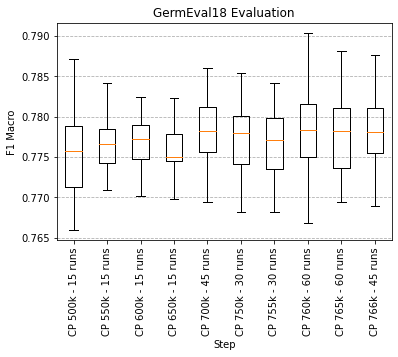
|
||||
|
||||
## Pre-training details
|
||||
# Pre-training details
|
||||
|
||||
### Data
|
||||
## Data
|
||||
- Cleaned Common Crawl Corpus 2019-09 German: [CC_net](https://github.com/facebookresearch/cc_net) (Only head coprus and filtered for language_score > 0.98) - 62 GB
|
||||
- German Wikipedia Article Pages Dump (20200701) - 5.5 GB
|
||||
- German Wikipedia Talk Pages Dump (20200620) - 1.1 GB
|
||||
@@ -84,7 +77,7 @@ The sentences were split with [SojaMo](https://github.com/tsproisl/SoMaJo). We t
|
||||
|
||||
More Details can be found here [Preperaing Datasets for German Electra Github](https://github.com/German-NLP-Group/german-transformer-training)
|
||||
|
||||
### Electra Branch no_strip_accents
|
||||
## Electra Branch no_strip_accents
|
||||
Because we do not want to stip accents in our training data we made a change to Electra and used this repo [Electra no_strip_accents](https://github.com/PhilipMay/electra/tree/no_strip_accents) (branch `no_strip_accents`). Then created the tf dataset with:
|
||||
|
||||
```bash
|
||||
@@ -92,13 +85,11 @@ python build_pretraining_dataset.py --corpus-dir <corpus_dir> --vocab-file <dir>
|
||||
```
|
||||
|
||||
## The training
|
||||
|
||||
The training itself can be performed with the Original Electra Repo (No special case for this needed).
|
||||
We run it with the following Config:
|
||||
|
||||
|
||||
<details>
|
||||
<summary>The exact Training Config</summary>
|
||||
<summary>The exact Training Config</summary>
|
||||
<br/>debug False
|
||||
<br/>disallow_correct False
|
||||
<br/>disc_weight 50.0
|
||||
@@ -143,7 +134,6 @@ We run it with the following Config:
|
||||
<br/>vocab_file gs://XXX
|
||||
<br/>vocab_size 32767
|
||||
<br/>weight_decay_rate 0.01
|
||||
|
||||
</details>
|
||||
|
||||
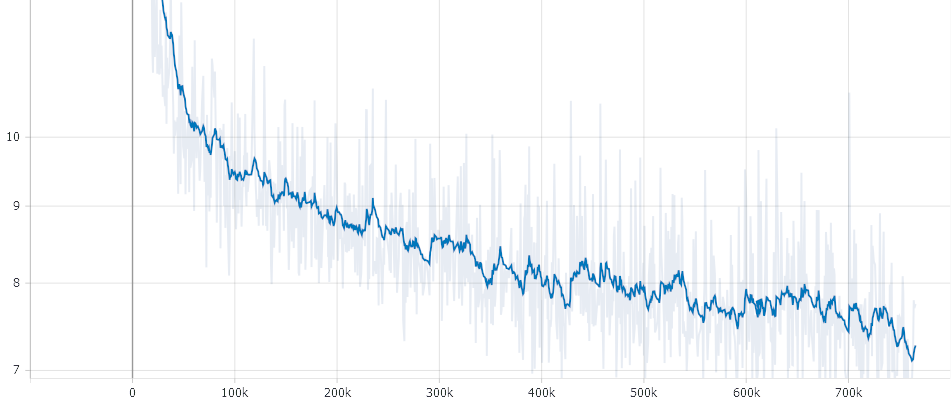
|
||||
@@ -155,7 +145,7 @@ Special thanks to [Stefan Schweter](https://github.com/stefan-it) for your feedb
|
||||
|
||||
[¹]: Source for the picture [Pinterest](https://www.pinterest.cl/pin/371828512984142193/)
|
||||
|
||||
## Negative Results
|
||||
# Negative Results
|
||||
We tried the following approaches which we found had no positive influence:
|
||||
|
||||
- **Increased Vocab Size**: Leads to more parameters and thus reduced examples/sec while no visible Performance gains were measured
|
||||
|
||||
@@ -0,0 +1,60 @@
|
||||
---
|
||||
language: id
|
||||
tags:
|
||||
- indobert
|
||||
- indobenchmark
|
||||
- indonlu
|
||||
license: mit
|
||||
inference: false
|
||||
datasets:
|
||||
- Indo4B
|
||||
---
|
||||
|
||||
# IndoBERT Base Model (phase1 - uncased)
|
||||
|
||||
[IndoBERT](https://arxiv.org/abs/2009.05387) is a state-of-the-art language model for Indonesian based on the BERT model. The pretrained model is trained using a masked language modeling (MLM) objective and next sentence prediction (NSP) objective.
|
||||
|
||||
## All Pre-trained Models
|
||||
|
||||
| Model | #params | Arch. | Training data |
|
||||
|--------------------------------|--------------------------------|-------|-----------------------------------|
|
||||
| `indobenchmark/indobert-base-p1` | 124.5M | Base | Indo4B (23.43 GB of text) |
|
||||
| `indobenchmark/indobert-base-p2` | 124.5M | Base | Indo4B (23.43 GB of text) |
|
||||
| `indobenchmark/indobert-large-p1` | 335.2M | Large | Indo4B (23.43 GB of text) |
|
||||
| `indobenchmark/indobert-large-p2` | 335.2M | Large | Indo4B (23.43 GB of text) |
|
||||
| `indobenchmark/indobert-lite-base-p1` | 11.7M | Base | Indo4B (23.43 GB of text) |
|
||||
| `indobenchmark/indobert-lite-base-p2` | 11.7M | Base | Indo4B (23.43 GB of text) |
|
||||
| `indobenchmark/indobert-lite-large-p1` | 17.7M | Large | Indo4B (23.43 GB of text) |
|
||||
| `indobenchmark/indobert-lite-large-p2` | 17.7M | Large | Indo4B (23.43 GB of text) |
|
||||
|
||||
## How to use
|
||||
|
||||
### Load model and tokenizer
|
||||
```python
|
||||
from transformers import BertTokenizer, AutoModel
|
||||
tokenizer = BertTokenizer.from_pretrained("indobenchmark/indobert-base-p1")
|
||||
model = AutoModel.from_pretrained("indobenchmark/indobert-base-p1")
|
||||
```
|
||||
|
||||
### Extract contextual representation
|
||||
```python
|
||||
x = torch.LongTensor(tokenizer.encode('aku adalah anak [MASK]')).view(1,-1)
|
||||
print(x, model(x)[0].sum())
|
||||
```
|
||||
|
||||
## Authors
|
||||
|
||||
<b>IndoBERT</b> was trained and evaluated by Bryan Wilie\*, Karissa Vincentio\*, Genta Indra Winata\*, Samuel Cahyawijaya\*, Xiaohong Li, Zhi Yuan Lim, Sidik Soleman, Rahmad Mahendra, Pascale Fung, Syafri Bahar, Ayu Purwarianti.
|
||||
|
||||
|
||||
## Citation
|
||||
If you use our work, please cite:
|
||||
|
||||
```bibtex
|
||||
@inproceedings{wilie2020indonlu,
|
||||
title={IndoNLU: Benchmark and Resources for Evaluating Indonesian Natural Language Understanding},
|
||||
author={Bryan Wilie and Karissa Vincentio and Genta Indra Winata and Samuel Cahyawijaya and X. Li and Zhi Yuan Lim and S. Soleman and R. Mahendra and Pascale Fung and Syafri Bahar and A. Purwarianti},
|
||||
booktitle={Proceedings of the 1st Conference of the Asia-Pacific Chapter of the Association for Computational Linguistics and the 10th International Joint Conference on Natural Language Processing},
|
||||
year={2020}
|
||||
}
|
||||
```
|
||||
Some files were not shown because too many files have changed in this diff Show More
Reference in New Issue
Block a user