Compare commits
2
Commits
| Author | SHA1 | Date | |
|---|---|---|---|
 sshleifer sshleifer
|
4b15df209e | ||
|
sshleifer
|
0c9cc060ee |
No files matched your search
+21
-18
@@ -3,7 +3,7 @@ jobs:
|
||||
run_tests_torch_and_tf:
|
||||
working_directory: ~/transformers
|
||||
docker:
|
||||
- image: circleci/python:3.6
|
||||
- image: circleci/python:3.5
|
||||
environment:
|
||||
OMP_NUM_THREADS: 1
|
||||
resource_class: xlarge
|
||||
@@ -14,7 +14,6 @@ jobs:
|
||||
- run: sudo pip install codecov pytest-cov
|
||||
- run: python -m pytest -n 8 --dist=loadfile -s -v ./tests/ --cov
|
||||
- run: codecov
|
||||
|
||||
run_tests_torch:
|
||||
working_directory: ~/transformers
|
||||
docker:
|
||||
@@ -29,6 +28,21 @@ jobs:
|
||||
- run: sudo pip install codecov pytest-cov
|
||||
- run: python -m pytest -n 8 --dist=loadfile -s -v ./tests/ --cov
|
||||
- run: codecov
|
||||
run_tests_legacy_torch:
|
||||
working_directory: ~/transformers
|
||||
docker:
|
||||
- image: circleci/python:3.7
|
||||
environment:
|
||||
OMP_NUM_THREADS: 1
|
||||
resource_class: xlarge
|
||||
parallelism: 1
|
||||
steps:
|
||||
- checkout
|
||||
- run: sudo pip install torch==1.0.0
|
||||
- run: sudo pip install .[sklearn,testing]
|
||||
- run: sudo pip install codecov pytest-cov
|
||||
- run: python -m pytest -n 8 --dist=loadfile -s -v ./tests/ --cov
|
||||
- run: codecov
|
||||
run_tests_tf:
|
||||
working_directory: ~/transformers
|
||||
docker:
|
||||
@@ -46,7 +60,7 @@ jobs:
|
||||
run_tests_custom_tokenizers:
|
||||
working_directory: ~/transformers
|
||||
docker:
|
||||
- image: circleci/python:3.6
|
||||
- image: circleci/python:3.5
|
||||
environment:
|
||||
RUN_CUSTOM_TOKENIZERS: yes
|
||||
steps:
|
||||
@@ -56,7 +70,7 @@ jobs:
|
||||
run_examples_torch:
|
||||
working_directory: ~/transformers
|
||||
docker:
|
||||
- image: circleci/python:3.6
|
||||
- image: circleci/python:3.5
|
||||
environment:
|
||||
OMP_NUM_THREADS: 1
|
||||
resource_class: xlarge
|
||||
@@ -66,20 +80,10 @@ jobs:
|
||||
- run: sudo pip install .[sklearn,torch,testing]
|
||||
- run: sudo pip install -r examples/requirements.txt
|
||||
- run: python -m pytest -n 8 --dist=loadfile -s -v ./examples/
|
||||
build_doc:
|
||||
working_directory: ~/transformers
|
||||
docker:
|
||||
- image: circleci/python:3.6
|
||||
steps:
|
||||
- checkout
|
||||
- run: sudo pip install .[tf,torch,docs]
|
||||
- run: cd docs && make html
|
||||
- store_artifacts:
|
||||
path: ./docs/_build
|
||||
deploy_doc:
|
||||
working_directory: ~/transformers
|
||||
docker:
|
||||
- image: circleci/python:3.6
|
||||
- image: circleci/python:3.5
|
||||
steps:
|
||||
- add_ssh_keys:
|
||||
fingerprints:
|
||||
@@ -104,7 +108,7 @@ jobs:
|
||||
check_repository_consistency:
|
||||
working_directory: ~/transformers
|
||||
docker:
|
||||
- image: circleci/python:3.6
|
||||
- image: circleci/python:3.5
|
||||
resource_class: small
|
||||
parallelism: 1
|
||||
steps:
|
||||
@@ -125,7 +129,6 @@ workflows:
|
||||
- run_examples_torch
|
||||
- run_tests_custom_tokenizers
|
||||
- run_tests_torch_and_tf
|
||||
- run_tests_torch
|
||||
- run_tests_legacy_torch
|
||||
- run_tests_tf
|
||||
- build_doc
|
||||
- deploy_doc: *workflow_filters
|
||||
@@ -40,7 +40,7 @@ Steps to reproduce the behavior:
|
||||
<!-- A clear and concise description of what you would expect to happen. -->
|
||||
|
||||
## Environment info
|
||||
<!-- You can run the command `transformers-cli env` and copy-and-paste its output below.
|
||||
<!-- You can run the command `python transformers-cli env` and copy-and-paste its output below.
|
||||
Don't forget to fill out the missing fields in that output! -->
|
||||
|
||||
- `transformers` version:
|
||||
|
||||
@@ -11,9 +11,9 @@ jobs:
|
||||
uses: actions/setup-python@v1
|
||||
with:
|
||||
python-version: 3.7
|
||||
# - name: Install dependencies
|
||||
# run: |
|
||||
# pip install .[tf,torch,quality]
|
||||
- name: Install dependencies
|
||||
run: |
|
||||
pip install .[tf,torch,quality]
|
||||
|
||||
|
||||
|
||||
@@ -1,11 +1,10 @@
|
||||
name: Self-hosted runner (push)
|
||||
|
||||
on:
|
||||
# push:
|
||||
# branches:
|
||||
# - master
|
||||
# pull_request:
|
||||
repository_dispatch:
|
||||
push:
|
||||
branches:
|
||||
- master
|
||||
pull_request:
|
||||
|
||||
|
||||
jobs:
|
||||
@@ -32,12 +31,12 @@ jobs:
|
||||
run: |
|
||||
source .env/bin/activate
|
||||
pip install .[sklearn,tf,torch,testing]
|
||||
pip uninstall -y tensorflow
|
||||
|
||||
- name: Are GPUs recognized by our DL frameworks
|
||||
run: |
|
||||
source .env/bin/activate
|
||||
python -c "import torch; print(torch.cuda.is_available())"
|
||||
python -c "import tensorflow as tf; print(tf.test.is_built_with_cuda(), tf.config.list_physical_devices('GPU'))"
|
||||
|
||||
- name: Run all non-slow tests on GPU
|
||||
env:
|
||||
|
||||
@@ -66,7 +66,7 @@ Choose the right framework for every part of a model's lifetime
|
||||
|
||||
## Installation
|
||||
|
||||
This repo is tested on Python 3.6+, PyTorch 1.0.0+ and TensorFlow 2.0.0-rc1
|
||||
This repo is tested on Python 3.5+, PyTorch 1.0.0+ and TensorFlow 2.0.0-rc1
|
||||
|
||||
You should install 🤗 Transformers in a [virtual environment](https://docs.python.org/3/library/venv.html). If you're unfamiliar with Python virtual environments, check out the [user guide](https://packaging.python.org/guides/installing-using-pip-and-virtual-environments/).
|
||||
|
||||
@@ -148,26 +148,23 @@ At some point in the future, you'll be able to seamlessly move from pre-training
|
||||
|
||||
🤗 Transformers currently provides the following NLU/NLG architectures:
|
||||
|
||||
1. **[BERT](https://huggingface.co/transformers/model_doc/bert.html)** (from Google) released with the paper [BERT: Pre-training of Deep Bidirectional Transformers for Language Understanding](https://arxiv.org/abs/1810.04805) by Jacob Devlin, Ming-Wei Chang, Kenton Lee and Kristina Toutanova.
|
||||
2. **[GPT](https://huggingface.co/transformers/model_doc/gpt.html)** (from OpenAI) released with the paper [Improving Language Understanding by Generative Pre-Training](https://blog.openai.com/language-unsupervised/) by Alec Radford, Karthik Narasimhan, Tim Salimans and Ilya Sutskever.
|
||||
3. **[GPT-2](https://huggingface.co/transformers/model_doc/gpt2.html)** (from OpenAI) released with the paper [Language Models are Unsupervised Multitask Learners](https://blog.openai.com/better-language-models/) by Alec Radford*, Jeffrey Wu*, Rewon Child, David Luan, Dario Amodei** and Ilya Sutskever**.
|
||||
4. **[Transformer-XL](https://huggingface.co/transformers/model_doc/transformerxl.html)** (from Google/CMU) released with the paper [Transformer-XL: Attentive Language Models Beyond a Fixed-Length Context](https://arxiv.org/abs/1901.02860) by Zihang Dai*, Zhilin Yang*, Yiming Yang, Jaime Carbonell, Quoc V. Le, Ruslan Salakhutdinov.
|
||||
5. **[XLNet](https://huggingface.co/transformers/model_doc/xlnet.html)** (from Google/CMU) released with the paper [XLNet: Generalized Autoregressive Pretraining for Language Understanding](https://arxiv.org/abs/1906.08237) by Zhilin Yang*, Zihang Dai*, Yiming Yang, Jaime Carbonell, Ruslan Salakhutdinov, Quoc V. Le.
|
||||
6. **[XLM](https://huggingface.co/transformers/model_doc/xlm.html)** (from Facebook) released together with the paper [Cross-lingual Language Model Pretraining](https://arxiv.org/abs/1901.07291) by Guillaume Lample and Alexis Conneau.
|
||||
7. **[RoBERTa](https://huggingface.co/transformers/model_doc/roberta.html)** (from Facebook), released together with the paper a [Robustly Optimized BERT Pretraining Approach](https://arxiv.org/abs/1907.11692) by Yinhan Liu, Myle Ott, Naman Goyal, Jingfei Du, Mandar Joshi, Danqi Chen, Omer Levy, Mike Lewis, Luke Zettlemoyer, Veselin Stoyanov.
|
||||
8. **[DistilBERT](https://huggingface.co/transformers/model_doc/distilbert.html)** (from HuggingFace), released together with the paper [DistilBERT, a distilled version of BERT: smaller, faster, cheaper and lighter](https://arxiv.org/abs/1910.01108) by Victor Sanh, Lysandre Debut and Thomas Wolf. The same method has been applied to compress GPT2 into [DistilGPT2](https://github.com/huggingface/transformers/tree/master/examples/distillation), RoBERTa into [DistilRoBERTa](https://github.com/huggingface/transformers/tree/master/examples/distillation), Multilingual BERT into [DistilmBERT](https://github.com/huggingface/transformers/tree/master/examples/distillation) and a German version of DistilBERT.
|
||||
9. **[CTRL](https://huggingface.co/transformers/model_doc/ctrl.html)** (from Salesforce) released with the paper [CTRL: A Conditional Transformer Language Model for Controllable Generation](https://arxiv.org/abs/1909.05858) by Nitish Shirish Keskar*, Bryan McCann*, Lav R. Varshney, Caiming Xiong and Richard Socher.
|
||||
10. **[CamemBERT](https://huggingface.co/transformers/model_doc/camembert.html)** (from Inria/Facebook/Sorbonne) released with the paper [CamemBERT: a Tasty French Language Model](https://arxiv.org/abs/1911.03894) by Louis Martin*, Benjamin Muller*, Pedro Javier Ortiz Suárez*, Yoann Dupont, Laurent Romary, Éric Villemonte de la Clergerie, Djamé Seddah and Benoît Sagot.
|
||||
11. **[ALBERT](https://huggingface.co/transformers/model_doc/albert.html)** (from Google Research and the Toyota Technological Institute at Chicago) released with the paper [ALBERT: A Lite BERT for Self-supervised Learning of Language Representations](https://arxiv.org/abs/1909.11942), by Zhenzhong Lan, Mingda Chen, Sebastian Goodman, Kevin Gimpel, Piyush Sharma, Radu Soricut.
|
||||
12. **[T5](https://huggingface.co/transformers/model_doc/t5.html)** (from Google AI) released with the paper [Exploring the Limits of Transfer Learning with a Unified Text-to-Text Transformer](https://arxiv.org/abs/1910.10683) by Colin Raffel and Noam Shazeer and Adam Roberts and Katherine Lee and Sharan Narang and Michael Matena and Yanqi Zhou and Wei Li and Peter J. Liu.
|
||||
13. **[XLM-RoBERTa](https://huggingface.co/transformers/model_doc/xlmroberta.html)** (from Facebook AI), released together with the paper [Unsupervised Cross-lingual Representation Learning at Scale](https://arxiv.org/abs/1911.02116) by Alexis Conneau*, Kartikay Khandelwal*, Naman Goyal, Vishrav Chaudhary, Guillaume Wenzek, Francisco Guzmán, Edouard Grave, Myle Ott, Luke Zettlemoyer and Veselin Stoyanov.
|
||||
1. **[BERT](https://github.com/google-research/bert)** (from Google) released with the paper [BERT: Pre-training of Deep Bidirectional Transformers for Language Understanding](https://arxiv.org/abs/1810.04805) by Jacob Devlin, Ming-Wei Chang, Kenton Lee and Kristina Toutanova.
|
||||
2. **[GPT](https://github.com/openai/finetune-transformer-lm)** (from OpenAI) released with the paper [Improving Language Understanding by Generative Pre-Training](https://blog.openai.com/language-unsupervised/) by Alec Radford, Karthik Narasimhan, Tim Salimans and Ilya Sutskever.
|
||||
3. **[GPT-2](https://blog.openai.com/better-language-models/)** (from OpenAI) released with the paper [Language Models are Unsupervised Multitask Learners](https://blog.openai.com/better-language-models/) by Alec Radford*, Jeffrey Wu*, Rewon Child, David Luan, Dario Amodei** and Ilya Sutskever**.
|
||||
4. **[Transformer-XL](https://github.com/kimiyoung/transformer-xl)** (from Google/CMU) released with the paper [Transformer-XL: Attentive Language Models Beyond a Fixed-Length Context](https://arxiv.org/abs/1901.02860) by Zihang Dai*, Zhilin Yang*, Yiming Yang, Jaime Carbonell, Quoc V. Le, Ruslan Salakhutdinov.
|
||||
5. **[XLNet](https://github.com/zihangdai/xlnet/)** (from Google/CMU) released with the paper [XLNet: Generalized Autoregressive Pretraining for Language Understanding](https://arxiv.org/abs/1906.08237) by Zhilin Yang*, Zihang Dai*, Yiming Yang, Jaime Carbonell, Ruslan Salakhutdinov, Quoc V. Le.
|
||||
6. **[XLM](https://github.com/facebookresearch/XLM/)** (from Facebook) released together with the paper [Cross-lingual Language Model Pretraining](https://arxiv.org/abs/1901.07291) by Guillaume Lample and Alexis Conneau.
|
||||
7. **[RoBERTa](https://github.com/pytorch/fairseq/tree/master/examples/roberta)** (from Facebook), released together with the paper a [Robustly Optimized BERT Pretraining Approach](https://arxiv.org/abs/1907.11692) by Yinhan Liu, Myle Ott, Naman Goyal, Jingfei Du, Mandar Joshi, Danqi Chen, Omer Levy, Mike Lewis, Luke Zettlemoyer, Veselin Stoyanov.
|
||||
8. **[DistilBERT](https://github.com/huggingface/transformers/tree/master/examples/distillation)** (from HuggingFace), released together with the paper [DistilBERT, a distilled version of BERT: smaller, faster, cheaper and lighter](https://arxiv.org/abs/1910.01108) by Victor Sanh, Lysandre Debut and Thomas Wolf. The same method has been applied to compress GPT2 into [DistilGPT2](https://github.com/huggingface/transformers/tree/master/examples/distillation), RoBERTa into [DistilRoBERTa](https://github.com/huggingface/transformers/tree/master/examples/distillation), Multilingual BERT into [DistilmBERT](https://github.com/huggingface/transformers/tree/master/examples/distillation) and a German version of DistilBERT.
|
||||
9. **[CTRL](https://github.com/salesforce/ctrl/)** (from Salesforce) released with the paper [CTRL: A Conditional Transformer Language Model for Controllable Generation](https://arxiv.org/abs/1909.05858) by Nitish Shirish Keskar*, Bryan McCann*, Lav R. Varshney, Caiming Xiong and Richard Socher.
|
||||
10. **[CamemBERT](https://camembert-model.fr)** (from Inria/Facebook/Sorbonne) released with the paper [CamemBERT: a Tasty French Language Model](https://arxiv.org/abs/1911.03894) by Louis Martin*, Benjamin Muller*, Pedro Javier Ortiz Suárez*, Yoann Dupont, Laurent Romary, Éric Villemonte de la Clergerie, Djamé Seddah and Benoît Sagot.
|
||||
11. **[ALBERT](https://github.com/google-research/ALBERT)** (from Google Research and the Toyota Technological Institute at Chicago) released with the paper [ALBERT: A Lite BERT for Self-supervised Learning of Language Representations](https://arxiv.org/abs/1909.11942), by Zhenzhong Lan, Mingda Chen, Sebastian Goodman, Kevin Gimpel, Piyush Sharma, Radu Soricut.
|
||||
12. **[T5](https://github.com/google-research/text-to-text-transfer-transformer)** (from Google AI) released with the paper [Exploring the Limits of Transfer Learning with a Unified Text-to-Text Transformer](https://arxiv.org/abs/1910.10683) by Colin Raffel and Noam Shazeer and Adam Roberts and Katherine Lee and Sharan Narang and Michael Matena and Yanqi Zhou and Wei Li and Peter J. Liu.
|
||||
13. **[XLM-RoBERTa](https://github.com/pytorch/fairseq/tree/master/examples/xlmr)** (from Facebook AI), released together with the paper [Unsupervised Cross-lingual Representation Learning at Scale](https://arxiv.org/abs/1911.02116) by Alexis Conneau*, Kartikay Khandelwal*, Naman Goyal, Vishrav Chaudhary, Guillaume Wenzek, Francisco Guzmán, Edouard Grave, Myle Ott, Luke Zettlemoyer and Veselin Stoyanov.
|
||||
14. **[MMBT](https://github.com/facebookresearch/mmbt/)** (from Facebook), released together with the paper a [Supervised Multimodal Bitransformers for Classifying Images and Text](https://arxiv.org/pdf/1909.02950.pdf) by Douwe Kiela, Suvrat Bhooshan, Hamed Firooz, Davide Testuggine.
|
||||
15. **[FlauBERT](https://huggingface.co/transformers/model_doc/flaubert.html)** (from CNRS) released with the paper [FlauBERT: Unsupervised Language Model Pre-training for French](https://arxiv.org/abs/1912.05372) by Hang Le, Loïc Vial, Jibril Frej, Vincent Segonne, Maximin Coavoux, Benjamin Lecouteux, Alexandre Allauzen, Benoît Crabbé, Laurent Besacier, Didier Schwab.
|
||||
16. **[BART](https://huggingface.co/transformers/model_doc/bart.html)** (from Facebook) released with the paper [BART: Denoising Sequence-to-Sequence Pre-training for Natural Language Generation, Translation, and Comprehension](https://arxiv.org/pdf/1910.13461.pdf) by Mike Lewis, Yinhan Liu, Naman Goyal, Marjan Ghazvininejad, Abdelrahman Mohamed, Omer Levy, Ves Stoyanov and Luke Zettlemoyer.
|
||||
17. **[ELECTRA](https://huggingface.co/transformers/model_doc/electra.html)** (from Google Research/Stanford University) released with the paper [ELECTRA: Pre-training text encoders as discriminators rather than generators](https://arxiv.org/abs/2003.10555) by Kevin Clark, Minh-Thang Luong, Quoc V. Le, Christopher D. Manning.
|
||||
18. **[DialoGPT](https://huggingface.co/transformers/model_doc/dialogpt.html)** (from Microsoft Research) released with the paper [DialoGPT: Large-Scale Generative Pre-training for Conversational Response Generation](https://arxiv.org/abs/1911.00536) by Yizhe Zhang, Siqi Sun, Michel Galley, Yen-Chun Chen, Chris Brockett, Xiang Gao, Jianfeng Gao, Jingjing Liu, Bill Dolan.
|
||||
18. **[Other community models](https://huggingface.co/models)**, contributed by the [community](https://huggingface.co/users).
|
||||
19. Want to contribute a new model? We have added a **detailed guide and templates** to guide you in the process of adding a new model. You can find them in the [`templates`](./templates) folder of the repository. Be sure to check the [contributing guidelines](./CONTRIBUTING.md) and contact the maintainers or open an issue to collect feedbacks before starting your PR.
|
||||
15. **[FlauBERT](https://github.com/getalp/Flaubert)** (from CNRS) released with the paper [FlauBERT: Unsupervised Language Model Pre-training for French](https://arxiv.org/abs/1912.05372) by Hang Le, Loïc Vial, Jibril Frej, Vincent Segonne, Maximin Coavoux, Benjamin Lecouteux, Alexandre Allauzen, Benoît Crabbé, Laurent Besacier, Didier Schwab.
|
||||
16. **[Other community models](https://huggingface.co/models)**, contributed by the [community](https://huggingface.co/users).
|
||||
17. Want to contribute a new model? We have added a **detailed guide and templates** to guide you in the process of adding a new model. You can find them in the [`templates`](./templates) folder of the repository. Be sure to check the [contributing guidelines](./CONTRIBUTING.md) and contact the maintainers or open an issue to collect feedbacks before starting your PR.
|
||||
|
||||
These implementations have been tested on several datasets (see the example scripts) and should match the performances of the original implementations (e.g. ~93 F1 on SQuAD for BERT Whole-Word-Masking, ~88 F1 on RocStories for OpenAI GPT, ~18.3 perplexity on WikiText 103 for Transformer-XL, ~0.916 Peason R coefficient on STS-B for XLNet). You can find more details on the performances in the Examples section of the [documentation](https://huggingface.co/transformers/examples.html).
|
||||
|
||||
@@ -338,6 +335,7 @@ python ./examples/run_glue.py \
|
||||
--task_name $TASK_NAME \
|
||||
--do_train \
|
||||
--do_eval \
|
||||
--do_lower_case \
|
||||
--data_dir $GLUE_DIR/$TASK_NAME \
|
||||
--max_seq_length 128 \
|
||||
--per_gpu_eval_batch_size=8 \
|
||||
@@ -391,6 +389,7 @@ python -m torch.distributed.launch --nproc_per_node 8 ./examples/run_glue.py \
|
||||
--task_name MRPC \
|
||||
--do_train \
|
||||
--do_eval \
|
||||
--do_lower_case \
|
||||
--data_dir $GLUE_DIR/MRPC/ \
|
||||
--max_seq_length 128 \
|
||||
--per_gpu_eval_batch_size=8 \
|
||||
@@ -423,6 +422,7 @@ python -m torch.distributed.launch --nproc_per_node=8 ./examples/run_squad.py \
|
||||
--model_name_or_path bert-large-uncased-whole-word-masking \
|
||||
--do_train \
|
||||
--do_eval \
|
||||
--do_lower_case \
|
||||
--train_file $SQUAD_DIR/train-v1.1.json \
|
||||
--predict_file $SQUAD_DIR/dev-v1.1.json \
|
||||
--learning_rate 3e-5 \
|
||||
@@ -471,7 +471,7 @@ python ./examples/run_generation.py \
|
||||
|
||||
Starting with `v2.2.2`, you can now upload and share your fine-tuned models with the community, using the <abbr title="Command-line interface">CLI</abbr> that's built-in to the library.
|
||||
|
||||
**First, create an account on [https://huggingface.co/join](https://huggingface.co/join)**. Optionally, join an existing organization or create a new one. Then:
|
||||
**First, create an account on [https://huggingface.co/join](https://huggingface.co/join)**. Then:
|
||||
|
||||
```shell
|
||||
transformers-cli login
|
||||
@@ -490,26 +490,19 @@ transformers-cli upload ./config.json [--filename folder/foobar.json]
|
||||
# (you can optionally override its filename, which can be nested inside a folder)
|
||||
```
|
||||
|
||||
If you want your model to be namespaced by your organization name rather than your username, add the following flag to any command:
|
||||
```shell
|
||||
--organization organization_name
|
||||
```
|
||||
|
||||
Your model will then be accessible through its identifier, a concatenation of your username (or organization name) and the folder name above:
|
||||
Your model will then be accessible through its identifier, a concatenation of your username and the folder name above:
|
||||
```python
|
||||
"username/pretrained_model"
|
||||
# or if an org:
|
||||
"organization_name/pretrained_model"
|
||||
```
|
||||
|
||||
**Please add a README.md model card** to the repo under `model_cards/` with: model description, training params (dataset, preprocessing, hardware used, hyperparameters), evaluation results, intended uses & limitations, etc.
|
||||
**Please add a README.md model card** to the repo under `model_cards/` with: model description, training params (dataset, preprocessing, hyperparameters), evaluation results, intended uses & limitations, etc.
|
||||
|
||||
Your model now has a page on huggingface.co/models 🔥
|
||||
|
||||
Anyone can load it from code:
|
||||
```python
|
||||
tokenizer = AutoTokenizer.from_pretrained("namespace/pretrained_model")
|
||||
model = AutoModel.from_pretrained("namespace/pretrained_model")
|
||||
tokenizer = AutoTokenizer.from_pretrained("username/pretrained_model")
|
||||
model = AutoModel.from_pretrained("username/pretrained_model")
|
||||
```
|
||||
|
||||
List all your files on S3:
|
||||
@@ -536,8 +529,6 @@ You can create `Pipeline` objects for the following down-stream tasks:
|
||||
- `text-classification`: Initialize a `TextClassificationPipeline` directly, or see `sentiment-analysis` for an example.
|
||||
- `question-answering`: Provided some context and a question refering to the context, it will extract the answer to the question in the context.
|
||||
- `fill-mask`: Takes an input sequence containing a masked token (e.g. `<mask>`) and return list of most probable filled sequences, with their probabilities.
|
||||
- `summarization`
|
||||
- `translation_xx_to_yy`
|
||||
|
||||
```python
|
||||
from transformers import pipeline
|
||||
|
||||
@@ -0,0 +1,7 @@
|
||||
FROM pytorch/pytorch:latest
|
||||
|
||||
RUN git clone https://github.com/NVIDIA/apex.git && cd apex && python setup.py install --cuda_ext --cpp_ext
|
||||
|
||||
RUN pip install transformers
|
||||
|
||||
WORKDIR /workspace
|
||||
@@ -1,26 +0,0 @@
|
||||
FROM ubuntu:18.04
|
||||
LABEL maintainer="Hugging Face"
|
||||
LABEL repository="transformers"
|
||||
|
||||
RUN apt update && \
|
||||
apt install -y bash \
|
||||
build-essential \
|
||||
git \
|
||||
curl \
|
||||
ca-certificates \
|
||||
python3 \
|
||||
python3-pip && \
|
||||
rm -rf /var/lib/apt/lists
|
||||
|
||||
RUN python3 -m pip install --no-cache-dir --upgrade pip && \
|
||||
python3 -m pip install --no-cache-dir \
|
||||
jupyter \
|
||||
tensorflow-cpu \
|
||||
torch
|
||||
|
||||
WORKDIR /workspace
|
||||
COPY . transformers/
|
||||
RUN cd transformers/ && \
|
||||
python3 -m pip install --no-cache-dir .
|
||||
|
||||
CMD ["/bin/bash"]
|
||||
@@ -1,26 +0,0 @@
|
||||
FROM nvidia/cuda:10.1-cudnn7-runtime-ubuntu18.04
|
||||
LABEL maintainer="Hugging Face"
|
||||
LABEL repository="transformers"
|
||||
|
||||
RUN apt update && \
|
||||
apt install -y bash \
|
||||
build-essential \
|
||||
git \
|
||||
curl \
|
||||
ca-certificates \
|
||||
python3 \
|
||||
python3-pip && \
|
||||
rm -rf /var/lib/apt/lists
|
||||
|
||||
RUN python3 -m pip install --no-cache-dir --upgrade pip && \
|
||||
python3 -m pip install --no-cache-dir \
|
||||
jupyter \
|
||||
tensorflow \
|
||||
torch
|
||||
|
||||
WORKDIR /workspace
|
||||
COPY . transformers/
|
||||
RUN cd transformers/ && \
|
||||
python3 -m pip install --no-cache-dir .
|
||||
|
||||
CMD ["/bin/bash"]
|
||||
@@ -1,25 +0,0 @@
|
||||
FROM ubuntu:18.04
|
||||
LABEL maintainer="Hugging Face"
|
||||
LABEL repository="transformers"
|
||||
|
||||
RUN apt update && \
|
||||
apt install -y bash \
|
||||
build-essential \
|
||||
git \
|
||||
curl \
|
||||
ca-certificates \
|
||||
python3 \
|
||||
python3-pip && \
|
||||
rm -rf /var/lib/apt/lists
|
||||
|
||||
RUN python3 -m pip install --no-cache-dir --upgrade pip && \
|
||||
python3 -m pip install --no-cache-dir \
|
||||
jupyter \
|
||||
torch
|
||||
|
||||
WORKDIR /workspace
|
||||
COPY . transformers/
|
||||
RUN cd transformers/ && \
|
||||
python3 -m pip install --no-cache-dir .
|
||||
|
||||
CMD ["/bin/bash"]
|
||||
@@ -1,25 +0,0 @@
|
||||
FROM nvidia/cuda:10.1-cudnn7-runtime-ubuntu18.04
|
||||
LABEL maintainer="Hugging Face"
|
||||
LABEL repository="transformers"
|
||||
|
||||
RUN apt update && \
|
||||
apt install -y bash \
|
||||
build-essential \
|
||||
git \
|
||||
curl \
|
||||
ca-certificates \
|
||||
python3 \
|
||||
python3-pip && \
|
||||
rm -rf /var/lib/apt/lists
|
||||
|
||||
RUN python3 -m pip install --no-cache-dir --upgrade pip && \
|
||||
python3 -m pip install --no-cache-dir \
|
||||
mkl \
|
||||
torch
|
||||
|
||||
WORKDIR /workspace
|
||||
COPY . transformers/
|
||||
RUN cd transformers/ && \
|
||||
python3 -m pip install --no-cache-dir .
|
||||
|
||||
CMD ["/bin/bash"]
|
||||
@@ -1,25 +0,0 @@
|
||||
FROM ubuntu:18.04
|
||||
LABEL maintainer="Hugging Face"
|
||||
LABEL repository="transformers"
|
||||
|
||||
RUN apt update && \
|
||||
apt install -y bash \
|
||||
build-essential \
|
||||
git \
|
||||
curl \
|
||||
ca-certificates \
|
||||
python3 \
|
||||
python3-pip && \
|
||||
rm -rf /var/lib/apt/lists
|
||||
|
||||
RUN python3 -m pip install --no-cache-dir --upgrade pip && \
|
||||
python3 -m pip install --no-cache-dir \
|
||||
mkl \
|
||||
tensorflow-cpu
|
||||
|
||||
WORKDIR /workspace
|
||||
COPY . transformers/
|
||||
RUN cd transformers/ && \
|
||||
python3 -m pip install --no-cache-dir .
|
||||
|
||||
CMD ["/bin/bash"]
|
||||
@@ -1,25 +0,0 @@
|
||||
FROM nvidia/cuda:10.1-cudnn7-runtime-ubuntu18.04
|
||||
LABEL maintainer="Hugging Face"
|
||||
LABEL repository="transformers"
|
||||
|
||||
RUN apt update && \
|
||||
apt install -y bash \
|
||||
build-essential \
|
||||
git \
|
||||
curl \
|
||||
ca-certificates \
|
||||
python3 \
|
||||
python3-pip && \
|
||||
rm -rf /var/lib/apt/lists
|
||||
|
||||
RUN python3 -m pip install --no-cache-dir --upgrade pip && \
|
||||
python3 -m pip install --no-cache-dir \
|
||||
mkl \
|
||||
tensorflow
|
||||
|
||||
WORKDIR /workspace
|
||||
COPY . transformers/
|
||||
RUN cd transformers/ && \
|
||||
python3 -m pip install --no-cache-dir .
|
||||
|
||||
CMD ["/bin/bash"]
|
||||
@@ -47,8 +47,6 @@ Once you have setup `sphinx`, you can build the documentation by running the fol
|
||||
make html
|
||||
```
|
||||
|
||||
A folder called ``_build/html`` should have been created. You can now open the file ``_build/html/index.html`` in your browser.
|
||||
|
||||
---
|
||||
**NOTE**
|
||||
|
||||
|
||||
+1
-1
@@ -26,7 +26,7 @@ author = u'huggingface'
|
||||
# The short X.Y version
|
||||
version = u''
|
||||
# The full version, including alpha/beta/rc tags
|
||||
release = u'2.8.0'
|
||||
release = u'2.5.1'
|
||||
|
||||
|
||||
# -- General configuration ---------------------------------------------------
|
||||
|
||||
@@ -103,6 +103,3 @@ The library currently contains PyTorch and Tensorflow implementations, pre-train
|
||||
model_doc/xlmroberta
|
||||
model_doc/flaubert
|
||||
model_doc/bart
|
||||
model_doc/t5
|
||||
model_doc/electra
|
||||
model_doc/dialogpt
|
||||
@@ -1,6 +1,6 @@
|
||||
# Installation
|
||||
|
||||
Transformers is tested on Python 3.6+ and PyTorch 1.1.0
|
||||
Transformers is tested on Python 3.5+ and PyTorch 1.1.0
|
||||
|
||||
## With pip
|
||||
|
||||
|
||||
@@ -61,8 +61,3 @@ QuestionAnsweringPipeline
|
||||
|
||||
.. autoclass:: transformers.QuestionAnsweringPipeline
|
||||
|
||||
|
||||
SummarizationPipeline
|
||||
==========================================
|
||||
|
||||
.. autoclass:: transformers.SummarizationPipeline
|
||||
@@ -1,38 +1,16 @@
|
||||
Tokenizer
|
||||
----------------------------------------------------
|
||||
|
||||
A tokenizer is in charge of preparing the inputs for a model. The library comprise tokenizers for all the models. Most of the tokenizers are available in two flavors: a full python implementation and a "Fast" implementation based on the Rust library `tokenizers`. The "Fast" implementations allows (1) a significant speed-up in particular when doing batched tokenization and (2) additional methods to map between the original string (character and words) and the token space (e.g. getting the index of the token comprising a given character or the span of characters corresponding to a given token). Currently no "Fast" implementation is available for the SentencePiece-based tokenizers (for T5, ALBERT, CamemBERT, XLMRoBERTa and XLNet models).
|
||||
The base class ``PreTrainedTokenizer`` implements the common methods for loading/saving a tokenizer either from a local file or directory, or from a pretrained tokenizer provided by the library (downloaded from HuggingFace's AWS S3 repository).
|
||||
|
||||
The base classes ``PreTrainedTokenizer`` and ``PreTrainedTokenizerFast`` implements the common methods for encoding string inputs in model inputs (see below) and instantiating/saving python and "Fast" tokenizers either from a local file or directory or from a pretrained tokenizer provided by the library (downloaded from HuggingFace's AWS S3 repository).
|
||||
``PreTrainedTokenizer`` is the main entry point into tokenizers as it also implements the main methods for using all the tokenizers:
|
||||
|
||||
``PreTrainedTokenizer`` and ``PreTrainedTokenizerFast`` thus implements the main methods for using all the tokenizers:
|
||||
|
||||
- tokenizing (spliting strings in sub-word token strings), converting tokens strings to ids and back, and encoding/decoding (i.e. tokenizing + convert to integers),
|
||||
- tokenizing, converting tokens to ids and back and encoding/decoding,
|
||||
- adding new tokens to the vocabulary in a way that is independant of the underlying structure (BPE, SentencePiece...),
|
||||
- managing special tokens like mask, beginning-of-sentence, etc tokens (adding them, assigning them to attributes in the tokenizer for easy access and making sure they are not split during tokenization)
|
||||
|
||||
``BatchEncoding`` holds the output of the tokenizer's encoding methods (``encode_plus`` and ``batch_encode_plus``) and is derived from a Python dictionary. When the tokenizer is a pure python tokenizer, this class behave just like a standard python dictionary and hold the various model inputs computed by these methodes (``input_ids``, ``attention_mask``...). When the tokenizer is a "Fast" tokenizer (i.e. backed by HuggingFace tokenizers library), this class provides in addition several advanced alignement methods which can be used to map between the original string (character and words) and the token space (e.g. getting the index of the token comprising a given character or the span of characters corresponding to a given token).
|
||||
- managing special tokens (adding them, assigning them to roles, making sure they are not split during tokenization)
|
||||
|
||||
``PreTrainedTokenizer``
|
||||
~~~~~~~~~~~~~~~~~~~~~~~~
|
||||
|
||||
.. autoclass:: transformers.PreTrainedTokenizer
|
||||
:members:
|
||||
|
||||
``PreTrainedTokenizerFast``
|
||||
~~~~~~~~~~~~~~~~~~~~~~~~
|
||||
|
||||
.. autoclass:: transformers.PreTrainedTokenizerFast
|
||||
:members:
|
||||
|
||||
``BatchEncoding``
|
||||
~~~~~~~~~~~~~~~~~~~~~~~~
|
||||
|
||||
.. autoclass:: transformers.BatchEncoding
|
||||
:members:
|
||||
|
||||
``SpecialTokensMixin``
|
||||
~~~~~~~~~~~~~~~~~~~~~~~~
|
||||
|
||||
.. autoclass:: transformers.SpecialTokensMixin
|
||||
:members:
|
||||
@@ -27,7 +27,7 @@ loss = outputs[0]
|
||||
# In transformers you can also have access to the logits:
|
||||
loss, logits = outputs[:2]
|
||||
|
||||
# And even the attention weights if you configure the model to output them (and other outputs too, see the docstrings and documentation)
|
||||
# And even the attention weigths if you configure the model to output them (and other outputs too, see the docstrings and documentation)
|
||||
model = BertForSequenceClassification.from_pretrained('bert-base-uncased', output_attentions=True)
|
||||
outputs = model(input_ids, labels=labels)
|
||||
loss, logits, attentions = outputs
|
||||
|
||||
@@ -30,8 +30,6 @@ Tips:
|
||||
similar to a BERT-like architecture with the same number of hidden layers as it has to iterate through the same
|
||||
number of (repeating) layers.
|
||||
|
||||
The original code can be found `here <https://github.com/google-research/ALBERT>`_.
|
||||
|
||||
AlbertConfig
|
||||
~~~~~~~~~~~~~~~~~~~~~
|
||||
|
||||
|
||||
@@ -7,7 +7,7 @@ file a `Github Issue <https://github.com/huggingface/transformers/issues/new?ass
|
||||
Paper
|
||||
~~~~~
|
||||
The Bart model was `proposed <https://arxiv.org/abs/1910.13461>`_ by Mike Lewis, Yinhan Liu, Naman Goyal, Marjan Ghazvininejad, Abdelrahman Mohamed, Omer Levy, Ves Stoyanov and Luke Zettlemoyer on 29 Oct, 2019.
|
||||
According to the abstract,
|
||||
According to the abstract:
|
||||
|
||||
- Bart uses a standard seq2seq/machine translation architecture with a bidirectional encoder (like BERT) and a left-to-right decoder (like GPT).
|
||||
- The pretraining task involves randomly shuffling the order of the original sentences and a novel in-filling scheme, where spans of text are replaced with a single mask token.
|
||||
@@ -18,28 +18,26 @@ The Authors' code can be found `here <https://github.com/pytorch/fairseq/tree/ma
|
||||
|
||||
Implementation Notes
|
||||
~~~~~~~~~~~~~~~~~~~~
|
||||
- Bart doesn't use :obj:`token_type_ids` for sequence classification. Use BartTokenizer.encode to get the proper splitting.
|
||||
- The forward pass of ``BartModel`` will create decoder inputs (using the helper function ``transformers.modeling_bart._prepare_bart_decoder_inputs``) if they are not passed. This is different than some other modeling APIs.
|
||||
- Model predictions are intended to be identical to the original implementation. This only works, however, if the string you pass to ``fairseq.encode`` starts with a space.
|
||||
- ``BartForConditionalGeneration.generate`` should be used for conditional generation tasks like summarization, see the example in that docstrings
|
||||
- Models that load the ``"bart-large-cnn"`` weights will not have a ``mask_token_id``, or be able to perform mask filling tasks.
|
||||
|
||||
- Bart doesn't use :obj:`token_type_ids`, for sequence classification just use BartTokenizer.encode to get the proper splitting.
|
||||
- Inputs to the decoder are created by BartModel.forward if they are not passed. This is different than some other model APIs.
|
||||
- Model predictions are intended to be identical to the original implementation. This only works, however, if the string you pass to fairseq.encode starts with a space.
|
||||
- Decoder inputs are created automatically by the helper function ``transformers.modeling_bart._prepare_bart_decoder_inputs``
|
||||
BartModel
|
||||
- ``MaskedLM.generate`` should be used for summarization, see the example in that docstrings
|
||||
|
||||
|
||||
BartModel
|
||||
~~~~~~~~~~~~~
|
||||
~~~~~~~~~~~~~~~~~~~~
|
||||
|
||||
.. autoclass:: transformers.BartModel
|
||||
:members: forward
|
||||
|
||||
.. autofunction:: transformers.modeling_bart._prepare_bart_decoder_inputs
|
||||
|
||||
BartForMaskedLM
|
||||
~~~~~~~~~~~~~~~~~~~~~~~~~~
|
||||
|
||||
BartForConditionalGeneration
|
||||
~~~~~~~~~~~~~~~~~~~~~~~~~~~~~~~~~
|
||||
|
||||
.. autoclass:: transformers.BartForConditionalGeneration
|
||||
:members: generate, forward
|
||||
.. autoclass:: transformers.BartForMaskedLM
|
||||
:members: forward, generate
|
||||
|
||||
|
||||
BartForSequenceClassification
|
||||
@@ -54,3 +52,8 @@ BartConfig
|
||||
.. autoclass:: transformers.BartConfig
|
||||
:members:
|
||||
|
||||
Automatic Creation of Decoder Inputs
|
||||
~~~~~~~~~~~~~~~~~~~~~~~~~~~~~~~~~~~~
|
||||
This is enabled by default
|
||||
|
||||
.. autofunction:: transformers.modeling_bart._prepare_bart_decoder_inputs
|
||||
@@ -35,8 +35,6 @@ Tips:
|
||||
prediction rather than a token prediction. However, averaging over the sequence may yield better results than using
|
||||
the [CLS] token.
|
||||
|
||||
The original code can be found `here <https://github.com/google-research/bert>`_.
|
||||
|
||||
BertConfig
|
||||
~~~~~~~~~~~~~~~~~~~~~
|
||||
|
||||
@@ -52,13 +50,6 @@ BertTokenizer
|
||||
create_token_type_ids_from_sequences, save_vocabulary
|
||||
|
||||
|
||||
BertTokenizerFast
|
||||
~~~~~~~~~~~~~~~~~~~~~
|
||||
|
||||
.. autoclass:: transformers.BertTokenizerFast
|
||||
:members:
|
||||
|
||||
|
||||
BertModel
|
||||
~~~~~~~~~~~~~~~~~~~~
|
||||
|
||||
|
||||
@@ -22,8 +22,6 @@ Tips:
|
||||
- This implementation is the same as RoBERTa. Refer to the `documentation of RoBERTa <./roberta.html>`__ for usage
|
||||
examples as well as the information relative to the inputs and outputs.
|
||||
|
||||
The original code can be found `here <https://camembert-model.fr/>`_.
|
||||
|
||||
CamembertConfig
|
||||
~~~~~~~~~~~~~~~~~~~~~~~~~~~~~~~~~~~~~~~~~~
|
||||
|
||||
|
||||
@@ -31,8 +31,6 @@ Tips:
|
||||
See `reusing the past in generative models <../quickstart.html#using-the-past>`_ for more information on the usage
|
||||
of this argument.
|
||||
|
||||
The original code can be found `here <https://github.com/salesforce/ctrl>`_.
|
||||
|
||||
|
||||
CTRLConfig
|
||||
~~~~~~~~~~~~~~~~~~~~~~~~~~~~~~~~
|
||||
|
||||
@@ -1,29 +0,0 @@
|
||||
DialoGPT
|
||||
----------------------------------------------------
|
||||
|
||||
Overview
|
||||
~~~~~~~~~~~~~~~~~~~~~
|
||||
|
||||
DialoGPT was proposed in
|
||||
`DialoGPT: Large-Scale Generative Pre-training for Conversational Response Generation <https://arxiv.org/abs/1911.00536>`_
|
||||
by Yizhe Zhang, Siqi Sun, Michel Galley, Yen-Chun Chen, Chris Brockett, Xiang Gao, Jianfeng Gao, Jingjing Liu, Bill Dolan.
|
||||
It's a GPT2 Model trained on 147M conversation-like exchanges extracted from Reddit.
|
||||
|
||||
The abstract from the paper is the following:
|
||||
|
||||
*We present a large, tunable neural conversational response generation model, DialoGPT (dialogue generative pre-trained transformer).
|
||||
Trained on 147M conversation-like exchanges extracted from Reddit comment chains over a period spanning from 2005 through 2017, DialoGPT extends the Hugging Face PyTorch transformer to attain a performance close to human both in terms of automatic and human evaluation in single-turn dialogue settings.
|
||||
We show that conversational systems that leverage DialoGPT generate more relevant, contentful and context-consistent responses than strong baseline systems.
|
||||
The pre-trained model and training pipeline are publicly released to facilitate research into neural response generation and the development of more intelligent open-domain dialogue systems.*
|
||||
|
||||
Tips:
|
||||
|
||||
- DialoGPT is a model with absolute position embeddings so it's usually advised to pad the inputs on
|
||||
the right rather than the left.
|
||||
- DialoGPT was trained with a causal language modeling (CLM) objective on conversational data and is therefore powerful at response generation in open-domain dialogue systems.
|
||||
- DialoGPT enables the user to create a chat bot in just 10 lines of code as shown on `DialoGPT's model card <https://huggingface.co/microsoft/DialoGPT-medium>`_.
|
||||
|
||||
|
||||
DialoGPT's architecture is based on the GPT2 model, so one can refer to GPT2's `docstring <https://huggingface.co/transformers/model_doc/gpt2.html>`_.
|
||||
|
||||
The original code can be found `here <https://github.com/microsoft/DialoGPT>`_.
|
||||
@@ -27,8 +27,6 @@ Tips:
|
||||
- DistilBert doesn't have `token_type_ids`, you don't need to indicate which token belongs to which segment. Just separate your segments with the separation token `tokenizer.sep_token` (or `[SEP]`)
|
||||
- DistilBert doesn't have options to select the input positions (`position_ids` input). This could be added if necessary though, just let's us know if you need this option.
|
||||
|
||||
The original code can be found `here <https://github.com/huggingface/transformers/tree/master/examples/distillation>`_.
|
||||
|
||||
|
||||
DistilBertConfig
|
||||
~~~~~~~~~~~~~~~~~~~~~~~~~~~~~~~~
|
||||
@@ -44,13 +42,6 @@ DistilBertTokenizer
|
||||
:members:
|
||||
|
||||
|
||||
DistilBertTokenizerFast
|
||||
~~~~~~~~~~~~~~~~~~~~~~~~~~~~~~~~
|
||||
|
||||
.. autoclass:: transformers.DistilBertTokenizerFast
|
||||
:members:
|
||||
|
||||
|
||||
DistilBertModel
|
||||
~~~~~~~~~~~~~~~~~~~~~~~~~~~~~~~
|
||||
|
||||
|
||||
@@ -1,124 +0,0 @@
|
||||
ELECTRA
|
||||
----------------------------------------------------
|
||||
|
||||
The ELECTRA model was proposed in the paper.
|
||||
`ELECTRA: Pre-training Text Encoders as Discriminators Rather Than Generators <https://openreview.net/pdf?id=r1xMH1BtvB>`__.
|
||||
ELECTRA is a new pre-training approach which trains two transformer models: the generator and the discriminator. The
|
||||
generator's role is to replace tokens in a sequence, and is therefore trained as a masked language model. The discriminator,
|
||||
which is the model we're interested in, tries to identify which tokens were replaced by the generator in the sequence.
|
||||
|
||||
The abstract from the paper is the following:
|
||||
|
||||
*Masked language modeling (MLM) pre-training methods such as BERT corrupt
|
||||
the input by replacing some tokens with [MASK] and then train a model to
|
||||
reconstruct the original tokens. While they produce good results when transferred
|
||||
to downstream NLP tasks, they generally require large amounts of compute to be
|
||||
effective. As an alternative, we propose a more sample-efficient pre-training task
|
||||
called replaced token detection. Instead of masking the input, our approach
|
||||
corrupts it by replacing some tokens with plausible alternatives sampled from a small
|
||||
generator network. Then, instead of training a model that predicts the original
|
||||
identities of the corrupted tokens, we train a discriminative model that predicts
|
||||
whether each token in the corrupted input was replaced by a generator sample
|
||||
or not. Thorough experiments demonstrate this new pre-training task is more
|
||||
efficient than MLM because the task is defined over all input tokens rather than
|
||||
just the small subset that was masked out. As a result, the contextual representations
|
||||
learned by our approach substantially outperform the ones learned by BERT
|
||||
given the same model size, data, and compute. The gains are particularly strong
|
||||
for small models; for example, we train a model on one GPU for 4 days that
|
||||
outperforms GPT (trained using 30x more compute) on the GLUE natural language
|
||||
understanding benchmark. Our approach also works well at scale, where it
|
||||
performs comparably to RoBERTa and XLNet while using less than 1/4 of their
|
||||
compute and outperforms them when using the same amount of compute.*
|
||||
|
||||
Tips:
|
||||
|
||||
- ELECTRA is the pre-training approach, therefore there is nearly no changes done to the underlying model: BERT. The
|
||||
only change is the separation of the embedding size and the hidden size -> The embedding size is generally smaller,
|
||||
while the hidden size is larger. An additional projection layer (linear) is used to project the embeddings from
|
||||
their embedding size to the hidden size. In the case where the embedding size is the same as the hidden size, no
|
||||
projection layer is used.
|
||||
- The ELECTRA checkpoints saved using `Google Research's implementation <https://github.com/google-research/electra>`__
|
||||
contain both the generator and discriminator. The conversion script requires the user to name which model to export
|
||||
into the correct architecture. Once converted to the HuggingFace format, these checkpoints may be loaded into all
|
||||
available ELECTRA models, however. This means that the discriminator may be loaded in the `ElectraForMaskedLM` model,
|
||||
and the generator may be loaded in the `ElectraForPreTraining` model (the classification head will be randomly
|
||||
initialized as it doesn't exist in the generator).
|
||||
|
||||
The original code can be found `here <https://github.com/google-research/electra>`_.
|
||||
|
||||
|
||||
ElectraConfig
|
||||
~~~~~~~~~~~~~~~~~~~~~~~~~~~~~~~~
|
||||
|
||||
.. autoclass:: transformers.ElectraConfig
|
||||
:members:
|
||||
|
||||
|
||||
ElectraTokenizer
|
||||
~~~~~~~~~~~~~~~~~~~~~~~~~~~~~~~~
|
||||
|
||||
.. autoclass:: transformers.ElectraTokenizer
|
||||
:members:
|
||||
|
||||
|
||||
ElectraTokenizerFast
|
||||
~~~~~~~~~~~~~~~~~~~~~~~~~~~~~~~~
|
||||
|
||||
.. autoclass:: transformers.ElectraTokenizerFast
|
||||
:members:
|
||||
|
||||
|
||||
ElectraModel
|
||||
~~~~~~~~~~~~~~~~~~~~~~~~~~~~~~~
|
||||
|
||||
.. autoclass:: transformers.ElectraModel
|
||||
:members:
|
||||
|
||||
|
||||
ElectraForPreTraining
|
||||
~~~~~~~~~~~~~~~~~~~~~~~~~~~~~~~
|
||||
|
||||
.. autoclass:: transformers.ElectraForPreTraining
|
||||
:members:
|
||||
|
||||
|
||||
ElectraForMaskedLM
|
||||
~~~~~~~~~~~~~~~~~~~~~~~~~~~~~~~~~~~~~
|
||||
|
||||
.. autoclass:: transformers.ElectraForMaskedLM
|
||||
:members:
|
||||
|
||||
|
||||
ElectraForTokenClassification
|
||||
~~~~~~~~~~~~~~~~~~~~~~~~~~~~~~~~~~~~~~~~
|
||||
|
||||
.. autoclass:: transformers.ElectraForTokenClassification
|
||||
:members:
|
||||
|
||||
|
||||
TFElectraModel
|
||||
~~~~~~~~~~~~~~~~~~~~~~~~~~~~~~~
|
||||
|
||||
.. autoclass:: transformers.TFElectraModel
|
||||
:members:
|
||||
|
||||
|
||||
TFElectraForPreTraining
|
||||
~~~~~~~~~~~~~~~~~~~~~~~~~~~~~~~
|
||||
|
||||
.. autoclass:: transformers.TFElectraForPreTraining
|
||||
:members:
|
||||
|
||||
|
||||
TFElectraForMaskedLM
|
||||
~~~~~~~~~~~~~~~~~~~~~~~~~~~~~~~~~~~~~
|
||||
|
||||
.. autoclass:: transformers.TFElectraForMaskedLM
|
||||
:members:
|
||||
|
||||
|
||||
TFElectraForTokenClassification
|
||||
~~~~~~~~~~~~~~~~~~~~~~~~~~~~~~~~~~~~~~~~
|
||||
|
||||
.. autoclass:: transformers.TFElectraForTokenClassification
|
||||
:members:
|
||||
@@ -20,8 +20,6 @@ of the time they outperform other pre-training approaches. Different versions of
|
||||
evaluation protocol for the downstream tasks, called FLUE (French Language Understanding Evaluation), are shared
|
||||
to the research community for further reproducible experiments in French NLP.*
|
||||
|
||||
The original code can be found `here <https://github.com/getalp/Flaubert>`_.
|
||||
|
||||
|
||||
FlaubertConfig
|
||||
~~~~~~~~~~~~~~~~~~~~~~~~~~~~~~~~
|
||||
|
||||
@@ -36,9 +36,6 @@ Tips:
|
||||
`Write With Transformer <https://transformer.huggingface.co/doc/gpt>`__ is a webapp created and hosted by
|
||||
Hugging Face showcasing the generative capabilities of several models. GPT is one of them.
|
||||
|
||||
The original code can be found `here <https://github.com/openai/finetune-transformer-lm>`_.
|
||||
|
||||
|
||||
OpenAIGPTConfig
|
||||
~~~~~~~~~~~~~~~~~~~~~
|
||||
|
||||
@@ -53,13 +50,6 @@ OpenAIGPTTokenizer
|
||||
:members: save_vocabulary
|
||||
|
||||
|
||||
OpenAIGPTTokenizerFast
|
||||
~~~~~~~~~~~~~~~~~~~~~~~~~~
|
||||
|
||||
.. autoclass:: transformers.OpenAIGPTTokenizerFast
|
||||
:members:
|
||||
|
||||
|
||||
OpenAIGPTModel
|
||||
~~~~~~~~~~~~~~~~~~~~~~~~~
|
||||
|
||||
|
||||
@@ -34,8 +34,6 @@ Tips:
|
||||
Hugging Face showcasing the generative capabilities of several models. GPT-2 is one of them and is available in five
|
||||
different sizes: small, medium, large, xl and a distilled version of the small checkpoint: distilgpt-2.
|
||||
|
||||
The original code can be found `here <https://openai.com/blog/better-language-models/>`_.
|
||||
|
||||
|
||||
GPT2Config
|
||||
~~~~~~~~~~~~~~~~~~~~~
|
||||
@@ -51,13 +49,6 @@ GPT2Tokenizer
|
||||
:members: save_vocabulary
|
||||
|
||||
|
||||
GPT2TokenizerFast
|
||||
~~~~~~~~~~~~~~~~~~~~~
|
||||
|
||||
.. autoclass:: transformers.GPT2TokenizerFast
|
||||
:members:
|
||||
|
||||
|
||||
GPT2Model
|
||||
~~~~~~~~~~~~~~~~~~~~~
|
||||
|
||||
|
||||
@@ -28,9 +28,6 @@ Tips:
|
||||
- RoBERTa doesn't have `token_type_ids`, you don't need to indicate which token belongs to which segment. Just separate your segments with the separation token `tokenizer.sep_token` (or `</s>`)
|
||||
- `Camembert <./camembert.html>`__ is a wrapper around RoBERTa. Refer to this page for usage examples.
|
||||
|
||||
The original code can be found `here <https://github.com/pytorch/fairseq/tree/master/examples/roberta>`_.
|
||||
|
||||
|
||||
RobertaConfig
|
||||
~~~~~~~~~~~~~~~~~~~~~
|
||||
|
||||
@@ -46,13 +43,6 @@ RobertaTokenizer
|
||||
create_token_type_ids_from_sequences, save_vocabulary
|
||||
|
||||
|
||||
RobertaTokenizerFast
|
||||
~~~~~~~~~~~~~~~~~~~~~
|
||||
|
||||
.. autoclass:: transformers.RobertaTokenizerFast
|
||||
:members: build_inputs_with_special_tokens
|
||||
|
||||
|
||||
RobertaModel
|
||||
~~~~~~~~~~~~~~~~~~~~
|
||||
|
||||
|
||||
@@ -1,103 +0,0 @@
|
||||
T5
|
||||
----------------------------------------------------
|
||||
**DISCLAIMER:** This model is still a work in progress, if you see something strange,
|
||||
file a `Github Issue <https://github.com/huggingface/transformers/issues/new?assignees=&labels=&template=bug-report.md&title>`_
|
||||
|
||||
Overview
|
||||
~~~~~
|
||||
The T5 model was presented in `Exploring the Limits of Transfer Learning with a Unified Text-to-Text Transformer <https://arxiv.org/pdf/1910.10683.pdf>`_ by Colin Raffel, Noam Shazeer, Adam Roberts, Katherine Lee, Sharan Narang, Michael Matena, Yanqi Zhou, Wei Li, Peter J. Liu in
|
||||
Here the abstract:
|
||||
|
||||
*Transfer learning, where a model is first pre-trained on a data-rich task before being fine-tuned on a downstream task, has emerged as a powerful technique in natural language processing (NLP). The effectiveness of transfer learning has given rise to a diversity of approaches, methodology, and practice.
|
||||
In this paper, we explore the landscape of transfer learning techniques for NLP by introducing a unified framework that converts every language problem into a text-to-text format.
|
||||
Our systematic study compares pre-training objectives, architectures, unlabeled datasets, transfer approaches, and other factors on dozens of language understanding tasks.
|
||||
By combining the insights from our exploration with scale and our new "Colossal Clean Crawled Corpus", we achieve state-of-the-art results on many benchmarks covering summarization, question answering, text classification, and more.
|
||||
To facilitate future work on transfer learning for NLP, we release our dataset, pre-trained models, and code.*
|
||||
|
||||
The Authors' code can be found `here <https://github.com/google-research/text-to-text-transfer-transformer>`_ .
|
||||
|
||||
Training
|
||||
~~~~~~~~~~~~~~~~~~~~
|
||||
T5 is an encoder-decoder model and converts all NLP problems into a text-to-text format. It is trained using teacher forcing.
|
||||
This means that for training we always need an input sequence and a target sequence.
|
||||
The input sequence is fed to the model using ``input_ids``. The target sequence is shifted to the right, *i.e.* perprended by a start-sequence token and fed to the decoder using the `decoder_input_ids`. In teacher-forcing style, the target sequence is then appended by the EOS token and corresponds to the ``lm_labels``. The PAD token is hereby used as the start-sequence token.
|
||||
T5 can be trained / fine-tuned both in a supervised and unsupervised fashion.
|
||||
|
||||
- Unsupervised denoising training
|
||||
In this setup spans of the input sequence are masked by so-called sentinel tokens (*a.k.a* unique mask tokens)
|
||||
and the output sequence is formed as a concatenation of the same sentinel tokens and the *real* masked tokens.
|
||||
Each sentinel tokens represents a unique mask token for this sentence and should start with ``<extra_id_1>``, ``<extrac_id_2>``, ... up to ``<extra_id_100>``. As a default 100 sentinel tokens are available in ``T5Tokenizer``.
|
||||
*E.g.* the sentence "The cute dog walks in the park" with the masks put on "cute dog" and "the" should be processed as follows:
|
||||
|
||||
::
|
||||
|
||||
input_ids = tokenizer.encode('The <extra_id_1> walks in <extra_id_2> park', return_tensors='pt')
|
||||
lm_labels = tokenizer.encode('<extra_id_1> cute dog <extra_id_2> the <extra_id_3> </s>', return_tensors='pt')
|
||||
# the forward function automatically creates the correct decoder_input_ids
|
||||
model(input_ids=input_ids, lm_labels=lm_labels)
|
||||
|
||||
- Supervised training
|
||||
In this setup the input sequence and output sequence are standard sequence to sequence input output mapping.
|
||||
In translation, *e.g.* the input sequence "The house is wonderful." and output sequence "Das Haus ist wunderbar." should
|
||||
be processed as follows:
|
||||
|
||||
::
|
||||
|
||||
input_ids = tokenizer.encode('translate English to German: The house is wonderful. </s>', return_tensors='pt')
|
||||
lm_labels = tokenizer.encode('Das Haus ist wunderbar. </s>', return_tensors='pt')
|
||||
# the forward function automatically creates the correct decoder_input_ids
|
||||
model(input_ids=input_ids, lm_labels=lm_labels)
|
||||
|
||||
Tips
|
||||
~~~~~~~~~~~~~~~~~~~~
|
||||
- T5 is an encoder-decoder model pre-trained on a multi-task mixture of unsupervised
|
||||
and supervised tasks and for which each task is converted into a text-to-text format.
|
||||
T5 works well on a variety of tasks out-of-the-box by prepending a different prefix to the input corresponding to each task, e.g.: for translation: *translate English to German: ..., summarize: ...*.
|
||||
For more information about which prefix to use, it is easiest to look into Appendix D of the `paper <https://arxiv.org/pdf/1910.10683.pdf>`_ .
|
||||
- For sequence to sequence generation, it is recommended to use ``T5ForConditionalGeneration.generate()``. The method takes care of feeding the encoded input via cross-attention layers to the decoder and auto-regressively generates the decoder output.
|
||||
- T5 uses relative scalar embeddings. Encoder input padding can be done on the left and on the right.
|
||||
|
||||
The original code can be found `here <https://github.com/google-research/text-to-text-transfer-transformer>`_.
|
||||
|
||||
|
||||
T5Config
|
||||
~~~~~~~~~~~~~~~~~~~~~
|
||||
|
||||
.. autoclass:: transformers.T5Config
|
||||
:members:
|
||||
|
||||
|
||||
T5Tokenizer
|
||||
~~~~~~~~~~~~~~~~~~~~~
|
||||
|
||||
.. autoclass:: transformers.T5Tokenizer
|
||||
:members: build_inputs_with_special_tokens, get_special_tokens_mask,
|
||||
create_token_type_ids_from_sequences, save_vocabulary
|
||||
|
||||
|
||||
T5Model
|
||||
~~~~~~~~~~~~~~~~~~~~
|
||||
|
||||
.. autoclass:: transformers.T5Model
|
||||
:members:
|
||||
|
||||
|
||||
T5ForConditionalGeneration
|
||||
~~~~~~~~~~~~~~~~~~~~~~~~~~~~~~~~~~~~~~~~
|
||||
|
||||
.. autoclass:: transformers.T5ForConditionalGeneration
|
||||
:members:
|
||||
|
||||
|
||||
TFT5Model
|
||||
~~~~~~~~~~~~~~~~~~~~
|
||||
|
||||
.. autoclass:: transformers.TFT5Model
|
||||
:members:
|
||||
|
||||
|
||||
TFT5ForConditionalGeneration
|
||||
~~~~~~~~~~~~~~~~~~~~~~~~~~
|
||||
|
||||
.. autoclass:: transformers.TFT5ForConditionalGeneration
|
||||
:members:
|
||||
@@ -30,8 +30,6 @@ Tips:
|
||||
The original implementation trains on SQuAD with padding on the left, therefore the padding defaults are set to left.
|
||||
- Transformer-XL is one of the few models that has no sequence length limit.
|
||||
|
||||
The original code can be found `here <https://github.com/kimiyoung/transformer-xl>`_.
|
||||
|
||||
|
||||
TransfoXLConfig
|
||||
~~~~~~~~~~~~~~~~~~~~~
|
||||
@@ -47,13 +45,6 @@ TransfoXLTokenizer
|
||||
:members: save_vocabulary
|
||||
|
||||
|
||||
TransfoXLTokenizerFast
|
||||
~~~~~~~~~~~~~~~~~~~~~~~~~~
|
||||
|
||||
.. autoclass:: transformers.TransfoXLTokenizerFast
|
||||
:members:
|
||||
|
||||
|
||||
TransfoXLModel
|
||||
~~~~~~~~~~~~~~~~~~~~~~~~~~
|
||||
|
||||
|
||||
@@ -30,8 +30,6 @@ Tips:
|
||||
- XLM has multilingual checkpoints which leverage a specific `lang` parameter. Check out the
|
||||
`multi-lingual <../multilingual.html>`__ page for more information.
|
||||
|
||||
The original code can be found `here <https://github.com/facebookresearch/XLM/>`_.
|
||||
|
||||
|
||||
XLMConfig
|
||||
~~~~~~~~~~~~~~~~~~~~~~~~~~~~~~~~~~~~~~~~~~
|
||||
|
||||
@@ -28,9 +28,6 @@ Tips:
|
||||
- This implementation is the same as RoBERTa. Refer to the `documentation of RoBERTa <./roberta.html>`__ for usage
|
||||
examples as well as the information relative to the inputs and outputs.
|
||||
|
||||
The original code can be found `here <https://github.com/pytorch/fairseq/tree/master/examples/xlmr>`_.
|
||||
|
||||
|
||||
XLMRobertaConfig
|
||||
~~~~~~~~~~~~~~~~~~~~~~~~~~~~~~~~~~~~~~~~~~~~~~
|
||||
|
||||
|
||||
@@ -32,8 +32,6 @@ Tips:
|
||||
`target_mapping` inputs to control the attention span and outputs (see examples in `examples/run_generation.py`)
|
||||
- XLNet is one of the few models that has no sequence length limit.
|
||||
|
||||
The original code can be found `here <https://github.com/zihangdai/xlnet/>`_.
|
||||
|
||||
|
||||
XLNetConfig
|
||||
~~~~~~~~~~~~~~~~~~~~~~~~~~~~~~~~~~~~~~~~~~
|
||||
|
||||
@@ -2,7 +2,7 @@
|
||||
|
||||
Starting with `v2.2.2`, you can now upload and share your fine-tuned models with the community, using the <abbr title="Command-line interface">CLI</abbr> that's built-in to the library.
|
||||
|
||||
**First, create an account on [https://huggingface.co/join](https://huggingface.co/join)**. Optionally, join an existing organization or create a new one. Then:
|
||||
**First, create an account on [https://huggingface.co/join](https://huggingface.co/join)**. Then:
|
||||
|
||||
```shell
|
||||
transformers-cli login
|
||||
@@ -21,26 +21,19 @@ transformers-cli upload ./config.json [--filename folder/foobar.json]
|
||||
# (you can optionally override its filename, which can be nested inside a folder)
|
||||
```
|
||||
|
||||
If you want your model to be namespaced by your organization name rather than your username, add the following flag to any command:
|
||||
```shell
|
||||
--organization organization_name
|
||||
```
|
||||
|
||||
Your model will then be accessible through its identifier, a concatenation of your username (or organization name) and the folder name above:
|
||||
Your model will then be accessible through its identifier, a concatenation of your username and the folder name above:
|
||||
```python
|
||||
"username/pretrained_model"
|
||||
# or if an org:
|
||||
"organization_name/pretrained_model"
|
||||
```
|
||||
|
||||
**Please add a README.md model card** to the repo under `model_cards/` with: model description, training params (dataset, preprocessing, hardware used, hyperparameters), evaluation results, intended uses & limitations, etc.
|
||||
**Please add a README.md model card** to the repo under `model_cards/` with: model description, training params (dataset, preprocessing, hyperparameters), evaluation results, intended uses & limitations, etc.
|
||||
|
||||
Your model now has a page on huggingface.co/models 🔥
|
||||
|
||||
Anyone can load it from code:
|
||||
```python
|
||||
tokenizer = AutoTokenizer.from_pretrained("namespace/pretrained_model")
|
||||
model = AutoModel.from_pretrained("namespace/pretrained_model")
|
||||
tokenizer = AutoTokenizer.from_pretrained("username/pretrained_model")
|
||||
model = AutoModel.from_pretrained("username/pretrained_model")
|
||||
```
|
||||
|
||||
List all your files on S3:
|
||||
@@ -52,4 +45,4 @@ You can also delete unneeded files:
|
||||
|
||||
```shell
|
||||
transformers-cli s3 rm …
|
||||
```
|
||||
```
|
||||
@@ -47,7 +47,6 @@ The different languages this model/tokenizer handles, as well as the ids of thes
|
||||
|
||||
.. code-block::
|
||||
|
||||
# Continuation of the previous script
|
||||
print(tokenizer.lang2id) # {'en': 0, 'fr': 1}
|
||||
|
||||
|
||||
@@ -55,7 +54,6 @@ These ids should be used when passing a language parameter during a model pass.
|
||||
|
||||
.. code-block::
|
||||
|
||||
# Continuation of the previous script
|
||||
input_ids = torch.tensor([tokenizer.encode("Wikipedia was used to")]) # batch size of 1
|
||||
|
||||
|
||||
@@ -64,7 +62,6 @@ filled with the appropriate language ids, of the same size as input_ids. For eng
|
||||
|
||||
.. code-block::
|
||||
|
||||
# Continuation of the previous script
|
||||
language_id = tokenizer.lang2id['en'] # 0
|
||||
langs = torch.tensor([language_id] * input_ids.shape[1]) # torch.tensor([0, 0, 0, ..., 0])
|
||||
|
||||
@@ -76,7 +73,6 @@ You can then feed it all as input to your model:
|
||||
|
||||
.. code-block::
|
||||
|
||||
# Continuation of the previous script
|
||||
outputs = model(input_ids, langs=langs)
|
||||
|
||||
|
||||
|
||||
@@ -1 +0,0 @@
|
||||
../../notebooks/README.md
|
||||
@@ -0,0 +1,16 @@
|
||||
Notebooks
|
||||
================================================
|
||||
|
||||
We include `three Jupyter Notebooks <https://github.com/huggingface/transformers/tree/master/notebooks>`_ that can be used to check that the predictions of the PyTorch model are identical to the predictions of the original TensorFlow model.
|
||||
|
||||
|
||||
*
|
||||
The first NoteBook (\ `Comparing-TF-and-PT-models.ipynb <https://github.com/huggingface/transformers/blob/master/notebooks/Comparing-TF-and-PT-models.ipynb>`_\ ) extracts the hidden states of a full sequence on each layers of the TensorFlow and the PyTorch models and computes the standard deviation between them. In the given example, we get a standard deviation of 1.5e-7 to 9e-7 on the various hidden state of the models.
|
||||
|
||||
*
|
||||
The second NoteBook (\ `Comparing-TF-and-PT-models-SQuAD.ipynb <https://github.com/huggingface/transformers/blob/master/notebooks/Comparing-TF-and-PT-models-SQuAD.ipynb>`_\ ) compares the loss computed by the TensorFlow and the PyTorch models for identical initialization of the fine-tuning layer of the ``BertForQuestionAnswering`` and computes the standard deviation between them. In the given example, we get a standard deviation of 2.5e-7 between the models.
|
||||
|
||||
*
|
||||
The third NoteBook (\ `Comparing-TF-and-PT-models-MLM-NSP.ipynb <https://github.com/huggingface/transformers/blob/master/notebooks/Comparing-TF-and-PT-models-MLM-NSP.ipynb>`_\ ) compares the predictions computed by the TensorFlow and the PyTorch models for masked token language modeling using the pre-trained masked language modeling model.
|
||||
|
||||
Please follow the instructions given in the notebooks to run and modify them.
|
||||
@@ -275,6 +275,7 @@ For a list that includes community-uploaded models, refer to `https://huggingfac
|
||||
| | | | FlauBERT large architecture |
|
||||
| | | (see `details <https://github.com/getalp/Flaubert>`__) |
|
||||
+-------------------+------------------------------------------------------------+---------------------------------------------------------------------------------------------------------------------------------------+
|
||||
+-------------------+------------------------------------------------------------+---------------------------------------------------------------------------------------------------------------------------------------+
|
||||
| Bart | ``bart-large`` | | 12-layer, 1024-hidden, 16-heads, 406M parameters |
|
||||
| | | (see `details <https://github.com/pytorch/fairseq/tree/master/examples/bart>`_) |
|
||||
| +------------------------------------------------------------+---------------------------------------------------------------------------------------------------------------------------------------+
|
||||
@@ -283,16 +284,7 @@ For a list that includes community-uploaded models, refer to `https://huggingfac
|
||||
| +------------------------------------------------------------+---------------------------------------------------------------------------------------------------------------------------------------+
|
||||
| | ``bart-large-cnn`` | | 12-layer, 1024-hidden, 16-heads, 406M parameters (same as base) |
|
||||
| | | | bart-large base architecture finetuned on cnn summarization task |
|
||||
| +------------------------------------------------------------+---------------------------------------------------------------------------------------------------------------------------------------+
|
||||
| | ``mbart-large-en-ro`` | | 12-layer, 1024-hidden, 16-heads, 880M parameters |
|
||||
| | | | bart-large architecture pretrained on cc25 multilingual data , finetuned on WMT english romanian translation. |
|
||||
+-------------------+------------------------------------------------------------+---------------------------------------------------------------------------------------------------------------------------------------+
|
||||
| DialoGPT | ``DialoGPT-small`` | | 12-layer, 768-hidden, 12-heads, 124M parameters |
|
||||
| | | | Trained on English text: 147M conversation-like exchanges extracted from Reddit. |
|
||||
| +------------------------------------------------------------+---------------------------------------------------------------------------------------------------------------------------------------+
|
||||
| | ``DialoGPT-medium`` | | 24-layer, 1024-hidden, 16-heads, 355M parameters |
|
||||
| | | | Trained on English text: 147M conversation-like exchanges extracted from Reddit. |
|
||||
| +------------------------------------------------------------+---------------------------------------------------------------------------------------------------------------------------------------+
|
||||
| | ``DialoGPT-large`` | | 36-layer, 1280-hidden, 20-heads, 774M parameters |
|
||||
| | | | Trained on English text: 147M conversation-like exchanges extracted from Reddit. |
|
||||
+-------------------+------------------------------------------------------------+---------------------------------------------------------------------------------------------------------------------------------------+
|
||||
|
||||
|
||||
.. <https://huggingface.co/transformers/examples.html>`__
|
||||
@@ -58,14 +58,14 @@ where
|
||||
|
||||
``Uncased`` means that the text has been lowercased before WordPiece tokenization, e.g., ``John Smith`` becomes ``john smith``. The Uncased model also strips out any accent markers. ``Cased`` means that the true case and accent markers are preserved. Typically, the Uncased model is better unless you know that case information is important for your task (e.g., Named Entity Recognition or Part-of-Speech tagging). For information about the Multilingual and Chinese model, see the `Multilingual README <https://github.com/google-research/bert/blob/master/multilingual.md>`__ or the original TensorFlow repository.
|
||||
|
||||
When using an ``uncased model``\ , make sure your tokenizer has ``do_lower_case=True`` (either in its configuration, or passed as an additional parameter).
|
||||
When using an ``uncased model``\ , make sure to pass ``--do_lower_case`` to the example training scripts (or pass ``do_lower_case=True`` to FullTokenizer if you're using your own script and loading the tokenizer your-self.).
|
||||
|
||||
Examples:
|
||||
|
||||
.. code-block:: python
|
||||
|
||||
# BERT
|
||||
tokenizer = BertTokenizer.from_pretrained('bert-base-uncased', do_basic_tokenize=True)
|
||||
tokenizer = BertTokenizer.from_pretrained('bert-base-uncased', do_lower_case=True, do_basic_tokenize=True)
|
||||
model = BertForSequenceClassification.from_pretrained('bert-base-uncased')
|
||||
|
||||
# OpenAI GPT
|
||||
@@ -140,13 +140,13 @@ Here is the recommended way of saving the model, configuration and vocabulary to
|
||||
|
||||
torch.save(model_to_save.state_dict(), output_model_file)
|
||||
model_to_save.config.to_json_file(output_config_file)
|
||||
tokenizer.save_pretrained(output_dir)
|
||||
tokenizer.save_vocabulary(output_dir)
|
||||
|
||||
# Step 2: Re-load the saved model and vocabulary
|
||||
|
||||
# Example for a Bert model
|
||||
model = BertForQuestionAnswering.from_pretrained(output_dir)
|
||||
tokenizer = BertTokenizer.from_pretrained(output_dir) # Add specific options if needed
|
||||
tokenizer = BertTokenizer.from_pretrained(output_dir, do_lower_case=args.do_lower_case) # Add specific options if needed
|
||||
# Example for a GPT model
|
||||
model = OpenAIGPTDoubleHeadsModel.from_pretrained(output_dir)
|
||||
tokenizer = OpenAIGPTTokenizer.from_pretrained(output_dir)
|
||||
|
||||
+9
-139
@@ -420,7 +420,7 @@ to generate the tokens following the initial sequence in PyTorch, and creating a
|
||||
sequence = f"Hugging Face is based in DUMBO, New York City, and is"
|
||||
|
||||
input = tokenizer.encode(sequence, return_tensors="pt")
|
||||
generated = model.generate(input, max_length=50, do_sample=True)
|
||||
generated = model.generate(input, max_length=50)
|
||||
|
||||
resulting_string = tokenizer.decode(generated.tolist()[0])
|
||||
print(resulting_string)
|
||||
@@ -432,10 +432,14 @@ to generate the tokens following the initial sequence in PyTorch, and creating a
|
||||
model = TFAutoModelWithLMHead.from_pretrained("gpt2")
|
||||
|
||||
sequence = f"Hugging Face is based in DUMBO, New York City, and is"
|
||||
input = tokenizer.encode(sequence, return_tensors="tf")
|
||||
generated = model.generate(input, max_length=50, do_sample=True)
|
||||
generated = tokenizer.encode(sequence)
|
||||
|
||||
resulting_string = tokenizer.decode(generated.tolist()[0])
|
||||
for i in range(50):
|
||||
predictions = model(tf.constant([generated]))[0]
|
||||
token = tf.argmax(predictions[0], axis=1)[-1].numpy()
|
||||
generated += [token]
|
||||
|
||||
resulting_string = tokenizer.decode(generated)
|
||||
print(resulting_string)
|
||||
|
||||
|
||||
@@ -590,138 +594,4 @@ following array should be the output:
|
||||
|
||||
::
|
||||
|
||||
[('[CLS]', 'O'), ('Hu', 'I-ORG'), ('##gging', 'I-ORG'), ('Face', 'I-ORG'), ('Inc', 'I-ORG'), ('.', 'O'), ('is', 'O'), ('a', 'O'), ('company', 'O'), ('based', 'O'), ('in', 'O'), ('New', 'I-LOC'), ('York', 'I-LOC'), ('City', 'I-LOC'), ('.', 'O'), ('Its', 'O'), ('headquarters', 'O'), ('are', 'O'), ('in', 'O'), ('D', 'I-LOC'), ('##UM', 'I-LOC'), ('##BO', 'I-LOC'), (',', 'O'), ('therefore', 'O'), ('very', 'O'), ('##c', 'O'), ('##lose', 'O'), ('to', 'O'), ('the', 'O'), ('Manhattan', 'I-LOC'), ('Bridge', 'I-LOC'), ('.', 'O'), ('[SEP]', 'O')]
|
||||
Summarization
|
||||
----------------------------------------------------
|
||||
|
||||
Summarization is the task of summarizing a text / an article into a shorter text.
|
||||
|
||||
An example of a summarization dataset is the CNN / Daily Mail dataset, which consists of long news articles and was created for the task of summarization.
|
||||
If you would like to fine-tune a model on a summarization task, you may leverage the ``examples/summarization/bart/run_train.sh`` (leveraging pytorch-lightning) script.
|
||||
|
||||
Here is an example using the pipelines do to summarization.
|
||||
It leverages a Bart model that was fine-tuned on the CNN / Daily Mail data set.
|
||||
|
||||
::
|
||||
|
||||
from transformers import pipeline
|
||||
|
||||
summarizer = pipeline("summarization")
|
||||
|
||||
ARTICLE = """ New York (CNN)When Liana Barrientos was 23 years old, she got married in Westchester County, New York.
|
||||
A year later, she got married again in Westchester County, but to a different man and without divorcing her first husband.
|
||||
Only 18 days after that marriage, she got hitched yet again. Then, Barrientos declared "I do" five more times, sometimes only within two weeks of each other.
|
||||
In 2010, she married once more, this time in the Bronx. In an application for a marriage license, she stated it was her "first and only" marriage.
|
||||
Barrientos, now 39, is facing two criminal counts of "offering a false instrument for filing in the first degree," referring to her false statements on the
|
||||
2010 marriage license application, according to court documents.
|
||||
Prosecutors said the marriages were part of an immigration scam.
|
||||
On Friday, she pleaded not guilty at State Supreme Court in the Bronx, according to her attorney, Christopher Wright, who declined to comment further.
|
||||
After leaving court, Barrientos was arrested and charged with theft of service and criminal trespass for allegedly sneaking into the New York subway through an emergency exit, said Detective
|
||||
Annette Markowski, a police spokeswoman. In total, Barrientos has been married 10 times, with nine of her marriages occurring between 1999 and 2002.
|
||||
All occurred either in Westchester County, Long Island, New Jersey or the Bronx. She is believed to still be married to four men, and at one time, she was married to eight men at once, prosecutors say.
|
||||
Prosecutors said the immigration scam involved some of her husbands, who filed for permanent residence status shortly after the marriages.
|
||||
Any divorces happened only after such filings were approved. It was unclear whether any of the men will be prosecuted.
|
||||
The case was referred to the Bronx District Attorney\'s Office by Immigration and Customs Enforcement and the Department of Homeland Security\'s
|
||||
Investigation Division. Seven of the men are from so-called "red-flagged" countries, including Egypt, Turkey, Georgia, Pakistan and Mali.
|
||||
Her eighth husband, Rashid Rajput, was deported in 2006 to his native Pakistan after an investigation by the Joint Terrorism Task Force.
|
||||
If convicted, Barrientos faces up to four years in prison. Her next court appearance is scheduled for May 18.
|
||||
"""
|
||||
|
||||
print(summarizer(ARTICLE, max_length=130, min_length=30))
|
||||
|
||||
Because the summarization pipeline depends on the ``PretrainedModel.generate()`` method, we can override the default arguments
|
||||
of ``PretrainedModel.generate()`` directly in the pipeline as is shown for ``max_length`` and ``min_length`` above.
|
||||
This outputs the following summary:
|
||||
|
||||
::
|
||||
|
||||
Liana Barrientos has been married 10 times, sometimes within two weeks of each other. Prosecutors say the marriages were part of an immigration scam. She pleaded not guilty at State Supreme Court in the Bronx on Friday.
|
||||
|
||||
Here is an example doing summarization using a model and a tokenizer. The process is the following:
|
||||
|
||||
- Instantiate a tokenizer and a model from the checkpoint name. Summarization is usually done using an encoder-decoder model, such as ``Bart`` or ``T5``.
|
||||
- Define the article that should be summarizaed.
|
||||
- Leverage the ``PretrainedModel.generate()`` method.
|
||||
- Add the T5 specific prefix "summarize: ".
|
||||
|
||||
Here Google`s T5 model is used that was only pre-trained on a multi-task mixed data set (including CNN / Daily Mail), but nevertheless yields very good results.
|
||||
::
|
||||
|
||||
## PYTORCH CODE
|
||||
from transformers import AutoModelWithLMHead, AutoTokenizer
|
||||
|
||||
model = AutoModelWithLMHead.from_pretrained("t5-base")
|
||||
tokenizer = AutoTokenizer.from_pretrained("t5-base")
|
||||
|
||||
# T5 uses a max_length of 512 so we cut the article to 512 tokens.
|
||||
inputs = tokenizer.encode("summarize: " + ARTICLE, return_tensors="pt", max_length=512)
|
||||
outputs = model.generate(inputs, max_length=150, min_length=40, length_penalty=2.0, num_beams=4, early_stopping=True)
|
||||
print(outputs)
|
||||
|
||||
## TENSORFLOW CODE
|
||||
from transformers import TFAutoModelWithLMHead, AutoTokenizer
|
||||
|
||||
model = TFAutoModelWithLMHead.from_pretrained("t5-base")
|
||||
tokenizer = AutoTokenizer.from_pretrained("t5-base")
|
||||
|
||||
# T5 uses a max_length of 512 so we cut the article to 512 tokens.
|
||||
inputs = tokenizer.encode("summarize: " + ARTICLE, return_tensors="tf", max_length=512)
|
||||
outputs = model.generate(inputs, max_length=150, min_length=40, length_penalty=2.0, num_beams=4, early_stopping=True)
|
||||
print(outputs)
|
||||
Translation
|
||||
----------------------------------------------------
|
||||
|
||||
Translation is the task of translating a text from one language to another.
|
||||
|
||||
An example of a translation dataset is the WMT English to German dataset, which has English sentences as the input data
|
||||
and German sentences as the target data.
|
||||
|
||||
Here is an example using the pipelines do to translation.
|
||||
It leverages a T5 model that was only pre-trained on a multi-task mixture dataset (including WMT), but yields impressive
|
||||
translation results nevertheless.
|
||||
|
||||
::
|
||||
|
||||
from transformers import pipeline
|
||||
|
||||
translator = pipeline("translation_en_to_de")
|
||||
print(translator("Hugging Face is a technology company based in New York and Paris", max_length=40))
|
||||
|
||||
Because the translation pipeline depends on the ``PretrainedModel.generate()`` method, we can override the default arguments
|
||||
of ``PretrainedModel.generate()`` directly in the pipeline as is shown for ``max_length`` above.
|
||||
This outputs the following translation into German:
|
||||
|
||||
::
|
||||
|
||||
Hugging Face ist ein Technologieunternehmen mit Sitz in New York und Paris.
|
||||
|
||||
Here is an example doing translation using a model and a tokenizer. The process is the following:
|
||||
|
||||
- Instantiate a tokenizer and a model from the checkpoint name. Summarization is usually done using an encoder-decoder model, such as ``Bart`` or ``T5``.
|
||||
- Define the article that should be summarizaed.
|
||||
- Leverage the ``PretrainedModel.generate()`` method.
|
||||
- Add the T5 specific prefix "translate English to German: "
|
||||
|
||||
::
|
||||
|
||||
## PYTORCH CODE
|
||||
from transformers import AutoModelWithLMHead, AutoTokenizer
|
||||
|
||||
model = AutoModelWithLMHead.from_pretrained("t5-base")
|
||||
tokenizer = AutoTokenizer.from_pretrained("t5-base")
|
||||
|
||||
inputs = tokenizer.encode("translate English to German: Hugging Face is a technology company based in New York and Paris", return_tensors="pt")
|
||||
outputs = model.generate(inputs, max_length=40, num_beams=4, early_stopping=True)
|
||||
|
||||
print(outputs)
|
||||
|
||||
## TENSORFLOW CODE
|
||||
from transformers import TFAutoModelWithLMHead, AutoTokenizer
|
||||
|
||||
model = TFAutoModelWithLMHead.from_pretrained("t5-base")
|
||||
tokenizer = AutoTokenizer.from_pretrained("t5-base")
|
||||
|
||||
inputs = tokenizer.encode("translate English to German: Hugging Face is a technology company based in New York and Paris", return_tensors="tf")
|
||||
outputs = model.generate(inputs, max_length=40, num_beams=4, early_stopping=True)
|
||||
|
||||
print(outputs)
|
||||
[('[CLS]', 'O'), ('Hu', 'I-ORG'), ('##gging', 'I-ORG'), ('Face', 'I-ORG'), ('Inc', 'I-ORG'), ('.', 'O'), ('is', 'O'), ('a', 'O'), ('company', 'O'), ('based', 'O'), ('in', 'O'), ('New', 'I-LOC'), ('York', 'I-LOC'), ('City', 'I-LOC'), ('.', 'O'), ('Its', 'O'), ('headquarters', 'O'), ('are', 'O'), ('in', 'O'), ('D', 'I-LOC'), ('##UM', 'I-LOC'), ('##BO', 'I-LOC'), (',', 'O'), ('therefore', 'O'), ('very', 'O'), ('##c', 'O'), ('##lose', 'O'), ('to', 'O'), ('the', 'O'), ('Manhattan', 'I-LOC'), ('Bridge', 'I-LOC'), ('.', 'O'), ('[SEP]', 'O')]
|
||||
+13
-46
@@ -17,7 +17,6 @@ pip install -r ./examples/requirements.txt
|
||||
| Section | Description |
|
||||
|----------------------------|------------------------------------------------------------------------------------------------------------------------------------------
|
||||
| [TensorFlow 2.0 models on GLUE](#TensorFlow-2.0-Bert-models-on-GLUE) | Examples running BERT TensorFlow 2.0 model on the GLUE tasks. |
|
||||
| [Running on TPUs](#running-on-tpus) | Examples on running fine-tuning tasks on Google TPUs to accelerate workloads. |
|
||||
| [Language Model training](#language-model-training) | Fine-tuning (or training from scratch) the library models for language modeling on a text dataset. Causal language modeling for GPT/GPT-2, masked language modeling for BERT/RoBERTa. |
|
||||
| [Language Generation](#language-generation) | Conditional text generation using the auto-regressive models of the library: GPT, GPT-2, Transformer-XL and XLNet. |
|
||||
| [GLUE](#glue) | Examples running BERT/XLM/XLNet/RoBERTa on the 9 GLUE tasks. Examples feature distributed training as well as half-precision. |
|
||||
@@ -49,54 +48,12 @@ Quick benchmarks from the script (no other modifications):
|
||||
|
||||
Mixed precision (AMP) reduces the training time considerably for the same hardware and hyper-parameters (same batch size was used).
|
||||
|
||||
## Running on TPUs
|
||||
|
||||
You can accelerate your workloads on Google's TPUs. For information on how to setup your TPU environment refer to this
|
||||
[README](https://github.com/pytorch/xla/blob/master/README.md).
|
||||
|
||||
The following are some examples of running the `*_tpu.py` finetuning scripts on TPUs. All steps for data preparation are
|
||||
identical to your normal GPU + Huggingface setup.
|
||||
|
||||
### GLUE
|
||||
|
||||
Before running anyone of these GLUE tasks you should download the
|
||||
[GLUE data](https://gluebenchmark.com/tasks) by running
|
||||
[this script](https://gist.github.com/W4ngatang/60c2bdb54d156a41194446737ce03e2e)
|
||||
and unpack it to some directory `$GLUE_DIR`.
|
||||
|
||||
For running your GLUE task on MNLI dataset you can run something like the following:
|
||||
|
||||
```
|
||||
export XRT_TPU_CONFIG="tpu_worker;0;$TPU_IP_ADDRESS:8470"
|
||||
export GLUE_DIR=/path/to/glue
|
||||
export TASK_NAME=MNLI
|
||||
|
||||
python run_glue_tpu.py \
|
||||
--model_type bert \
|
||||
--model_name_or_path bert-base-cased \
|
||||
--task_name $TASK_NAME \
|
||||
--do_train \
|
||||
--do_eval \
|
||||
--data_dir $GLUE_DIR/$TASK_NAME \
|
||||
--max_seq_length 128 \
|
||||
--train_batch_size 32 \
|
||||
--learning_rate 3e-5 \
|
||||
--num_train_epochs 3.0 \
|
||||
--output_dir /tmp/$TASK_NAME \
|
||||
--overwrite_output_dir \
|
||||
--logging_steps 50 \
|
||||
--save_steps 200 \
|
||||
--num_cores=8 \
|
||||
--only_log_master
|
||||
```
|
||||
|
||||
|
||||
## Language model training
|
||||
|
||||
Based on the script [`run_language_modeling.py`](https://github.com/huggingface/transformers/blob/master/examples/run_language_modeling.py).
|
||||
|
||||
Fine-tuning (or training from scratch) the library models for language modeling on a text dataset for GPT, GPT-2, BERT and RoBERTa (DistilBERT
|
||||
to be added soon). GPT and GPT-2 are fine-tuned using a causal language modeling (CLM) loss while BERT and RoBERTa
|
||||
Fine-tuning (or training from scratch) the library models for language modeling on a text dataset for GPT, GPT-2, BERT and RoBERTa (DistilBERT
|
||||
to be added soon). GPT and GPT-2 are fine-tuned using a causal language modeling (CLM) loss while BERT and RoBERTa
|
||||
are fine-tuned using a masked language modeling (MLM) loss.
|
||||
|
||||
Before running the following example, you should get a file that contains text on which the language model will be
|
||||
@@ -211,6 +168,7 @@ python run_glue.py \
|
||||
--task_name $TASK_NAME \
|
||||
--do_train \
|
||||
--do_eval \
|
||||
--do_lower_case \
|
||||
--data_dir $GLUE_DIR/$TASK_NAME \
|
||||
--max_seq_length 128 \
|
||||
--per_gpu_train_batch_size 32 \
|
||||
@@ -251,6 +209,7 @@ python run_glue.py \
|
||||
--task_name MRPC \
|
||||
--do_train \
|
||||
--do_eval \
|
||||
--do_lower_case \
|
||||
--data_dir $GLUE_DIR/MRPC/ \
|
||||
--max_seq_length 128 \
|
||||
--per_gpu_train_batch_size 32 \
|
||||
@@ -277,6 +236,7 @@ python run_glue.py \
|
||||
--task_name MRPC \
|
||||
--do_train \
|
||||
--do_eval \
|
||||
--do_lower_case \
|
||||
--data_dir $GLUE_DIR/MRPC/ \
|
||||
--max_seq_length 128 \
|
||||
--per_gpu_train_batch_size 32 \
|
||||
@@ -301,6 +261,7 @@ python -m torch.distributed.launch \
|
||||
--task_name MRPC \
|
||||
--do_train \
|
||||
--do_eval \
|
||||
--do_lower_case \
|
||||
--data_dir $GLUE_DIR/MRPC/ \
|
||||
--max_seq_length 128 \
|
||||
--per_gpu_train_batch_size 8 \
|
||||
@@ -334,6 +295,7 @@ python -m torch.distributed.launch \
|
||||
--task_name mnli \
|
||||
--do_train \
|
||||
--do_eval \
|
||||
--do_lower_case \
|
||||
--data_dir $GLUE_DIR/MNLI/ \
|
||||
--max_seq_length 128 \
|
||||
--per_gpu_train_batch_size 8 \
|
||||
@@ -374,6 +336,7 @@ python ./examples/run_multiple_choice.py \
|
||||
--model_name_or_path roberta-base \
|
||||
--do_train \
|
||||
--do_eval \
|
||||
--do_lower_case \
|
||||
--data_dir $SWAG_DIR \
|
||||
--learning_rate 5e-5 \
|
||||
--num_train_epochs 3 \
|
||||
@@ -416,9 +379,10 @@ export SQUAD_DIR=/path/to/SQUAD
|
||||
|
||||
python run_squad.py \
|
||||
--model_type bert \
|
||||
--model_name_or_path bert-base-uncased \
|
||||
--model_name_or_path bert-base-cased \
|
||||
--do_train \
|
||||
--do_eval \
|
||||
--do_lower_case \
|
||||
--train_file $SQUAD_DIR/train-v1.1.json \
|
||||
--predict_file $SQUAD_DIR/dev-v1.1.json \
|
||||
--per_gpu_train_batch_size 12 \
|
||||
@@ -447,6 +411,7 @@ python -m torch.distributed.launch --nproc_per_node=8 ./examples/run_squad.py \
|
||||
--model_name_or_path bert-large-uncased-whole-word-masking \
|
||||
--do_train \
|
||||
--do_eval \
|
||||
--do_lower_case \
|
||||
--train_file $SQUAD_DIR/train-v1.1.json \
|
||||
--predict_file $SQUAD_DIR/dev-v1.1.json \
|
||||
--learning_rate 3e-5 \
|
||||
@@ -482,6 +447,7 @@ python run_squad.py \
|
||||
--model_name_or_path xlnet-large-cased \
|
||||
--do_train \
|
||||
--do_eval \
|
||||
--do_lower_case \
|
||||
--train_file $SQUAD_DIR/train-v1.1.json \
|
||||
--predict_file $SQUAD_DIR/dev-v1.1.json \
|
||||
--learning_rate 3e-5 \
|
||||
@@ -631,6 +597,7 @@ python examples/hans/test_hans.py \
|
||||
--task_name hans \
|
||||
--model_type $MODEL_TYPE \
|
||||
--do_eval \
|
||||
--do_lower_case \
|
||||
--data_dir $HANS_DIR \
|
||||
--model_name_or_path $MODEL_PATH \
|
||||
--max_seq_length 128 \
|
||||
|
||||
+84
-263
@@ -20,20 +20,11 @@
|
||||
|
||||
import argparse
|
||||
import csv
|
||||
import logging
|
||||
import timeit
|
||||
from time import time
|
||||
from typing import Callable, List
|
||||
from typing import List
|
||||
|
||||
from transformers import (
|
||||
AutoConfig,
|
||||
AutoTokenizer,
|
||||
MemorySummary,
|
||||
is_tf_available,
|
||||
is_torch_available,
|
||||
start_memory_tracing,
|
||||
stop_memory_tracing,
|
||||
)
|
||||
from transformers import AutoConfig, AutoTokenizer, is_tf_available, is_torch_available
|
||||
|
||||
|
||||
if is_tf_available():
|
||||
@@ -47,8 +38,10 @@ if is_torch_available():
|
||||
|
||||
input_text = """Bent over their instruments, three hundred Fertilizers were plunged, as
|
||||
the Director of Hatcheries and Conditioning entered the room, in the
|
||||
scarcely breathing silence, the absent-minded, soliloquizing hum or
|
||||
|
||||
|
||||
|
||||
scarcely breathing silence, the absent-minded, soliloquizing hum or
|
||||
whistle, of absorbed concentration. A troop of newly arrived students,
|
||||
very young, pink and callow, followed nervously, rather abjectly, at the
|
||||
Director's heels. Each of them carried a notebook, in which, whenever
|
||||
@@ -257,22 +250,15 @@ as they entered."""
|
||||
|
||||
def create_setup_and_compute(
|
||||
model_names: List[str],
|
||||
batch_sizes: List[int],
|
||||
slice_sizes: List[int],
|
||||
gpu: bool = True,
|
||||
tensorflow: bool = False,
|
||||
average_over: int = 3,
|
||||
no_speed: bool = False,
|
||||
no_memory: bool = False,
|
||||
verbose: bool = False,
|
||||
torchscript: bool = False,
|
||||
xla: bool = False,
|
||||
amp: bool = False,
|
||||
fp16: bool = False,
|
||||
save_to_csv: bool = False,
|
||||
csv_time_filename: str = f"time_{round(time())}.csv",
|
||||
csv_memory_filename: str = f"memory_{round(time())}.csv",
|
||||
print_fn: Callable[[str], None] = print,
|
||||
csv_filename: str = f"results_{round(time())}.csv",
|
||||
):
|
||||
if xla:
|
||||
tf.config.optimizer.set_jit(True)
|
||||
@@ -281,152 +267,69 @@ def create_setup_and_compute(
|
||||
|
||||
if tensorflow:
|
||||
dictionary = {model_name: {} for model_name in model_names}
|
||||
results = _compute_tensorflow(
|
||||
model_names,
|
||||
batch_sizes,
|
||||
slice_sizes,
|
||||
dictionary,
|
||||
average_over,
|
||||
amp,
|
||||
no_speed,
|
||||
no_memory,
|
||||
verbose,
|
||||
print_fn,
|
||||
)
|
||||
results = _compute_tensorflow(model_names, dictionary, average_over, amp)
|
||||
else:
|
||||
device = "cuda" if (gpu and torch.cuda.is_available()) else "cpu"
|
||||
dictionary = {model_name: {} for model_name in model_names}
|
||||
results = _compute_pytorch(
|
||||
model_names,
|
||||
batch_sizes,
|
||||
slice_sizes,
|
||||
dictionary,
|
||||
average_over,
|
||||
device,
|
||||
torchscript,
|
||||
fp16,
|
||||
no_speed,
|
||||
no_memory,
|
||||
verbose,
|
||||
print_fn,
|
||||
)
|
||||
results = _compute_pytorch(model_names, dictionary, average_over, device, torchscript, fp16)
|
||||
|
||||
print_fn("=========== RESULTS ===========")
|
||||
print("=========== RESULTS ===========")
|
||||
for model_name in model_names:
|
||||
print_fn("\t" + f"======= MODEL CHECKPOINT: {model_name} =======")
|
||||
print("\t" + f"======= MODEL CHECKPOINT: {model_name} =======")
|
||||
for batch_size in results[model_name]["bs"]:
|
||||
print_fn("\t\t" + f"===== BATCH SIZE: {batch_size} =====")
|
||||
print("\t\t" + f"===== BATCH SIZE: {batch_size} =====")
|
||||
for slice_size in results[model_name]["ss"]:
|
||||
time = results[model_name]["time"][batch_size][slice_size]
|
||||
memory = results[model_name]["memory"][batch_size][slice_size]
|
||||
if isinstance(time, str):
|
||||
print_fn(f"\t\t{model_name}/{batch_size}/{slice_size}: " f"{time} " f"{memory}")
|
||||
result = results[model_name]["results"][batch_size][slice_size]
|
||||
if isinstance(result, str):
|
||||
print(f"\t\t{model_name}/{batch_size}/{slice_size}: " f"{result}")
|
||||
else:
|
||||
print_fn(
|
||||
f"\t\t{model_name}/{batch_size}/{slice_size}: "
|
||||
f"{(round(1000 * time) / 1000)}"
|
||||
f"s "
|
||||
f"{memory}"
|
||||
)
|
||||
print(f"\t\t{model_name}/{batch_size}/{slice_size}: " f"{(round(1000 * result) / 1000)}" f"s")
|
||||
|
||||
if save_to_csv:
|
||||
with open(csv_time_filename, mode="w") as csv_time_file, open(
|
||||
csv_memory_filename, mode="w"
|
||||
) as csv_memory_file:
|
||||
with open(csv_filename, mode="w") as csv_file:
|
||||
fieldnames = [
|
||||
"model",
|
||||
"1x8",
|
||||
"1x64",
|
||||
"1x128",
|
||||
"1x256",
|
||||
"1x512",
|
||||
"1x1024",
|
||||
"2x8",
|
||||
"2x64",
|
||||
"2x128",
|
||||
"2x256",
|
||||
"2x512",
|
||||
"2x1024",
|
||||
"4x8",
|
||||
"4x64",
|
||||
"4x128",
|
||||
"4x256",
|
||||
"4x512",
|
||||
"4x1024",
|
||||
"8x8",
|
||||
"8x64",
|
||||
"8x128",
|
||||
"8x256",
|
||||
"8x512",
|
||||
"8x1024",
|
||||
]
|
||||
|
||||
assert len(model_names) > 0, "At least 1 model should be defined, but got {}".format(model_names)
|
||||
|
||||
fieldnames = ["model", "batch_size", "sequence_length"]
|
||||
time_writer = csv.DictWriter(csv_time_file, fieldnames=fieldnames + ["time_in_s"])
|
||||
time_writer.writeheader()
|
||||
memory_writer = csv.DictWriter(csv_memory_file, fieldnames=fieldnames + ["memory"])
|
||||
memory_writer.writeheader()
|
||||
writer = csv.DictWriter(csv_file, fieldnames=fieldnames)
|
||||
writer.writeheader()
|
||||
|
||||
for model_name in model_names:
|
||||
time_dict = results[model_name]["time"]
|
||||
memory_dict = results[model_name]["memory"]
|
||||
for bs in time_dict:
|
||||
for ss in time_dict[bs]:
|
||||
time_writer.writerow(
|
||||
{
|
||||
"model": model_name,
|
||||
"batch_size": bs,
|
||||
"sequence_length": ss,
|
||||
"time_in_s": "{:.4f}".format(time_dict[bs][ss]),
|
||||
}
|
||||
)
|
||||
|
||||
for bs in memory_dict:
|
||||
for ss in time_dict[bs]:
|
||||
memory_writer.writerow(
|
||||
{
|
||||
"model": model_name,
|
||||
"batch_size": bs,
|
||||
"sequence_length": ss,
|
||||
"memory": memory_dict[bs][ss],
|
||||
}
|
||||
)
|
||||
model_results = {
|
||||
f"{bs}x{ss}": results[model_name]["results"][bs][ss]
|
||||
for bs in results[model_name]["results"]
|
||||
for ss in results[model_name]["results"][bs]
|
||||
}
|
||||
writer.writerow({"model": model_name, **model_results})
|
||||
|
||||
|
||||
def print_summary_statistics(summary: MemorySummary, print_fn: Callable[[str], None]):
|
||||
print_fn(
|
||||
"\nLines by line memory consumption:\n"
|
||||
+ "\n".join(
|
||||
f"{state.frame.filename}:{state.frame.line_number}: mem {state.cpu_gpu}: {state.frame.line_text}"
|
||||
for state in summary.sequential
|
||||
)
|
||||
)
|
||||
print_fn(
|
||||
"\nLines with top memory consumption:\n"
|
||||
+ "\n".join(
|
||||
f"=> {state.frame.filename}:{state.frame.line_number}: mem {state.cpu_gpu}: {state.frame.line_text}"
|
||||
for state in summary.cumulative[:6]
|
||||
)
|
||||
)
|
||||
print_fn(
|
||||
"\nLines with lowest memory consumption:\n"
|
||||
+ "\n".join(
|
||||
f"=> {state.frame.filename}:{state.frame.line_number}: mem {state.cpu_gpu}: {state.frame.line_text}"
|
||||
for state in summary.cumulative[-6:]
|
||||
)
|
||||
)
|
||||
print_fn(f"\nTotal memory increase: {summary.total}")
|
||||
|
||||
|
||||
def get_print_function(save_print_log, log_filename):
|
||||
if save_print_log:
|
||||
logging.basicConfig(
|
||||
level=logging.DEBUG,
|
||||
filename=log_filename,
|
||||
filemode="a+",
|
||||
format="%(asctime)-15s %(levelname)-8s %(message)s",
|
||||
)
|
||||
|
||||
def print_with_print_log(*args):
|
||||
logging.info(*args)
|
||||
print(*args)
|
||||
|
||||
return print_with_print_log
|
||||
else:
|
||||
return print
|
||||
|
||||
|
||||
def _compute_pytorch(
|
||||
model_names,
|
||||
batch_sizes,
|
||||
slice_sizes,
|
||||
dictionary,
|
||||
average_over,
|
||||
device,
|
||||
torchscript,
|
||||
fp16,
|
||||
no_speed,
|
||||
no_memory,
|
||||
verbose,
|
||||
print_fn,
|
||||
):
|
||||
def _compute_pytorch(model_names, dictionary, average_over, device, torchscript, fp16):
|
||||
for c, model_name in enumerate(model_names):
|
||||
print_fn(f"{c + 1} / {len(model_names)}")
|
||||
print(f"{c + 1} / {len(model_names)}")
|
||||
config = AutoConfig.from_pretrained(model_name, torchscript=torchscript)
|
||||
model = AutoModel.from_pretrained(model_name, config=config)
|
||||
tokenizer = AutoTokenizer.from_pretrained(model_name)
|
||||
@@ -434,70 +337,45 @@ def _compute_pytorch(
|
||||
tokenized_sequence = tokenizer.encode(input_text, add_special_tokens=False)
|
||||
|
||||
max_input_size = tokenizer.max_model_input_sizes[model_name]
|
||||
batch_sizes = [1, 2, 4, 8]
|
||||
slice_sizes = [8, 64, 128, 256, 512, 1024]
|
||||
|
||||
dictionary[model_name] = {"bs": batch_sizes, "ss": slice_sizes, "time": {}, "memory": {}}
|
||||
dictionary[model_name]["time"] = {i: {} for i in batch_sizes}
|
||||
dictionary[model_name]["memory"] = {i: {} for i in batch_sizes}
|
||||
|
||||
print_fn("Using model {}".format(model))
|
||||
print_fn("Number of all parameters {}".format(model.num_parameters()))
|
||||
dictionary[model_name] = {"bs": batch_sizes, "ss": slice_sizes, "results": {}}
|
||||
dictionary[model_name]["results"] = {i: {} for i in batch_sizes}
|
||||
|
||||
for batch_size in batch_sizes:
|
||||
if fp16:
|
||||
model.half()
|
||||
model.to(device)
|
||||
model.eval()
|
||||
|
||||
for slice_size in slice_sizes:
|
||||
if max_input_size is not None and slice_size > max_input_size:
|
||||
dictionary[model_name]["time"][batch_size][slice_size] = "N/A"
|
||||
dictionary[model_name]["results"][batch_size][slice_size] = "N/A"
|
||||
else:
|
||||
sequence = torch.tensor(tokenized_sequence[:slice_size], device=device).repeat(batch_size, 1)
|
||||
try:
|
||||
if torchscript:
|
||||
print_fn("Tracing model with sequence size {}".format(sequence.shape))
|
||||
print("Tracing model with sequence size", sequence.shape)
|
||||
inference = torch.jit.trace(model, sequence)
|
||||
inference(sequence)
|
||||
else:
|
||||
inference = model
|
||||
inference(sequence)
|
||||
|
||||
if not no_memory:
|
||||
# model.add_memory_hooks() # Forward method tracing (only for PyTorch models)
|
||||
|
||||
# Line by line memory tracing (all code in the module `transformers`) works for all models/arbitrary code
|
||||
trace = start_memory_tracing("transformers")
|
||||
inference(sequence)
|
||||
summary = stop_memory_tracing(trace)
|
||||
|
||||
if verbose:
|
||||
print_summary_statistics(summary, print_fn)
|
||||
|
||||
dictionary[model_name]["memory"][batch_size][slice_size] = str(summary.total)
|
||||
else:
|
||||
dictionary[model_name]["memory"][batch_size][slice_size] = "N/A"
|
||||
|
||||
if not no_speed:
|
||||
print_fn("Going through model with sequence of shape".format(sequence.shape))
|
||||
runtimes = timeit.repeat(lambda: inference(sequence), repeat=average_over, number=3)
|
||||
average_time = sum(runtimes) / float(len(runtimes)) / 3.0
|
||||
dictionary[model_name]["time"][batch_size][slice_size] = average_time
|
||||
else:
|
||||
dictionary[model_name]["time"][batch_size][slice_size] = "N/A"
|
||||
|
||||
print("Going through model with sequence of shape", sequence.shape)
|
||||
runtimes = timeit.repeat(lambda: inference(sequence), repeat=average_over, number=3)
|
||||
average_time = sum(runtimes) / float(len(runtimes)) / 3.0
|
||||
dictionary[model_name]["results"][batch_size][slice_size] = average_time
|
||||
except RuntimeError as e:
|
||||
print_fn("Doesn't fit on GPU. {}".format(e))
|
||||
print("Doesn't fit on GPU.", e)
|
||||
torch.cuda.empty_cache()
|
||||
dictionary[model_name]["time"][batch_size][slice_size] = "N/A"
|
||||
dictionary[model_name]["memory"][batch_size][slice_size] = "N/A"
|
||||
dictionary[model_name]["results"][batch_size][slice_size] = "N/A"
|
||||
return dictionary
|
||||
|
||||
|
||||
def _compute_tensorflow(
|
||||
model_names, batch_sizes, slice_sizes, dictionary, average_over, amp, no_speed, no_memory, verbose, print_fn
|
||||
):
|
||||
def _compute_tensorflow(model_names, dictionary, average_over, amp):
|
||||
for c, model_name in enumerate(model_names):
|
||||
print_fn(f"{c + 1} / {len(model_names)}")
|
||||
print(f"{c + 1} / {len(model_names)}")
|
||||
config = AutoConfig.from_pretrained(model_name)
|
||||
model = TFAutoModel.from_pretrained(model_name, config=config)
|
||||
tokenizer = AutoTokenizer.from_pretrained(model_name)
|
||||
@@ -505,13 +383,13 @@ def _compute_tensorflow(
|
||||
tokenized_sequence = tokenizer.encode(input_text, add_special_tokens=False)
|
||||
|
||||
max_input_size = tokenizer.max_model_input_sizes[model_name]
|
||||
batch_sizes = [1, 2, 4, 8]
|
||||
slice_sizes = [8, 64, 128, 256, 512, 1024]
|
||||
|
||||
dictionary[model_name] = {"bs": batch_sizes, "ss": slice_sizes, "time": {}, "memory": {}}
|
||||
dictionary[model_name]["time"] = {i: {} for i in batch_sizes}
|
||||
dictionary[model_name]["memory"] = {i: {} for i in batch_sizes}
|
||||
dictionary[model_name] = {"bs": batch_sizes, "ss": slice_sizes, "results": {}}
|
||||
dictionary[model_name]["results"] = {i: {} for i in batch_sizes}
|
||||
|
||||
print_fn("Using model {}".format(model))
|
||||
print_fn("Number of all parameters {}".format(model.num_parameters()))
|
||||
print("Using model", model)
|
||||
|
||||
@tf.function
|
||||
def inference(inputs):
|
||||
@@ -520,41 +398,24 @@ def _compute_tensorflow(
|
||||
for batch_size in batch_sizes:
|
||||
for slice_size in slice_sizes:
|
||||
if max_input_size is not None and slice_size > max_input_size:
|
||||
dictionary[model_name]["time"][batch_size][slice_size] = "N/A"
|
||||
dictionary[model_name]["results"][batch_size][slice_size] = "N/A"
|
||||
else:
|
||||
sequence = tf.stack(
|
||||
[tf.squeeze(tf.constant(tokenized_sequence[:slice_size])[None, :])] * batch_size
|
||||
)
|
||||
|
||||
try:
|
||||
print_fn("Going through model with sequence of shape {}".format(sequence.shape))
|
||||
print("Going through model with sequence of shape", sequence.shape)
|
||||
# To make sure that the model is traced + that the tensors are on the appropriate device
|
||||
inference(sequence)
|
||||
|
||||
if not no_memory:
|
||||
# Line by line memory tracing (all code in the module `transformers`) works for all models/arbitrary code
|
||||
trace = start_memory_tracing("transformers")
|
||||
inference(sequence)
|
||||
summary = stop_memory_tracing(trace)
|
||||
|
||||
if verbose:
|
||||
print_summary_statistics(summary, print_fn)
|
||||
|
||||
dictionary[model_name]["memory"][batch_size][slice_size] = str(summary.total)
|
||||
else:
|
||||
dictionary[model_name]["memory"][batch_size][slice_size] = "N/A"
|
||||
|
||||
if not no_speed:
|
||||
runtimes = timeit.repeat(lambda: inference(sequence), repeat=average_over, number=3)
|
||||
average_time = sum(runtimes) / float(len(runtimes)) / 3.0
|
||||
dictionary[model_name]["time"][batch_size][slice_size] = average_time
|
||||
else:
|
||||
dictionary[model_name]["time"][batch_size][slice_size] = "N/A"
|
||||
|
||||
runtimes = timeit.repeat(lambda: inference(sequence), repeat=average_over, number=3)
|
||||
average_time = sum(runtimes) / float(len(runtimes)) / 3.0
|
||||
dictionary[model_name]["results"][batch_size][slice_size] = average_time
|
||||
except tf.errors.ResourceExhaustedError as e:
|
||||
print_fn("Doesn't fit on GPU. {}".format(e))
|
||||
dictionary[model_name]["time"][batch_size][slice_size] = "N/A"
|
||||
dictionary[model_name]["memory"][batch_size][slice_size] = "N/A"
|
||||
print("Doesn't fit on GPU.", e)
|
||||
torch.cuda.empty_cache()
|
||||
dictionary[model_name]["results"][batch_size][slice_size] = "N/A"
|
||||
return dictionary
|
||||
|
||||
|
||||
@@ -572,9 +433,6 @@ def main():
|
||||
"of all available model "
|
||||
"architectures.",
|
||||
)
|
||||
parser.add_argument("--verbose", required=False, action="store_true", help="Verbose memory tracing")
|
||||
parser.add_argument("--no_speed", required=False, action="store_true", help="Don't perform speed measurments")
|
||||
parser.add_argument("--no_memory", required=False, action="store_true", help="Don't perform memory measurments")
|
||||
parser.add_argument(
|
||||
"--torch", required=False, action="store_true", help="Benchmark the Pytorch version of the " "models"
|
||||
)
|
||||
@@ -614,31 +472,11 @@ def main():
|
||||
)
|
||||
parser.add_argument("--save_to_csv", required=False, action="store_true", help="Save to a CSV file.")
|
||||
parser.add_argument(
|
||||
"--log_print", required=False, action="store_true", help="Save all print statements in log file."
|
||||
)
|
||||
parser.add_argument(
|
||||
"--csv_time_filename",
|
||||
required=False,
|
||||
default=f"time_{round(time())}.csv",
|
||||
help="CSV filename used if saving time results to csv.",
|
||||
)
|
||||
parser.add_argument(
|
||||
"--csv_memory_filename",
|
||||
required=False,
|
||||
default=f"memory_{round(time())}.csv",
|
||||
help="CSV filename used if saving memory results to csv.",
|
||||
)
|
||||
parser.add_argument(
|
||||
"--log_filename",
|
||||
required=False,
|
||||
default=f"log_{round(time())}.txt",
|
||||
help="Log filename used if print statements are saved in log.",
|
||||
"--csv_filename", required=False, default=None, help="CSV filename used if saving results to csv."
|
||||
)
|
||||
parser.add_argument(
|
||||
"--average_over", required=False, default=30, type=int, help="Times an experiment will be run."
|
||||
)
|
||||
parser.add_argument("--batch_sizes", nargs="+", type=int, default=[1, 2, 4, 8])
|
||||
parser.add_argument("--slice_sizes", nargs="+", type=int, default=[8, 64, 128, 256, 512, 1024])
|
||||
|
||||
args = parser.parse_args()
|
||||
if args.models == "all":
|
||||
@@ -653,33 +491,23 @@ def main():
|
||||
"distilgpt2",
|
||||
"roberta-base",
|
||||
"ctrl",
|
||||
"t5-base",
|
||||
"bart-large",
|
||||
]
|
||||
else:
|
||||
args.models = args.models.split()
|
||||
|
||||
print_fn = get_print_function(args.log_print, args.log_filename)
|
||||
print_fn("Running with arguments: {}".format(args))
|
||||
print("Running with arguments", args)
|
||||
|
||||
if args.torch:
|
||||
if is_torch_available():
|
||||
create_setup_and_compute(
|
||||
model_names=args.models,
|
||||
batch_sizes=args.batch_sizes,
|
||||
slice_sizes=args.slice_sizes,
|
||||
tensorflow=False,
|
||||
gpu=args.torch_cuda,
|
||||
torchscript=args.torchscript,
|
||||
fp16=args.fp16,
|
||||
save_to_csv=args.save_to_csv,
|
||||
csv_time_filename=args.csv_time_filename,
|
||||
csv_memory_filename=args.csv_memory_filename,
|
||||
csv_filename=args.csv_filename,
|
||||
average_over=args.average_over,
|
||||
no_speed=args.no_speed,
|
||||
no_memory=args.no_memory,
|
||||
verbose=args.verbose,
|
||||
print_fn=print_fn,
|
||||
)
|
||||
else:
|
||||
raise ImportError("Trying to run a PyTorch benchmark but PyTorch was not found in the environment.")
|
||||
@@ -688,19 +516,12 @@ def main():
|
||||
if is_tf_available():
|
||||
create_setup_and_compute(
|
||||
model_names=args.models,
|
||||
batch_sizes=args.batch_sizes,
|
||||
slice_sizes=args.slice_sizes,
|
||||
tensorflow=True,
|
||||
xla=args.xla,
|
||||
amp=args.amp,
|
||||
save_to_csv=args.save_to_csv,
|
||||
csv_time_filename=args.csv_time_filename,
|
||||
csv_memory_filename=args.csv_memory_filename,
|
||||
csv_filename=args.csv_filename,
|
||||
average_over=args.average_over,
|
||||
no_speed=args.no_speed,
|
||||
no_memory=args.no_memory,
|
||||
verbose=args.verbose,
|
||||
print_fn=print_fn,
|
||||
)
|
||||
else:
|
||||
raise ImportError("Trying to run a TensorFlow benchmark but TensorFlow was not found in the environment.")
|
||||
|
||||
@@ -249,8 +249,8 @@ def main():
|
||||
losses = model(input_ids, mc_token_ids=mc_token_ids, lm_labels=lm_labels, mc_labels=mc_labels)
|
||||
loss = args.lm_coef * losses[0] + losses[1]
|
||||
loss.backward()
|
||||
optimizer.step()
|
||||
scheduler.step()
|
||||
optimizer.step()
|
||||
optimizer.zero_grad()
|
||||
tr_loss += loss.item()
|
||||
exp_average_loss = (
|
||||
|
||||
@@ -3,5 +3,5 @@ transformers
|
||||
gitpython==3.0.2
|
||||
tensorboard>=1.14.0
|
||||
tensorboardX==1.8
|
||||
psutil==5.6.6
|
||||
psutil==5.6.3
|
||||
scipy==1.3.1
|
||||
@@ -1,9 +0,0 @@
|
||||
# GLUE Benchmark
|
||||
|
||||
Based on the script [`run_glue.py`](https://github.com/huggingface/transformers/blob/master/examples/run_glue.py).
|
||||
|
||||
#### Run PyTorch version using PyTorch-Lightning
|
||||
|
||||
Run `bash run_pl.sh` from the `glue` directory. This will also install `pytorch-lightning` and the requirements in `examples/requirements.txt`. It is a shell pipeline that will automatically download, pre-process the data and run the specified models. Logs are saved in `lightning_logs` directory.
|
||||
|
||||
Pass `--n_gpu` flag to change the number of GPUs. Default uses 1. At the end, the expected results are: `TEST RESULTS {'val_loss': tensor(0.0707), 'precision': 0.852427800698191, 'recall': 0.869537067011978, 'f1': 0.8608974358974358}`
|
||||
@@ -1,38 +0,0 @@
|
||||
# Install newest ptl.
|
||||
pip install -U git+http://github.com/PyTorchLightning/pytorch-lightning/
|
||||
# Install example requirements
|
||||
pip install -r ../requirements.txt
|
||||
|
||||
# Download glue data
|
||||
python3 ../../utils/download_glue_data.py
|
||||
|
||||
export TASK=mrpc
|
||||
export DATA_DIR=./glue_data/MRPC/
|
||||
export MAX_LENGTH=128
|
||||
export LEARNING_RATE=2e-5
|
||||
export BERT_MODEL=bert-base-cased
|
||||
export MODEL_TYPE=bert
|
||||
export BATCH_SIZE=32
|
||||
export NUM_EPOCHS=3
|
||||
export SEED=2
|
||||
export OUTPUT_DIR_NAME=mrpc-pl-bert
|
||||
export CURRENT_DIR=${PWD}
|
||||
export OUTPUT_DIR=${CURRENT_DIR}/${OUTPUT_DIR_NAME}
|
||||
|
||||
# Make output directory if it doesn't exist
|
||||
mkdir -p $OUTPUT_DIR
|
||||
# Add parent directory to python path to access transformer_base.py
|
||||
export PYTHONPATH="../":"${PYTHONPATH}"
|
||||
|
||||
python3 run_pl_glue.py --data_dir $DATA_DIR \
|
||||
--model_type $MODEL_TYPE \
|
||||
--task $TASK \
|
||||
--model_name_or_path $BERT_MODEL \
|
||||
--output_dir $OUTPUT_DIR \
|
||||
--max_seq_length $MAX_LENGTH \
|
||||
--learning_rate $LEARNING_RATE \
|
||||
--num_train_epochs $NUM_EPOCHS \
|
||||
--train_batch_size $BATCH_SIZE \
|
||||
--seed $SEED \
|
||||
--do_train \
|
||||
--do_predict
|
||||
@@ -1,192 +0,0 @@
|
||||
import argparse
|
||||
import glob
|
||||
import logging
|
||||
import os
|
||||
import time
|
||||
|
||||
import numpy as np
|
||||
import torch
|
||||
from torch.utils.data import DataLoader, TensorDataset
|
||||
|
||||
from transformer_base import BaseTransformer, add_generic_args, generic_train
|
||||
from transformers import glue_compute_metrics as compute_metrics
|
||||
from transformers import glue_convert_examples_to_features as convert_examples_to_features
|
||||
from transformers import glue_output_modes
|
||||
from transformers import glue_processors as processors
|
||||
from transformers import glue_tasks_num_labels
|
||||
|
||||
|
||||
logger = logging.getLogger(__name__)
|
||||
|
||||
|
||||
class GLUETransformer(BaseTransformer):
|
||||
|
||||
mode = "sequence-classification"
|
||||
|
||||
def __init__(self, hparams):
|
||||
hparams.glue_output_mode = glue_output_modes[hparams.task]
|
||||
num_labels = glue_tasks_num_labels[hparams.task]
|
||||
|
||||
super().__init__(hparams, num_labels, self.mode)
|
||||
|
||||
def forward(self, **inputs):
|
||||
return self.model(**inputs)
|
||||
|
||||
def training_step(self, batch, batch_idx):
|
||||
inputs = {"input_ids": batch[0], "attention_mask": batch[1], "labels": batch[3]}
|
||||
|
||||
if self.hparams.model_type != "distilbert":
|
||||
inputs["token_type_ids"] = batch[2] if self.hparams.model_type in ["bert", "xlnet", "albert"] else None
|
||||
|
||||
outputs = self(**inputs)
|
||||
loss = outputs[0]
|
||||
|
||||
tensorboard_logs = {"loss": loss, "rate": self.lr_scheduler.get_last_lr()[-1]}
|
||||
return {"loss": loss, "log": tensorboard_logs}
|
||||
|
||||
def prepare_data(self):
|
||||
"Called to initialize data. Use the call to construct features"
|
||||
args = self.hparams
|
||||
processor = processors[args.task]()
|
||||
self.labels = processor.get_labels()
|
||||
|
||||
for mode in ["train", "dev"]:
|
||||
cached_features_file = self._feature_file(mode)
|
||||
if not os.path.exists(cached_features_file) and not args.overwrite_cache:
|
||||
logger.info("Creating features from dataset file at %s", args.data_dir)
|
||||
examples = (
|
||||
processor.get_dev_examples(args.data_dir)
|
||||
if mode == "dev"
|
||||
else processor.get_train_examples(args.data_dir)
|
||||
)
|
||||
features = convert_examples_to_features(
|
||||
examples,
|
||||
self.tokenizer,
|
||||
max_length=args.max_seq_length,
|
||||
label_list=self.labels,
|
||||
output_mode=args.glue_output_mode,
|
||||
)
|
||||
logger.info("Saving features into cached file %s", cached_features_file)
|
||||
torch.save(features, cached_features_file)
|
||||
|
||||
def load_dataset(self, mode, batch_size):
|
||||
"Load datasets. Called after prepare data."
|
||||
|
||||
# We test on dev set to compare to benchmarks without having to submit to GLUE server
|
||||
mode = "dev" if mode == "test" else mode
|
||||
|
||||
cached_features_file = self._feature_file(mode)
|
||||
logger.info("Loading features from cached file %s", cached_features_file)
|
||||
features = torch.load(cached_features_file)
|
||||
all_input_ids = torch.tensor([f.input_ids for f in features], dtype=torch.long)
|
||||
all_attention_mask = torch.tensor([f.attention_mask for f in features], dtype=torch.long)
|
||||
all_token_type_ids = torch.tensor([f.token_type_ids for f in features], dtype=torch.long)
|
||||
if self.hparams.glue_output_mode == "classification":
|
||||
all_labels = torch.tensor([f.label for f in features], dtype=torch.long)
|
||||
elif self.hparams.glue_output_mode == "regression":
|
||||
all_labels = torch.tensor([f.label for f in features], dtype=torch.float)
|
||||
|
||||
return DataLoader(
|
||||
TensorDataset(all_input_ids, all_attention_mask, all_token_type_ids, all_labels),
|
||||
batch_size=batch_size,
|
||||
shuffle=True,
|
||||
)
|
||||
|
||||
def validation_step(self, batch, batch_idx):
|
||||
inputs = {"input_ids": batch[0], "attention_mask": batch[1], "labels": batch[3]}
|
||||
|
||||
if self.hparams.model_type != "distilbert":
|
||||
inputs["token_type_ids"] = batch[2] if self.hparams.model_type in ["bert", "xlnet", "albert"] else None
|
||||
|
||||
outputs = self(**inputs)
|
||||
tmp_eval_loss, logits = outputs[:2]
|
||||
preds = logits.detach().cpu().numpy()
|
||||
out_label_ids = inputs["labels"].detach().cpu().numpy()
|
||||
|
||||
return {"val_loss": tmp_eval_loss.detach().cpu(), "pred": preds, "target": out_label_ids}
|
||||
|
||||
def _eval_end(self, outputs):
|
||||
val_loss_mean = torch.stack([x["val_loss"] for x in outputs]).mean().detach().cpu().item()
|
||||
preds = np.concatenate([x["pred"] for x in outputs], axis=0)
|
||||
|
||||
if self.hparams.glue_output_mode == "classification":
|
||||
preds = np.argmax(preds, axis=1)
|
||||
elif self.hparams.glue_output_mode == "regression":
|
||||
preds = np.squeeze(preds)
|
||||
|
||||
out_label_ids = np.concatenate([x["target"] for x in outputs], axis=0)
|
||||
out_label_list = [[] for _ in range(out_label_ids.shape[0])]
|
||||
preds_list = [[] for _ in range(out_label_ids.shape[0])]
|
||||
|
||||
results = {**{"val_loss": val_loss_mean}, **compute_metrics(self.hparams.task, preds, out_label_ids)}
|
||||
|
||||
ret = {k: v for k, v in results.items()}
|
||||
ret["log"] = results
|
||||
return ret, preds_list, out_label_list
|
||||
|
||||
def validation_end(self, outputs: list) -> dict:
|
||||
ret, preds, targets = self._eval_end(outputs)
|
||||
logs = ret["log"]
|
||||
return {"val_loss": logs["val_loss"], "log": logs, "progress_bar": logs}
|
||||
|
||||
def test_epoch_end(self, outputs):
|
||||
# updating to test_epoch_end instead of deprecated test_end
|
||||
ret, predictions, targets = self._eval_end(outputs)
|
||||
|
||||
# Converting to the dic required by pl
|
||||
# https://github.com/PyTorchLightning/pytorch-lightning/blob/master/\
|
||||
# pytorch_lightning/trainer/logging.py#L139
|
||||
logs = ret["log"]
|
||||
# `val_loss` is the key returned by `self._eval_end()` but actually refers to `test_loss`
|
||||
return {"avg_test_loss": logs["val_loss"], "log": logs, "progress_bar": logs}
|
||||
|
||||
@staticmethod
|
||||
def add_model_specific_args(parser, root_dir):
|
||||
# Add NER specific options
|
||||
BaseTransformer.add_model_specific_args(parser, root_dir)
|
||||
parser.add_argument(
|
||||
"--max_seq_length",
|
||||
default=128,
|
||||
type=int,
|
||||
help="The maximum total input sequence length after tokenization. Sequences longer "
|
||||
"than this will be truncated, sequences shorter will be padded.",
|
||||
)
|
||||
|
||||
parser.add_argument(
|
||||
"--task", default="", type=str, required=True, help="The GLUE task to run",
|
||||
)
|
||||
|
||||
parser.add_argument(
|
||||
"--data_dir",
|
||||
default=None,
|
||||
type=str,
|
||||
required=True,
|
||||
help="The input data dir. Should contain the training files for the CoNLL-2003 NER task.",
|
||||
)
|
||||
|
||||
parser.add_argument(
|
||||
"--overwrite_cache", action="store_true", help="Overwrite the cached training and evaluation sets"
|
||||
)
|
||||
|
||||
return parser
|
||||
|
||||
|
||||
if __name__ == "__main__":
|
||||
parser = argparse.ArgumentParser()
|
||||
add_generic_args(parser, os.getcwd())
|
||||
parser = GLUETransformer.add_model_specific_args(parser, os.getcwd())
|
||||
args = parser.parse_args()
|
||||
|
||||
# If output_dir not provided, a folder will be generated in pwd
|
||||
if args.output_dir is None:
|
||||
args.output_dir = os.path.join("./results", f"{args.task}_{args.model_type}_{time.strftime('%Y%m%d_%H%M%S')}",)
|
||||
os.makedirs(args.output_dir)
|
||||
|
||||
model = GLUETransformer(args)
|
||||
trainer = generic_train(model, args)
|
||||
|
||||
# Optionally, predict on dev set and write to output_dir
|
||||
if args.do_predict:
|
||||
checkpoints = list(sorted(glob.glob(os.path.join(args.output_dir, "checkpointepoch=*.ckpt"), recursive=True)))
|
||||
model = model.load_from_checkpoint(checkpoints[-1])
|
||||
trainer.test(model)
|
||||
@@ -342,8 +342,8 @@ def load_and_cache_examples(args, task, tokenizer, evaluate=False):
|
||||
max_length=args.max_seq_length,
|
||||
output_mode=output_mode,
|
||||
pad_on_left=bool(args.model_type in ["xlnet"]), # pad on the left for xlnet
|
||||
pad_token=tokenizer.pad_token_id,
|
||||
pad_token_segment_id=tokenizer.pad_token_type_id,
|
||||
pad_token=tokenizer.convert_tokens_to_ids([tokenizer.pad_token])[0],
|
||||
pad_token_segment_id=4 if args.model_type in ["xlnet"] else 0,
|
||||
)
|
||||
if args.local_rank in [-1, 0]:
|
||||
logger.info("Saving features into cached file %s", cached_features_file)
|
||||
|
||||
@@ -112,13 +112,6 @@ Here is a small comparison between BERT (large, cased), RoBERTa (large, cased) a
|
||||
| `roberta-large` | 95.96 | 91.87
|
||||
| `distilbert-base-uncased` | 94.34 | 90.32
|
||||
|
||||
#### Run PyTorch version using PyTorch-Lightning
|
||||
|
||||
Run `bash run_pl.sh` from the `ner` directory. This would also install `pytorch-lightning` and the `examples/requirements.txt`. It is a shell pipeline which would automatically download, pre-process the data and run the models in `germeval-model` directory. Logs are saved in `lightning_logs` directory.
|
||||
|
||||
Pass `--n_gpu` flag to change the number of GPUs. Default uses 1. At the end, the expected results are: `TEST RESULTS {'val_loss': tensor(0.0707), 'precision': 0.852427800698191, 'recall': 0.869537067011978, 'f1': 0.8608974358974358}`
|
||||
|
||||
|
||||
### Run the Tensorflow 2 version
|
||||
|
||||
To start training, just run:
|
||||
|
||||
+45
-18
@@ -31,12 +31,26 @@ from torch.utils.data.distributed import DistributedSampler
|
||||
from tqdm import tqdm, trange
|
||||
|
||||
from transformers import (
|
||||
MODEL_FOR_TOKEN_CLASSIFICATION_MAPPING,
|
||||
WEIGHTS_NAME,
|
||||
AdamW,
|
||||
AutoConfig,
|
||||
AutoModelForTokenClassification,
|
||||
AutoTokenizer,
|
||||
AlbertConfig,
|
||||
AlbertForTokenClassification,
|
||||
AlbertTokenizer,
|
||||
BertConfig,
|
||||
BertForTokenClassification,
|
||||
BertTokenizer,
|
||||
CamembertConfig,
|
||||
CamembertForTokenClassification,
|
||||
CamembertTokenizer,
|
||||
DistilBertConfig,
|
||||
DistilBertForTokenClassification,
|
||||
DistilBertTokenizer,
|
||||
RobertaConfig,
|
||||
RobertaForTokenClassification,
|
||||
RobertaTokenizer,
|
||||
XLMRobertaConfig,
|
||||
XLMRobertaForTokenClassification,
|
||||
XLMRobertaTokenizer,
|
||||
get_linear_schedule_with_warmup,
|
||||
)
|
||||
from utils_ner import convert_examples_to_features, get_labels, read_examples_from_file
|
||||
@@ -50,10 +64,22 @@ except ImportError:
|
||||
|
||||
logger = logging.getLogger(__name__)
|
||||
|
||||
MODEL_CONFIG_CLASSES = list(MODEL_FOR_TOKEN_CLASSIFICATION_MAPPING.keys())
|
||||
MODEL_TYPES = tuple(conf.model_type for conf in MODEL_CONFIG_CLASSES)
|
||||
ALL_MODELS = sum(
|
||||
(
|
||||
tuple(conf.pretrained_config_archive_map.keys())
|
||||
for conf in (BertConfig, RobertaConfig, DistilBertConfig, CamembertConfig, XLMRobertaConfig)
|
||||
),
|
||||
(),
|
||||
)
|
||||
|
||||
ALL_MODELS = sum((tuple(conf.pretrained_config_archive_map.keys()) for conf in MODEL_CONFIG_CLASSES), ())
|
||||
MODEL_CLASSES = {
|
||||
"albert": (AlbertConfig, AlbertForTokenClassification, AlbertTokenizer),
|
||||
"bert": (BertConfig, BertForTokenClassification, BertTokenizer),
|
||||
"roberta": (RobertaConfig, RobertaForTokenClassification, RobertaTokenizer),
|
||||
"distilbert": (DistilBertConfig, DistilBertForTokenClassification, DistilBertTokenizer),
|
||||
"camembert": (CamembertConfig, CamembertForTokenClassification, CamembertTokenizer),
|
||||
"xlmroberta": (XLMRobertaConfig, XLMRobertaForTokenClassification, XLMRobertaTokenizer),
|
||||
}
|
||||
|
||||
TOKENIZER_ARGS = ["do_lower_case", "strip_accents", "keep_accents", "use_fast"]
|
||||
|
||||
@@ -196,8 +222,8 @@ def train(args, train_dataset, model, tokenizer, labels, pad_token_label_id):
|
||||
else:
|
||||
torch.nn.utils.clip_grad_norm_(model.parameters(), args.max_grad_norm)
|
||||
|
||||
optimizer.step()
|
||||
scheduler.step() # Update learning rate schedule
|
||||
optimizer.step()
|
||||
model.zero_grad()
|
||||
global_step += 1
|
||||
|
||||
@@ -348,8 +374,8 @@ def load_and_cache_examples(args, tokenizer, labels, pad_token_label_id, mode):
|
||||
# roberta uses an extra separator b/w pairs of sentences, cf. github.com/pytorch/fairseq/commit/1684e166e3da03f5b600dbb7855cb98ddfcd0805
|
||||
pad_on_left=bool(args.model_type in ["xlnet"]),
|
||||
# pad on the left for xlnet
|
||||
pad_token=tokenizer.pad_token_id,
|
||||
pad_token_segment_id=tokenizer.pad_token_type_id,
|
||||
pad_token=tokenizer.convert_tokens_to_ids([tokenizer.pad_token])[0],
|
||||
pad_token_segment_id=4 if args.model_type in ["xlnet"] else 0,
|
||||
pad_token_label_id=pad_token_label_id,
|
||||
)
|
||||
if args.local_rank in [-1, 0]:
|
||||
@@ -385,7 +411,7 @@ def main():
|
||||
default=None,
|
||||
type=str,
|
||||
required=True,
|
||||
help="Model type selected in the list: " + ", ".join(MODEL_TYPES),
|
||||
help="Model type selected in the list: " + ", ".join(MODEL_CLASSES.keys()),
|
||||
)
|
||||
parser.add_argument(
|
||||
"--model_name_or_path",
|
||||
@@ -568,7 +594,8 @@ def main():
|
||||
torch.distributed.barrier() # Make sure only the first process in distributed training will download model & vocab
|
||||
|
||||
args.model_type = args.model_type.lower()
|
||||
config = AutoConfig.from_pretrained(
|
||||
config_class, model_class, tokenizer_class = MODEL_CLASSES[args.model_type]
|
||||
config = config_class.from_pretrained(
|
||||
args.config_name if args.config_name else args.model_name_or_path,
|
||||
num_labels=num_labels,
|
||||
id2label={str(i): label for i, label in enumerate(labels)},
|
||||
@@ -577,12 +604,12 @@ def main():
|
||||
)
|
||||
tokenizer_args = {k: v for k, v in vars(args).items() if v is not None and k in TOKENIZER_ARGS}
|
||||
logger.info("Tokenizer arguments: %s", tokenizer_args)
|
||||
tokenizer = AutoTokenizer.from_pretrained(
|
||||
tokenizer = tokenizer_class.from_pretrained(
|
||||
args.tokenizer_name if args.tokenizer_name else args.model_name_or_path,
|
||||
cache_dir=args.cache_dir if args.cache_dir else None,
|
||||
**tokenizer_args,
|
||||
)
|
||||
model = AutoModelForTokenClassification.from_pretrained(
|
||||
model = model_class.from_pretrained(
|
||||
args.model_name_or_path,
|
||||
from_tf=bool(".ckpt" in args.model_name_or_path),
|
||||
config=config,
|
||||
@@ -623,7 +650,7 @@ def main():
|
||||
# Evaluation
|
||||
results = {}
|
||||
if args.do_eval and args.local_rank in [-1, 0]:
|
||||
tokenizer = AutoTokenizer.from_pretrained(args.output_dir, **tokenizer_args)
|
||||
tokenizer = tokenizer_class.from_pretrained(args.output_dir, **tokenizer_args)
|
||||
checkpoints = [args.output_dir]
|
||||
if args.eval_all_checkpoints:
|
||||
checkpoints = list(
|
||||
@@ -633,7 +660,7 @@ def main():
|
||||
logger.info("Evaluate the following checkpoints: %s", checkpoints)
|
||||
for checkpoint in checkpoints:
|
||||
global_step = checkpoint.split("-")[-1] if len(checkpoints) > 1 else ""
|
||||
model = AutoModelForTokenClassification.from_pretrained(checkpoint)
|
||||
model = model_class.from_pretrained(checkpoint)
|
||||
model.to(args.device)
|
||||
result, _ = evaluate(args, model, tokenizer, labels, pad_token_label_id, mode="dev", prefix=global_step)
|
||||
if global_step:
|
||||
@@ -645,8 +672,8 @@ def main():
|
||||
writer.write("{} = {}\n".format(key, str(results[key])))
|
||||
|
||||
if args.do_predict and args.local_rank in [-1, 0]:
|
||||
tokenizer = AutoTokenizer.from_pretrained(args.output_dir, **tokenizer_args)
|
||||
model = AutoModelForTokenClassification.from_pretrained(args.output_dir)
|
||||
tokenizer = tokenizer_class.from_pretrained(args.output_dir, **tokenizer_args)
|
||||
model = model_class.from_pretrained(args.output_dir)
|
||||
model.to(args.device)
|
||||
result, predictions = evaluate(args, model, tokenizer, labels, pad_token_label_id, mode="test")
|
||||
# Save results
|
||||
|
||||
Executable → Regular
+6
-14
@@ -1,9 +1,6 @@
|
||||
#!/usr/bin/env bash
|
||||
|
||||
# Install newest ptl.
|
||||
pip install -U git+http://github.com/PyTorchLightning/pytorch-lightning/
|
||||
# for seqeval metrics import
|
||||
pip install -r ../requirements.txt
|
||||
|
||||
|
||||
curl -L 'https://sites.google.com/site/germeval2014ner/data/NER-de-train.tsv?attredirects=0&d=1' \
|
||||
| grep -v "^#" | cut -f 2,3 | tr '\t' ' ' > train.txt.tmp
|
||||
@@ -18,18 +15,12 @@ python3 preprocess.py train.txt.tmp $BERT_MODEL $MAX_LENGTH > train.txt
|
||||
python3 preprocess.py dev.txt.tmp $BERT_MODEL $MAX_LENGTH > dev.txt
|
||||
python3 preprocess.py test.txt.tmp $BERT_MODEL $MAX_LENGTH > test.txt
|
||||
cat train.txt dev.txt test.txt | cut -d " " -f 2 | grep -v "^$"| sort | uniq > labels.txt
|
||||
export OUTPUT_DIR=germeval-model
|
||||
export BATCH_SIZE=32
|
||||
export NUM_EPOCHS=3
|
||||
export SAVE_STEPS=750
|
||||
export SEED=1
|
||||
|
||||
export OUTPUT_DIR_NAME=germeval-model
|
||||
export CURRENT_DIR=${PWD}
|
||||
export OUTPUT_DIR=${CURRENT_DIR}/${OUTPUT_DIR_NAME}
|
||||
mkdir -p $OUTPUT_DIR
|
||||
|
||||
# Add parent directory to python path to access transformer_base.py
|
||||
export PYTHONPATH="../":"${PYTHONPATH}"
|
||||
|
||||
python3 run_pl_ner.py --data_dir ./ \
|
||||
--model_type bert \
|
||||
--labels ./labels.txt \
|
||||
@@ -37,7 +28,8 @@ python3 run_pl_ner.py --data_dir ./ \
|
||||
--output_dir $OUTPUT_DIR \
|
||||
--max_seq_length $MAX_LENGTH \
|
||||
--num_train_epochs $NUM_EPOCHS \
|
||||
--train_batch_size $BATCH_SIZE \
|
||||
--train_batch_size 32 \
|
||||
--save_steps $SAVE_STEPS \
|
||||
--seed $SEED \
|
||||
--do_train \
|
||||
--do_predict
|
||||
--do_predict
|
||||
+52
-26
@@ -21,13 +21,11 @@ class NERTransformer(BaseTransformer):
|
||||
A training module for NER. See BaseTransformer for the core options.
|
||||
"""
|
||||
|
||||
mode = "token-classification"
|
||||
|
||||
def __init__(self, hparams):
|
||||
self.labels = get_labels(hparams.labels)
|
||||
num_labels = len(self.labels)
|
||||
self.pad_token_label_id = CrossEntropyLoss().ignore_index
|
||||
super(NERTransformer, self).__init__(hparams, num_labels, self.mode)
|
||||
super(NERTransformer, self).__init__(hparams, num_labels)
|
||||
|
||||
def forward(self, **inputs):
|
||||
return self.model(**inputs)
|
||||
@@ -40,11 +38,21 @@ class NERTransformer(BaseTransformer):
|
||||
batch[2] if self.hparams.model_type in ["bert", "xlnet"] else None
|
||||
) # XLM and RoBERTa don"t use segment_ids
|
||||
|
||||
outputs = self(**inputs)
|
||||
outputs = self.forward(**inputs)
|
||||
loss = outputs[0]
|
||||
tensorboard_logs = {"loss": loss, "rate": self.lr_scheduler.get_last_lr()[-1]}
|
||||
return {"loss": loss, "log": tensorboard_logs}
|
||||
|
||||
def _feature_file(self, mode):
|
||||
return os.path.join(
|
||||
self.hparams.data_dir,
|
||||
"cached_{}_{}_{}".format(
|
||||
mode,
|
||||
list(filter(None, self.hparams.model_name_or_path.split("/"))).pop(),
|
||||
str(self.hparams.max_seq_length),
|
||||
),
|
||||
)
|
||||
|
||||
def prepare_data(self):
|
||||
"Called to initialize data. Use the call to construct features"
|
||||
args = self.hparams
|
||||
@@ -64,8 +72,8 @@ class NERTransformer(BaseTransformer):
|
||||
sep_token=self.tokenizer.sep_token,
|
||||
sep_token_extra=bool(args.model_type in ["roberta"]),
|
||||
pad_on_left=bool(args.model_type in ["xlnet"]),
|
||||
pad_token=self.tokenizer.pad_token_id,
|
||||
pad_token_segment_id=self.tokenizer.pad_token_type_id,
|
||||
pad_token=self.tokenizer.convert_tokens_to_ids([self.tokenizer.pad_token])[0],
|
||||
pad_token_segment_id=4 if args.model_type in ["xlnet"] else 0,
|
||||
pad_token_label_id=self.pad_token_label_id,
|
||||
)
|
||||
logger.info("Saving features into cached file %s", cached_features_file)
|
||||
@@ -92,7 +100,7 @@ class NERTransformer(BaseTransformer):
|
||||
inputs["token_type_ids"] = (
|
||||
batch[2] if self.hparams.model_type in ["bert", "xlnet"] else None
|
||||
) # XLM and RoBERTa don"t use segment_ids
|
||||
outputs = self(**inputs)
|
||||
outputs = self.forward(**inputs)
|
||||
tmp_eval_loss, logits = outputs[:2]
|
||||
preds = logits.detach().cpu().numpy()
|
||||
out_label_ids = inputs["labels"].detach().cpu().numpy()
|
||||
@@ -122,27 +130,49 @@ class NERTransformer(BaseTransformer):
|
||||
"f1": f1_score(out_label_list, preds_list),
|
||||
}
|
||||
|
||||
if self.is_logger():
|
||||
logger.info("***** Eval results *****")
|
||||
for key in sorted(results.keys()):
|
||||
logger.info(" %s = %s", key, str(results[key]))
|
||||
|
||||
tensorboard_logs = results
|
||||
ret = {k: v for k, v in results.items()}
|
||||
ret["log"] = results
|
||||
ret["log"] = tensorboard_logs
|
||||
return ret, preds_list, out_label_list
|
||||
|
||||
def validation_end(self, outputs):
|
||||
# todo: update to validation_epoch_end instead of deprecated validation_end
|
||||
# when stable
|
||||
ret, preds, targets = self._eval_end(outputs)
|
||||
logs = ret["log"]
|
||||
return {"val_loss": logs["val_loss"], "log": logs, "progress_bar": logs}
|
||||
return ret
|
||||
|
||||
def test_epoch_end(self, outputs):
|
||||
# updating to test_epoch_end instead of deprecated test_end
|
||||
def test_end(self, outputs):
|
||||
ret, predictions, targets = self._eval_end(outputs)
|
||||
|
||||
# Converting to the dict required by pl
|
||||
# https://github.com/PyTorchLightning/pytorch-lightning/blob/master/\
|
||||
# pytorch_lightning/trainer/logging.py#L139
|
||||
logs = ret["log"]
|
||||
# `val_loss` is the key returned by `self._eval_end()` but actually refers to `test_loss`
|
||||
return {"avg_test_loss": logs["val_loss"], "log": logs, "progress_bar": logs}
|
||||
if self.is_logger():
|
||||
# Write output to a file:
|
||||
# Save results
|
||||
output_test_results_file = os.path.join(self.hparams.output_dir, "test_results.txt")
|
||||
with open(output_test_results_file, "w") as writer:
|
||||
for key in sorted(ret.keys()):
|
||||
if key != "log":
|
||||
writer.write("{} = {}\n".format(key, str(ret[key])))
|
||||
# Save predictions
|
||||
output_test_predictions_file = os.path.join(self.hparams.output_dir, "test_predictions.txt")
|
||||
with open(output_test_predictions_file, "w") as writer:
|
||||
with open(os.path.join(self.hparams.data_dir, "test.txt"), "r") as f:
|
||||
example_id = 0
|
||||
for line in f:
|
||||
if line.startswith("-DOCSTART-") or line == "" or line == "\n":
|
||||
writer.write(line)
|
||||
if not predictions[example_id]:
|
||||
example_id += 1
|
||||
elif predictions[example_id]:
|
||||
output_line = line.split()[0] + " " + predictions[example_id].pop(0) + "\n"
|
||||
writer.write(output_line)
|
||||
else:
|
||||
logger.warning(
|
||||
"Maximum sequence length exceeded: No prediction for '%s'.", line.split()[0]
|
||||
)
|
||||
return ret
|
||||
|
||||
@staticmethod
|
||||
def add_model_specific_args(parser, root_dir):
|
||||
@@ -187,10 +217,6 @@ if __name__ == "__main__":
|
||||
trainer = generic_train(model, args)
|
||||
|
||||
if args.do_predict:
|
||||
# See https://github.com/huggingface/transformers/issues/3159
|
||||
# pl use this format to create a checkpoint:
|
||||
# https://github.com/PyTorchLightning/pytorch-lightning/blob/master\
|
||||
# /pytorch_lightning/callbacks/model_checkpoint.py#L169
|
||||
checkpoints = list(sorted(glob.glob(os.path.join(args.output_dir, "checkpointepoch=*.ckpt"), recursive=True)))
|
||||
model = model.load_from_checkpoint(checkpoints[-1])
|
||||
checkpoints = list(sorted(glob.glob(args.output_dir + "/checkpoint_*.ckpt", recursive=True)))
|
||||
NERTransformer.load_from_checkpoint(checkpoints[-1])
|
||||
trainer.test(model)
|
||||
+42
-28
@@ -13,11 +13,16 @@ from seqeval import metrics
|
||||
|
||||
from transformers import (
|
||||
TF2_WEIGHTS_NAME,
|
||||
TF_MODEL_FOR_TOKEN_CLASSIFICATION_MAPPING,
|
||||
AutoConfig,
|
||||
AutoTokenizer,
|
||||
BertConfig,
|
||||
BertTokenizer,
|
||||
DistilBertConfig,
|
||||
DistilBertTokenizer,
|
||||
GradientAccumulator,
|
||||
TFAutoModelForTokenClassification,
|
||||
RobertaConfig,
|
||||
RobertaTokenizer,
|
||||
TFBertForTokenClassification,
|
||||
TFDistilBertForTokenClassification,
|
||||
TFRobertaForTokenClassification,
|
||||
create_optimizer,
|
||||
)
|
||||
from utils_ner import convert_examples_to_features, get_labels, read_examples_from_file
|
||||
@@ -29,17 +34,22 @@ except ImportError:
|
||||
from fastprogress.fastprogress import master_bar, progress_bar
|
||||
|
||||
|
||||
MODEL_CONFIG_CLASSES = list(TF_MODEL_FOR_TOKEN_CLASSIFICATION_MAPPING.keys())
|
||||
MODEL_TYPES = tuple(conf.model_type for conf in MODEL_CONFIG_CLASSES)
|
||||
ALL_MODELS = sum(
|
||||
(tuple(conf.pretrained_config_archive_map.keys()) for conf in (BertConfig, RobertaConfig, DistilBertConfig)), ()
|
||||
)
|
||||
|
||||
ALL_MODELS = sum((tuple(conf.pretrained_config_archive_map.keys()) for conf in MODEL_CONFIG_CLASSES), (),)
|
||||
MODEL_CLASSES = {
|
||||
"bert": (BertConfig, TFBertForTokenClassification, BertTokenizer),
|
||||
"roberta": (RobertaConfig, TFRobertaForTokenClassification, RobertaTokenizer),
|
||||
"distilbert": (DistilBertConfig, TFDistilBertForTokenClassification, DistilBertTokenizer),
|
||||
}
|
||||
|
||||
|
||||
flags.DEFINE_string(
|
||||
"data_dir", None, "The input data dir. Should contain the .conll files (or other data files) " "for the task."
|
||||
)
|
||||
|
||||
flags.DEFINE_string("model_type", None, "Model type selected in the list: " + ", ".join(MODEL_TYPES))
|
||||
flags.DEFINE_string("model_type", None, "Model type selected in the list: " + ", ".join(MODEL_CLASSES.keys()))
|
||||
|
||||
flags.DEFINE_string(
|
||||
"model_name_or_path",
|
||||
@@ -157,9 +167,7 @@ def train(
|
||||
writer = tf.summary.create_file_writer("/tmp/mylogs")
|
||||
|
||||
with strategy.scope():
|
||||
loss_fct = tf.keras.losses.SparseCategoricalCrossentropy(
|
||||
from_logits=True, reduction=tf.keras.losses.Reduction.NONE
|
||||
)
|
||||
loss_fct = tf.keras.losses.SparseCategoricalCrossentropy(reduction=tf.keras.losses.Reduction.NONE)
|
||||
optimizer = create_optimizer(args["learning_rate"], num_train_steps, args["warmup_steps"])
|
||||
|
||||
if args["fp16"]:
|
||||
@@ -207,9 +215,11 @@ def train(
|
||||
|
||||
with tf.GradientTape() as tape:
|
||||
logits = model(train_features["input_ids"], **inputs)[0]
|
||||
active_loss = tf.reshape(train_labels, (-1,)) != pad_token_label_id
|
||||
active_logits = tf.boolean_mask(tf.reshape(logits, (-1, len(labels))), active_loss)
|
||||
active_labels = tf.boolean_mask(tf.reshape(train_labels, (-1,)), active_loss)
|
||||
logits = tf.reshape(logits, (-1, len(labels) + 1))
|
||||
active_loss = tf.reshape(train_features["input_mask"], (-1,))
|
||||
active_logits = tf.boolean_mask(logits, active_loss)
|
||||
train_labels = tf.reshape(train_labels, (-1,))
|
||||
active_labels = tf.boolean_mask(train_labels, active_loss)
|
||||
cross_entropy = loss_fct(active_labels, active_logits)
|
||||
loss = tf.reduce_sum(cross_entropy) * (1.0 / train_batch_size)
|
||||
grads = tape.gradient(loss, model.trainable_variables)
|
||||
@@ -329,9 +339,11 @@ def evaluate(args, strategy, model, tokenizer, labels, pad_token_label_id, mode)
|
||||
|
||||
with strategy.scope():
|
||||
logits = model(eval_features["input_ids"], **inputs)[0]
|
||||
active_loss = tf.reshape(eval_labels, (-1,)) != pad_token_label_id
|
||||
active_logits = tf.boolean_mask(tf.reshape(logits, (-1, len(labels))), active_loss)
|
||||
active_labels = tf.boolean_mask(tf.reshape(eval_labels, (-1,)), active_loss)
|
||||
tmp_logits = tf.reshape(logits, (-1, len(labels) + 1))
|
||||
active_loss = tf.reshape(eval_features["input_mask"], (-1,))
|
||||
active_logits = tf.boolean_mask(tmp_logits, active_loss)
|
||||
tmp_eval_labels = tf.reshape(eval_labels, (-1,))
|
||||
active_labels = tf.boolean_mask(tmp_eval_labels, active_loss)
|
||||
cross_entropy = loss_fct(active_labels, active_logits)
|
||||
loss += tf.reduce_sum(cross_entropy) * (1.0 / eval_batch_size)
|
||||
|
||||
@@ -434,8 +446,8 @@ def load_and_cache_examples(args, tokenizer, labels, pad_token_label_id, batch_s
|
||||
# roberta uses an extra separator b/w pairs of sentences, cf. github.com/pytorch/fairseq/commit/1684e166e3da03f5b600dbb7855cb98ddfcd0805
|
||||
pad_on_left=bool(args["model_type"] in ["xlnet"]),
|
||||
# pad on the left for xlnet
|
||||
pad_token=tokenizer.pad_token_id,
|
||||
pad_token_segment_id=tokenizer.pad_token_type_id,
|
||||
pad_token=tokenizer.convert_tokens_to_ids([tokenizer.pad_token])[0],
|
||||
pad_token_segment_id=4 if args["model_type"] in ["xlnet"] else 0,
|
||||
pad_token_label_id=pad_token_label_id,
|
||||
)
|
||||
logging.info("Saving features into cached file %s", cached_features_file)
|
||||
@@ -495,9 +507,10 @@ def main(_):
|
||||
)
|
||||
|
||||
labels = get_labels(args["labels"])
|
||||
num_labels = len(labels)
|
||||
pad_token_label_id = -1
|
||||
config = AutoConfig.from_pretrained(
|
||||
num_labels = len(labels) + 1
|
||||
pad_token_label_id = 0
|
||||
config_class, model_class, tokenizer_class = MODEL_CLASSES[args["model_type"]]
|
||||
config = config_class.from_pretrained(
|
||||
args["config_name"] if args["config_name"] else args["model_name_or_path"],
|
||||
num_labels=num_labels,
|
||||
cache_dir=args["cache_dir"] if args["cache_dir"] else None,
|
||||
@@ -507,19 +520,20 @@ def main(_):
|
||||
|
||||
# Training
|
||||
if args["do_train"]:
|
||||
tokenizer = AutoTokenizer.from_pretrained(
|
||||
tokenizer = tokenizer_class.from_pretrained(
|
||||
args["tokenizer_name"] if args["tokenizer_name"] else args["model_name_or_path"],
|
||||
do_lower_case=args["do_lower_case"],
|
||||
cache_dir=args["cache_dir"] if args["cache_dir"] else None,
|
||||
)
|
||||
|
||||
with strategy.scope():
|
||||
model = TFAutoModelForTokenClassification.from_pretrained(
|
||||
model = model_class.from_pretrained(
|
||||
args["model_name_or_path"],
|
||||
from_pt=bool(".bin" in args["model_name_or_path"]),
|
||||
config=config,
|
||||
cache_dir=args["cache_dir"] if args["cache_dir"] else None,
|
||||
)
|
||||
model.layers[-1].activation = tf.keras.activations.softmax
|
||||
|
||||
train_batch_size = args["per_device_train_batch_size"] * args["n_device"]
|
||||
train_dataset, num_train_examples = load_and_cache_examples(
|
||||
@@ -548,7 +562,7 @@ def main(_):
|
||||
|
||||
# Evaluation
|
||||
if args["do_eval"]:
|
||||
tokenizer = AutoTokenizer.from_pretrained(args["output_dir"], do_lower_case=args["do_lower_case"])
|
||||
tokenizer = tokenizer_class.from_pretrained(args["output_dir"], do_lower_case=args["do_lower_case"])
|
||||
checkpoints = []
|
||||
results = []
|
||||
|
||||
@@ -570,7 +584,7 @@ def main(_):
|
||||
global_step = checkpoint.split("-")[-1] if re.match(".*checkpoint-[0-9]", checkpoint) else "final"
|
||||
|
||||
with strategy.scope():
|
||||
model = TFAutoModelForTokenClassification.from_pretrained(checkpoint)
|
||||
model = model_class.from_pretrained(checkpoint)
|
||||
|
||||
y_true, y_pred, eval_loss = evaluate(
|
||||
args, strategy, model, tokenizer, labels, pad_token_label_id, mode="dev"
|
||||
@@ -597,8 +611,8 @@ def main(_):
|
||||
writer.write("\n")
|
||||
|
||||
if args["do_predict"]:
|
||||
tokenizer = AutoTokenizer.from_pretrained(args["output_dir"], do_lower_case=args["do_lower_case"])
|
||||
model = TFAutoModelForTokenClassification.from_pretrained(args["output_dir"])
|
||||
tokenizer = tokenizer_class.from_pretrained(args["output_dir"], do_lower_case=args["do_lower_case"])
|
||||
model = model_class.from_pretrained(args["output_dir"])
|
||||
eval_batch_size = args["per_device_eval_batch_size"] * args["n_device"]
|
||||
predict_dataset, _ = load_and_cache_examples(
|
||||
args, tokenizer, labels, pad_token_label_id, eval_batch_size, mode="test"
|
||||
|
||||
@@ -1,4 +1,3 @@
|
||||
import argparse
|
||||
import logging
|
||||
import os
|
||||
import random
|
||||
@@ -8,38 +7,47 @@ import pytorch_lightning as pl
|
||||
import torch
|
||||
|
||||
from transformers import (
|
||||
ALL_PRETRAINED_MODEL_ARCHIVE_MAP,
|
||||
AdamW,
|
||||
AutoConfig,
|
||||
AutoModel,
|
||||
AutoModelForPreTraining,
|
||||
AutoModelForQuestionAnswering,
|
||||
AutoModelForSequenceClassification,
|
||||
AutoModelForTokenClassification,
|
||||
AutoModelWithLMHead,
|
||||
AutoTokenizer,
|
||||
BertConfig,
|
||||
BertForTokenClassification,
|
||||
BertTokenizer,
|
||||
CamembertConfig,
|
||||
CamembertForTokenClassification,
|
||||
CamembertTokenizer,
|
||||
DistilBertConfig,
|
||||
DistilBertForTokenClassification,
|
||||
DistilBertTokenizer,
|
||||
RobertaConfig,
|
||||
RobertaForTokenClassification,
|
||||
RobertaTokenizer,
|
||||
XLMRobertaConfig,
|
||||
XLMRobertaForTokenClassification,
|
||||
XLMRobertaTokenizer,
|
||||
get_linear_schedule_with_warmup,
|
||||
)
|
||||
from transformers.modeling_auto import MODEL_MAPPING
|
||||
|
||||
|
||||
logger = logging.getLogger(__name__)
|
||||
|
||||
|
||||
ALL_MODELS = tuple(ALL_PRETRAINED_MODEL_ARCHIVE_MAP)
|
||||
MODEL_CLASSES = tuple(m.model_type for m in MODEL_MAPPING)
|
||||
ALL_MODELS = sum(
|
||||
(
|
||||
tuple(conf.pretrained_config_archive_map.keys())
|
||||
for conf in (BertConfig, RobertaConfig, DistilBertConfig, CamembertConfig, XLMRobertaConfig)
|
||||
),
|
||||
(),
|
||||
)
|
||||
|
||||
MODEL_MODES = {
|
||||
"base": AutoModel,
|
||||
"sequence-classification": AutoModelForSequenceClassification,
|
||||
"question-answering": AutoModelForQuestionAnswering,
|
||||
"pretraining": AutoModelForPreTraining,
|
||||
"token-classification": AutoModelForTokenClassification,
|
||||
"language-modeling": AutoModelWithLMHead,
|
||||
MODEL_CLASSES = {
|
||||
"bert": (BertConfig, BertForTokenClassification, BertTokenizer),
|
||||
"roberta": (RobertaConfig, RobertaForTokenClassification, RobertaTokenizer),
|
||||
"distilbert": (DistilBertConfig, DistilBertForTokenClassification, DistilBertTokenizer),
|
||||
"camembert": (CamembertConfig, CamembertForTokenClassification, CamembertTokenizer),
|
||||
"xlmroberta": (XLMRobertaConfig, XLMRobertaForTokenClassification, XLMRobertaTokenizer),
|
||||
}
|
||||
|
||||
|
||||
def set_seed(args: argparse.Namespace):
|
||||
def set_seed(args):
|
||||
random.seed(args.seed)
|
||||
np.random.seed(args.seed)
|
||||
torch.manual_seed(args.seed)
|
||||
@@ -48,29 +56,29 @@ def set_seed(args: argparse.Namespace):
|
||||
|
||||
|
||||
class BaseTransformer(pl.LightningModule):
|
||||
def __init__(self, hparams: argparse.Namespace, num_labels=None, mode="base", **config_kwargs):
|
||||
def __init__(self, hparams, num_labels=None):
|
||||
"Initialize a model."
|
||||
|
||||
super(BaseTransformer, self).__init__()
|
||||
self.hparams = hparams
|
||||
cache_dir = self.hparams.cache_dir if self.hparams.cache_dir else None
|
||||
self.hparams.model_type = self.hparams.model_type.lower()
|
||||
config = AutoConfig.from_pretrained(
|
||||
|
||||
config_class, model_class, tokenizer_class = MODEL_CLASSES[self.hparams.model_type]
|
||||
config = config_class.from_pretrained(
|
||||
self.hparams.config_name if self.hparams.config_name else self.hparams.model_name_or_path,
|
||||
**({"num_labels": num_labels} if num_labels is not None else {}),
|
||||
cache_dir=cache_dir,
|
||||
**config_kwargs,
|
||||
num_labels=num_labels,
|
||||
cache_dir=self.hparams.cache_dir if self.hparams.cache_dir else None,
|
||||
)
|
||||
tokenizer = AutoTokenizer.from_pretrained(
|
||||
tokenizer = tokenizer_class.from_pretrained(
|
||||
self.hparams.tokenizer_name if self.hparams.tokenizer_name else self.hparams.model_name_or_path,
|
||||
do_lower_case=self.hparams.do_lower_case,
|
||||
cache_dir=cache_dir,
|
||||
cache_dir=self.hparams.cache_dir if self.hparams.cache_dir else None,
|
||||
)
|
||||
model = MODEL_MODES[mode].from_pretrained(
|
||||
model = model_class.from_pretrained(
|
||||
self.hparams.model_name_or_path,
|
||||
from_tf=bool(".ckpt" in self.hparams.model_name_or_path),
|
||||
config=config,
|
||||
cache_dir=cache_dir,
|
||||
cache_dir=self.hparams.cache_dir if self.hparams.cache_dir else None,
|
||||
)
|
||||
self.config, self.tokenizer, self.model = config, tokenizer, model
|
||||
|
||||
@@ -105,8 +113,8 @@ class BaseTransformer(pl.LightningModule):
|
||||
self.lr_scheduler.step()
|
||||
|
||||
def get_tqdm_dict(self):
|
||||
avg_loss = getattr(self.trainer, "avg_loss", 0.0)
|
||||
tqdm_dict = {"loss": "{:.3f}".format(avg_loss), "lr": self.lr_scheduler.get_last_lr()[-1]}
|
||||
tqdm_dict = {"loss": "{:.3f}".format(self.trainer.avg_loss), "lr": self.lr_scheduler.get_last_lr()[-1]}
|
||||
|
||||
return tqdm_dict
|
||||
|
||||
def test_step(self, batch, batch_nb):
|
||||
@@ -136,16 +144,6 @@ class BaseTransformer(pl.LightningModule):
|
||||
def test_dataloader(self):
|
||||
return self.load_dataset("test", self.hparams.eval_batch_size)
|
||||
|
||||
def _feature_file(self, mode):
|
||||
return os.path.join(
|
||||
self.hparams.data_dir,
|
||||
"cached_{}_{}_{}".format(
|
||||
mode,
|
||||
list(filter(None, self.hparams.model_name_or_path.split("/"))).pop(),
|
||||
str(self.hparams.max_seq_length),
|
||||
),
|
||||
)
|
||||
|
||||
@staticmethod
|
||||
def add_model_specific_args(parser, root_dir):
|
||||
parser.add_argument(
|
||||
@@ -153,7 +151,7 @@ class BaseTransformer(pl.LightningModule):
|
||||
default=None,
|
||||
type=str,
|
||||
required=True,
|
||||
help="Model type selected in the list: " + ", ".join(MODEL_CLASSES),
|
||||
help="Model type selected in the list: " + ", ".join(MODEL_CLASSES.keys()),
|
||||
)
|
||||
parser.add_argument(
|
||||
"--model_name_or_path",
|
||||
@@ -192,31 +190,6 @@ class BaseTransformer(pl.LightningModule):
|
||||
parser.add_argument("--eval_batch_size", default=32, type=int)
|
||||
|
||||
|
||||
class LoggingCallback(pl.Callback):
|
||||
def on_validation_end(self, trainer: pl.Trainer, pl_module: pl.LightningModule):
|
||||
logger.info("***** Validation results *****")
|
||||
if pl_module.is_logger():
|
||||
metrics = trainer.callback_metrics
|
||||
# Log results
|
||||
for key in sorted(metrics):
|
||||
if key not in ["log", "progress_bar"]:
|
||||
logger.info("{} = {}\n".format(key, str(metrics[key])))
|
||||
|
||||
def on_test_end(self, trainer: pl.Trainer, pl_module: pl.LightningModule):
|
||||
logger.info("***** Test results *****")
|
||||
|
||||
if pl_module.is_logger():
|
||||
metrics = trainer.callback_metrics
|
||||
|
||||
# Log and save results to file
|
||||
output_test_results_file = os.path.join(pl_module.hparams.output_dir, "test_results.txt")
|
||||
with open(output_test_results_file, "w") as writer:
|
||||
for key in sorted(metrics):
|
||||
if key not in ["log", "progress_bar"]:
|
||||
logger.info("{} = {}\n".format(key, str(metrics[key])))
|
||||
writer.write("{} = {}\n".format(key, str(metrics[key])))
|
||||
|
||||
|
||||
def add_generic_args(parser, root_dir):
|
||||
parser.add_argument(
|
||||
"--output_dir",
|
||||
@@ -257,7 +230,7 @@ def add_generic_args(parser, root_dir):
|
||||
parser.add_argument("--seed", type=int, default=42, help="random seed for initialization")
|
||||
|
||||
|
||||
def generic_train(model: BaseTransformer, args: argparse.Namespace):
|
||||
def generic_train(model, args):
|
||||
# init model
|
||||
set_seed(args)
|
||||
|
||||
@@ -284,7 +257,6 @@ def generic_train(model: BaseTransformer, args: argparse.Namespace):
|
||||
early_stop_callback=False,
|
||||
gradient_clip_val=args.max_grad_norm,
|
||||
checkpoint_callback=checkpoint_callback,
|
||||
callbacks=[LoggingCallback()],
|
||||
)
|
||||
|
||||
if args.fp16:
|
||||
@@ -112,15 +112,12 @@ def convert_examples_to_features(
|
||||
label_ids = []
|
||||
for word, label in zip(example.words, example.labels):
|
||||
word_tokens = tokenizer.tokenize(word)
|
||||
|
||||
# bert-base-multilingual-cased sometimes output "nothing ([]) when calling tokenize with just a space.
|
||||
if len(word_tokens) > 0:
|
||||
tokens.extend(word_tokens)
|
||||
# Use the real label id for the first token of the word, and padding ids for the remaining tokens
|
||||
label_ids.extend([label_map[label]] + [pad_token_label_id] * (len(word_tokens) - 1))
|
||||
tokens.extend(word_tokens)
|
||||
# Use the real label id for the first token of the word, and padding ids for the remaining tokens
|
||||
label_ids.extend([label_map[label]] + [pad_token_label_id] * (len(word_tokens) - 1))
|
||||
|
||||
# Account for [CLS] and [SEP] with "- 2" and with "- 3" for RoBERTa.
|
||||
special_tokens_count = tokenizer.num_added_tokens()
|
||||
special_tokens_count = 3 if sep_token_extra else 2
|
||||
if len(tokens) > max_seq_length - special_tokens_count:
|
||||
tokens = tokens[: (max_seq_length - special_tokens_count)]
|
||||
label_ids = label_ids[: (max_seq_length - special_tokens_count)]
|
||||
|
||||
@@ -2,8 +2,3 @@ tensorboardX
|
||||
tensorboard
|
||||
scikit-learn
|
||||
seqeval
|
||||
psutil
|
||||
sacrebleu
|
||||
rouge-score
|
||||
tensorflow_datasets
|
||||
pytorch-lightning==0.7.3 # April 10, 2020 release
|
||||
+214
-75
@@ -22,8 +22,6 @@ import json
|
||||
import logging
|
||||
import os
|
||||
import random
|
||||
from dataclasses import dataclass, field
|
||||
from typing import Optional
|
||||
|
||||
import numpy as np
|
||||
import torch
|
||||
@@ -32,14 +30,32 @@ from torch.utils.data.distributed import DistributedSampler
|
||||
from tqdm import tqdm, trange
|
||||
|
||||
from transformers import (
|
||||
MODEL_FOR_SEQUENCE_CLASSIFICATION_MAPPING,
|
||||
WEIGHTS_NAME,
|
||||
AdamW,
|
||||
AutoConfig,
|
||||
AutoModelForSequenceClassification,
|
||||
AutoTokenizer,
|
||||
HfArgumentParser,
|
||||
TrainingArguments,
|
||||
AlbertConfig,
|
||||
AlbertForSequenceClassification,
|
||||
AlbertTokenizer,
|
||||
BertConfig,
|
||||
BertForSequenceClassification,
|
||||
BertTokenizer,
|
||||
DistilBertConfig,
|
||||
DistilBertForSequenceClassification,
|
||||
DistilBertTokenizer,
|
||||
FlaubertConfig,
|
||||
FlaubertForSequenceClassification,
|
||||
FlaubertTokenizer,
|
||||
RobertaConfig,
|
||||
RobertaForSequenceClassification,
|
||||
RobertaTokenizer,
|
||||
XLMConfig,
|
||||
XLMForSequenceClassification,
|
||||
XLMRobertaConfig,
|
||||
XLMRobertaForSequenceClassification,
|
||||
XLMRobertaTokenizer,
|
||||
XLMTokenizer,
|
||||
XLNetConfig,
|
||||
XLNetForSequenceClassification,
|
||||
XLNetTokenizer,
|
||||
get_linear_schedule_with_warmup,
|
||||
)
|
||||
from transformers import glue_compute_metrics as compute_metrics
|
||||
@@ -56,10 +72,33 @@ except ImportError:
|
||||
|
||||
logger = logging.getLogger(__name__)
|
||||
|
||||
MODEL_CONFIG_CLASSES = list(MODEL_FOR_SEQUENCE_CLASSIFICATION_MAPPING.keys())
|
||||
MODEL_TYPES = tuple(conf.model_type for conf in MODEL_CONFIG_CLASSES)
|
||||
ALL_MODELS = sum(
|
||||
(
|
||||
tuple(conf.pretrained_config_archive_map.keys())
|
||||
for conf in (
|
||||
BertConfig,
|
||||
XLNetConfig,
|
||||
XLMConfig,
|
||||
RobertaConfig,
|
||||
DistilBertConfig,
|
||||
AlbertConfig,
|
||||
XLMRobertaConfig,
|
||||
FlaubertConfig,
|
||||
)
|
||||
),
|
||||
(),
|
||||
)
|
||||
|
||||
ALL_MODELS = sum((tuple(conf.pretrained_config_archive_map.keys()) for conf in MODEL_CONFIG_CLASSES), (),)
|
||||
MODEL_CLASSES = {
|
||||
"bert": (BertConfig, BertForSequenceClassification, BertTokenizer),
|
||||
"xlnet": (XLNetConfig, XLNetForSequenceClassification, XLNetTokenizer),
|
||||
"xlm": (XLMConfig, XLMForSequenceClassification, XLMTokenizer),
|
||||
"roberta": (RobertaConfig, RobertaForSequenceClassification, RobertaTokenizer),
|
||||
"distilbert": (DistilBertConfig, DistilBertForSequenceClassification, DistilBertTokenizer),
|
||||
"albert": (AlbertConfig, AlbertForSequenceClassification, AlbertTokenizer),
|
||||
"xlmroberta": (XLMRobertaConfig, XLMRobertaForSequenceClassification, XLMRobertaTokenizer),
|
||||
"flaubert": (FlaubertConfig, FlaubertForSequenceClassification, FlaubertTokenizer),
|
||||
}
|
||||
|
||||
|
||||
def set_seed(args):
|
||||
@@ -162,7 +201,7 @@ def train(args, train_dataset, model, tokenizer):
|
||||
train_iterator = trange(
|
||||
epochs_trained, int(args.num_train_epochs), desc="Epoch", disable=args.local_rank not in [-1, 0],
|
||||
)
|
||||
set_seed(args) # Added here for reproducibility
|
||||
set_seed(args) # Added here for reproductibility
|
||||
for _ in train_iterator:
|
||||
epoch_iterator = tqdm(train_dataloader, desc="Iteration", disable=args.local_rank not in [-1, 0])
|
||||
for step, batch in enumerate(epoch_iterator):
|
||||
@@ -194,11 +233,7 @@ def train(args, train_dataset, model, tokenizer):
|
||||
loss.backward()
|
||||
|
||||
tr_loss += loss.item()
|
||||
if (step + 1) % args.gradient_accumulation_steps == 0 or (
|
||||
# last step in epoch but step is always smaller than gradient_accumulation_steps
|
||||
len(epoch_iterator) <= args.gradient_accumulation_steps
|
||||
and (step + 1) == len(epoch_iterator)
|
||||
):
|
||||
if (step + 1) % args.gradient_accumulation_steps == 0:
|
||||
if args.fp16:
|
||||
torch.nn.utils.clip_grad_norm_(amp.master_params(optimizer), args.max_grad_norm)
|
||||
else:
|
||||
@@ -358,7 +393,14 @@ def load_and_cache_examples(args, task, tokenizer, evaluate=False):
|
||||
processor.get_dev_examples(args.data_dir) if evaluate else processor.get_train_examples(args.data_dir)
|
||||
)
|
||||
features = convert_examples_to_features(
|
||||
examples, tokenizer, max_length=args.max_seq_length, label_list=label_list, output_mode=output_mode,
|
||||
examples,
|
||||
tokenizer,
|
||||
label_list=label_list,
|
||||
max_length=args.max_seq_length,
|
||||
output_mode=output_mode,
|
||||
pad_on_left=bool(args.model_type in ["xlnet"]), # pad on the left for xlnet
|
||||
pad_token=tokenizer.convert_tokens_to_ids([tokenizer.pad_token])[0],
|
||||
pad_token_segment_id=4 if args.model_type in ["xlnet"] else 0,
|
||||
)
|
||||
if args.local_rank in [-1, 0]:
|
||||
logger.info("Saving features into cached file %s", cached_features_file)
|
||||
@@ -380,54 +422,137 @@ def load_and_cache_examples(args, task, tokenizer, evaluate=False):
|
||||
return dataset
|
||||
|
||||
|
||||
@dataclass
|
||||
class ModelArguments:
|
||||
"""
|
||||
Arguments pertaining to which model/config/tokenizer we are going to fine-tune from.
|
||||
"""
|
||||
|
||||
model_name_or_path: str = field(
|
||||
metadata={"help": "Path to pre-trained model or shortcut name selected in the list: " + ", ".join(ALL_MODELS)}
|
||||
)
|
||||
model_type: str = field(metadata={"help": "Model type selected in the list: " + ", ".join(MODEL_TYPES)})
|
||||
config_name: Optional[str] = field(
|
||||
default=None, metadata={"help": "Pretrained config name or path if not the same as model_name"}
|
||||
)
|
||||
tokenizer_name: Optional[str] = field(
|
||||
default=None, metadata={"help": "Pretrained tokenizer name or path if not the same as model_name"}
|
||||
)
|
||||
cache_dir: Optional[str] = field(
|
||||
default=None, metadata={"help": "Where do you want to store the pre-trained models downloaded from s3"}
|
||||
)
|
||||
|
||||
|
||||
@dataclass
|
||||
class DataProcessingArguments:
|
||||
task_name: str = field(
|
||||
metadata={"help": "The name of the task to train selected in the list: " + ", ".join(processors.keys())}
|
||||
)
|
||||
data_dir: str = field(
|
||||
metadata={"help": "The input data dir. Should contain the .tsv files (or other data files) for the task."}
|
||||
)
|
||||
max_seq_length: int = field(
|
||||
default=128,
|
||||
metadata={
|
||||
"help": "The maximum total input sequence length after tokenization. Sequences longer "
|
||||
"than this will be truncated, sequences shorter will be padded."
|
||||
},
|
||||
)
|
||||
overwrite_cache: bool = field(
|
||||
default=False, metadata={"help": "Overwrite the cached training and evaluation sets"}
|
||||
)
|
||||
|
||||
|
||||
def main():
|
||||
parser = HfArgumentParser((ModelArguments, DataProcessingArguments, TrainingArguments))
|
||||
model_args, dataprocessing_args, training_args = parser.parse_args_into_dataclasses()
|
||||
parser = argparse.ArgumentParser()
|
||||
|
||||
# For now, let's merge all the sets of args into one,
|
||||
# but soon, we'll keep distinct sets of args, with a cleaner separation of concerns.
|
||||
args = argparse.Namespace(**vars(model_args), **vars(dataprocessing_args), **vars(training_args))
|
||||
# Required parameters
|
||||
parser.add_argument(
|
||||
"--data_dir",
|
||||
default=None,
|
||||
type=str,
|
||||
required=True,
|
||||
help="The input data dir. Should contain the .tsv files (or other data files) for the task.",
|
||||
)
|
||||
parser.add_argument(
|
||||
"--model_type",
|
||||
default=None,
|
||||
type=str,
|
||||
required=True,
|
||||
help="Model type selected in the list: " + ", ".join(MODEL_CLASSES.keys()),
|
||||
)
|
||||
parser.add_argument(
|
||||
"--model_name_or_path",
|
||||
default=None,
|
||||
type=str,
|
||||
required=True,
|
||||
help="Path to pre-trained model or shortcut name selected in the list: " + ", ".join(ALL_MODELS),
|
||||
)
|
||||
parser.add_argument(
|
||||
"--task_name",
|
||||
default=None,
|
||||
type=str,
|
||||
required=True,
|
||||
help="The name of the task to train selected in the list: " + ", ".join(processors.keys()),
|
||||
)
|
||||
parser.add_argument(
|
||||
"--output_dir",
|
||||
default=None,
|
||||
type=str,
|
||||
required=True,
|
||||
help="The output directory where the model predictions and checkpoints will be written.",
|
||||
)
|
||||
|
||||
# Other parameters
|
||||
parser.add_argument(
|
||||
"--config_name", default="", type=str, help="Pretrained config name or path if not the same as model_name",
|
||||
)
|
||||
parser.add_argument(
|
||||
"--tokenizer_name",
|
||||
default="",
|
||||
type=str,
|
||||
help="Pretrained tokenizer name or path if not the same as model_name",
|
||||
)
|
||||
parser.add_argument(
|
||||
"--cache_dir",
|
||||
default="",
|
||||
type=str,
|
||||
help="Where do you want to store the pre-trained models downloaded from s3",
|
||||
)
|
||||
parser.add_argument(
|
||||
"--max_seq_length",
|
||||
default=128,
|
||||
type=int,
|
||||
help="The maximum total input sequence length after tokenization. Sequences longer "
|
||||
"than this will be truncated, sequences shorter will be padded.",
|
||||
)
|
||||
parser.add_argument("--do_train", action="store_true", help="Whether to run training.")
|
||||
parser.add_argument("--do_eval", action="store_true", help="Whether to run eval on the dev set.")
|
||||
parser.add_argument(
|
||||
"--evaluate_during_training", action="store_true", help="Run evaluation during training at each logging step.",
|
||||
)
|
||||
parser.add_argument(
|
||||
"--do_lower_case", action="store_true", help="Set this flag if you are using an uncased model.",
|
||||
)
|
||||
|
||||
parser.add_argument(
|
||||
"--per_gpu_train_batch_size", default=8, type=int, help="Batch size per GPU/CPU for training.",
|
||||
)
|
||||
parser.add_argument(
|
||||
"--per_gpu_eval_batch_size", default=8, type=int, help="Batch size per GPU/CPU for evaluation.",
|
||||
)
|
||||
parser.add_argument(
|
||||
"--gradient_accumulation_steps",
|
||||
type=int,
|
||||
default=1,
|
||||
help="Number of updates steps to accumulate before performing a backward/update pass.",
|
||||
)
|
||||
parser.add_argument("--learning_rate", default=5e-5, type=float, help="The initial learning rate for Adam.")
|
||||
parser.add_argument("--weight_decay", default=0.0, type=float, help="Weight decay if we apply some.")
|
||||
parser.add_argument("--adam_epsilon", default=1e-8, type=float, help="Epsilon for Adam optimizer.")
|
||||
parser.add_argument("--max_grad_norm", default=1.0, type=float, help="Max gradient norm.")
|
||||
parser.add_argument(
|
||||
"--num_train_epochs", default=3.0, type=float, help="Total number of training epochs to perform.",
|
||||
)
|
||||
parser.add_argument(
|
||||
"--max_steps",
|
||||
default=-1,
|
||||
type=int,
|
||||
help="If > 0: set total number of training steps to perform. Override num_train_epochs.",
|
||||
)
|
||||
parser.add_argument("--warmup_steps", default=0, type=int, help="Linear warmup over warmup_steps.")
|
||||
|
||||
parser.add_argument("--logging_steps", type=int, default=500, help="Log every X updates steps.")
|
||||
parser.add_argument("--save_steps", type=int, default=500, help="Save checkpoint every X updates steps.")
|
||||
parser.add_argument(
|
||||
"--eval_all_checkpoints",
|
||||
action="store_true",
|
||||
help="Evaluate all checkpoints starting with the same prefix as model_name ending and ending with step number",
|
||||
)
|
||||
parser.add_argument("--no_cuda", action="store_true", help="Avoid using CUDA when available")
|
||||
parser.add_argument(
|
||||
"--overwrite_output_dir", action="store_true", help="Overwrite the content of the output directory",
|
||||
)
|
||||
parser.add_argument(
|
||||
"--overwrite_cache", action="store_true", help="Overwrite the cached training and evaluation sets",
|
||||
)
|
||||
parser.add_argument("--seed", type=int, default=42, help="random seed for initialization")
|
||||
|
||||
parser.add_argument(
|
||||
"--fp16",
|
||||
action="store_true",
|
||||
help="Whether to use 16-bit (mixed) precision (through NVIDIA apex) instead of 32-bit",
|
||||
)
|
||||
parser.add_argument(
|
||||
"--fp16_opt_level",
|
||||
type=str,
|
||||
default="O1",
|
||||
help="For fp16: Apex AMP optimization level selected in ['O0', 'O1', 'O2', and 'O3']."
|
||||
"See details at https://nvidia.github.io/apex/amp.html",
|
||||
)
|
||||
parser.add_argument("--local_rank", type=int, default=-1, help="For distributed training: local_rank")
|
||||
parser.add_argument("--server_ip", type=str, default="", help="For distant debugging.")
|
||||
parser.add_argument("--server_port", type=str, default="", help="For distant debugging.")
|
||||
args = parser.parse_args()
|
||||
|
||||
if (
|
||||
os.path.exists(args.output_dir)
|
||||
@@ -436,9 +561,20 @@ def main():
|
||||
and not args.overwrite_output_dir
|
||||
):
|
||||
raise ValueError(
|
||||
f"Output directory ({args.output_dir}) already exists and is not empty. Use --overwrite_output_dir to overcome."
|
||||
"Output directory ({}) already exists and is not empty. Use --overwrite_output_dir to overcome.".format(
|
||||
args.output_dir
|
||||
)
|
||||
)
|
||||
|
||||
# Setup distant debugging if needed
|
||||
if args.server_ip and args.server_port:
|
||||
# Distant debugging - see https://code.visualstudio.com/docs/python/debugging#_attach-to-a-local-script
|
||||
import ptvsd
|
||||
|
||||
print("Waiting for debugger attach")
|
||||
ptvsd.enable_attach(address=(args.server_ip, args.server_port), redirect_output=True)
|
||||
ptvsd.wait_for_attach()
|
||||
|
||||
# Setup CUDA, GPU & distributed training
|
||||
if args.local_rank == -1 or args.no_cuda:
|
||||
device = torch.device("cuda" if torch.cuda.is_available() and not args.no_cuda else "cpu")
|
||||
@@ -482,20 +618,23 @@ def main():
|
||||
torch.distributed.barrier() # Make sure only the first process in distributed training will download model & vocab
|
||||
|
||||
args.model_type = args.model_type.lower()
|
||||
config = AutoConfig.from_pretrained(
|
||||
config_class, model_class, tokenizer_class = MODEL_CLASSES[args.model_type]
|
||||
config = config_class.from_pretrained(
|
||||
args.config_name if args.config_name else args.model_name_or_path,
|
||||
num_labels=num_labels,
|
||||
finetuning_task=args.task_name,
|
||||
cache_dir=args.cache_dir,
|
||||
cache_dir=args.cache_dir if args.cache_dir else None,
|
||||
)
|
||||
tokenizer = AutoTokenizer.from_pretrained(
|
||||
args.tokenizer_name if args.tokenizer_name else args.model_name_or_path, cache_dir=args.cache_dir,
|
||||
tokenizer = tokenizer_class.from_pretrained(
|
||||
args.tokenizer_name if args.tokenizer_name else args.model_name_or_path,
|
||||
do_lower_case=args.do_lower_case,
|
||||
cache_dir=args.cache_dir if args.cache_dir else None,
|
||||
)
|
||||
model = AutoModelForSequenceClassification.from_pretrained(
|
||||
model = model_class.from_pretrained(
|
||||
args.model_name_or_path,
|
||||
from_tf=bool(".ckpt" in args.model_name_or_path),
|
||||
config=config,
|
||||
cache_dir=args.cache_dir,
|
||||
cache_dir=args.cache_dir if args.cache_dir else None,
|
||||
)
|
||||
|
||||
if args.local_rank == 0:
|
||||
@@ -530,14 +669,14 @@ def main():
|
||||
torch.save(args, os.path.join(args.output_dir, "training_args.bin"))
|
||||
|
||||
# Load a trained model and vocabulary that you have fine-tuned
|
||||
model = AutoModelForSequenceClassification.from_pretrained(args.output_dir)
|
||||
tokenizer = AutoTokenizer.from_pretrained(args.output_dir)
|
||||
model = model_class.from_pretrained(args.output_dir)
|
||||
tokenizer = tokenizer_class.from_pretrained(args.output_dir)
|
||||
model.to(args.device)
|
||||
|
||||
# Evaluation
|
||||
results = {}
|
||||
if args.do_eval and args.local_rank in [-1, 0]:
|
||||
tokenizer = AutoTokenizer.from_pretrained(args.output_dir)
|
||||
tokenizer = tokenizer_class.from_pretrained(args.output_dir, do_lower_case=args.do_lower_case)
|
||||
checkpoints = [args.output_dir]
|
||||
if args.eval_all_checkpoints:
|
||||
checkpoints = list(
|
||||
@@ -549,7 +688,7 @@ def main():
|
||||
global_step = checkpoint.split("-")[-1] if len(checkpoints) > 1 else ""
|
||||
prefix = checkpoint.split("/")[-1] if checkpoint.find("checkpoint") != -1 else ""
|
||||
|
||||
model = AutoModelForSequenceClassification.from_pretrained(checkpoint)
|
||||
model = model_class.from_pretrained(checkpoint)
|
||||
model.to(args.device)
|
||||
result = evaluate(args, model, tokenizer, prefix=prefix)
|
||||
result = dict((k + "_{}".format(global_step), v) for k, v in result.items())
|
||||
|
||||
@@ -38,14 +38,28 @@ from torch.utils.data.distributed import DistributedSampler
|
||||
from tqdm import tqdm, trange
|
||||
|
||||
from transformers import (
|
||||
MODEL_WITH_LM_HEAD_MAPPING,
|
||||
WEIGHTS_NAME,
|
||||
AdamW,
|
||||
AutoConfig,
|
||||
AutoModelWithLMHead,
|
||||
AutoTokenizer,
|
||||
BertConfig,
|
||||
BertForMaskedLM,
|
||||
BertTokenizer,
|
||||
CamembertConfig,
|
||||
CamembertForMaskedLM,
|
||||
CamembertTokenizer,
|
||||
DistilBertConfig,
|
||||
DistilBertForMaskedLM,
|
||||
DistilBertTokenizer,
|
||||
GPT2Config,
|
||||
GPT2LMHeadModel,
|
||||
GPT2Tokenizer,
|
||||
OpenAIGPTConfig,
|
||||
OpenAIGPTLMHeadModel,
|
||||
OpenAIGPTTokenizer,
|
||||
PreTrainedModel,
|
||||
PreTrainedTokenizer,
|
||||
RobertaConfig,
|
||||
RobertaForMaskedLM,
|
||||
RobertaTokenizer,
|
||||
get_linear_schedule_with_warmup,
|
||||
)
|
||||
|
||||
@@ -59,15 +73,21 @@ except ImportError:
|
||||
logger = logging.getLogger(__name__)
|
||||
|
||||
|
||||
MODEL_CONFIG_CLASSES = list(MODEL_WITH_LM_HEAD_MAPPING.keys())
|
||||
MODEL_TYPES = tuple(conf.model_type for conf in MODEL_CONFIG_CLASSES)
|
||||
MODEL_CLASSES = {
|
||||
"gpt2": (GPT2Config, GPT2LMHeadModel, GPT2Tokenizer),
|
||||
"openai-gpt": (OpenAIGPTConfig, OpenAIGPTLMHeadModel, OpenAIGPTTokenizer),
|
||||
"bert": (BertConfig, BertForMaskedLM, BertTokenizer),
|
||||
"roberta": (RobertaConfig, RobertaForMaskedLM, RobertaTokenizer),
|
||||
"distilbert": (DistilBertConfig, DistilBertForMaskedLM, DistilBertTokenizer),
|
||||
"camembert": (CamembertConfig, CamembertForMaskedLM, CamembertTokenizer),
|
||||
}
|
||||
|
||||
|
||||
class TextDataset(Dataset):
|
||||
def __init__(self, tokenizer: PreTrainedTokenizer, args, file_path: str, block_size=512):
|
||||
assert os.path.isfile(file_path)
|
||||
|
||||
block_size = block_size - tokenizer.num_special_tokens_to_add(pair=False)
|
||||
block_size = block_size - (tokenizer.max_len - tokenizer.max_len_single_sentence)
|
||||
|
||||
directory, filename = os.path.split(file_path)
|
||||
cached_features_file = os.path.join(
|
||||
@@ -233,9 +253,6 @@ def train(args, train_dataset, model: PreTrainedModel, tokenizer: PreTrainedToke
|
||||
else:
|
||||
t_total = len(train_dataloader) // args.gradient_accumulation_steps * args.num_train_epochs
|
||||
|
||||
model = model.module if hasattr(model, "module") else model # Take care of distributed/parallel training
|
||||
model.resize_token_embeddings(len(tokenizer))
|
||||
|
||||
# Prepare optimizer and schedule (linear warmup and decay)
|
||||
no_decay = ["bias", "LayerNorm.weight"]
|
||||
optimizer_grouped_parameters = [
|
||||
@@ -312,17 +329,16 @@ def train(args, train_dataset, model: PreTrainedModel, tokenizer: PreTrainedToke
|
||||
|
||||
tr_loss, logging_loss = 0.0, 0.0
|
||||
|
||||
model_to_resize = model.module if hasattr(model, "module") else model # Take care of distributed/parallel training
|
||||
model_to_resize.resize_token_embeddings(len(tokenizer))
|
||||
|
||||
model.zero_grad()
|
||||
train_iterator = trange(
|
||||
epochs_trained, int(args.num_train_epochs), desc="Epoch", disable=args.local_rank not in [-1, 0]
|
||||
)
|
||||
set_seed(args) # Added here for reproducibility
|
||||
for epoch in train_iterator:
|
||||
for _ in train_iterator:
|
||||
epoch_iterator = tqdm(train_dataloader, desc="Iteration", disable=args.local_rank not in [-1, 0])
|
||||
|
||||
if args.local_rank != -1:
|
||||
train_sampler.set_epoch(epoch)
|
||||
|
||||
for step, batch in enumerate(epoch_iterator):
|
||||
|
||||
# Skip past any already trained steps if resuming training
|
||||
@@ -628,7 +644,6 @@ def main():
|
||||
and os.listdir(args.output_dir)
|
||||
and args.do_train
|
||||
and not args.overwrite_output_dir
|
||||
and not args.should_continue
|
||||
):
|
||||
raise ValueError(
|
||||
"Output directory ({}) already exists and is not empty. Use --overwrite_output_dir to overcome.".format(
|
||||
@@ -678,26 +693,23 @@ def main():
|
||||
if args.local_rank not in [-1, 0]:
|
||||
torch.distributed.barrier() # Barrier to make sure only the first process in distributed training download model & vocab
|
||||
|
||||
config_class, model_class, tokenizer_class = MODEL_CLASSES[args.model_type]
|
||||
|
||||
if args.config_name:
|
||||
config = AutoConfig.from_pretrained(args.config_name, cache_dir=args.cache_dir)
|
||||
config = config_class.from_pretrained(args.config_name, cache_dir=args.cache_dir)
|
||||
elif args.model_name_or_path:
|
||||
config = AutoConfig.from_pretrained(args.model_name_or_path, cache_dir=args.cache_dir)
|
||||
config = config_class.from_pretrained(args.model_name_or_path, cache_dir=args.cache_dir)
|
||||
else:
|
||||
# When we release a pip version exposing CONFIG_MAPPING,
|
||||
# we can do `config = CONFIG_MAPPING[args.model_type]()`.
|
||||
raise ValueError(
|
||||
"You are instantiating a new config instance from scratch. This is not supported, but you can do it from another script, save it,"
|
||||
"and load it from here, using --config_name"
|
||||
)
|
||||
config = config_class()
|
||||
|
||||
if args.tokenizer_name:
|
||||
tokenizer = AutoTokenizer.from_pretrained(args.tokenizer_name, cache_dir=args.cache_dir)
|
||||
tokenizer = tokenizer_class.from_pretrained(args.tokenizer_name, cache_dir=args.cache_dir)
|
||||
elif args.model_name_or_path:
|
||||
tokenizer = AutoTokenizer.from_pretrained(args.model_name_or_path, cache_dir=args.cache_dir)
|
||||
tokenizer = tokenizer_class.from_pretrained(args.model_name_or_path, cache_dir=args.cache_dir)
|
||||
else:
|
||||
raise ValueError(
|
||||
"You are instantiating a new tokenizer from scratch. This is not supported, but you can do it from another script, save it,"
|
||||
"and load it from here, using --tokenizer_name"
|
||||
"You are instantiating a new {} tokenizer. This is not supported, but you can do it from another script, save it,"
|
||||
"and load it from here, using --tokenizer_name".format(tokenizer_class.__name__)
|
||||
)
|
||||
|
||||
if args.block_size <= 0:
|
||||
@@ -707,7 +719,7 @@ def main():
|
||||
args.block_size = min(args.block_size, tokenizer.max_len)
|
||||
|
||||
if args.model_name_or_path:
|
||||
model = AutoModelWithLMHead.from_pretrained(
|
||||
model = model_class.from_pretrained(
|
||||
args.model_name_or_path,
|
||||
from_tf=bool(".ckpt" in args.model_name_or_path),
|
||||
config=config,
|
||||
@@ -715,7 +727,7 @@ def main():
|
||||
)
|
||||
else:
|
||||
logger.info("Training new model from scratch")
|
||||
model = AutoModelWithLMHead.from_config(config)
|
||||
model = model_class(config=config)
|
||||
|
||||
model.to(args.device)
|
||||
|
||||
@@ -756,8 +768,8 @@ def main():
|
||||
torch.save(args, os.path.join(args.output_dir, "training_args.bin"))
|
||||
|
||||
# Load a trained model and vocabulary that you have fine-tuned
|
||||
model = AutoModelWithLMHead.from_pretrained(args.output_dir)
|
||||
tokenizer = AutoTokenizer.from_pretrained(args.output_dir)
|
||||
model = model_class.from_pretrained(args.output_dir)
|
||||
tokenizer = tokenizer_class.from_pretrained(args.output_dir)
|
||||
model.to(args.device)
|
||||
|
||||
# Evaluation
|
||||
@@ -774,7 +786,7 @@ def main():
|
||||
global_step = checkpoint.split("-")[-1] if len(checkpoints) > 1 else ""
|
||||
prefix = checkpoint.split("/")[-1] if checkpoint.find("checkpoint") != -1 else ""
|
||||
|
||||
model = AutoModelWithLMHead.from_pretrained(checkpoint)
|
||||
model = model_class.from_pretrained(checkpoint)
|
||||
model.to(args.device)
|
||||
result = evaluate(args, model, tokenizer, prefix=prefix)
|
||||
result = dict((k + "_{}".format(global_step), v) for k, v in result.items())
|
||||
|
||||
@@ -361,8 +361,7 @@ def load_and_cache_examples(args, task, tokenizer, evaluate=False, test=False):
|
||||
args.max_seq_length,
|
||||
tokenizer,
|
||||
pad_on_left=bool(args.model_type in ["xlnet"]), # pad on the left for xlnet
|
||||
pad_token=tokenizer.pad_token_id,
|
||||
pad_token_segment_id=tokenizer.pad_token_type_id,
|
||||
pad_token_segment_id=4 if args.model_type in ["xlnet"] else 0,
|
||||
)
|
||||
if args.local_rank in [-1, 0]:
|
||||
logger.info("Saving features into cached file %s", cached_features_file)
|
||||
|
||||
+45
-14
@@ -30,12 +30,29 @@ from torch.utils.data.distributed import DistributedSampler
|
||||
from tqdm import tqdm, trange
|
||||
|
||||
from transformers import (
|
||||
MODEL_FOR_QUESTION_ANSWERING_MAPPING,
|
||||
WEIGHTS_NAME,
|
||||
AdamW,
|
||||
AutoConfig,
|
||||
AutoModelForQuestionAnswering,
|
||||
AutoTokenizer,
|
||||
AlbertConfig,
|
||||
AlbertForQuestionAnswering,
|
||||
AlbertTokenizer,
|
||||
BertConfig,
|
||||
BertForQuestionAnswering,
|
||||
BertTokenizer,
|
||||
CamembertConfig,
|
||||
CamembertForQuestionAnswering,
|
||||
CamembertTokenizer,
|
||||
DistilBertConfig,
|
||||
DistilBertForQuestionAnswering,
|
||||
DistilBertTokenizer,
|
||||
RobertaConfig,
|
||||
RobertaForQuestionAnswering,
|
||||
RobertaTokenizer,
|
||||
XLMConfig,
|
||||
XLMForQuestionAnswering,
|
||||
XLMTokenizer,
|
||||
XLNetConfig,
|
||||
XLNetForQuestionAnswering,
|
||||
XLNetTokenizer,
|
||||
get_linear_schedule_with_warmup,
|
||||
squad_convert_examples_to_features,
|
||||
)
|
||||
@@ -55,10 +72,23 @@ except ImportError:
|
||||
|
||||
logger = logging.getLogger(__name__)
|
||||
|
||||
MODEL_CONFIG_CLASSES = list(MODEL_FOR_QUESTION_ANSWERING_MAPPING.keys())
|
||||
MODEL_TYPES = tuple(conf.model_type for conf in MODEL_CONFIG_CLASSES)
|
||||
ALL_MODELS = sum(
|
||||
(
|
||||
tuple(conf.pretrained_config_archive_map.keys())
|
||||
for conf in (BertConfig, CamembertConfig, RobertaConfig, XLNetConfig, XLMConfig)
|
||||
),
|
||||
(),
|
||||
)
|
||||
|
||||
ALL_MODELS = sum((tuple(conf.pretrained_config_archive_map.keys()) for conf in MODEL_CONFIG_CLASSES), (),)
|
||||
MODEL_CLASSES = {
|
||||
"bert": (BertConfig, BertForQuestionAnswering, BertTokenizer),
|
||||
"camembert": (CamembertConfig, CamembertForQuestionAnswering, CamembertTokenizer),
|
||||
"roberta": (RobertaConfig, RobertaForQuestionAnswering, RobertaTokenizer),
|
||||
"xlnet": (XLNetConfig, XLNetForQuestionAnswering, XLNetTokenizer),
|
||||
"xlm": (XLMConfig, XLMForQuestionAnswering, XLMTokenizer),
|
||||
"distilbert": (DistilBertConfig, DistilBertForQuestionAnswering, DistilBertTokenizer),
|
||||
"albert": (AlbertConfig, AlbertForQuestionAnswering, AlbertTokenizer),
|
||||
}
|
||||
|
||||
|
||||
def set_seed(args):
|
||||
@@ -483,7 +513,7 @@ def main():
|
||||
default=None,
|
||||
type=str,
|
||||
required=True,
|
||||
help="Model type selected in the list: " + ", ".join(MODEL_TYPES),
|
||||
help="Model type selected in the list: " + ", ".join(MODEL_CLASSES.keys()),
|
||||
)
|
||||
parser.add_argument(
|
||||
"--model_name_or_path",
|
||||
@@ -727,16 +757,17 @@ def main():
|
||||
torch.distributed.barrier()
|
||||
|
||||
args.model_type = args.model_type.lower()
|
||||
config = AutoConfig.from_pretrained(
|
||||
config_class, model_class, tokenizer_class = MODEL_CLASSES[args.model_type]
|
||||
config = config_class.from_pretrained(
|
||||
args.config_name if args.config_name else args.model_name_or_path,
|
||||
cache_dir=args.cache_dir if args.cache_dir else None,
|
||||
)
|
||||
tokenizer = AutoTokenizer.from_pretrained(
|
||||
tokenizer = tokenizer_class.from_pretrained(
|
||||
args.tokenizer_name if args.tokenizer_name else args.model_name_or_path,
|
||||
do_lower_case=args.do_lower_case,
|
||||
cache_dir=args.cache_dir if args.cache_dir else None,
|
||||
)
|
||||
model = AutoModelForQuestionAnswering.from_pretrained(
|
||||
model = model_class.from_pretrained(
|
||||
args.model_name_or_path,
|
||||
from_tf=bool(".ckpt" in args.model_name_or_path),
|
||||
config=config,
|
||||
@@ -786,8 +817,8 @@ def main():
|
||||
torch.save(args, os.path.join(args.output_dir, "training_args.bin"))
|
||||
|
||||
# Load a trained model and vocabulary that you have fine-tuned
|
||||
model = AutoModelForQuestionAnswering.from_pretrained(args.output_dir) # , force_download=True)
|
||||
tokenizer = AutoTokenizer.from_pretrained(args.output_dir, do_lower_case=args.do_lower_case)
|
||||
model = model_class.from_pretrained(args.output_dir) # , force_download=True)
|
||||
tokenizer = tokenizer_class.from_pretrained(args.output_dir, do_lower_case=args.do_lower_case)
|
||||
model.to(args.device)
|
||||
|
||||
# Evaluation - we can ask to evaluate all the checkpoints (sub-directories) in a directory
|
||||
@@ -811,7 +842,7 @@ def main():
|
||||
for checkpoint in checkpoints:
|
||||
# Reload the model
|
||||
global_step = checkpoint.split("-")[-1] if len(checkpoints) > 1 else ""
|
||||
model = AutoModelForQuestionAnswering.from_pretrained(checkpoint) # , force_download=True)
|
||||
model = model_class.from_pretrained(checkpoint) # , force_download=True)
|
||||
model.to(args.device)
|
||||
|
||||
# Evaluate
|
||||
|
||||
@@ -48,10 +48,10 @@ train_examples = info.splits["train"].num_examples
|
||||
valid_examples = info.splits["validation"].num_examples
|
||||
|
||||
# Prepare dataset for GLUE as a tf.data.Dataset instance
|
||||
train_dataset = glue_convert_examples_to_features(data["train"], tokenizer, max_length=128, task=TASK)
|
||||
train_dataset = glue_convert_examples_to_features(data["train"], tokenizer, 128, TASK)
|
||||
|
||||
# MNLI expects either validation_matched or validation_mismatched
|
||||
valid_dataset = glue_convert_examples_to_features(data["validation"], tokenizer, max_length=128, task=TASK)
|
||||
valid_dataset = glue_convert_examples_to_features(data["validation"], tokenizer, 128, TASK)
|
||||
train_dataset = train_dataset.shuffle(128).batch(BATCH_SIZE).repeat(-1)
|
||||
valid_dataset = valid_dataset.batch(EVAL_BATCH_SIZE)
|
||||
|
||||
|
||||
@@ -1,611 +0,0 @@
|
||||
# coding=utf-8
|
||||
# Copyright 2019 The Google AI Language Team Authors and The HuggingFace Inc. team.
|
||||
# Copyright (c) 2019, NVIDIA CORPORATION. All rights reserved.
|
||||
#
|
||||
# Licensed under the Apache License, Version 2.0 (the "License");
|
||||
# you may not use this file except in compliance with the License.
|
||||
# You may obtain a copy of the License at
|
||||
#
|
||||
# http://www.apache.org/licenses/LICENSE-2.0
|
||||
#
|
||||
# Unless required by applicable law or agreed to in writing, software
|
||||
# distributed under the License is distributed on an "AS IS" BASIS,
|
||||
# WITHOUT WARRANTIES OR CONDITIONS OF ANY KIND, either express or implied.
|
||||
# See the License for the specific language governing permissions and
|
||||
# limitations under the License.
|
||||
""" Finetuning the library models for sequence classification on GLUE (Bert, DistilBert, XLNet, RoBERTa)."""
|
||||
|
||||
from __future__ import absolute_import, division, print_function
|
||||
|
||||
import argparse
|
||||
import glob
|
||||
import logging
|
||||
import os
|
||||
import random
|
||||
|
||||
import numpy as np
|
||||
import torch
|
||||
import torch_xla.core.xla_model as xm
|
||||
import torch_xla.debug.metrics as met
|
||||
import torch_xla.distributed.parallel_loader as pl
|
||||
import torch_xla.distributed.xla_multiprocessing as xmp
|
||||
from torch.utils.data import DataLoader, RandomSampler, TensorDataset
|
||||
from torch.utils.data.distributed import DistributedSampler
|
||||
from tqdm import tqdm, trange
|
||||
|
||||
from transformers import (
|
||||
WEIGHTS_NAME,
|
||||
AdamW,
|
||||
BertConfig,
|
||||
BertForSequenceClassification,
|
||||
BertTokenizer,
|
||||
DistilBertConfig,
|
||||
DistilBertForSequenceClassification,
|
||||
DistilBertTokenizer,
|
||||
RobertaConfig,
|
||||
RobertaForSequenceClassification,
|
||||
RobertaTokenizer,
|
||||
XLMConfig,
|
||||
XLMForSequenceClassification,
|
||||
XLMTokenizer,
|
||||
XLNetConfig,
|
||||
XLNetForSequenceClassification,
|
||||
XLNetTokenizer,
|
||||
get_linear_schedule_with_warmup,
|
||||
)
|
||||
from transformers import glue_compute_metrics as compute_metrics
|
||||
from transformers import glue_convert_examples_to_features as convert_examples_to_features
|
||||
from transformers import glue_output_modes as output_modes
|
||||
from transformers import glue_processors as processors
|
||||
|
||||
|
||||
try:
|
||||
# Only tensorboardX supports writing directly to gs://
|
||||
from tensorboardX import SummaryWriter
|
||||
except ImportError:
|
||||
from torch.utils.tensorboard import SummaryWriter
|
||||
|
||||
|
||||
logger = logging.getLogger(__name__)
|
||||
|
||||
ALL_MODELS = sum(
|
||||
(
|
||||
tuple(conf.pretrained_config_archive_map.keys())
|
||||
for conf in (BertConfig, XLNetConfig, XLMConfig, RobertaConfig, DistilBertConfig)
|
||||
),
|
||||
(),
|
||||
)
|
||||
|
||||
MODEL_CLASSES = {
|
||||
"bert": (BertConfig, BertForSequenceClassification, BertTokenizer),
|
||||
"xlnet": (XLNetConfig, XLNetForSequenceClassification, XLNetTokenizer),
|
||||
"xlm": (XLMConfig, XLMForSequenceClassification, XLMTokenizer),
|
||||
"roberta": (RobertaConfig, RobertaForSequenceClassification, RobertaTokenizer),
|
||||
"distilbert": (DistilBertConfig, DistilBertForSequenceClassification, DistilBertTokenizer),
|
||||
}
|
||||
|
||||
|
||||
def set_seed(seed):
|
||||
random.seed(seed)
|
||||
np.random.seed(seed)
|
||||
torch.manual_seed(seed)
|
||||
|
||||
|
||||
def get_sampler(dataset):
|
||||
if xm.xrt_world_size() <= 1:
|
||||
return RandomSampler(dataset)
|
||||
return DistributedSampler(dataset, num_replicas=xm.xrt_world_size(), rank=xm.get_ordinal())
|
||||
|
||||
|
||||
def train(args, train_dataset, model, tokenizer, disable_logging=False):
|
||||
""" Train the model """
|
||||
if xm.is_master_ordinal():
|
||||
# Only master writes to Tensorboard
|
||||
tb_writer = SummaryWriter(args.tensorboard_logdir)
|
||||
|
||||
train_sampler = get_sampler(train_dataset)
|
||||
dataloader = DataLoader(train_dataset, sampler=train_sampler, batch_size=args.train_batch_size)
|
||||
|
||||
if args.max_steps > 0:
|
||||
t_total = args.max_steps
|
||||
args.num_train_epochs = args.max_steps // (len(dataloader) // args.gradient_accumulation_steps) + 1
|
||||
else:
|
||||
t_total = len(dataloader) // args.gradient_accumulation_steps * args.num_train_epochs
|
||||
|
||||
# Prepare optimizer and schedule (linear warmup and decay)
|
||||
no_decay = ["bias", "LayerNorm.weight"]
|
||||
optimizer_grouped_parameters = [
|
||||
{
|
||||
"params": [p for n, p in model.named_parameters() if not any(nd in n for nd in no_decay)],
|
||||
"weight_decay": args.weight_decay,
|
||||
},
|
||||
{"params": [p for n, p in model.named_parameters() if any(nd in n for nd in no_decay)], "weight_decay": 0.0},
|
||||
]
|
||||
optimizer = AdamW(optimizer_grouped_parameters, lr=args.learning_rate, eps=args.adam_epsilon)
|
||||
scheduler = get_linear_schedule_with_warmup(
|
||||
optimizer, num_warmup_steps=args.warmup_steps, num_training_steps=t_total,
|
||||
)
|
||||
|
||||
# Train!
|
||||
logger.info("***** Running training *****")
|
||||
logger.info(" Num examples = %d", len(dataloader) * args.train_batch_size)
|
||||
logger.info(" Num Epochs = %d", args.num_train_epochs)
|
||||
logger.info(" Instantaneous batch size per TPU core = %d", args.train_batch_size)
|
||||
logger.info(
|
||||
" Total train batch size (w. parallel, distributed & accumulation) = %d",
|
||||
(args.train_batch_size * args.gradient_accumulation_steps * xm.xrt_world_size()),
|
||||
)
|
||||
logger.info(" Gradient Accumulation steps = %d", args.gradient_accumulation_steps)
|
||||
logger.info(" Total optimization steps = %d", t_total)
|
||||
|
||||
global_step = 0
|
||||
loss = None
|
||||
model.zero_grad()
|
||||
train_iterator = trange(int(args.num_train_epochs), desc="Epoch", disable=disable_logging)
|
||||
set_seed(args.seed) # Added here for reproductibility (even between python 2 and 3)
|
||||
for epoch in train_iterator:
|
||||
# tpu-comment: Get TPU parallel loader which sends data to TPU in background.
|
||||
train_dataloader = pl.ParallelLoader(dataloader, [args.device]).per_device_loader(args.device)
|
||||
epoch_iterator = tqdm(train_dataloader, desc="Iteration", total=len(dataloader), disable=disable_logging)
|
||||
for step, batch in enumerate(epoch_iterator):
|
||||
|
||||
# Save model checkpoint.
|
||||
if args.save_steps > 0 and global_step % args.save_steps == 0:
|
||||
output_dir = os.path.join(args.output_dir, "checkpoint-{}".format(global_step))
|
||||
logger.info("Saving model checkpoint to %s", output_dir)
|
||||
|
||||
if xm.is_master_ordinal():
|
||||
if not os.path.exists(output_dir):
|
||||
os.makedirs(output_dir)
|
||||
torch.save(args, os.path.join(output_dir, "training_args.bin"))
|
||||
|
||||
# Barrier to wait for saving checkpoint.
|
||||
xm.rendezvous("mid_training_checkpoint")
|
||||
# model.save_pretrained needs to be called by all ordinals
|
||||
model.save_pretrained(output_dir)
|
||||
|
||||
model.train()
|
||||
inputs = {"input_ids": batch[0], "attention_mask": batch[1], "labels": batch[3]}
|
||||
if args.model_type != "distilbert":
|
||||
# XLM, DistilBERT and RoBERTa don't use segment_ids
|
||||
inputs["token_type_ids"] = batch[2] if args.model_type in ["bert", "xlnet"] else None
|
||||
outputs = model(**inputs)
|
||||
loss = outputs[0] # model outputs are always tuple in transformers (see doc)
|
||||
|
||||
if args.gradient_accumulation_steps > 1:
|
||||
loss = loss / args.gradient_accumulation_steps
|
||||
|
||||
loss.backward()
|
||||
|
||||
if (step + 1) % args.gradient_accumulation_steps == 0:
|
||||
torch.nn.utils.clip_grad_norm_(model.parameters(), args.max_grad_norm)
|
||||
|
||||
xm.optimizer_step(optimizer)
|
||||
scheduler.step() # Update learning rate schedule
|
||||
model.zero_grad()
|
||||
global_step += 1
|
||||
|
||||
if args.logging_steps > 0 and global_step % args.logging_steps == 0:
|
||||
# Log metrics.
|
||||
results = {}
|
||||
if args.evaluate_during_training:
|
||||
results = evaluate(args, model, tokenizer, disable_logging=disable_logging)
|
||||
loss_scalar = loss.item()
|
||||
logger.info(
|
||||
"global_step: {global_step}, lr: {lr:.6f}, loss: {loss:.3f}".format(
|
||||
global_step=global_step, lr=scheduler.get_lr()[0], loss=loss_scalar
|
||||
)
|
||||
)
|
||||
if xm.is_master_ordinal():
|
||||
# tpu-comment: All values must be in CPU and not on TPU device
|
||||
for key, value in results.items():
|
||||
tb_writer.add_scalar("eval_{}".format(key), value, global_step)
|
||||
tb_writer.add_scalar("lr", scheduler.get_lr()[0], global_step)
|
||||
tb_writer.add_scalar("loss", loss_scalar, global_step)
|
||||
|
||||
if args.max_steps > 0 and global_step > args.max_steps:
|
||||
epoch_iterator.close()
|
||||
break
|
||||
if args.metrics_debug:
|
||||
# tpu-comment: Logging debug metrics for PyTorch/XLA (compile, execute times, ops, etc.)
|
||||
xm.master_print(met.metrics_report())
|
||||
if args.max_steps > 0 and global_step > args.max_steps:
|
||||
train_iterator.close()
|
||||
break
|
||||
|
||||
if xm.is_master_ordinal():
|
||||
tb_writer.close()
|
||||
return global_step, loss.item()
|
||||
|
||||
|
||||
def evaluate(args, model, tokenizer, prefix="", disable_logging=False):
|
||||
"""Evaluate the model"""
|
||||
if xm.is_master_ordinal():
|
||||
# Only master writes to Tensorboard
|
||||
tb_writer = SummaryWriter(args.tensorboard_logdir)
|
||||
|
||||
# Loop to handle MNLI double evaluation (matched, mis-matched)
|
||||
eval_task_names = ("mnli", "mnli-mm") if args.task_name == "mnli" else (args.task_name,)
|
||||
eval_outputs_dirs = (args.output_dir, args.output_dir + "-MM") if args.task_name == "mnli" else (args.output_dir,)
|
||||
|
||||
results = {}
|
||||
for eval_task, eval_output_dir in zip(eval_task_names, eval_outputs_dirs):
|
||||
eval_dataset = load_and_cache_examples(args, eval_task, tokenizer, evaluate=True)
|
||||
eval_sampler = get_sampler(eval_dataset)
|
||||
|
||||
if not os.path.exists(eval_output_dir):
|
||||
os.makedirs(eval_output_dir)
|
||||
|
||||
dataloader = DataLoader(eval_dataset, sampler=eval_sampler, batch_size=args.eval_batch_size, shuffle=False)
|
||||
eval_dataloader = pl.ParallelLoader(dataloader, [args.device]).per_device_loader(args.device)
|
||||
|
||||
# Eval!
|
||||
logger.info("***** Running evaluation {} *****".format(prefix))
|
||||
logger.info(" Num examples = %d", len(dataloader) * args.eval_batch_size)
|
||||
logger.info(" Batch size = %d", args.eval_batch_size)
|
||||
eval_loss = 0.0
|
||||
nb_eval_steps = 0
|
||||
preds = None
|
||||
out_label_ids = None
|
||||
for batch in tqdm(eval_dataloader, desc="Evaluating", disable=disable_logging):
|
||||
model.eval()
|
||||
|
||||
with torch.no_grad():
|
||||
inputs = {"input_ids": batch[0], "attention_mask": batch[1], "labels": batch[3]}
|
||||
if args.model_type != "distilbert":
|
||||
# XLM, DistilBERT and RoBERTa don't use segment_ids
|
||||
inputs["token_type_ids"] = batch[2] if args.model_type in ["bert", "xlnet"] else None
|
||||
outputs = model(**inputs)
|
||||
batch_eval_loss, logits = outputs[:2]
|
||||
|
||||
eval_loss += batch_eval_loss
|
||||
nb_eval_steps += 1
|
||||
if preds is None:
|
||||
preds = logits.detach().cpu().numpy()
|
||||
out_label_ids = inputs["labels"].detach().cpu().numpy()
|
||||
else:
|
||||
preds = np.append(preds, logits.detach().cpu().numpy(), axis=0)
|
||||
out_label_ids = np.append(out_label_ids, inputs["labels"].detach().cpu().numpy(), axis=0)
|
||||
|
||||
# tpu-comment: Get all predictions and labels from all worker shards of eval dataset
|
||||
preds = xm.mesh_reduce("eval_preds", preds, np.concatenate)
|
||||
out_label_ids = xm.mesh_reduce("eval_out_label_ids", out_label_ids, np.concatenate)
|
||||
|
||||
eval_loss = eval_loss / nb_eval_steps
|
||||
if args.output_mode == "classification":
|
||||
preds = np.argmax(preds, axis=1)
|
||||
elif args.output_mode == "regression":
|
||||
preds = np.squeeze(preds)
|
||||
result = compute_metrics(eval_task, preds, out_label_ids)
|
||||
results.update(result)
|
||||
results["eval_loss"] = eval_loss.item()
|
||||
|
||||
output_eval_file = os.path.join(eval_output_dir, prefix, "eval_results.txt")
|
||||
if xm.is_master_ordinal():
|
||||
with open(output_eval_file, "w") as writer:
|
||||
logger.info("***** Eval results {} *****".format(prefix))
|
||||
for key in sorted(results.keys()):
|
||||
logger.info(" %s = %s", key, str(results[key]))
|
||||
writer.write("%s = %s\n" % (key, str(results[key])))
|
||||
tb_writer.add_scalar(f"{eval_task}/{key}", results[key])
|
||||
|
||||
if args.metrics_debug:
|
||||
# tpu-comment: Logging debug metrics for PyTorch/XLA (compile, execute times, ops, etc.)
|
||||
xm.master_print(met.metrics_report())
|
||||
|
||||
if xm.is_master_ordinal():
|
||||
tb_writer.close()
|
||||
|
||||
return results
|
||||
|
||||
|
||||
def load_and_cache_examples(args, task, tokenizer, evaluate=False):
|
||||
if not xm.is_master_ordinal():
|
||||
xm.rendezvous("load_and_cache_examples")
|
||||
|
||||
processor = processors[task]()
|
||||
output_mode = output_modes[task]
|
||||
cached_features_file = os.path.join(
|
||||
args.cache_dir,
|
||||
"cached_{}_{}_{}_{}".format(
|
||||
"dev" if evaluate else "train",
|
||||
list(filter(None, args.model_name_or_path.split("/"))).pop(),
|
||||
str(args.max_seq_length),
|
||||
str(task),
|
||||
),
|
||||
)
|
||||
|
||||
# Load data features from cache or dataset file
|
||||
if os.path.exists(cached_features_file) and not args.overwrite_cache:
|
||||
logger.info("Loading features from cached file %s", cached_features_file)
|
||||
features = torch.load(cached_features_file)
|
||||
else:
|
||||
logger.info("Creating features from dataset file at %s", args.data_dir)
|
||||
label_list = processor.get_labels()
|
||||
if task in ["mnli", "mnli-mm"] and args.model_type in ["roberta"]:
|
||||
# HACK(label indices are swapped in RoBERTa pretrained model)
|
||||
label_list[1], label_list[2] = label_list[2], label_list[1]
|
||||
examples = (
|
||||
processor.get_dev_examples(args.data_dir) if evaluate else processor.get_train_examples(args.data_dir)
|
||||
)
|
||||
features = convert_examples_to_features(
|
||||
examples, tokenizer, max_length=args.max_seq_length, label_list=label_list, output_mode=output_mode,
|
||||
)
|
||||
logger.info("Saving features into cached file %s", cached_features_file)
|
||||
torch.save(features, cached_features_file)
|
||||
|
||||
if xm.is_master_ordinal():
|
||||
xm.rendezvous("load_and_cache_examples")
|
||||
|
||||
# Convert to Tensors and build dataset
|
||||
all_input_ids = torch.tensor([f.input_ids for f in features], dtype=torch.long)
|
||||
all_attention_mask = torch.tensor([f.attention_mask for f in features], dtype=torch.long)
|
||||
all_token_type_ids = torch.tensor([f.token_type_ids for f in features], dtype=torch.long)
|
||||
if output_mode == "classification":
|
||||
all_labels = torch.tensor([f.label for f in features], dtype=torch.long)
|
||||
elif output_mode == "regression":
|
||||
all_labels = torch.tensor([f.label for f in features], dtype=torch.float)
|
||||
|
||||
dataset = TensorDataset(all_input_ids, all_attention_mask, all_token_type_ids, all_labels)
|
||||
return dataset
|
||||
|
||||
|
||||
def main(args):
|
||||
if (
|
||||
os.path.exists(args.output_dir)
|
||||
and os.listdir(args.output_dir)
|
||||
and args.do_train
|
||||
and not args.overwrite_output_dir
|
||||
):
|
||||
raise ValueError(
|
||||
(
|
||||
"Output directory ({}) already exists and is not empty." " Use --overwrite_output_dir to overcome."
|
||||
).format(args.output_dir)
|
||||
)
|
||||
|
||||
# tpu-comment: Get TPU/XLA Device
|
||||
args.device = xm.xla_device()
|
||||
|
||||
# Setup logging
|
||||
logging.basicConfig(
|
||||
format="[xla:{}] %(asctime)s - %(levelname)s - %(name)s - %(message)s".format(xm.get_ordinal()),
|
||||
datefmt="%m/%d/%Y %H:%M:%S",
|
||||
level=logging.INFO,
|
||||
)
|
||||
disable_logging = False
|
||||
if not xm.is_master_ordinal() and args.only_log_master:
|
||||
# Disable all non-master loggers below CRITICAL.
|
||||
logging.disable(logging.CRITICAL)
|
||||
disable_logging = True
|
||||
logger.warning("Process rank: %s, device: %s, num_cores: %s", xm.get_ordinal(), args.device, args.num_cores)
|
||||
|
||||
# Set seed to have same initialization
|
||||
set_seed(args.seed)
|
||||
|
||||
# Prepare GLUE task
|
||||
args.task_name = args.task_name.lower()
|
||||
if args.task_name not in processors:
|
||||
raise ValueError("Task not found: %s" % (args.task_name))
|
||||
processor = processors[args.task_name]()
|
||||
args.output_mode = output_modes[args.task_name]
|
||||
label_list = processor.get_labels()
|
||||
num_labels = len(label_list)
|
||||
|
||||
if not xm.is_master_ordinal():
|
||||
xm.rendezvous(
|
||||
"download_only_once"
|
||||
) # Make sure only the first process in distributed training will download model & vocab
|
||||
|
||||
# Load pretrained model and tokenizer
|
||||
args.model_type = args.model_type.lower()
|
||||
config_class, model_class, tokenizer_class = MODEL_CLASSES[args.model_type]
|
||||
config = config_class.from_pretrained(
|
||||
args.config_name if args.config_name else args.model_name_or_path,
|
||||
num_labels=num_labels,
|
||||
finetuning_task=args.task_name,
|
||||
cache_dir=args.cache_dir if args.cache_dir else None,
|
||||
xla_device=True,
|
||||
)
|
||||
tokenizer = tokenizer_class.from_pretrained(
|
||||
args.tokenizer_name if args.tokenizer_name else args.model_name_or_path,
|
||||
do_lower_case=args.do_lower_case,
|
||||
cache_dir=args.cache_dir if args.cache_dir else None,
|
||||
)
|
||||
model = model_class.from_pretrained(
|
||||
args.model_name_or_path,
|
||||
from_tf=bool(".ckpt" in args.model_name_or_path),
|
||||
config=config,
|
||||
cache_dir=args.cache_dir if args.cache_dir else None,
|
||||
)
|
||||
|
||||
if xm.is_master_ordinal():
|
||||
xm.rendezvous("download_only_once")
|
||||
|
||||
# Send model to TPU/XLA device.
|
||||
model.to(args.device)
|
||||
|
||||
logger.info("Training/evaluation parameters %s", args)
|
||||
|
||||
if args.do_train:
|
||||
# Train the model.
|
||||
train_dataset = load_and_cache_examples(args, args.task_name, tokenizer, evaluate=False)
|
||||
global_step, tr_loss = train(args, train_dataset, model, tokenizer, disable_logging=disable_logging)
|
||||
logger.info(" global_step = %s, average loss = %s", global_step, tr_loss)
|
||||
|
||||
if xm.is_master_ordinal():
|
||||
# Save trained model.
|
||||
# Saving best-practices: if you use defaults names for the model, you can reload it using from_pretrained()
|
||||
|
||||
# Create output directory if needed
|
||||
if not os.path.exists(args.output_dir):
|
||||
os.makedirs(args.output_dir)
|
||||
|
||||
logger.info("Saving model checkpoint to %s", args.output_dir)
|
||||
# Save a trained model, configuration and tokenizer using `save_pretrained()`.
|
||||
# They can then be reloaded using `from_pretrained()`
|
||||
tokenizer.save_pretrained(args.output_dir)
|
||||
# Good practice: save your training arguments together with the trained.
|
||||
torch.save(args, os.path.join(args.output_dir, "training_args.bin"))
|
||||
|
||||
xm.rendezvous("post_training_checkpoint")
|
||||
# model.save_pretrained needs to be called by all ordinals
|
||||
model.save_pretrained(args.output_dir)
|
||||
|
||||
# Load a trained model and vocabulary that you have fine-tuned
|
||||
model = model_class.from_pretrained(args.output_dir)
|
||||
tokenizer = tokenizer_class.from_pretrained(args.output_dir)
|
||||
model.to(args.device)
|
||||
|
||||
# Evaluation
|
||||
results = {}
|
||||
if args.do_eval:
|
||||
tokenizer = tokenizer_class.from_pretrained(args.output_dir, do_lower_case=args.do_lower_case)
|
||||
checkpoints = [args.output_dir]
|
||||
if args.eval_all_checkpoints:
|
||||
checkpoints = list(
|
||||
os.path.dirname(c) for c in sorted(glob.glob(args.output_dir + "/**/" + WEIGHTS_NAME, recursive=True))
|
||||
)
|
||||
logging.getLogger("transformers.modeling_utils").setLevel(logging.WARN) # Reduce logging
|
||||
logger.info("Evaluate the following checkpoints: %s", checkpoints)
|
||||
for checkpoint in checkpoints:
|
||||
global_step = checkpoint.split("-")[-1] if len(checkpoints) > 1 else ""
|
||||
prefix = checkpoint.split("/")[-1] if checkpoint.find("checkpoint") != -1 else ""
|
||||
|
||||
model = model_class.from_pretrained(checkpoint)
|
||||
model.to(args.device)
|
||||
result = evaluate(args, model, tokenizer, prefix=prefix, disable_logging=disable_logging)
|
||||
result = dict((k + "_{}".format(global_step), v) for k, v in result.items())
|
||||
results.update(result)
|
||||
|
||||
return results
|
||||
|
||||
|
||||
def get_args():
|
||||
parser = argparse.ArgumentParser()
|
||||
|
||||
# Required parameters
|
||||
parser.add_argument(
|
||||
"--data_dir",
|
||||
default=None,
|
||||
type=str,
|
||||
required=True,
|
||||
help="The input data dir. Should contain the .tsv files (or other data files) for the task.",
|
||||
)
|
||||
parser.add_argument(
|
||||
"--model_type",
|
||||
default=None,
|
||||
type=str,
|
||||
required=True,
|
||||
help="Model type selected in the list: " + ", ".join(MODEL_CLASSES.keys()),
|
||||
)
|
||||
parser.add_argument(
|
||||
"--model_name_or_path",
|
||||
default=None,
|
||||
type=str,
|
||||
required=True,
|
||||
help="Path to pre-trained model or shortcut name selected in the list: " + ", ".join(ALL_MODELS),
|
||||
)
|
||||
parser.add_argument(
|
||||
"--task_name",
|
||||
default=None,
|
||||
type=str,
|
||||
required=True,
|
||||
help="The name of the task to train selected in the list: " + ", ".join(processors.keys()),
|
||||
)
|
||||
parser.add_argument(
|
||||
"--output_dir",
|
||||
default=None,
|
||||
type=str,
|
||||
required=True,
|
||||
help="The output directory where the model predictions and checkpoints will be written.",
|
||||
)
|
||||
|
||||
# TPU Parameters
|
||||
parser.add_argument("--num_cores", default=8, type=int, help="Number of TPU cores to use (1 or 8).")
|
||||
parser.add_argument("--metrics_debug", action="store_true", help="Whether to print debug metrics.")
|
||||
|
||||
# Other parameters
|
||||
parser.add_argument(
|
||||
"--config_name", default="", type=str, help="Pretrained config name or path if not the same as model_name"
|
||||
)
|
||||
parser.add_argument(
|
||||
"--tokenizer_name",
|
||||
default="",
|
||||
type=str,
|
||||
help="Pretrained tokenizer name or path if not the same as model_name",
|
||||
)
|
||||
parser.add_argument(
|
||||
"--cache_dir",
|
||||
default="",
|
||||
type=str,
|
||||
help="Where do you want to store the pre-trained models downloaded and features file generated",
|
||||
)
|
||||
parser.add_argument(
|
||||
"--max_seq_length",
|
||||
default=128,
|
||||
type=int,
|
||||
help="The maximum total input sequence length after tokenization. Sequences longer "
|
||||
"than this will be truncated, sequences shorter will be padded.",
|
||||
)
|
||||
parser.add_argument("--do_train", action="store_true", help="Whether to run training.")
|
||||
parser.add_argument("--do_eval", action="store_true", help="Whether to run eval on the dev set.")
|
||||
parser.add_argument(
|
||||
"--evaluate_during_training", action="store_true", help="Rul evaluation during training at each logging step."
|
||||
)
|
||||
parser.add_argument(
|
||||
"--do_lower_case", action="store_true", help="Set this flag if you are using an uncased model."
|
||||
)
|
||||
|
||||
parser.add_argument("--train_batch_size", default=8, type=int, help="Per core batch size for training.")
|
||||
parser.add_argument("--eval_batch_size", default=8, type=int, help="Per core batch size for evaluation.")
|
||||
parser.add_argument(
|
||||
"--gradient_accumulation_steps",
|
||||
type=int,
|
||||
default=1,
|
||||
help="Number of updates steps to accumulate before performing a backward/update pass.",
|
||||
)
|
||||
parser.add_argument("--learning_rate", default=5e-5, type=float, help="The initial learning rate for Adam.")
|
||||
parser.add_argument("--weight_decay", default=0.0, type=float, help="Weight deay if we apply some.")
|
||||
parser.add_argument("--adam_epsilon", default=1e-8, type=float, help="Epsilon for Adam optimizer.")
|
||||
parser.add_argument("--max_grad_norm", default=1.0, type=float, help="Max gradient norm.")
|
||||
parser.add_argument(
|
||||
"--num_train_epochs", default=3.0, type=float, help="Total number of training epochs to perform."
|
||||
)
|
||||
parser.add_argument(
|
||||
"--max_steps",
|
||||
default=-1,
|
||||
type=int,
|
||||
help="If > 0: set total number of training steps to perform. Override num_train_epochs.",
|
||||
)
|
||||
parser.add_argument("--warmup_steps", default=0, type=int, help="Linear warmup over warmup_steps.")
|
||||
parser.add_argument("--tensorboard_logdir", default="./runs", type=str, help="Where to write tensorboard metrics.")
|
||||
parser.add_argument("--logging_steps", type=int, default=50, help="Log every X update steps.")
|
||||
parser.add_argument("--only_log_master", action="store_true", help="Whether to log only from each hosts master.")
|
||||
parser.add_argument("--save_steps", type=int, default=50, help="Save checkpoint every X update steps.")
|
||||
parser.add_argument(
|
||||
"--eval_all_checkpoints",
|
||||
action="store_true",
|
||||
help="Evaluate all checkpoints starting with the same prefix as model_name ending and ending with step number",
|
||||
)
|
||||
parser.add_argument(
|
||||
"--overwrite_output_dir", action="store_true", help="Overwrite the content of the output directory"
|
||||
)
|
||||
parser.add_argument(
|
||||
"--overwrite_cache", action="store_true", help="Overwrite the cached training and evaluation sets"
|
||||
)
|
||||
parser.add_argument("--seed", type=int, default=42, help="random seed for initialization")
|
||||
|
||||
return parser.parse_args()
|
||||
|
||||
|
||||
def _mp_fn(rank, args):
|
||||
main(args)
|
||||
|
||||
|
||||
def main_cli():
|
||||
args = get_args()
|
||||
xmp.spawn(_mp_fn, args=(args,), nprocs=args.num_cores)
|
||||
|
||||
|
||||
if __name__ == "__main__":
|
||||
main_cli()
|
||||
@@ -344,7 +344,14 @@ def load_and_cache_examples(args, task, tokenizer, evaluate=False):
|
||||
processor.get_test_examples(args.data_dir) if evaluate else processor.get_train_examples(args.data_dir)
|
||||
)
|
||||
features = convert_examples_to_features(
|
||||
examples, tokenizer, max_length=args.max_seq_length, label_list=label_list, output_mode=output_mode,
|
||||
examples,
|
||||
tokenizer,
|
||||
label_list=label_list,
|
||||
max_length=args.max_seq_length,
|
||||
output_mode=output_mode,
|
||||
pad_on_left=False,
|
||||
pad_token=tokenizer.convert_tokens_to_ids([tokenizer.pad_token])[0],
|
||||
pad_token_segment_id=0,
|
||||
)
|
||||
if args.local_rank in [-1, 0]:
|
||||
logger.info("Saving features into cached file %s", cached_features_file)
|
||||
|
||||
@@ -1,29 +1,23 @@
|
||||
### Get Preprocessed CNN Data
|
||||
### Get the CNN/Daily Mail Data
|
||||
To be able to reproduce the authors' results on the CNN/Daily Mail dataset you first need to download both CNN and Daily Mail datasets [from Kyunghyun Cho's website](https://cs.nyu.edu/~kcho/DMQA/) (the links next to "Stories") in the same folder. Then uncompress the archives by running:
|
||||
|
||||
```bash
|
||||
wget https://s3.amazonaws.com/datasets.huggingface.co/summarization/cnn_dm.tgz
|
||||
tar -xzvf cnn_dm.tgz
|
||||
tar -xvf cnn_stories.tgz && tar -xvf dailymail_stories.tgz
|
||||
```
|
||||
|
||||
this should make a directory called cnn_dm/ with files like `test.source`.
|
||||
To use your own data, copy that files format. Each article to be summarized is on its own line.
|
||||
|
||||
### Evaluation
|
||||
### Usage
|
||||
To create summaries for each article in dataset, run:
|
||||
```bash
|
||||
python evaluate_cnn.py <path_to_test.source> cnn_test_summaries.txt
|
||||
```
|
||||
the default batch size, 8, fits in 16GB GPU memory, but may need to be adjusted to fit your system.
|
||||
|
||||
|
||||
### Training
|
||||
Run/modify `run_train.sh`
|
||||
|
||||
### Where is the code?
|
||||
The core model is in `src/transformers/modeling_bart.py`. This directory only contains examples.
|
||||
|
||||
## (WIP) Rouge Scores
|
||||
### (WIP) Rouge Scores
|
||||
|
||||
### Stanford CoreNLP Setup
|
||||
```
|
||||
@@ -38,7 +32,6 @@ unzip stanford-corenlp-full-2018-10-05.zip
|
||||
cd stanford-corenlp-full-2018-10-05
|
||||
export CLASSPATH=stanford-corenlp-3.9.2.jar:stanford-corenlp-3.9.2-models.jar
|
||||
```
|
||||
Then run `ptb_tokenize` on `test.target` and your generated hypotheses.
|
||||
### Rouge Setup
|
||||
Install `files2rouge` following the instructions at [here](https://github.com/pltrdy/files2rouge).
|
||||
I also needed to run `sudo apt-get install libxml-parser-perl`
|
||||
|
||||
@@ -4,7 +4,7 @@ from pathlib import Path
|
||||
import torch
|
||||
from tqdm import tqdm
|
||||
|
||||
from transformers import BartForConditionalGeneration, BartTokenizer
|
||||
from transformers import BartForMaskedLM, BartTokenizer
|
||||
|
||||
|
||||
DEFAULT_DEVICE = "cuda" if torch.cuda.is_available() else "cpu"
|
||||
@@ -16,28 +16,20 @@ def chunks(lst, n):
|
||||
yield lst[i : i + n]
|
||||
|
||||
|
||||
def generate_summaries(
|
||||
examples: list, out_file: str, model_name: str, batch_size: int = 8, device: str = DEFAULT_DEVICE
|
||||
):
|
||||
def generate_summaries(lns, out_file, batch_size=8, device=DEFAULT_DEVICE):
|
||||
fout = Path(out_file).open("w")
|
||||
model = BartForConditionalGeneration.from_pretrained(model_name).to(device)
|
||||
model = BartForMaskedLM.from_pretrained("bart-large-cnn", output_past=True,)
|
||||
tokenizer = BartTokenizer.from_pretrained("bart-large")
|
||||
|
||||
max_length = 140
|
||||
min_length = 55
|
||||
|
||||
for batch in tqdm(list(chunks(examples, batch_size))):
|
||||
for batch in tqdm(list(chunks(lns, batch_size))):
|
||||
dct = tokenizer.batch_encode_plus(batch, max_length=1024, return_tensors="pt", pad_to_max_length=True)
|
||||
summaries = model.generate(
|
||||
input_ids=dct["input_ids"].to(device),
|
||||
attention_mask=dct["attention_mask"].to(device),
|
||||
num_beams=4,
|
||||
length_penalty=2.0,
|
||||
max_length=max_length + 2, # +2 from original because we start at step=1 and stop before max_length
|
||||
min_length=min_length + 1, # +1 from original because we start at step=1
|
||||
max_length=140,
|
||||
min_len=55,
|
||||
no_repeat_ngram_size=3,
|
||||
early_stopping=True,
|
||||
decoder_start_token_id=model.config.eos_token_id,
|
||||
)
|
||||
dec = [tokenizer.decode(g, skip_special_tokens=True, clean_up_tokenization_spaces=False) for g in summaries]
|
||||
for hypothesis in dec:
|
||||
@@ -45,7 +37,7 @@ def generate_summaries(
|
||||
fout.flush()
|
||||
|
||||
|
||||
def run_generate():
|
||||
def _run_generate():
|
||||
parser = argparse.ArgumentParser()
|
||||
parser.add_argument(
|
||||
"source_path", type=str, help="like cnn_dm/test.source",
|
||||
@@ -53,9 +45,6 @@ def run_generate():
|
||||
parser.add_argument(
|
||||
"output_path", type=str, help="where to save summaries",
|
||||
)
|
||||
parser.add_argument(
|
||||
"model_name", type=str, default="bart-large-cnn", help="like bart-large-cnn",
|
||||
)
|
||||
parser.add_argument(
|
||||
"--device", type=str, required=False, default=DEFAULT_DEVICE, help="cuda, cuda:1, cpu etc.",
|
||||
)
|
||||
@@ -63,9 +52,9 @@ def run_generate():
|
||||
"--bs", type=int, default=8, required=False, help="batch size: how many to summarize at a time",
|
||||
)
|
||||
args = parser.parse_args()
|
||||
examples = [" " + x.rstrip() for x in open(args.source_path).readlines()]
|
||||
generate_summaries(examples, args.output_path, args.model_name, batch_size=args.bs, device=args.device)
|
||||
lns = [" " + x.rstrip() for x in open(args.source_path).readlines()]
|
||||
generate_summaries(lns, args.output_path, batch_size=args.bs, device=args.device)
|
||||
|
||||
|
||||
if __name__ == "__main__":
|
||||
run_generate()
|
||||
_run_generate()
|
||||
@@ -1,184 +0,0 @@
|
||||
import argparse
|
||||
import glob
|
||||
import logging
|
||||
import os
|
||||
import time
|
||||
|
||||
import torch
|
||||
from torch.utils.data import DataLoader
|
||||
|
||||
from transformer_base import BaseTransformer, add_generic_args, generic_train, get_linear_schedule_with_warmup
|
||||
|
||||
|
||||
try:
|
||||
from .utils import SummarizationDataset
|
||||
except ImportError:
|
||||
from utils import SummarizationDataset
|
||||
|
||||
|
||||
logger = logging.getLogger(__name__)
|
||||
|
||||
|
||||
class SummarizationTrainer(BaseTransformer):
|
||||
|
||||
mode = "language-modeling"
|
||||
|
||||
def __init__(self, hparams):
|
||||
super().__init__(hparams, num_labels=None, mode=self.mode)
|
||||
self.dataset_kwargs: dict = dict(
|
||||
data_dir=self.hparams.data_dir,
|
||||
max_source_length=self.hparams.max_source_length,
|
||||
max_target_length=self.hparams.max_target_length,
|
||||
)
|
||||
|
||||
def forward(self, input_ids, attention_mask=None, decoder_input_ids=None, lm_labels=None):
|
||||
return self.model(
|
||||
input_ids, attention_mask=attention_mask, decoder_input_ids=decoder_input_ids, lm_labels=lm_labels,
|
||||
)
|
||||
|
||||
def _step(self, batch):
|
||||
pad_token_id = self.tokenizer.pad_token_id
|
||||
source_ids, source_mask, y = batch["source_ids"], batch["source_mask"], batch["target_ids"]
|
||||
y_ids = y[:, :-1].contiguous()
|
||||
lm_labels = y[:, 1:].clone()
|
||||
lm_labels[y[:, 1:] == pad_token_id] = -100
|
||||
outputs = self(source_ids, attention_mask=source_mask, decoder_input_ids=y_ids, lm_labels=lm_labels,)
|
||||
|
||||
loss = outputs[0]
|
||||
|
||||
return loss
|
||||
|
||||
def training_step(self, batch, batch_idx):
|
||||
loss = self._step(batch)
|
||||
|
||||
tensorboard_logs = {"train_loss": loss}
|
||||
return {"loss": loss, "log": tensorboard_logs}
|
||||
|
||||
def validation_step(self, batch, batch_idx):
|
||||
loss = self._step(batch)
|
||||
return {"val_loss": loss}
|
||||
|
||||
def validation_end(self, outputs):
|
||||
avg_loss = torch.stack([x["val_loss"] for x in outputs]).mean()
|
||||
tensorboard_logs = {"val_loss": avg_loss}
|
||||
return {"avg_val_loss": avg_loss, "log": tensorboard_logs}
|
||||
|
||||
def test_step(self, batch, batch_idx):
|
||||
pad_token_id = self.tokenizer.pad_token_id
|
||||
source_ids, source_mask, y = SummarizationDataset.trim_seq2seq_batch(batch, pad_token_id)
|
||||
# NOTE: the following kwargs get more speed and lower quality summaries than those in evaluate_cnn.py
|
||||
generated_ids = self.model.generate(
|
||||
input_ids=source_ids,
|
||||
attention_mask=source_mask,
|
||||
num_beams=1,
|
||||
max_length=80,
|
||||
repetition_penalty=2.5,
|
||||
length_penalty=1.0,
|
||||
early_stopping=True,
|
||||
use_cache=True,
|
||||
)
|
||||
preds = [
|
||||
self.tokenizer.decode(g, skip_special_tokens=True, clean_up_tokenization_spaces=True)
|
||||
for g in generated_ids
|
||||
]
|
||||
target = [self.tokenizer.decode(t, skip_special_tokens=True, clean_up_tokenization_spaces=True) for t in y]
|
||||
loss = self._step(batch)
|
||||
|
||||
return {"val_loss": loss, "preds": preds, "target": target}
|
||||
|
||||
def test_end(self, outputs):
|
||||
return self.validation_end(outputs)
|
||||
|
||||
def test_epoch_end(self, outputs):
|
||||
output_test_predictions_file = os.path.join(self.hparams.output_dir, "test_predictions.txt")
|
||||
output_test_targets_file = os.path.join(self.hparams.output_dir, "test_targets.txt")
|
||||
# write predictions and targets for later rouge evaluation.
|
||||
with open(output_test_predictions_file, "w+") as p_writer, open(output_test_targets_file, "w+") as t_writer:
|
||||
for output_batch in outputs:
|
||||
p_writer.writelines(s + "\n" for s in output_batch["preds"])
|
||||
t_writer.writelines(s + "\n" for s in output_batch["target"])
|
||||
p_writer.close()
|
||||
t_writer.close()
|
||||
|
||||
return self.test_end(outputs)
|
||||
|
||||
def get_dataloader(self, type_path: str, batch_size: int) -> DataLoader:
|
||||
dataset = SummarizationDataset(self.tokenizer, type_path=type_path, **self.dataset_kwargs)
|
||||
dataloader = DataLoader(dataset, batch_size=batch_size, collate_fn=dataset.collate_fn)
|
||||
return dataloader
|
||||
|
||||
def train_dataloader(self) -> DataLoader:
|
||||
dataloader = self.get_dataloader("train", batch_size=self.hparams.train_batch_size)
|
||||
t_total = (
|
||||
(len(dataloader.dataset) // (self.hparams.train_batch_size * max(1, self.hparams.n_gpu)))
|
||||
// self.hparams.gradient_accumulation_steps
|
||||
* float(self.hparams.num_train_epochs)
|
||||
)
|
||||
scheduler = get_linear_schedule_with_warmup(
|
||||
self.opt, num_warmup_steps=self.hparams.warmup_steps, num_training_steps=t_total
|
||||
)
|
||||
self.lr_scheduler = scheduler
|
||||
return dataloader
|
||||
|
||||
def val_dataloader(self) -> DataLoader:
|
||||
return self.get_dataloader("val", batch_size=self.hparams.eval_batch_size)
|
||||
|
||||
def test_dataloader(self) -> DataLoader:
|
||||
return self.get_dataloader("test", batch_size=self.hparams.eval_batch_size)
|
||||
|
||||
@staticmethod
|
||||
def add_model_specific_args(parser, root_dir):
|
||||
BaseTransformer.add_model_specific_args(parser, root_dir)
|
||||
# Add BART specific options
|
||||
parser.add_argument(
|
||||
"--max_source_length",
|
||||
default=1024,
|
||||
type=int,
|
||||
help="The maximum total input sequence length after tokenization. Sequences longer "
|
||||
"than this will be truncated, sequences shorter will be padded.",
|
||||
)
|
||||
parser.add_argument(
|
||||
"--max_target_length",
|
||||
default=56,
|
||||
type=int,
|
||||
help="The maximum total input sequence length after tokenization. Sequences longer "
|
||||
"than this will be truncated, sequences shorter will be padded.",
|
||||
)
|
||||
|
||||
parser.add_argument(
|
||||
"--data_dir",
|
||||
default=None,
|
||||
type=str,
|
||||
required=True,
|
||||
help="The input data dir. Should contain the dataset files for the CNN/DM summarization task.",
|
||||
)
|
||||
return parser
|
||||
|
||||
|
||||
def main(args):
|
||||
|
||||
# If output_dir not provided, a folder will be generated in pwd
|
||||
if not args.output_dir:
|
||||
args.output_dir = os.path.join("./results", f"{args.task}_{args.model_type}_{time.strftime('%Y%m%d_%H%M%S')}",)
|
||||
os.makedirs(args.output_dir)
|
||||
model = SummarizationTrainer(args)
|
||||
trainer = generic_train(model, args)
|
||||
|
||||
# Optionally, predict on dev set and write to output_dir
|
||||
if args.do_predict:
|
||||
# See https://github.com/huggingface/transformers/issues/3159
|
||||
# pl use this format to create a checkpoint:
|
||||
# https://github.com/PyTorchLightning/pytorch-lightning/blob/master\
|
||||
# /pytorch_lightning/callbacks/model_checkpoint.py#L169
|
||||
checkpoints = list(sorted(glob.glob(os.path.join(args.output_dir, "checkpointepoch=*.ckpt"), recursive=True)))
|
||||
model = model.load_from_checkpoint(checkpoints[-1])
|
||||
trainer.test(model)
|
||||
|
||||
|
||||
if __name__ == "__main__":
|
||||
parser = argparse.ArgumentParser()
|
||||
add_generic_args(parser, os.getcwd())
|
||||
parser = SummarizationTrainer.add_model_specific_args(parser, os.getcwd())
|
||||
args = parser.parse_args()
|
||||
|
||||
main(args)
|
||||
@@ -1,19 +0,0 @@
|
||||
export OUTPUT_DIR_NAME=bart_sum
|
||||
export CURRENT_DIR=${PWD}
|
||||
export OUTPUT_DIR=${CURRENT_DIR}/${OUTPUT_DIR_NAME}
|
||||
|
||||
# Make output directory if it doesn't exist
|
||||
mkdir -p $OUTPUT_DIR
|
||||
|
||||
# Add parent directory to python path to access transformer_base.py
|
||||
export PYTHONPATH="../../":"${PYTHONPATH}"
|
||||
|
||||
python finetune.py \
|
||||
--data_dir=./cnn-dailymail/cnn_dm \
|
||||
--model_type=bart \
|
||||
--model_name_or_path=bart-large \
|
||||
--learning_rate=3e-5 \
|
||||
--train_batch_size=4 \
|
||||
--eval_batch_size=4 \
|
||||
--output_dir=$OUTPUT_DIR \
|
||||
--do_train $@
|
||||
@@ -1,33 +0,0 @@
|
||||
# Script for verifying that run_bart_sum can be invoked from its directory
|
||||
|
||||
# Get tiny dataset with cnn_dm format (4 examples for train, val, test)
|
||||
wget https://s3.amazonaws.com/datasets.huggingface.co/summarization/cnn_tiny.tgz
|
||||
tar -xzvf cnn_tiny.tgz
|
||||
rm cnn_tiny.tgz
|
||||
|
||||
export OUTPUT_DIR_NAME=bart_utest_output
|
||||
export CURRENT_DIR=${PWD}
|
||||
export OUTPUT_DIR=${CURRENT_DIR}/${OUTPUT_DIR_NAME}
|
||||
|
||||
# Make output directory if it doesn't exist
|
||||
mkdir -p $OUTPUT_DIR
|
||||
|
||||
# Add parent directory to python path to access transformer_base.py and utils.py
|
||||
export PYTHONPATH="../../":"${PYTHONPATH}"
|
||||
python finetune.py \
|
||||
--data_dir=cnn_tiny/ \
|
||||
--model_type=bart \
|
||||
--model_name_or_path=sshleifer/bart-tiny-random \
|
||||
--learning_rate=3e-5 \
|
||||
--train_batch_size=2 \
|
||||
--eval_batch_size=2 \
|
||||
--output_dir=$OUTPUT_DIR \
|
||||
--num_train_epochs=1 \
|
||||
--n_gpu=0 \
|
||||
--do_train $@
|
||||
|
||||
rm -rf cnn_tiny
|
||||
rm -rf $OUTPUT_DIR
|
||||
|
||||
|
||||
|
||||
@@ -1,148 +1,28 @@
|
||||
import argparse
|
||||
import logging
|
||||
import os
|
||||
import sys
|
||||
import tempfile
|
||||
import unittest
|
||||
from pathlib import Path
|
||||
from unittest.mock import patch
|
||||
|
||||
from torch.utils.data import DataLoader
|
||||
from .evaluate_cnn import _run_generate
|
||||
|
||||
from transformers import BartTokenizer
|
||||
|
||||
from .evaluate_cnn import run_generate
|
||||
from .finetune import main
|
||||
from .utils import SummarizationDataset
|
||||
|
||||
articles = [" New York (CNN)When Liana Barrientos was 23 years old, she got married in Westchester County."]
|
||||
|
||||
logging.basicConfig(level=logging.DEBUG)
|
||||
|
||||
logger = logging.getLogger()
|
||||
|
||||
DEFAULT_ARGS = {
|
||||
"output_dir": "",
|
||||
"fp16": False,
|
||||
"fp16_opt_level": "O1",
|
||||
"n_gpu": 1,
|
||||
"n_tpu_cores": 0,
|
||||
"max_grad_norm": 1.0,
|
||||
"do_train": True,
|
||||
"do_predict": False,
|
||||
"gradient_accumulation_steps": 1,
|
||||
"server_ip": "",
|
||||
"server_port": "",
|
||||
"seed": 42,
|
||||
"model_type": "bart",
|
||||
"model_name_or_path": "sshleifer/bart-tiny-random",
|
||||
"config_name": "",
|
||||
"tokenizer_name": "",
|
||||
"cache_dir": "",
|
||||
"do_lower_case": False,
|
||||
"learning_rate": 3e-05,
|
||||
"weight_decay": 0.0,
|
||||
"adam_epsilon": 1e-08,
|
||||
"warmup_steps": 0,
|
||||
"num_train_epochs": 1,
|
||||
"train_batch_size": 2,
|
||||
"eval_batch_size": 2,
|
||||
"max_source_length": 12,
|
||||
"max_target_length": 12,
|
||||
}
|
||||
|
||||
|
||||
def _dump_articles(path: Path, articles: list):
|
||||
with path.open("w") as f:
|
||||
f.write("\n".join(articles))
|
||||
|
||||
|
||||
def make_test_data_dir():
|
||||
tmp_dir = Path(tempfile.gettempdir())
|
||||
articles = [" Sam ate lunch today", "Sams lunch ingredients"]
|
||||
summaries = ["A very interesting story about what I ate for lunch.", "Avocado, celery, turkey, coffee"]
|
||||
for split in ["train", "val", "test"]:
|
||||
_dump_articles((tmp_dir / f"{split}.source"), articles)
|
||||
_dump_articles((tmp_dir / f"{split}.target"), summaries)
|
||||
return tmp_dir
|
||||
|
||||
|
||||
class TestBartExamples(unittest.TestCase):
|
||||
@classmethod
|
||||
def setUpClass(cls):
|
||||
def test_bart_cnn_cli(self):
|
||||
stream_handler = logging.StreamHandler(sys.stdout)
|
||||
logger.addHandler(stream_handler)
|
||||
logging.disable(logging.CRITICAL) # remove noisy download output from tracebacks
|
||||
return cls
|
||||
|
||||
def test_bart_cnn_cli(self):
|
||||
tmp = Path(tempfile.gettempdir()) / "utest_generations_bart_sum.hypo"
|
||||
output_file_name = Path(tempfile.gettempdir()) / "utest_output_bart_sum.hypo"
|
||||
articles = [" New York (CNN)When Liana Barrientos was 23 years old, she got married in Westchester County."]
|
||||
_dump_articles(tmp, articles)
|
||||
testargs = ["evaluate_cnn.py", str(tmp), str(output_file_name), "sshleifer/bart-tiny-random"]
|
||||
tmp = Path(tempfile.gettempdir()) / "utest_generations.hypo"
|
||||
with tmp.open("w") as f:
|
||||
f.write("\n".join(articles))
|
||||
testargs = ["evaluate_cnn.py", str(tmp), "output.txt"]
|
||||
with patch.object(sys, "argv", testargs):
|
||||
run_generate()
|
||||
self.assertTrue(Path(output_file_name).exists())
|
||||
os.remove(Path(output_file_name))
|
||||
|
||||
def test_bart_run_sum_cli(self):
|
||||
args_d: dict = DEFAULT_ARGS.copy()
|
||||
tmp_dir = make_test_data_dir()
|
||||
output_dir = tempfile.mkdtemp(prefix="output_")
|
||||
args_d.update(
|
||||
data_dir=tmp_dir, model_type="bart", train_batch_size=2, eval_batch_size=2, n_gpu=0, output_dir=output_dir,
|
||||
)
|
||||
main(argparse.Namespace(**args_d))
|
||||
args_d.update({"do_train": False, "do_predict": True})
|
||||
|
||||
main(argparse.Namespace(**args_d))
|
||||
contents = os.listdir(output_dir)
|
||||
expected_contents = {
|
||||
"checkpointepoch=0.ckpt",
|
||||
"test_results.txt",
|
||||
}
|
||||
created_files = {os.path.basename(p) for p in contents}
|
||||
self.assertSetEqual(expected_contents, created_files)
|
||||
|
||||
def test_t5_run_sum_cli(self):
|
||||
args_d: dict = DEFAULT_ARGS.copy()
|
||||
tmp_dir = make_test_data_dir()
|
||||
output_dir = tempfile.mkdtemp(prefix="output_")
|
||||
args_d.update(
|
||||
data_dir=tmp_dir,
|
||||
model_type="t5",
|
||||
model_name_or_path="patrickvonplaten/t5-tiny-random",
|
||||
train_batch_size=2,
|
||||
eval_batch_size=2,
|
||||
n_gpu=0,
|
||||
output_dir=output_dir,
|
||||
do_predict=True,
|
||||
)
|
||||
main(argparse.Namespace(**args_d))
|
||||
|
||||
# args_d.update({"do_train": False, "do_predict": True})
|
||||
# main(argparse.Namespace(**args_d))
|
||||
|
||||
def test_bart_summarization_dataset(self):
|
||||
tmp_dir = Path(tempfile.gettempdir())
|
||||
articles = [" Sam ate lunch today", "Sams lunch ingredients"]
|
||||
summaries = ["A very interesting story about what I ate for lunch.", "Avocado, celery, turkey, coffee"]
|
||||
_dump_articles((tmp_dir / "train.source"), articles)
|
||||
_dump_articles((tmp_dir / "train.target"), summaries)
|
||||
tokenizer = BartTokenizer.from_pretrained("bart-large")
|
||||
max_len_source = max(len(tokenizer.encode(a)) for a in articles)
|
||||
max_len_target = max(len(tokenizer.encode(a)) for a in summaries)
|
||||
trunc_target = 4
|
||||
train_dataset = SummarizationDataset(
|
||||
tokenizer, data_dir=tmp_dir, type_path="train", max_source_length=20, max_target_length=trunc_target,
|
||||
)
|
||||
dataloader = DataLoader(train_dataset, batch_size=2, collate_fn=train_dataset.collate_fn)
|
||||
for batch in dataloader:
|
||||
self.assertEqual(batch["source_mask"].shape, batch["source_ids"].shape)
|
||||
# show that articles were trimmed.
|
||||
self.assertEqual(batch["source_ids"].shape[1], max_len_source)
|
||||
self.assertGreater(20, batch["source_ids"].shape[1]) # trimmed significantly
|
||||
|
||||
# show that targets were truncated
|
||||
self.assertEqual(batch["target_ids"].shape[1], trunc_target) # Truncated
|
||||
self.assertGreater(max_len_target, trunc_target) # Truncated
|
||||
_run_generate()
|
||||
self.assertTrue(Path("output.txt").exists())
|
||||
@@ -1,56 +0,0 @@
|
||||
import os
|
||||
|
||||
import torch
|
||||
from torch.utils.data import Dataset
|
||||
|
||||
from transformers.tokenization_utils import trim_batch
|
||||
|
||||
|
||||
def encode_file(tokenizer, data_path, max_length, pad_to_max_length=True, return_tensors="pt"):
|
||||
examples = []
|
||||
with open(data_path, "r") as f:
|
||||
for text in f.readlines():
|
||||
tokenized = tokenizer.batch_encode_plus(
|
||||
[text], max_length=max_length, pad_to_max_length=pad_to_max_length, return_tensors=return_tensors,
|
||||
)
|
||||
examples.append(tokenized)
|
||||
return examples
|
||||
|
||||
|
||||
class SummarizationDataset(Dataset):
|
||||
def __init__(
|
||||
self,
|
||||
tokenizer,
|
||||
data_dir="./cnn-dailymail/cnn_dm/",
|
||||
type_path="train",
|
||||
max_source_length=1024,
|
||||
max_target_length=56,
|
||||
):
|
||||
super().__init__()
|
||||
self.tokenizer = tokenizer
|
||||
self.source = encode_file(tokenizer, os.path.join(data_dir, type_path + ".source"), max_source_length)
|
||||
self.target = encode_file(tokenizer, os.path.join(data_dir, type_path + ".target"), max_target_length)
|
||||
|
||||
def __len__(self):
|
||||
return len(self.source)
|
||||
|
||||
def __getitem__(self, index):
|
||||
source_ids = self.source[index]["input_ids"].squeeze()
|
||||
target_ids = self.target[index]["input_ids"].squeeze()
|
||||
src_mask = self.source[index]["attention_mask"].squeeze()
|
||||
return {"source_ids": source_ids, "source_mask": src_mask, "target_ids": target_ids}
|
||||
|
||||
@staticmethod
|
||||
def trim_seq2seq_batch(batch, pad_token_id):
|
||||
y = trim_batch(batch["target_ids"], pad_token_id)
|
||||
source_ids, source_mask = trim_batch(batch["source_ids"], pad_token_id, attention_mask=batch["source_mask"])
|
||||
return source_ids, source_mask, y
|
||||
|
||||
def collate_fn(self, batch):
|
||||
input_ids = torch.stack([x["source_ids"] for x in batch])
|
||||
masks = torch.stack([x["source_mask"] for x in batch])
|
||||
target_ids = torch.stack([x["target_ids"] for x in batch])
|
||||
pad_token_id = self.tokenizer.pad_token_id
|
||||
y = trim_batch(target_ids, pad_token_id)
|
||||
source_ids, source_mask = trim_batch(input_ids, pad_token_id, attention_mask=masks)
|
||||
return {"source_ids": source_ids, "source_mask": source_mask, "target_ids": y}
|
||||
@@ -23,7 +23,7 @@ logger = logging.getLogger(__name__)
|
||||
|
||||
|
||||
BERTABS_FINETUNED_CONFIG_MAP = {
|
||||
"bertabs-finetuned-cnndm": "https://s3.amazonaws.com/models.huggingface.co/bert/remi/bertabs-finetuned-cnndm-extractive-abstractive-summarization/config.json",
|
||||
"bertabs-finetuned-cnndm": "https://s3.amazonaws.com/models.huggingface.co/bert/remi/bertabs-finetuned-cnndm-extractive-abstractive-summarization-config.json",
|
||||
}
|
||||
|
||||
|
||||
|
||||
@@ -157,7 +157,7 @@ def convert_bertabs_checkpoints(path_to_checkpoints, dump_path):
|
||||
# directory structure. We save the state_dict instead.
|
||||
logging.info("saving the model's state dictionary")
|
||||
torch.save(
|
||||
new_model.state_dict(), "./bertabs-finetuned-cnndm-extractive-abstractive-summarization/pytorch_model.bin"
|
||||
new_model.state_dict(), "bertabs-finetuned-cnndm-extractive-abstractive-summarization-pytorch_model.bin"
|
||||
)
|
||||
|
||||
|
||||
|
||||
@@ -34,7 +34,7 @@ from transformers import BertConfig, BertModel, PreTrainedModel
|
||||
MAX_SIZE = 5000
|
||||
|
||||
BERTABS_FINETUNED_MODEL_MAP = {
|
||||
"bertabs-finetuned-cnndm": "https://s3.amazonaws.com/models.huggingface.co/bert/remi/bertabs-finetuned-cnndm-extractive-abstractive-summarization/pytorch_model.bin",
|
||||
"bertabs-finetuned-cnndm": "https://s3.amazonaws.com/models.huggingface.co/bert/remi/bertabs-finetuned-cnndm-extractive-abstractive-summarization-pytorch_model.bin",
|
||||
}
|
||||
|
||||
|
||||
@@ -844,7 +844,7 @@ class Translator(object):
|
||||
dec_out, dec_states = self.model.decoder(decoder_input, src_features, dec_states, step=step)
|
||||
|
||||
# Generator forward.
|
||||
log_probs = self.generator(dec_out.transpose(0, 1).squeeze(0))
|
||||
log_probs = self.generator.forward(dec_out.transpose(0, 1).squeeze(0))
|
||||
vocab_size = log_probs.size(-1)
|
||||
|
||||
if step < min_length:
|
||||
|
||||
@@ -1,29 +0,0 @@
|
||||
***This script evaluates the the multitask pre-trained checkpoint for ``t5-base`` (see paper [here](https://arxiv.org/pdf/1910.10683.pdf)) on the CNN/Daily Mail test dataset. Please note that the results in the paper were attained using a model fine-tuned on summarization, so that results will be worse here by approx. 0.5 ROUGE points***
|
||||
|
||||
### Get the CNN Data
|
||||
First, you need to download the CNN data. It's about ~400 MB and can be downloaded by
|
||||
running
|
||||
|
||||
```bash
|
||||
python download_cnn_daily_mail.py cnn_articles_input_data.txt cnn_articles_reference_summaries.txt
|
||||
```
|
||||
|
||||
You should confirm that each file has 11490 lines:
|
||||
|
||||
```bash
|
||||
wc -l cnn_articles_input_data.txt # should print 11490
|
||||
wc -l cnn_articles_reference_summaries.txt # should print 11490
|
||||
```
|
||||
|
||||
### Generating Summaries
|
||||
|
||||
To create summaries for each article in dataset, run:
|
||||
```bash
|
||||
python evaluate_cnn.py cnn_articles_input_data.txt cnn_generated_articles_summaries.txt cnn_articles_reference_summaries.txt rouge_score.txt
|
||||
```
|
||||
The default batch size, 8, fits in 16GB GPU memory, but may need to be adjusted to fit your system.
|
||||
The rouge scores "rouge1, rouge2, rougeL" are automatically created and saved in ``rouge_score.txt``.
|
||||
|
||||
|
||||
### Finetuning
|
||||
Pass model_type=t5 and model `examples/summarization/bart/finetune.py`
|
||||
Whitespace-only changes.
@@ -1,31 +0,0 @@
|
||||
import argparse
|
||||
from pathlib import Path
|
||||
|
||||
import tensorflow_datasets as tfds
|
||||
|
||||
|
||||
def main(input_path, reference_path, data_dir):
|
||||
cnn_ds = tfds.load("cnn_dailymail", split="test", shuffle_files=False, data_dir=data_dir)
|
||||
cnn_ds_iter = tfds.as_numpy(cnn_ds)
|
||||
|
||||
test_articles_file = Path(input_path).open("w")
|
||||
test_summaries_file = Path(reference_path).open("w")
|
||||
|
||||
for example in cnn_ds_iter:
|
||||
test_articles_file.write(example["article"].decode("utf-8") + "\n")
|
||||
test_articles_file.flush()
|
||||
test_summaries_file.write(example["highlights"].decode("utf-8").replace("\n", " ") + "\n")
|
||||
test_summaries_file.flush()
|
||||
|
||||
|
||||
if __name__ == "__main__":
|
||||
parser = argparse.ArgumentParser()
|
||||
parser.add_argument("input_path", type=str, help="where to save the articles input data")
|
||||
parser.add_argument(
|
||||
"reference_path", type=str, help="where to save the reference summaries",
|
||||
)
|
||||
parser.add_argument(
|
||||
"--data_dir", type=str, default="~/tensorflow_datasets", help="where to save the tensorflow datasets.",
|
||||
)
|
||||
args = parser.parse_args()
|
||||
main(args.input_path, args.reference_path, args.data_dir)
|
||||
@@ -1,101 +0,0 @@
|
||||
import argparse
|
||||
from pathlib import Path
|
||||
|
||||
import torch
|
||||
from tqdm import tqdm
|
||||
|
||||
from rouge_score import rouge_scorer, scoring
|
||||
from transformers import T5ForConditionalGeneration, T5Tokenizer
|
||||
|
||||
|
||||
def chunks(lst, n):
|
||||
"""Yield successive n-sized chunks from lst."""
|
||||
for i in range(0, len(lst), n):
|
||||
yield lst[i : i + n]
|
||||
|
||||
|
||||
def generate_summaries(lns, output_file_path, model_size, batch_size, device):
|
||||
output_file = Path(output_file_path).open("w")
|
||||
|
||||
model = T5ForConditionalGeneration.from_pretrained(model_size)
|
||||
model.to(device)
|
||||
|
||||
tokenizer = T5Tokenizer.from_pretrained(model_size)
|
||||
|
||||
# update config with summarization specific params
|
||||
task_specific_params = model.config.task_specific_params
|
||||
if task_specific_params is not None:
|
||||
model.config.update(task_specific_params.get("summarization", {}))
|
||||
|
||||
for batch in tqdm(list(chunks(lns, batch_size))):
|
||||
batch = [model.config.prefix + text for text in batch]
|
||||
|
||||
dct = tokenizer.batch_encode_plus(batch, max_length=512, return_tensors="pt", pad_to_max_length=True)
|
||||
input_ids = dct["input_ids"].to(device)
|
||||
attention_mask = dct["attention_mask"].to(device)
|
||||
|
||||
summaries = model.generate(input_ids=input_ids, attention_mask=attention_mask)
|
||||
dec = [tokenizer.decode(g, skip_special_tokens=True, clean_up_tokenization_spaces=False) for g in summaries]
|
||||
|
||||
for hypothesis in dec:
|
||||
output_file.write(hypothesis + "\n")
|
||||
output_file.flush()
|
||||
|
||||
|
||||
def calculate_rouge(output_lns, reference_lns, score_path):
|
||||
score_file = Path(score_path).open("w")
|
||||
scorer = rouge_scorer.RougeScorer(["rouge1", "rouge2", "rougeL"], use_stemmer=True)
|
||||
aggregator = scoring.BootstrapAggregator()
|
||||
|
||||
for reference_ln, output_ln in zip(reference_lns, output_lns):
|
||||
scores = scorer.score(reference_ln, output_ln)
|
||||
aggregator.add_scores(scores)
|
||||
|
||||
result = aggregator.aggregate()
|
||||
score_file.write(
|
||||
"ROUGE_1: \n{} \n\n ROUGE_2: \n{} \n\n ROUGE_L: \n{} \n\n".format(
|
||||
result["rouge1"], result["rouge2"], result["rougeL"]
|
||||
)
|
||||
)
|
||||
|
||||
|
||||
def run_generate():
|
||||
parser = argparse.ArgumentParser()
|
||||
parser.add_argument(
|
||||
"model_size",
|
||||
type=str,
|
||||
help="T5 model size, either 't5-small', 't5-base', 't5-large', 't5-3b', 't5-11b'. Defaults to 't5-base'.",
|
||||
default="t5-base",
|
||||
)
|
||||
parser.add_argument(
|
||||
"input_path", type=str, help="like cnn_dm/test_articles_input.txt",
|
||||
)
|
||||
parser.add_argument(
|
||||
"output_path", type=str, help="where to save summaries",
|
||||
)
|
||||
parser.add_argument("reference_path", type=str, help="like cnn_dm/test_reference_summaries.txt")
|
||||
parser.add_argument(
|
||||
"score_path", type=str, help="where to save the rouge score",
|
||||
)
|
||||
parser.add_argument(
|
||||
"--batch_size", type=int, default=8, required=False, help="batch size: how many to summarize at a time",
|
||||
)
|
||||
parser.add_argument(
|
||||
"--no_cuda", default=False, type=bool, help="Whether to force the execution on CPU.",
|
||||
)
|
||||
|
||||
args = parser.parse_args()
|
||||
args.device = torch.device("cuda" if torch.cuda.is_available() and not args.no_cuda else "cpu")
|
||||
|
||||
source_lns = [x.rstrip() for x in open(args.input_path).readlines()]
|
||||
|
||||
generate_summaries(source_lns, args.output_path, args.model_size, args.batch_size, args.device)
|
||||
|
||||
output_lns = [x.rstrip() for x in open(args.output_path).readlines()]
|
||||
reference_lns = [x.rstrip() for x in open(args.reference_path).readlines()]
|
||||
|
||||
calculate_rouge(output_lns, reference_lns, args.score_path)
|
||||
|
||||
|
||||
if __name__ == "__main__":
|
||||
run_generate()
|
||||
@@ -1,44 +0,0 @@
|
||||
import logging
|
||||
import sys
|
||||
import tempfile
|
||||
import unittest
|
||||
from pathlib import Path
|
||||
from unittest.mock import patch
|
||||
|
||||
from .evaluate_cnn import run_generate
|
||||
|
||||
|
||||
output_file_name = "output_t5_sum.txt"
|
||||
score_file_name = "score_t5_sum.txt"
|
||||
|
||||
articles = ["New York (CNN)When Liana Barrientos was 23 years old, she got married in Westchester County."]
|
||||
|
||||
logging.basicConfig(level=logging.DEBUG)
|
||||
|
||||
logger = logging.getLogger()
|
||||
|
||||
|
||||
class TestT5Examples(unittest.TestCase):
|
||||
def test_t5_cli(self):
|
||||
stream_handler = logging.StreamHandler(sys.stdout)
|
||||
logger.addHandler(stream_handler)
|
||||
tmp = Path(tempfile.gettempdir()) / "utest_generations_t5_sum.hypo"
|
||||
with tmp.open("w") as f:
|
||||
f.write("\n".join(articles))
|
||||
|
||||
output_file_name = Path(tempfile.gettempdir()) / "utest_output_t5_sum.hypo"
|
||||
score_file_name = Path(tempfile.gettempdir()) / "utest_score_t5_sum.hypo"
|
||||
|
||||
testargs = [
|
||||
"evaluate_cnn.py",
|
||||
"patrickvonplaten/t5-tiny-random",
|
||||
str(tmp),
|
||||
str(output_file_name),
|
||||
str(tmp),
|
||||
str(score_file_name),
|
||||
]
|
||||
|
||||
with patch.object(sys, "argv", testargs):
|
||||
run_generate()
|
||||
self.assertTrue(Path(output_file_name).exists())
|
||||
self.assertTrue(Path(score_file_name).exists())
|
||||
@@ -1,51 +0,0 @@
|
||||
***This script evaluates the multitask pre-trained checkpoint for ``t5-base`` (see paper [here](https://arxiv.org/pdf/1910.10683.pdf)) on the English to German WMT dataset. Please note that the results in the paper were attained using a model fine-tuned on translation, so that results will be worse here by approx. 1.5 BLEU points***
|
||||
|
||||
### Intro
|
||||
|
||||
This example shows how T5 (here the official [paper](https://arxiv.org/abs/1910.10683)) can be
|
||||
evaluated on the WMT English-German dataset.
|
||||
|
||||
### Get the WMT Data
|
||||
|
||||
To be able to reproduce the authors' results on WMT English to German, you first need to download
|
||||
the WMT14 en-de news datasets.
|
||||
Go on Stanford's official NLP [website](https://nlp.stanford.edu/projects/nmt/) and find "newstest2014.en" and "newstest2014.de" under WMT'14 English-German data or download the dataset directly via:
|
||||
|
||||
```bash
|
||||
curl https://nlp.stanford.edu/projects/nmt/data/wmt14.en-de/newstest2014.en > newstest2014.en
|
||||
curl https://nlp.stanford.edu/projects/nmt/data/wmt14.en-de/newstest2014.de > newstest2014.de
|
||||
```
|
||||
|
||||
You should have 2737 sentences in each file. You can verify this by running:
|
||||
|
||||
```bash
|
||||
wc -l newstest2014.en # should give 2737
|
||||
```
|
||||
|
||||
### Usage
|
||||
|
||||
Let's check the longest and shortest sentence in our file to find reasonable decoding hyperparameters:
|
||||
|
||||
Get the longest and shortest sentence:
|
||||
|
||||
```bash
|
||||
awk '{print NF}' newstest2014.en | sort -n | head -1 # shortest sentence has 2 word
|
||||
awk '{print NF}' newstest2014.en | sort -n | tail -1 # longest sentence has 91 words
|
||||
```
|
||||
|
||||
We will set our `max_length` to ~3 times the longest sentence and leave `min_length` to its default value of 0.
|
||||
We decode with beam search `num_beams=4` as proposed in the paper. Also as is common in beam search we set `early_stopping=True` and `length_penalty=2.0`.
|
||||
|
||||
To create translation for each in dataset and get a final BLEU score, run:
|
||||
```bash
|
||||
python evaluate_wmt.py <path_to_newstest2014.en> newstest2014_de_translations.txt <path_to_newstest2014.de> newsstest2014_en_de_bleu.txt
|
||||
```
|
||||
the default batch size, 16, fits in 16GB GPU memory, but may need to be adjusted to fit your system.
|
||||
|
||||
### Where is the code?
|
||||
The core model is in `src/transformers/modeling_t5.py`. This directory only contains examples.
|
||||
|
||||
### BLEU Scores
|
||||
|
||||
The BLEU score is calculated using [sacrebleu](https://github.com/mjpost/sacreBLEU) by mjpost.
|
||||
To get the BLEU score we used
|
||||
Whitespace-only changes.
@@ -1,103 +0,0 @@
|
||||
import argparse
|
||||
from pathlib import Path
|
||||
|
||||
import torch
|
||||
from tqdm import tqdm
|
||||
|
||||
from sacrebleu import corpus_bleu
|
||||
from transformers import T5ForConditionalGeneration, T5Tokenizer
|
||||
|
||||
|
||||
def chunks(lst, n):
|
||||
"""Yield successive n-sized chunks from lst."""
|
||||
for i in range(0, len(lst), n):
|
||||
yield lst[i : i + n]
|
||||
|
||||
|
||||
def generate_translations(lns, output_file_path, model_size, batch_size, device):
|
||||
model = T5ForConditionalGeneration.from_pretrained(model_size)
|
||||
model.to(device)
|
||||
|
||||
tokenizer = T5Tokenizer.from_pretrained(model_size)
|
||||
|
||||
# update config with summarization specific params
|
||||
task_specific_params = model.config.task_specific_params
|
||||
if task_specific_params is not None:
|
||||
model.config.update(task_specific_params.get("translation_en_to_de", {}))
|
||||
|
||||
with Path(output_file_path).open("w") as output_file:
|
||||
for batch in tqdm(list(chunks(lns, batch_size))):
|
||||
batch = [model.config.prefix + text for text in batch]
|
||||
|
||||
dct = tokenizer.batch_encode_plus(batch, max_length=512, return_tensors="pt", pad_to_max_length=True)
|
||||
|
||||
input_ids = dct["input_ids"].to(device)
|
||||
attention_mask = dct["attention_mask"].to(device)
|
||||
|
||||
translations = model.generate(input_ids=input_ids, attention_mask=attention_mask)
|
||||
dec = [
|
||||
tokenizer.decode(g, skip_special_tokens=True, clean_up_tokenization_spaces=False) for g in translations
|
||||
]
|
||||
|
||||
for hypothesis in dec:
|
||||
output_file.write(hypothesis + "\n")
|
||||
|
||||
|
||||
def calculate_bleu_score(output_lns, refs_lns, score_path):
|
||||
bleu = corpus_bleu(output_lns, [refs_lns])
|
||||
result = "BLEU score: {}".format(bleu.score)
|
||||
with Path(score_path).open("w") as score_file:
|
||||
score_file.write(result)
|
||||
|
||||
|
||||
def run_generate():
|
||||
parser = argparse.ArgumentParser()
|
||||
parser.add_argument(
|
||||
"model_size",
|
||||
type=str,
|
||||
help="T5 model size, either 't5-small', 't5-base', 't5-large', 't5-3b', 't5-11b'. Defaults to 't5-base'.",
|
||||
default="t5-base",
|
||||
)
|
||||
parser.add_argument(
|
||||
"input_path", type=str, help="like wmt/newstest2014.en",
|
||||
)
|
||||
parser.add_argument(
|
||||
"output_path", type=str, help="where to save translation",
|
||||
)
|
||||
parser.add_argument(
|
||||
"reference_path", type=str, help="like wmt/newstest2014.de",
|
||||
)
|
||||
parser.add_argument(
|
||||
"score_path", type=str, help="where to save the bleu score",
|
||||
)
|
||||
parser.add_argument(
|
||||
"--batch_size", type=int, default=16, required=False, help="batch size: how many to summarize at a time",
|
||||
)
|
||||
parser.add_argument(
|
||||
"--no_cuda", default=False, type=bool, help="Whether to force the execution on CPU.",
|
||||
)
|
||||
|
||||
args = parser.parse_args()
|
||||
args.device = torch.device("cuda" if torch.cuda.is_available() and not args.no_cuda else "cpu")
|
||||
|
||||
dash_pattern = (" ##AT##-##AT## ", "-")
|
||||
|
||||
# Read input lines into python
|
||||
with open(args.input_path, "r") as input_file:
|
||||
input_lns = [x.strip().replace(dash_pattern[0], dash_pattern[1]) for x in input_file.readlines()]
|
||||
|
||||
generate_translations(input_lns, args.output_path, args.model_size, args.batch_size, args.device)
|
||||
|
||||
# Read generated lines into python
|
||||
with open(args.output_path, "r") as output_file:
|
||||
output_lns = [x.strip() for x in output_file.readlines()]
|
||||
|
||||
# Read reference lines into python
|
||||
with open(args.reference_path, "r") as reference_file:
|
||||
refs_lns = [x.strip().replace(dash_pattern[0], dash_pattern[1]) for x in reference_file.readlines()]
|
||||
|
||||
calculate_bleu_score(output_lns, refs_lns, args.score_path)
|
||||
|
||||
|
||||
if __name__ == "__main__":
|
||||
run_generate()
|
||||
@@ -1,50 +0,0 @@
|
||||
import logging
|
||||
import sys
|
||||
import tempfile
|
||||
import unittest
|
||||
from pathlib import Path
|
||||
from unittest.mock import patch
|
||||
|
||||
from .evaluate_wmt import run_generate
|
||||
|
||||
|
||||
text = ["When Liana Barrientos was 23 years old, she got married in Westchester County."]
|
||||
translation = ["Als Liana Barrientos 23 Jahre alt war, heiratete sie in Westchester County."]
|
||||
|
||||
output_file_name = "output_t5_trans.txt"
|
||||
score_file_name = "score_t5_trans.txt"
|
||||
|
||||
logging.basicConfig(level=logging.DEBUG)
|
||||
|
||||
logger = logging.getLogger()
|
||||
|
||||
|
||||
class TestT5Examples(unittest.TestCase):
|
||||
def test_t5_cli(self):
|
||||
stream_handler = logging.StreamHandler(sys.stdout)
|
||||
logger.addHandler(stream_handler)
|
||||
|
||||
tmp_source = Path(tempfile.gettempdir()) / "utest_generations_t5_trans.hypo"
|
||||
with tmp_source.open("w") as f:
|
||||
f.write("\n".join(text))
|
||||
|
||||
tmp_target = Path(tempfile.gettempdir()) / "utest_generations_t5_trans.target"
|
||||
with tmp_target.open("w") as f:
|
||||
f.write("\n".join(translation))
|
||||
|
||||
output_file_name = Path(tempfile.gettempdir()) / "utest_output_trans.hypo"
|
||||
score_file_name = Path(tempfile.gettempdir()) / "utest_score.hypo"
|
||||
|
||||
testargs = [
|
||||
"evaluate_wmt.py",
|
||||
"patrickvonplaten/t5-tiny-random",
|
||||
str(tmp_source),
|
||||
str(output_file_name),
|
||||
str(tmp_target),
|
||||
str(score_file_name),
|
||||
]
|
||||
|
||||
with patch.object(sys, "argv", testargs):
|
||||
run_generate()
|
||||
self.assertTrue(Path(output_file_name).exists())
|
||||
self.assertTrue(Path(score_file_name).exists())
|
||||
@@ -320,9 +320,7 @@ def convert_examples_to_features(
|
||||
else:
|
||||
text_b = example.question + " " + ending
|
||||
|
||||
inputs = tokenizer.encode_plus(
|
||||
text_a, text_b, add_special_tokens=True, max_length=max_length, return_token_type_ids=True
|
||||
)
|
||||
inputs = tokenizer.encode_plus(text_a, text_b, add_special_tokens=True, max_length=max_length,)
|
||||
if "num_truncated_tokens" in inputs and inputs["num_truncated_tokens"] > 0:
|
||||
logger.info(
|
||||
"Attention! you are cropping tokens (swag task is ok). "
|
||||
|
||||
@@ -1,14 +0,0 @@
|
||||
---
|
||||
language:
|
||||
- bulgarian
|
||||
- czech
|
||||
- polish
|
||||
- russian
|
||||
---
|
||||
|
||||
# bert-base-bg-cs-pl-ru-cased
|
||||
|
||||
SlavicBERT\[1\] \(Slavic \(bg, cs, pl, ru\), cased, 12‑layer, 768‑hidden, 12‑heads, 180M parameters\) was trained on Russian News and four Wikipedias: Bulgarian, Czech, Polish, and Russian. Subtoken vocabulary was built using this data. Multilingual BERT was used as an initialization for SlavicBERT.
|
||||
|
||||
|
||||
\[1\]: Arkhipov M., Trofimova M., Kuratov Y., Sorokin A. \(2019\). [Tuning Multilingual Transformers for Language-Specific Named Entity Recognition](https://www.aclweb.org/anthology/W19-3712/). ACL anthology W19-3712.
|
||||
@@ -1,17 +0,0 @@
|
||||
---
|
||||
language:
|
||||
- english
|
||||
---
|
||||
|
||||
# bert-base-cased-conversational
|
||||
|
||||
Conversational BERT \(English, cased, 12‑layer, 768‑hidden, 12‑heads, 110M parameters\) was trained on the English part of Twitter, Reddit, DailyDialogues\[1\], OpenSubtitles\[2\], Debates\[3\], Blogs\[4\], Facebook News Comments. We used this training data to build the vocabulary of English subtokens and took English cased version of BERT‑base as an initialization for English Conversational BERT.
|
||||
|
||||
|
||||
\[1\]: Yanran Li, Hui Su, Xiaoyu Shen, Wenjie Li, Ziqiang Cao, and Shuzi Niu. DailyDialog: A Manually Labelled Multi-turn Dialogue Dataset. IJCNLP 2017.
|
||||
|
||||
\[2\]: P. Lison and J. Tiedemann, 2016, OpenSubtitles2016: Extracting Large Parallel Corpora from Movie and TV Subtitles. In Proceedings of the 10th International Conference on Language Resources and Evaluation \(LREC 2016\)
|
||||
|
||||
\[3\]: Justine Zhang, Ravi Kumar, Sujith Ravi, Cristian Danescu-Niculescu-Mizil. Proceedings of NAACL, 2016.
|
||||
|
||||
\[4\]: J. Schler, M. Koppel, S. Argamon and J. Pennebaker \(2006\). Effects of Age and Gender on Blogging in Proceedings of 2006 AAAI Spring Symposium on Computational Approaches for Analyzing Weblogs.
|
||||
@@ -1,15 +0,0 @@
|
||||
---
|
||||
language:
|
||||
- multilingual
|
||||
---
|
||||
|
||||
# bert-base-multilingual-cased-sentence
|
||||
|
||||
Sentence Multilingual BERT \(101 languages, cased, 12‑layer, 768‑hidden, 12‑heads, 180M parameters\) is a representation‑based sentence encoder for 101 languages of Multilingual BERT. It is initialized with Multilingual BERT and then fine‑tuned on english MultiNLI\[1\] and on dev set of multilingual XNLI\[2\]. Sentence representations are mean pooled token embeddings in the same manner as in Sentence‑BERT\[3\].
|
||||
|
||||
|
||||
\[1\]: Williams A., Nangia N. & Bowman S. \(2017\) A Broad-Coverage Challenge Corpus for Sentence Understanding through Inference. arXiv preprint [arXiv:1704.05426](https://arxiv.org/abs/1704.05426)
|
||||
|
||||
\[2\]: Williams A., Bowman S. \(2018\) XNLI: Evaluating Cross-lingual Sentence Representations. arXiv preprint [arXiv:1809.05053](https://arxiv.org/abs/1809.05053)
|
||||
|
||||
\[3\]: N. Reimers, I. Gurevych \(2019\) Sentence-BERT: Sentence Embeddings using Siamese BERT-Networks. arXiv preprint [arXiv:1908.10084](https://arxiv.org/abs/1908.10084)
|
||||
@@ -1,13 +0,0 @@
|
||||
---
|
||||
language:
|
||||
- russian
|
||||
---
|
||||
|
||||
# rubert-base-cased-conversational
|
||||
|
||||
Conversational RuBERT \(Russian, cased, 12‑layer, 768‑hidden, 12‑heads, 180M parameters\) was trained on OpenSubtitles\[1\], [Dirty](https://d3.ru/), [Pikabu](https://pikabu.ru/), and a Social Media segment of Taiga corpus\[2\]. We assembled a new vocabulary for Conversational RuBERT model on this data and initialized the model with [RuBERT](../rubert-base-cased).
|
||||
|
||||
|
||||
\[1\]: P. Lison and J. Tiedemann, 2016, OpenSubtitles2016: Extracting Large Parallel Corpora from Movie and TV Subtitles. In Proceedings of the 10th International Conference on Language Resources and Evaluation \(LREC 2016\)
|
||||
|
||||
\[2\]: Shavrina T., Shapovalova O. \(2017\) TO THE METHODOLOGY OF CORPUS CONSTRUCTION FOR MACHINE LEARNING: «TAIGA» SYNTAX TREE CORPUS AND PARSER. in proc. of “CORPORA2017”, international conference , Saint-Petersbourg, 2017.
|
||||
@@ -1,15 +0,0 @@
|
||||
---
|
||||
language:
|
||||
- russian
|
||||
---
|
||||
|
||||
# rubert-base-cased-sentence
|
||||
|
||||
Sentence RuBERT \(Russian, cased, 12-layer, 768-hidden, 12-heads, 180M parameters\) is a representation‑based sentence encoder for Russian. It is initialized with RuBERT and fine‑tuned on SNLI\[1\] google-translated to russian and on russian part of XNLI dev set\[2\]. Sentence representations are mean pooled token embeddings in the same manner as in Sentence‑BERT\[3\].
|
||||
|
||||
|
||||
\[1\]: S. R. Bowman, G. Angeli, C. Potts, and C. D. Manning. \(2015\) A large annotated corpus for learning natural language inference. arXiv preprint [arXiv:1508.05326](https://arxiv.org/abs/1508.05326)
|
||||
|
||||
\[2\]: Williams A., Bowman S. \(2018\) XNLI: Evaluating Cross-lingual Sentence Representations. arXiv preprint [arXiv:1809.05053](https://arxiv.org/abs/1809.05053)
|
||||
|
||||
\[3\]: N. Reimers, I. Gurevych \(2019\) Sentence-BERT: Sentence Embeddings using Siamese BERT-Networks. arXiv preprint [arXiv:1908.10084](https://arxiv.org/abs/1908.10084)
|
||||
@@ -1,11 +0,0 @@
|
||||
---
|
||||
language:
|
||||
- russian
|
||||
---
|
||||
|
||||
# rubert-base-cased
|
||||
|
||||
RuBERT \(Russian, cased, 12‑layer, 768‑hidden, 12‑heads, 180M parameters\) was trained on the Russian part of Wikipedia and news data. We used this training data to build a vocabulary of Russian subtokens and took a multilingual version of BERT‑base as an initialization for RuBERT\[1\].
|
||||
|
||||
|
||||
\[1\]: Kuratov, Y., Arkhipov, M. \(2019\). Adaptation of Deep Bidirectional Multilingual Transformers for Russian Language. arXiv preprint [arXiv:1905.07213](https://arxiv.org/abs/1905.07213).
|
||||
@@ -1,54 +0,0 @@
|
||||
# MS-bert
|
||||
|
||||
## Introduction
|
||||
|
||||
This repository provides codes and models of MS-BERT.
|
||||
MS-BERT was pre-trained on notes from neurological examination for Multiple Sclerosis (MS) patients at St. Michael's Hospital in Toronto, Canada.
|
||||
|
||||
## Data
|
||||
|
||||
The dataset contained approximately 75,000 clinical notes, for about 5000 patients, totaling to over 35.7 million words.
|
||||
These notes were collected from patients who visited St. Michael's Hospital MS Clinic between 2015 to 2019.
|
||||
The notes contained a variety of information pertaining to a neurological exam.
|
||||
For example, a note can contain information on the patient's condition, their progress over time and diagnosis.
|
||||
The gender split within the dataset was observed to be 72% female and 28% male ([which reflects the natural discrepancy seen in MS][1]).
|
||||
Further sections will describe how MS-BERT was pre trained through the use of these clinically relevant and rich neurological notes.
|
||||
|
||||
## Data pre-processing
|
||||
|
||||
The data was pre-processed to remove any identifying information. This includes information on: patient names, doctor names, hospital names, patient identification numbers, phone numbers, addresses, and time. In order to de-identify the information, we used a curated database that contained patient and doctor information. This curated database was paired with regular expressions to find and remove any identifying pieces of information. Each of these identifiers were replaced with a specific token. These tokens were chosen based on three criteria: (1) they belong to the current BERT vocab, (2), they have relatively the same semantic meaning as the word they are replacing, and (3), the token is not found in the original unprocessed dataset. The replacements that met the criteria above were as follows:
|
||||
|
||||
Female first names -> Lucie
|
||||
|
||||
Male first names -> Ezekiel
|
||||
|
||||
Last/family names -> Salamanca.
|
||||
|
||||
Dates -> 2010s
|
||||
|
||||
Patient IDs -> 999
|
||||
|
||||
Phone numbers -> 1718
|
||||
|
||||
Addresses -> Silesia
|
||||
|
||||
Time -> 1610
|
||||
|
||||
Locations/Hospital/Clinic names -> Troy
|
||||
|
||||
## Pre-training
|
||||
|
||||
The starting point for our model is the already pre-trained and fine-tuned BLUE-BERT base. We further pre-train it using the masked language modelling task from the huggingface transformers [library](https://github.com/huggingface).
|
||||
|
||||
The hyperparameters can be found in the config file in this repository or [here](https://s3.amazonaws.com/models.huggingface.co/bert/NLP4H/ms_bert/config.json)
|
||||
|
||||
## Acknowledgements
|
||||
|
||||
We would like to thank the researchers and staff at the Data Science and Advanced Analytics (DSAA) team, St. Michael’s hospital, for providing consistent support and guidance throughout this project.
|
||||
We would also like to thank Dr. Marzyeh Ghassemi, Taylor Killan, Nathan Ng and Haoran Zhang for providing us the opportunity to work on this exciting project.
|
||||
|
||||
## Disclaimer
|
||||
|
||||
MS-BERT shows the results of research conducted at the Data Science and Advanced Analytics (DSAA) team, St. Michael’s hospital. The results produced by MS-BERT are not intended for direct diagnostic use or medical decision-making without review and oversight by a clinical professional. Individuals should not make decisions about their health solely on the basis of the results produced by MS-BERT. St. Michael’s hospital does not independently verify the validity or utility of the results produced by MS-BERT. If you have questions about the results produced by MS-BERT please consult a healthcare professional. More information about St. Michael’s hospital’s disclaimer policy can be found <here>.
|
||||
|
||||
[1]: https://www.ncbi.nlm.nih.gov/pmc/articles/PMC3707353/
|
||||
@@ -1,84 +0,0 @@
|
||||
---
|
||||
language: finnish
|
||||
---
|
||||
|
||||
## Quickstart
|
||||
|
||||
**Release 1.0** (November 25, 2019)
|
||||
|
||||
Download the models here:
|
||||
|
||||
* Cased Finnish BERT Base: [bert-base-finnish-cased-v1.zip](http://dl.turkunlp.org/finbert/bert-base-finnish-cased-v1.zip)
|
||||
* Uncased Finnish BERT Base: [bert-base-finnish-uncased-v1.zip](http://dl.turkunlp.org/finbert/bert-base-finnish-uncased-v1.zip)
|
||||
|
||||
We generally recommend the use of the cased model.
|
||||
|
||||
Paper presenting Finnish BERT: [arXiv:1912.07076](https://arxiv.org/abs/1912.07076)
|
||||
|
||||
## What's this?
|
||||
|
||||
A version of Google's [BERT](https://github.com/google-research/bert) deep transfer learning model for Finnish. The model can be fine-tuned to achieve state-of-the-art results for various Finnish natural language processing tasks.
|
||||
|
||||
FinBERT features a custom 50,000 wordpiece vocabulary that has much better coverage of Finnish words than e.g. the previously released [multilingual BERT](https://github.com/google-research/bert/blob/master/multilingual.md) models from Google:
|
||||
|
||||
| Vocabulary | Example |
|
||||
|------------|---------|
|
||||
| FinBERT | Suomessa vaihtuu kesän aikana sekä pääministeri että valtiovarain ##ministeri . |
|
||||
| Multilingual BERT | Suomessa vai ##htuu kes ##än aikana sekä p ##ää ##minister ##i että valt ##io ##vara ##in ##minister ##i . |
|
||||
|
||||
FinBERT has been pre-trained for 1 million steps on over 3 billion tokens (24B characters) of Finnish text drawn from news, online discussion, and internet crawls. By contrast, Multilingual BERT was trained on Wikipedia texts, where the Finnish Wikipedia text is approximately 3% of the amount used to train FinBERT.
|
||||
|
||||
These features allow FinBERT to outperform not only Multilingual BERT but also all previously proposed models when fine-tuned for Finnish natural language processing tasks.
|
||||
|
||||
## Results
|
||||
|
||||
### Document classification
|
||||
|
||||
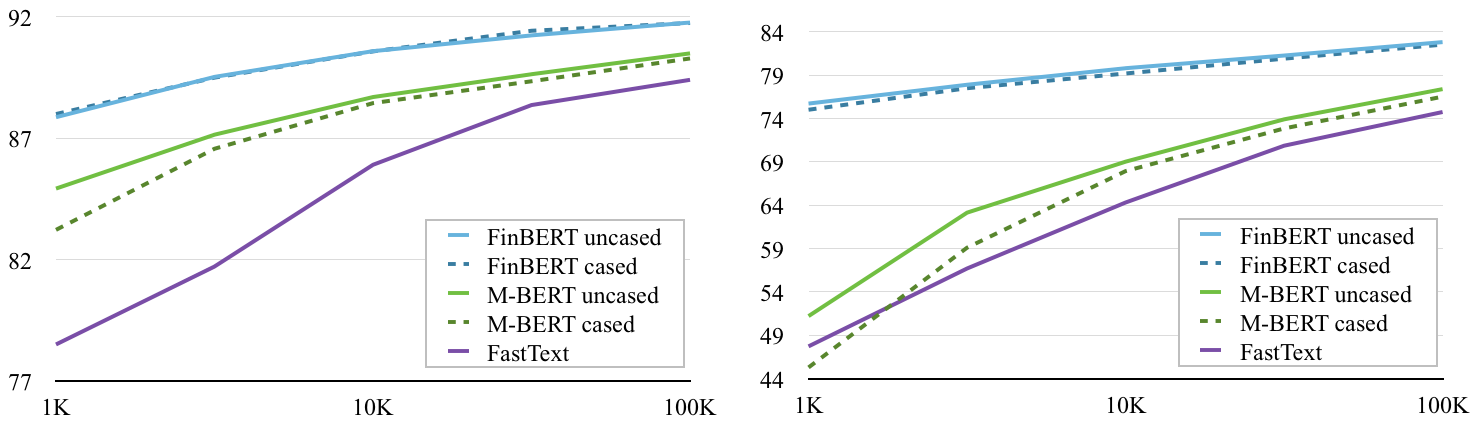
|
||||
|
||||
FinBERT outperforms multilingual BERT (M-BERT) on document classification over a range of training set sizes on the Yle news (left) and Ylilauta online discussion (right) corpora. (Baseline classification performance with [FastText](https://fasttext.cc/) included for reference.)
|
||||
|
||||
[[code](https://github.com/spyysalo/finbert-text-classification)][[Yle data](https://github.com/spyysalo/yle-corpus)] [[Ylilauta data](https://github.com/spyysalo/ylilauta-corpus)]
|
||||
|
||||
### Named Entity Recognition
|
||||
|
||||
Evaluation on FiNER corpus ([Ruokolainen et al 2019](https://arxiv.org/abs/1908.04212))
|
||||
|
||||
| Model | Accuracy |
|
||||
|--------------------|----------|
|
||||
| **FinBERT** | **92.40%** |
|
||||
| Multilingual BERT | 90.29% |
|
||||
| [FiNER-tagger](https://github.com/Traubert/FiNer-rules) (rule-based) | 86.82% |
|
||||
|
||||
(FiNER tagger results from [Ruokolainen et al. 2019](https://arxiv.org/pdf/1908.04212.pdf))
|
||||
|
||||
[[code](https://github.com/jouniluoma/keras-bert-ner)][[data](https://github.com/mpsilfve/finer-data)]
|
||||
|
||||
### Part of speech tagging
|
||||
|
||||
Evaluation on three Finnish corpora annotated with [Universal Dependencies](https://universaldependencies.org/) part-of-speech tags: the Turku Dependency Treebank (TDT), FinnTreeBank (FTB), and Parallel UD treebank (PUD)
|
||||
|
||||
| Model | TDT | FTB | PUD |
|
||||
|-------------------|-------------|-------------|-------------|
|
||||
| **FinBERT** | **98.23%** | **98.39%** | **98.08%** |
|
||||
| Multilingual BERT | 96.97% | 95.87% | 97.58% |
|
||||
|
||||
[[code](https://github.com/spyysalo/bert-pos)][[data](http://hdl.handle.net/11234/1-2837)]
|
||||
|
||||
## Use with PyTorch
|
||||
|
||||
If you want to use the model with the huggingface/transformers library, follow the steps in [huggingface_transformers.md](https://github.com/TurkuNLP/FinBERT/blob/master/huggingface_transformers.md)
|
||||
|
||||
## Previous releases
|
||||
|
||||
### Release 0.2
|
||||
|
||||
**October 24, 2019** Beta version of the BERT base uncased model trained from scratch on a corpus of Finnish news, online discussions, and crawled data.
|
||||
|
||||
Download the model here: [bert-base-finnish-uncased.zip](http://dl.turkunlp.org/finbert/bert-base-finnish-uncased.zip)
|
||||
|
||||
### Release 0.1
|
||||
|
||||
**September 30, 2019** We release a beta version of the BERT base cased model trained from scratch on a corpus of Finnish news, online discussions, and crawled data.
|
||||
|
||||
Download the model here: [bert-base-finnish-cased.zip](http://dl.turkunlp.org/finbert/bert-base-finnish-cased.zip)
|
||||
@@ -1,84 +0,0 @@
|
||||
---
|
||||
language: finnish
|
||||
---
|
||||
|
||||
## Quickstart
|
||||
|
||||
**Release 1.0** (November 25, 2019)
|
||||
|
||||
Download the models here:
|
||||
|
||||
* Cased Finnish BERT Base: [bert-base-finnish-cased-v1.zip](http://dl.turkunlp.org/finbert/bert-base-finnish-cased-v1.zip)
|
||||
* Uncased Finnish BERT Base: [bert-base-finnish-uncased-v1.zip](http://dl.turkunlp.org/finbert/bert-base-finnish-uncased-v1.zip)
|
||||
|
||||
We generally recommend the use of the cased model.
|
||||
|
||||
Paper presenting Finnish BERT: [arXiv:1912.07076](https://arxiv.org/abs/1912.07076)
|
||||
|
||||
## What's this?
|
||||
|
||||
A version of Google's [BERT](https://github.com/google-research/bert) deep transfer learning model for Finnish. The model can be fine-tuned to achieve state-of-the-art results for various Finnish natural language processing tasks.
|
||||
|
||||
FinBERT features a custom 50,000 wordpiece vocabulary that has much better coverage of Finnish words than e.g. the previously released [multilingual BERT](https://github.com/google-research/bert/blob/master/multilingual.md) models from Google:
|
||||
|
||||
| Vocabulary | Example |
|
||||
|------------|---------|
|
||||
| FinBERT | Suomessa vaihtuu kesän aikana sekä pääministeri että valtiovarain ##ministeri . |
|
||||
| Multilingual BERT | Suomessa vai ##htuu kes ##än aikana sekä p ##ää ##minister ##i että valt ##io ##vara ##in ##minister ##i . |
|
||||
|
||||
FinBERT has been pre-trained for 1 million steps on over 3 billion tokens (24B characters) of Finnish text drawn from news, online discussion, and internet crawls. By contrast, Multilingual BERT was trained on Wikipedia texts, where the Finnish Wikipedia text is approximately 3% of the amount used to train FinBERT.
|
||||
|
||||
These features allow FinBERT to outperform not only Multilingual BERT but also all previously proposed models when fine-tuned for Finnish natural language processing tasks.
|
||||
|
||||
## Results
|
||||
|
||||
### Document classification
|
||||
|
||||

|
||||
|
||||
FinBERT outperforms multilingual BERT (M-BERT) on document classification over a range of training set sizes on the Yle news (left) and Ylilauta online discussion (right) corpora. (Baseline classification performance with [FastText](https://fasttext.cc/) included for reference.)
|
||||
|
||||
[[code](https://github.com/spyysalo/finbert-text-classification)][[Yle data](https://github.com/spyysalo/yle-corpus)] [[Ylilauta data](https://github.com/spyysalo/ylilauta-corpus)]
|
||||
|
||||
### Named Entity Recognition
|
||||
|
||||
Evaluation on FiNER corpus ([Ruokolainen et al 2019](https://arxiv.org/abs/1908.04212))
|
||||
|
||||
| Model | Accuracy |
|
||||
|--------------------|----------|
|
||||
| **FinBERT** | **92.40%** |
|
||||
| Multilingual BERT | 90.29% |
|
||||
| [FiNER-tagger](https://github.com/Traubert/FiNer-rules) (rule-based) | 86.82% |
|
||||
|
||||
(FiNER tagger results from [Ruokolainen et al. 2019](https://arxiv.org/pdf/1908.04212.pdf))
|
||||
|
||||
[[code](https://github.com/jouniluoma/keras-bert-ner)][[data](https://github.com/mpsilfve/finer-data)]
|
||||
|
||||
### Part of speech tagging
|
||||
|
||||
Evaluation on three Finnish corpora annotated with [Universal Dependencies](https://universaldependencies.org/) part-of-speech tags: the Turku Dependency Treebank (TDT), FinnTreeBank (FTB), and Parallel UD treebank (PUD)
|
||||
|
||||
| Model | TDT | FTB | PUD |
|
||||
|-------------------|-------------|-------------|-------------|
|
||||
| **FinBERT** | **98.23%** | **98.39%** | **98.08%** |
|
||||
| Multilingual BERT | 96.97% | 95.87% | 97.58% |
|
||||
|
||||
[[code](https://github.com/spyysalo/bert-pos)][[data](http://hdl.handle.net/11234/1-2837)]
|
||||
|
||||
## Use with PyTorch
|
||||
|
||||
If you want to use the model with the huggingface/transformers library, follow the steps in [huggingface_transformers.md](https://github.com/TurkuNLP/FinBERT/blob/master/huggingface_transformers.md)
|
||||
|
||||
## Previous releases
|
||||
|
||||
### Release 0.2
|
||||
|
||||
**October 24, 2019** Beta version of the BERT base uncased model trained from scratch on a corpus of Finnish news, online discussions, and crawled data.
|
||||
|
||||
Download the model here: [bert-base-finnish-uncased.zip](http://dl.turkunlp.org/finbert/bert-base-finnish-uncased.zip)
|
||||
|
||||
### Release 0.1
|
||||
|
||||
**September 30, 2019** We release a beta version of the BERT base cased model trained from scratch on a corpus of Finnish news, online discussions, and crawled data.
|
||||
|
||||
Download the model here: [bert-base-finnish-cased.zip](http://dl.turkunlp.org/finbert/bert-base-finnish-cased.zip)
|
||||
@@ -64,8 +64,27 @@ TensorFlow: 2.1.0
|
||||
Python: 3.7.6
|
||||
```
|
||||
|
||||
### Access this albert_xxlargev1_sqd2_512 fine-tuned model with:
|
||||
### Inferencing / prediction works with the current Transformers v2.4.1
|
||||
|
||||
### Access this albert_xxlargev1_sqd2_512 fine-tuned model with "tried & true" code:
|
||||
|
||||
```python
|
||||
tokenizer = AutoTokenizer.from_pretrained("ahotrod/albert_xxlargev1_squad2_512")
|
||||
model = AutoModelForQuestionAnswering.from_pretrained("ahotrod/albert_xxlargev1_squad2_512")
|
||||
config_class, model_class, tokenizer_class = \
|
||||
AlbertConfig, AlbertForQuestionAnswering, AlbertTokenizer
|
||||
|
||||
model_name_or_path = "ahotrod/albert_xxlargev1_squad2_512"
|
||||
config = config_class.from_pretrained(model_name_or_path)
|
||||
tokenizer = tokenizer_class.from_pretrained(model_name_or_path, do_lower_case=True)
|
||||
model = model_class.from_pretrained(model_name_or_path, config=config)
|
||||
```
|
||||
|
||||
### or the AutoModels (AutoConfig, AutoTokenizer & AutoModel) should also work, however I have yet to use them in my app & confirm:
|
||||
|
||||
```python
|
||||
from transformers import AutoConfig, AutoTokenizer, AutoModel
|
||||
|
||||
model_name_or_path = "ahotrod/albert_xxlargev1_squad2_512"
|
||||
config = AutoConfig.from_pretrained(model_name_or_path)
|
||||
tokenizer = AutoTokenizer.from_pretrained(model_name_or_path, do_lower_case=True)
|
||||
model = AutoModel.from_pretrained(model_name_or_path, config=config)
|
||||
```
|
||||
@@ -1,56 +0,0 @@
|
||||
## RoBERTa-large language model fine-tuned on SQuAD2.0
|
||||
|
||||
### with the following results:
|
||||
|
||||
```
|
||||
"exact": 84.46896319380106,
|
||||
"f1": 87.85388093408943,
|
||||
"total": 11873,
|
||||
"HasAns_exact": 81.37651821862349,
|
||||
"HasAns_f1": 88.1560607844881,
|
||||
"HasAns_total": 5928,
|
||||
"NoAns_exact": 87.55256518082422,
|
||||
"NoAns_f1": 87.55256518082422,
|
||||
"NoAns_total": 5945,
|
||||
"best_exact": 84.46896319380106,
|
||||
"best_exact_thresh": 0.0,
|
||||
"best_f1": 87.85388093408929,
|
||||
"best_f1_thresh": 0.0
|
||||
```
|
||||
### from script:
|
||||
```
|
||||
python ${EXAMPLES}/run_squad.py \
|
||||
--model_type roberta \
|
||||
--model_name_or_path roberta-large \
|
||||
--do_train \
|
||||
--do_eval \
|
||||
--train_file ${SQUAD}/train-v2.0.json \
|
||||
--predict_file ${SQUAD}/dev-v2.0.json \
|
||||
--version_2_with_negative \
|
||||
--do_lower_case \
|
||||
--num_train_epochs 3 \
|
||||
--warmup_steps 1642 \
|
||||
--weight_decay 0.01 \
|
||||
--learning_rate 3e-5 \
|
||||
--adam_epsilon 1e-6 \
|
||||
--max_seq_length 512 \
|
||||
--doc_stride 128 \
|
||||
--per_gpu_train_batch_size 8 \
|
||||
--gradient_accumulation_steps 6 \
|
||||
--per_gpu_eval_batch_size 48 \
|
||||
--threads 12 \
|
||||
--logging_steps 50 \
|
||||
--save_steps 2000 \
|
||||
--overwrite_output_dir \
|
||||
--output_dir ${MODEL_PATH}
|
||||
$@
|
||||
```
|
||||
### using the following system & software:
|
||||
```
|
||||
Transformers: 2.7.0
|
||||
PyTorch: 1.4.0
|
||||
TensorFlow: 2.1.0
|
||||
Python: 3.7.7
|
||||
OS/Platform: Linux-5.3.0-46-generic-x86_64-with-debian-buster-sid
|
||||
CPU/GPU: Intel i9-9900K / NVIDIA Titan RTX 24GB
|
||||
```
|
||||
@@ -56,8 +56,22 @@ PyTorch: 1.4.0
|
||||
TensorFlow: 2.1.0
|
||||
Python: 3.7.6
|
||||
```
|
||||
### Inferencing / prediction works with Transformers v2.4.1, the latest version tested
|
||||
|
||||
### Utilize this xlnet_large_squad2_512 fine-tuned model with:
|
||||
```python
|
||||
tokenizer = AutoTokenizer.from_pretrained("ahotrod/xlnet_large_squad2_512")
|
||||
model = AutoModelForQuestionAnswering.from_pretrained("ahotrod/xlnet_large_squad2_512")
|
||||
config_class, model_class, tokenizer_class = \
|
||||
XLNetConfig, XLNetforQuestionAnswering, XLNetTokenizer
|
||||
model_name_or_path = "ahotrod/xlnet_large_squad2_512"
|
||||
config = config_class.from_pretrained(model_name_or_path)
|
||||
tokenizer = tokenizer_class.from_pretrained(model_name_or_path, do_lower_case=True)
|
||||
model = model_class.from_pretrained(model_name_or_path, config=config)
|
||||
```
|
||||
### or the AutoModels (AutoConfig, AutoTokenizer & AutoModel) should also work, however I have yet to use them in my apps & confirm:
|
||||
```python
|
||||
from transformers import AutoConfig, AutoTokenizer, AutoModel
|
||||
model_name_or_path = "ahotrod/xlnet_large_squad2_512"
|
||||
config = AutoConfig.from_pretrained(model_name_or_path)
|
||||
tokenizer = AutoTokenizer.from_pretrained(model_name_or_path, do_lower_case=True)
|
||||
model = AutoModel.from_pretrained(model_name_or_path, config=config)
|
||||
```
|
||||
@@ -1,8 +0,0 @@
|
||||
---
|
||||
tags:
|
||||
- exbert
|
||||
---
|
||||
|
||||
<a href="https://huggingface.co/exbert/?model=albert-base-v1">
|
||||
<img width="300px" src="https://hf-dinosaur.huggingface.co/exbert/button.png">
|
||||
</a>
|
||||
@@ -1,8 +0,0 @@
|
||||
---
|
||||
tags:
|
||||
- exbert
|
||||
---
|
||||
|
||||
<a href="https://huggingface.co/exbert/?model=albert-xxlarge-v2">
|
||||
<img width="300px" src="https://hf-dinosaur.huggingface.co/exbert/button.png">
|
||||
</a>
|
||||
Loaded 100 of 388 files, more files were not shown because too many files have changed in this diff.
Show more
Reference in new issue
Block a user